
The role of CEO in governance is defined as the central leadership function that connects board strategy to organisational execution, ensuring accountability, compliance, and mission integrity at every level. In a non-profit context, this is not a passive administrative duty. The CEO is the person the board relies on to translate governance intent into operational reality, and the person the organisation relies on to represent its interests at board level. Organisational governance is the framework within which that dual responsibility operates.
What are the key governance responsibilities of a CEO in a non-profit?
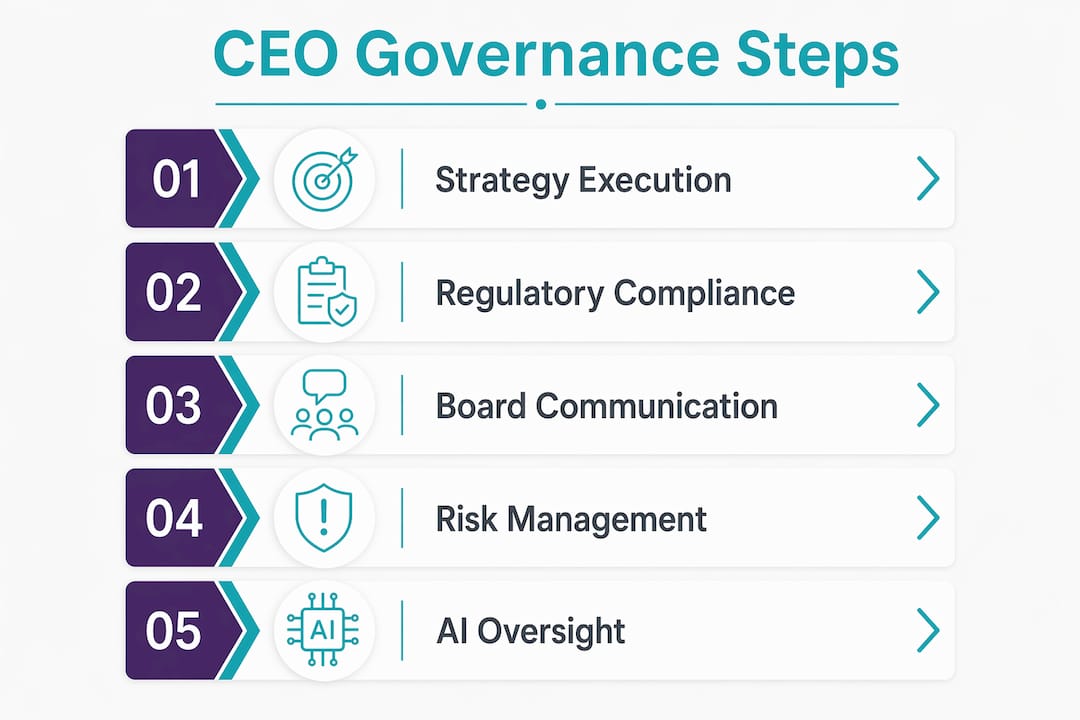
CEO responsibilities in governance span four distinct areas: operational management, regulatory compliance, transparent reporting, and board relationship stewardship. Each carries real accountability, not just procedural obligation.
Operational management means the CEO executes the strategy the board approves. This includes resource allocation, staff performance, and programme delivery that aligns with the organisation's stated mission. Deviation from board-approved strategy is a governance failure, not just a management one.

Regulatory compliance requires the CEO to maintain current knowledge of the legal and policy frameworks that govern the organisation. In Australia's human services sector, this spans obligations under the NDIS Quality and Safeguards Commission, the Australian Charities and Not-for-profits Commission (ACNC), and state-based community services legislation. Ignorance of a regulatory change is not a defence.
Transparent reporting is where many CEOs underperform. Governance transparency depends largely on the CEO's control over board material content, requiring balance to ensure informed decision-making without overload. The board needs enough to govern well. Too little creates blind spots; too much creates noise.
Board relationship stewardship is the least codified but most consequential responsibility. The CEO manages up, not just down.
- Report on challenges, not just achievements
- Maintain a governance calendar that structures board interactions across the year
- Manage the complexity of board papers so they are digestible and decision-ready
- Treat the board chair relationship as a strategic priority, not a formality
Pro Tip: Use a governance calendar to schedule formal reporting, informal check-ins, and risk reviews across the year. Structured cadence reduces reactive governance and builds board confidence.
AI governance is now a core CEO responsibility in governance, not a future consideration. Boards increasingly view AI governance capability as a core leadership test when evaluating CEOs, focusing on workflow redesign and workforce trust over technical knowledge alone.
How do the CEO and board chair roles interact in effective governance?
The CEO leads execution. The chair leads board effectiveness. These are distinct functions, and confusing them creates governance risk.
The CEO-board chair relationship is the most critical governance partnership. Informal, substantive dialogue beyond scheduled meetings is necessary to build the trust required to navigate difficult periods. A CEO who only speaks to the chair at formal meetings is governing reactively.
The question of whether to combine or separate the two roles is genuinely contested. 44% of Russell 3000 companies combined the CEO and chair roles in 2025, down from 57% in 2020. That decline reflects growing recognition that independent board oversight strengthens governance credibility, particularly for organisations with complex stakeholder environments.
| Structure | Strengths | Risks |
|---|---|---|
| Combined CEO and Chair | Faster decisions, clear accountability, consistent strategy | Reduced independent oversight, potential conflicts of interest |
| Separated CEO and Chair | Stronger board independence, clearer checks and balances | Possible communication friction, slower decision cycles |
| Lead Independent Director model | Preserves independence while maintaining CEO influence | Requires clear role definition to avoid duplication |
CEOs who hold both roles tend to stay in office around 3 years longer than those with separate roles. Longer tenure supports consistent strategy execution, though the governance trade-offs depend heavily on organisational context and board composition.
For most non-profits, separating the roles and investing in a strong lead independent director function is the more defensible structure. It signals accountability to funders, regulators, and the communities you serve.
Pro Tip: Schedule a monthly one-on-one with your board chair outside of formal meetings. Thirty minutes of substantive dialogue prevents the kind of governance surprises that damage trust when they surface at a full board meeting.
What governance strategies should ceos adopt for emerging risks like AI?
AI governance is the most pressing new frontier for non-profit CEOs in 2026. The challenge is not understanding the technology. The challenge is building oversight structures before the risks compound.
-
Commission an AI inventory within 90 days. Many CEOs are governing unknown AI systems already in use across their organisations. A CTO or CDO-led audit should classify every AI tool by risk tier before any governance framework is designed.
-
Assign clear ownership. AI governance requires a named executive accountable for cross-functional oversight. Without ownership, risk management defaults to whoever notices the problem first.
-
Establish a structured reporting schedule. 2026 AI governance guidance recommends monthly AI risk dashboards for governance committees, quarterly reports to CEOs, and annual board-level reviews covering risks and compliance. This cadence keeps the board informed without creating reporting fatigue.
-
Align AI governance with existing ethical and legal obligations. For non-profits operating under ACNC or NDIS frameworks, AI use that affects service delivery or client data carries direct regulatory implications. Governance frameworks must reflect that.
-
Brief the board on AI risk annually at minimum. Boards that are not regularly informed about AI use cannot govern it. The CEO is responsible for closing that gap.
Embedding a governance culture that treats AI oversight as a standing agenda item is the difference between proactive leadership and reactive crisis management.
How can non-profit ceos build genuine transparency with their boards?
Transparency is not the same as disclosure. A CEO can share volumes of information and still leave a board unable to govern effectively.
Effective board management is less about limiting a CEO's time and more about maximising the quality of board interactions. Trust and transparency are the foundation of that quality. Boards that only hear good news become poor governors. They lose the calibration needed to assess risk and support the CEO when conditions deteriorate.
"Honest sharing of organisational challenges fosters supportive board behaviour and quality oversight."
Practical approaches that build genuine transparency include:
- Report on what is not working, not just what is. A CEO who surfaces problems early builds credibility. One who surfaces them late builds suspicion.
- Use governance meeting facilitation techniques that create space for board members to ask questions, not just receive information.
- Calibrate the complexity of board papers to the board's capacity. A 60-page report that no one reads is not transparency.
- Invest in informal communication. A brief call after a significant operational development keeps the chair informed and prevents surprises at the next meeting.
Adaptive governance models that align CEO leadership structures with organisational strategy consistently outperform fixed norms. The CEO who treats transparency as a leadership discipline, rather than a reporting obligation, builds the kind of board relationship that sustains the organisation through difficult periods.
Key takeaways
The CEO's governance role is defined by accountability, board partnership, and the discipline to manage both compliance and emerging risks with equal rigour.
| Point | Details |
|---|---|
| CEO as governance link | The CEO connects board strategy to operational execution and is accountable for both directions. |
| Transparency over disclosure | Reporting challenges, not just successes, builds the board trust that sustains effective oversight. |
| CEO-chair relationship | Regular informal dialogue with the board chair is a governance requirement, not a courtesy. |
| AI governance is now | CEOs must own AI risk oversight, including auditing unknown systems and establishing structured reporting. |
| Structure follows strategy | Combined or separated CEO-chair roles should reflect organisational context, not convention. |
Governance is a leadership discipline, not a compliance cage
After nearly three decades working across Australia's human services sector, I have seen the full spectrum of how CEOs relate to governance. Some treat it as a constraint. Others treat it as the architecture that makes everything else possible.
The CEOs who govern well share one characteristic: they treat the board relationship as a strategic investment, not an obligation to manage. They brief the chair before problems become crises. They report honestly on what is not working. They bring the board into emerging risks like AI early, rather than waiting until a policy framework forces the conversation.
Boards value CEO leadership that treats governance as a strategic discipline and a compass for ethical accountability. That framing matters. When a CEO sees governance as the compass rather than the cage, the whole organisation benefits. Decisions get made with clearer accountability. Risk gets surfaced earlier. The board becomes a genuine asset rather than a quarterly obligation.
The question worth sitting with: are you governing your organisation, or are you managing your board's perception of it?
— Rachel
How the planning and practice hub supports non-profit ceos in governance
Non-profit CEOs navigating governance complexity rarely need more theory. They need practical frameworks that fit their organisation's actual structure, regulatory obligations, and board dynamics.
The Planning and Practice Hub works directly with non-profit leaders across Australia's human services sector to co-develop governance frameworks that are fit for purpose. From board reporting structures and AI risk oversight to compliance alignment across more than 50 regulatory bodies, the work is specific to your context, not adapted from a corporate template. If you are looking for non-profit governance support that reflects the realities of your sector, that is exactly what we do.
FAQ
What is the ceo's primary role in non-profit governance?
The CEO's primary governance role is to execute board-approved strategy, maintain regulatory compliance, and provide transparent reporting that enables effective board oversight. The CEO is the accountable link between the board and the organisation's operations.
Should a non-profit CEO also serve as board chair?
Separating the roles is generally the stronger governance structure for non-profits, as it preserves independent board oversight and signals accountability to funders and regulators. 44% of Russell 3000 companies still combine the roles, but that figure has declined significantly since 2020.
How should a CEO approach AI governance in 2026?
The CEO should commission an AI inventory within 90 days, assign named executive ownership, and establish a structured reporting schedule that includes monthly risk dashboards and annual board-level reviews. Shadow AI in particular requires a CTO or CDO-led audit to classify risks before governance frameworks are designed.
How does a CEO build genuine trust with the board?
Trust is built through honest reporting that includes challenges, not just achievements, and through regular informal communication with the board chair beyond scheduled meetings. Quality of board interaction matters more than the volume of information shared.
What is the difference between governance and compliance for a CEO?
Governance and compliance are related but distinct. Compliance is adherence to specific legal and regulatory requirements. Governance is the broader system of accountability, oversight, and decision-making within which compliance sits. A CEO must manage both, but governance is the wider discipline.