
Strategic governance meeting facilitation is the process of expertly designing and guiding governance meetings to produce clear decisions, maintain compliance, and secure active board participation. For non-profit leaders, this is not a soft skill. It is a core leadership function that directly shapes organisational accountability and mission delivery. When facilitation is done well, boards move from discussion to resolution, members feel heard, and the organisation stays aligned with its regulatory obligations. When it is done poorly, meetings drift, decisions stall, and engagement erodes. This article gives you the preparation tools, facilitation techniques, and follow-up strategies to run governance meetings that genuinely work.
What is strategic governance meeting facilitation?
Strategic governance meeting facilitation is the structured practice of guiding a group through governance processes to reach decisions, not just conversations. The industry term for this discipline is meeting facilitation, though in governance contexts it carries a specific weight: the facilitator is responsible for process integrity, not content outcomes. As the research confirms, a common misconception is that facilitators provide the strategy. They do not. They create the conditions for the group to generate it, surfacing tensions, balancing dominant and quiet voices, and keeping the process honest.
For non-profits, this distinction matters enormously. Your board members bring diverse expertise, competing priorities, and varying levels of governance literacy. A skilled facilitator holds that complexity without letting it derail the meeting. The result is a room where compliance obligations are addressed, decisions are made with clarity, and every member leaves knowing what was agreed and why. That is the standard to aim for, and it is achievable with the right preparation and technique.

How to prepare for effective governance meeting facilitation
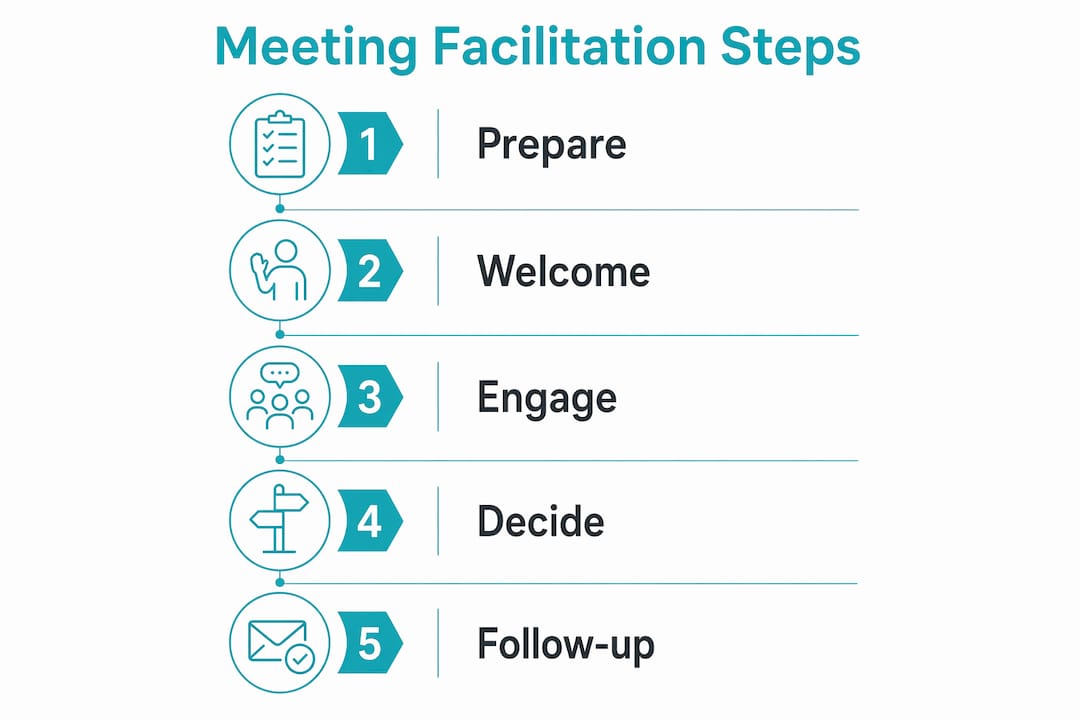
Preparation is not a preliminary step. Pre-meeting discovery work accounts for roughly 30% of total facilitation effort but drives approximately 50% of session outcomes. That ratio should reframe how you allocate your time before any governance meeting.
Effective preparation covers four areas:
- Stakeholder interviews. Speak with key participants before the meeting to surface concerns, identify potential conflicts, and understand what decisions are genuinely needed. This prevents surprises and allows you to design an agenda that addresses real issues.
- Agenda design. A governance agenda is not a list of topics. It is a sequence of decisions. Each item should state the purpose (inform, discuss, or decide), the time allocated, and the person responsible for presenting.
- Role clarity. Define who has decision authority before the meeting begins. Ambiguity about who can approve what is one of the most common causes of circular discussion in non-profit boards.
- Materials and technology. Distribute pre-reads 24 to 48 hours before the meeting. Use collaborative tools such as Miro, Microsoft Whiteboard, or a shared document for live note-taking so that decisions are captured in real time.
The following table compares common preparation tools and their primary benefit for governance meetings:
| Preparation tool | Primary benefit |
|---|---|
| Stakeholder interviews | Surfaces hidden concerns before they derail discussion |
| Structured agenda template | Keeps meeting focused on decisions, not updates |
| Pre-read documents (24-48 hrs prior) | Reduces information-sharing time during the meeting |
| Shared digital whiteboard (e.g. Miro) | Enables real-time capture of decisions and actions |
| Role and authority matrix | Prevents circular discussion about who can decide |
Pro Tip: Send the agenda with a single framing question for each item. For example: "Agenda item 3: Risk register review. Question for the board: Are current risk controls sufficient, or do we need to escalate any items?" This primes participants to arrive with a position, not just a presence.
What facilitation techniques improve group dynamics and decision-making?
The facilitator's role is to manage group process integrity, not to influence the content of decisions. In practice, this means actively managing the room so that all voices contribute and discussions close with resolution.
Creating psychological safety from the first minute
The opening 60 seconds of a meeting set the psychological tone for everything that follows. A brief, direct welcome that names the purpose of the meeting and confirms the decision points signals to participants that this is a working session, not a talking shop. Avoid lengthy housekeeping or status updates at the start. They drain energy before the substantive work begins.
Managing dominant voices and drawing out quieter members
Turn-taking and written reflections are two of the most effective tools for equity in governance discussions. Before opening a contentious topic, ask participants to write their initial position on paper or in a shared document for 90 seconds before anyone speaks. This prevents the first voice in the room from anchoring the entire discussion. For dominant participants, a simple redirect such as "Thank you, let's hear from others before we return to that point" is direct without being dismissive.
Closing decisions before the room moves on
Discussion without decision is the primary failure mode in governance meetings. Skilled facilitators recognise the moment when a discussion has reached its useful limit and call it. Techniques include:
- Fist to five. Ask participants to show a number of fingers indicating their level of support for a proposed decision. It surfaces consensus or dissent instantly.
- Explicit decision statement. Before moving to the next agenda item, state the decision aloud: "We have agreed to X. Is that correct?" This prevents revisiting decisions later.
- Parking lot. Capture off-agenda items in a visible "parking lot" so participants feel heard without derailing the meeting. Review the parking lot in the final five minutes.
Pro Tip: The last five minutes of a governance meeting are as important as the first. Reserve them exclusively for summarising decisions and confirming next steps. Never introduce a new agenda item in this window. Doing so signals that the meeting has no real structure, and it erodes trust in the facilitation process.
How should you structure meeting cadence for governance excellence?
Meeting frequency and agenda structure are not administrative details. They are governance architecture. A tiered meeting cadence is best practice: quarterly sessions for strategic direction and KPI reviews, monthly meetings for policy approvals and compliance oversight, and biweekly standups for execution tracking. This structure prevents governance topics from being crowded out by operational noise.
Governance meetings typically run 60 to 120 minutes and focus on structural roles, policies, and organisational domains. Tactical meetings run 30 to 60 minutes and address operational work. The recommended ratio is 20% governance to 80% tactical. When that ratio inverts, it is a signal that the organisation lacks clear separation between board oversight and management function. Understanding the difference between compliance and governance is the first step to designing an agenda that addresses both without conflating them.
The table below illustrates the distinction in practice:
| Meeting type | Duration | Primary focus |
|---|---|---|
| Governance (quarterly) | 90-120 minutes | Strategic direction, KPI review, risk oversight |
| Governance (monthly) | 60-90 minutes | Policy approvals, compliance reporting |
| Tactical (biweekly) | 30-60 minutes | Execution updates, operational decisions |
Agenda items that belong in governance meetings include risk register reviews, policy amendments, financial oversight, and board composition matters. Items such as project status updates, staff rosters, and client case reviews belong in operational or management meetings. Mixing these categories is one of the most common reasons non-profit boards feel overwhelmed and under-informed simultaneously.
What post-meeting follow-up strategies drive accountability?
The meeting ends when the room empties, but the facilitation does not. Follow-up is where governance decisions either take root or quietly disappear. A concise meeting summary distributed within 24 hours is the single most important post-meeting action. It should capture decisions made, actions assigned, owners named, and deadlines confirmed. It should not be a verbatim transcript.
Effective follow-up practices include:
- Named action owners. Every action item must have one person responsible. Shared ownership is no ownership.
- Confirmed timelines. Attach a specific date to every action, not "as soon as possible."
- Individual check-ins after difficult discussions. If a contentious issue was raised or a board member was visibly disengaged, a brief one-on-one conversation within 48 hours preserves the relationship and surfaces concerns before they become patterns.
- KPI alignment. Where possible, link governance decisions to existing organisational KPIs so that progress is measurable and reportable at the next meeting.
The most common follow-up mistake is sending a summary without confirming that recipients have read and accepted their action items. A brief reply-requested email or a standing agenda item at the next meeting to review outstanding actions closes that loop. For non-profits, where governance and mission delivery are inseparable, this accountability culture is not optional. It is the mechanism through which board decisions translate into community impact.
How do you troubleshoot common facilitation challenges?
Even well-prepared facilitators encounter resistance, conflict, and drift. The difference between a competent and an excellent facilitator is the ability to respond without losing the room's confidence.
Common challenges and their practical responses:
- Conflict between board members. Acknowledge the tension directly without taking sides. "I can see there are strong views here. Let's separate the positions from the people and focus on the decision we need to make."
- Agenda drift. Use the parking lot without apology. "That's worth discussing. I'm going to capture it here so we can return to it. Right now we need to stay with item four."
- Dominant participants. Redirect with structure, not confrontation. Introduce a round-robin format for the next agenda item to redistribute airtime.
- Disengaged participants. Direct a specific, low-stakes question to a quiet member. "We haven't heard your perspective on this yet. What's your read on the risk here?"
Pro Tip: Know the difference between a productive tangent and a derailing one. A tangent that surfaces a genuine governance risk is worth 90 seconds of attention before redirecting. A tangent that relitigates a decision already made is not. The facilitator's job is to make that call clearly and without hesitation.
Failing to close decisively and manage time undermines meeting effectiveness and stakeholder confidence. Boards that repeatedly leave meetings without clear resolutions begin to disengage, not because they lack commitment, but because they have learned the meeting will not produce anything worth their full attention.
Key takeaways
Effective governance meeting facilitation requires structured preparation, disciplined technique, and consistent follow-through to convert board discussion into accountable decisions.
| Point | Details |
|---|---|
| Preparation drives outcomes | Pre-meeting stakeholder interviews and agenda design account for the majority of facilitation impact. |
| Facilitation manages process, not content | The facilitator's role is to create conditions for group decisions, not to influence what those decisions are. |
| Cadence separates governance from operations | A tiered meeting structure (quarterly, monthly, biweekly) keeps governance topics distinct from tactical work. |
| Closing decisions is a skill | Techniques like fist-to-five and explicit decision statements prevent discussion from cycling without resolution. |
| Follow-up completes the facilitation | Named action owners and 24-hour summaries are what turn governance meetings into governance outcomes. |
What nearly three decades in governance has taught me
I have sat in hundreds of governance meetings across the non-profit sector, and the pattern I see most often is not conflict or disengagement. It is exhaustion. Board members who are genuinely committed to their organisation's mission, arriving at meetings that feel like they are going in circles. That exhaustion is a facilitation problem, not a people problem.
The most transformative shift I have seen in organisations is when leaders stop treating facilitation as a meeting management task and start treating it as a form of stewardship. When you facilitate a governance meeting well, you are protecting the board's capacity to do its best work. You are creating the conditions for why governance matters to become visible and felt, not just stated in a policy document.
What I have also learned is that psychological safety is not a workshop concept. It is built in the first 60 seconds of a meeting and either sustained or destroyed in the moments that follow. The facilitator who acknowledges a difficult question, redirects a dominant voice with respect, and closes a decision with clarity is doing something genuinely difficult. It takes practice, self-awareness, and a willingness to be uncomfortable in service of the group.
My advice to non-profit leaders developing their facilitation skills: start with preparation. Most facilitation failures are preparation failures in disguise. When you know the room before you walk into it, you can lead it.
— Rachel
How Theplanningandpracticehub supports your governance meetings
At Theplanningandpracticehub, we work directly with non-profit leaders and executives to strengthen governance meeting facilitation from the ground up. Rachel Willis and the team bring nearly three decades of experience in Australia's human services sector, offering tailored facilitation support that addresses your organisation's specific compliance obligations, board dynamics, and strategic priorities. Whether you need a facilitator for a critical board session or a longer-term partnership to build your internal facilitation capability, we design our support around your context, not a generic template. Explore our non-profit support services to find out how we can help your board work with greater clarity and confidence.
FAQ
What is strategic governance meeting facilitation?
Strategic governance meeting facilitation is the structured process of designing and guiding governance meetings to produce clear decisions, maintain compliance, and support active board participation. The facilitator manages process integrity rather than influencing the content of decisions.
How long should a governance meeting run?
Governance meetings typically run 60 to 120 minutes and focus on structural roles, policies, and organisational oversight, distinct from shorter tactical meetings that address operational work.
What is the recommended cadence for governance meetings?
A tiered cadence is best practice: quarterly sessions for strategic direction, monthly meetings for policy and compliance, and biweekly standups for execution. Pilot this structure for one to two quarters before adjusting.
How do you handle conflict during a governance meeting?
Acknowledge the tension directly without taking sides, then redirect the group to the decision at hand. Separating positions from people and using structured techniques like round-robin discussion prevents conflict from derailing the agenda.
What should a post-meeting governance summary include?
A governance meeting summary should capture every decision made, each action item with a named owner and confirmed deadline, and any items parked for future discussion. Distribute it within 24 hours of the meeting.