
Governance culture is defined as the shared values, behaviours, and accountability norms that shape how decisions are made across an organisation. To embed governance culture in your organisation, you need more than a policy document or a values statement on the wall. You need integrated leadership commitment, structured corporate governance frameworks, and systems that make the right behaviour the default. The AICD, OECD, and SHRM each provide principles that translate this ambition into practice, and the Australian context adds specific legal and regulatory weight that makes getting this right non-negotiable.
How to embed governance culture in your organisation
The foundation sits in five principles the AICD outlines for boards overseeing organisational culture: leadership tone, strategy integration, risk embedding, governance oversight, and accountability with monitoring. These are not aspirational headings. They are the structural pillars that, when applied consistently, create the conditions for culture to take hold. The OECD defines good corporate governance as structures that enable trust, transparency, and accountability, with a direct link to long-term organisational sustainability. That definition matters because it frames governance culture not as a soft concept but as a performance driver.
Each principle requires a specific organisational response:
- Leadership tone means the board and executive team model the behaviours they expect. Stated values mean nothing if leaders act differently under pressure.
- Strategy integration requires culture to be treated as a strategic input, not a byproduct. Culture shapes how strategy gets executed at every level.
- Risk embedding means governance culture must live inside risk management processes, not sit alongside them as a separate agenda item.
- Governance oversight requires boards to ask concrete questions about culture, not just receive assurance reports.
- Accountability with monitoring means establishing measurable indicators and reviewing them regularly.
Pro Tip: When mapping your governance framework, check whether each of these five principles has a named owner, a defined process, and a review cycle. If any of the three is missing, the principle is aspirational, not operational.
How do leadership behaviours translate governance culture into practice?
SHRM identifies leadership as the primary architect of organisational culture, with a clear warning: employees watch what leaders do, not what they say. The gap between stated values and visible behaviour is where governance culture fails most often. A board that approves a speak-up policy but never references it in meetings sends a louder message than the policy itself.

Boards operationalise culture through the questions they ask. Rather than accepting a general assurance that "culture is strong," effective boards ask: What behaviours are being rewarded? Where are the complaints coming from? What does staff turnover data tell us about team-level culture? These questions create a monitoring discipline that turns oversight into practice.
The AICD's work on cyber resilience governance offers a useful model. Boards are expected to promote awareness, assign accountability, and integrate cyber security into risk management. The same logic applies to governance culture broadly. Assign it. Monitor it. Hold people accountable for it.
Culture audits and real-time reporting tools give boards the evidence layer they need to move beyond gut feel. Without data, culture oversight is opinion. With data, it becomes governance.
- Define the specific behaviours that reflect your governance values.
- Identify who is responsible for modelling and monitoring those behaviours at each level.
- Build culture indicators into board reporting, not as a separate agenda item but as part of risk and performance reporting.
- Review the indicators at each board meeting and ask what has changed since the last review.
- Act visibly when behaviours fall short. Silence is endorsement.
What systems and processes support governance culture in daily workflows?
Compliance culture is defined by Diligent as ethical behaviours embedded in workflows and consistent leadership decisions, supported by enabling technology and real-time data. This is the distinction between governance as a separate function and governance as the way work gets done. The goal is the second. Understanding the difference between compliance and governance is the starting point for designing systems that serve both without conflating them.
Speak-up mechanisms are a critical test of whether governance culture is real. Under the Corporations Act, Australian organisations face specific whistleblower requirements including reporting channels, anonymity protections, continuous training, and governance review obligations. Meeting the legal minimum is not the same as building a speak-up culture. The legal framework sets the floor. Culture determines whether people actually use the mechanisms.
| System | What it does | What to watch for |
|---|---|---|
| Speak-up channels | Provides safe reporting pathways for concerns | Low usage may signal fear, not absence of issues |
| Culture audits | Identifies gaps between intended and actual behaviour | Frequency matters. Annual is rarely enough |
| Compliance training | Builds capability and reinforces expectations | Generic training has low retention. Contextualise it |
| Real-time reporting tools | Enables continuous oversight of culture indicators | Data without review is noise |
Pro Tip: Technology supports culture monitoring, but it does not replace the human judgement required to interpret what the data means. AI-powered compliance tools can automate routine oversight tasks, freeing leaders to focus on the patterns that require genuine analysis.
Cross-functional ownership matters here. Governance culture cannot be owned solely by the legal or compliance team. HR, operations, and finance all carry responsibility for the behaviours within their functions. Governance professionals who build those internal partnerships create a far more durable culture than those who rely on top-down mandates alone.
How do you measure and monitor governance culture over time?
Culture audits identify gaps between intended and actual culture, giving boards the evidence they need to maintain accountability and adapt their approach. A governance culture assessment is not a one-time exercise. It is a recurring discipline, and the frequency should match the pace of organisational change.
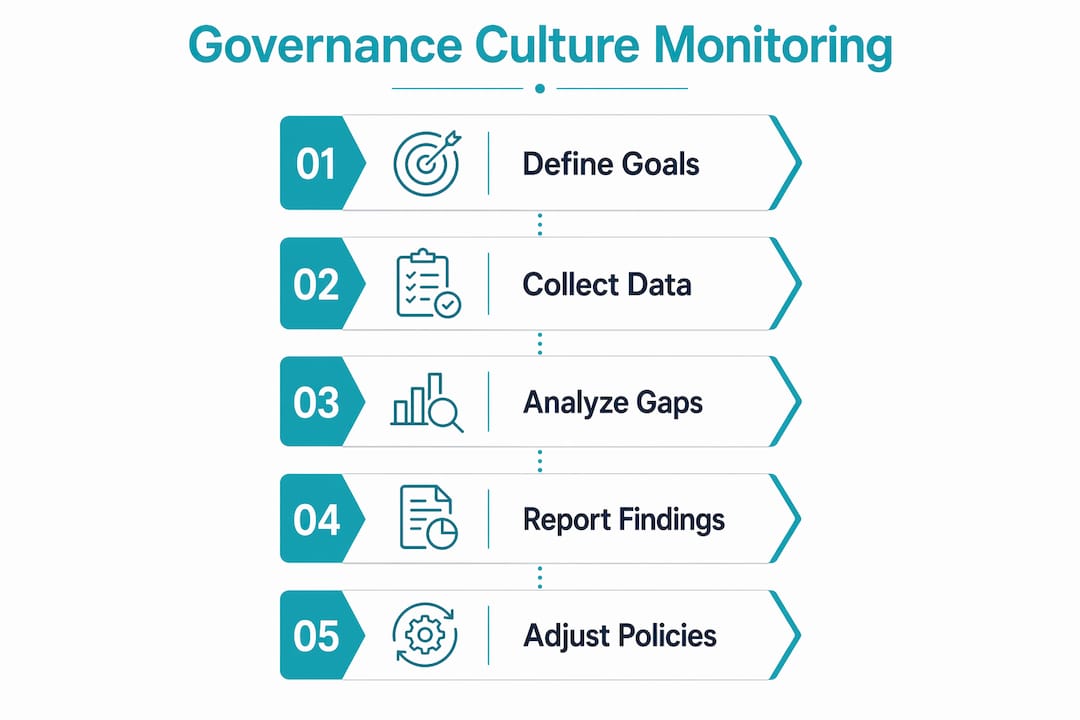
Boards use indicators and red flags to maintain oversight. Red flags include rising complaint volumes, unexplained staff turnover, repeated near-misses in compliance, and a pattern of decisions that contradict stated values. These are not proof of culture failure on their own, but they are signals that warrant a structured response. A governance review process gives boards a structured mechanism to examine these signals without defaulting to crisis management.
SHRM confirms that culture is a strategic asset with a measurable link to organisational performance and resilience. This means culture monitoring belongs in the same reporting framework as financial and operational performance. Organisations that treat culture as a separate, softer agenda item consistently underinvest in the oversight mechanisms that would catch problems early.
Adapting governance culture as the organisation evolves is not optional. Mergers, leadership changes, regulatory shifts, and growth all create pressure points where culture can fracture. The organisations that manage these transitions well are the ones that have built the monitoring discipline before the pressure arrives.
Key takeaways
Embedding governance culture requires structured frameworks, visible leadership behaviour, and continuous monitoring. It is not achieved through statements alone.
| Point | Details |
|---|---|
| Start with the five AICD principles | Apply leadership tone, strategy integration, risk embedding, oversight, and accountability as operational pillars, not aspirational headings. |
| Leadership behaviour is the primary signal | Employees read what leaders do under pressure. Contradictions between stated values and visible actions undermine culture faster than any policy failure. |
| Speak-up mechanisms are a legal and cultural test | Australian whistleblower requirements set the legal floor. Whether people actually use reporting channels reflects the real state of your governance culture. |
| Monitoring must be evidence-based | Culture audits, real-time data, and board-level indicators turn oversight from opinion into governance. Review frequency should match organisational change. |
| Culture is a strategic asset | Organisations that embed governance practices into daily workflows, not as a separate compliance function, build the resilience that sustains performance. |
What I have learned about embedding governance culture
After nearly three decades working across Australia's human services sector, the pattern I see most often is this: organisations invest heavily in governance documents and almost nothing in governance behaviour. The frameworks are sound. The values statements are well-crafted. And then the board meeting happens, and nobody asks the hard question.
Governance culture requires ongoing discipline, curiosity, and judgement. There is no one-size-fits-all approach, and the organisations that treat it as a compliance tick-box are the ones that get caught out when something goes wrong. The evidence layer matters. Concrete questions matter. The willingness to act on what the data shows matters most of all.
Technology is genuinely useful here, but I have seen organisations use dashboards as a substitute for conversation rather than a prompt for it. The data should generate questions, not close them. The most effective governance professionals I have worked with treat every culture indicator as the beginning of an inquiry, not the end of one.
The uncomfortable truth is that governance culture is a leadership accountability issue before it is a systems issue. Fix the leadership accountability first. The systems will follow.
— Rachel
How Theplanningandpracticehub supports governance culture work
Theplanningandpracticehub works with Australian organisations across the government and not-for-profit sectors to build governance culture that holds up under scrutiny. Led by Rachel Willis, with close to three decades of sector experience, the Hub offers tailored support across governance framework design, board advisory, compliance integration, and leadership development. This is not generic consulting. It is co-developed, contextual work that addresses the specific regulatory and cultural challenges your organisation faces. If you are ready to move from governance statements to governance practice, explore the full range of services or visit Theplanningandpracticehub to start the conversation.
FAQ
What does it mean to embed governance culture in an organisation?
Embedding governance culture means integrating shared values, accountability norms, and ethical behaviours into daily workflows and leadership decisions, not just documenting them in policy. The AICD defines this as requiring structured oversight, risk integration, and measurable accountability at board level.
What are the five AICD governance culture principles?
The AICD outlines five principles for boards overseeing culture: leadership tone, strategy integration, risk embedding, governance oversight, and accountability with monitoring. Each principle requires a named owner, a defined process, and a regular review cycle to be operational rather than aspirational.
What are the legal requirements for speak-up culture in Australia?
Under the Corporations Act, Australian organisations must provide reporting channels, anonymity protections, continuous training, and governance review mechanisms for whistleblowers. Meeting these requirements establishes the legal minimum. Whether staff actually use these channels reflects the real depth of your governance culture.
How often should an organisation conduct a governance culture assessment?
Culture audits should occur at a frequency that matches the pace of organisational change. Annual reviews are a starting point, but organisations undergoing mergers, leadership transitions, or significant regulatory shifts should assess culture more frequently to catch fracture points early.
How does technology support governance culture monitoring?
Technology tools, including AI-powered compliance platforms like those offered by Diligent, automate routine oversight tasks and provide real-time data on culture indicators. The data should prompt leadership inquiry, not replace it. Human judgement remains the critical layer in interpreting what the indicators mean.