
Transparency in non-profit governance is the practice of openly disclosing financial, programmatic, and decision-making information to stakeholders to strengthen accountability and trust. As a fundamental pillar of legitimacy, it extends well beyond publishing an annual report. Boards that treat transparency as a continuous discipline rather than a periodic obligation build stronger donor relationships, reduce governance risk, and demonstrate the kind of credibility that sustains long-term mission delivery. For non-profit leaders and board members, understanding what transparency requires in practice is the starting point for getting it right.
What is the role of transparency in non-profit governance?
Transparency is the mechanism boards use to exercise oversight and earn the trust of every stakeholder who depends on them. That includes donors, regulators, service recipients, staff, and the broader community. When governance information is visible, stakeholders can assess whether an organisation is performing as it claims. Without that visibility, trust is assumed rather than earned, and assumptions are fragile.
The scope of transparency matters here. Many boards default to financial disclosure as the primary measure of openness, but effective transparency covers at least four distinct areas:
- Financial clarity: Revenue sources, expenditure categories, and how funds are allocated to programmes versus administration.
- Governance visibility: Board composition, member qualifications, conflict-of-interest registers, and how decisions are made.
- Operational discipline: Documented processes, compliance records, and evidence of internal controls.
- Impact reporting: Outcomes data, programme evaluations, and honest accounts of what has and has not worked.
Each of these serves a different stakeholder need. Donors want to know their funds are used well. Regulators need evidence of compliance. Communities want proof that services are actually reaching people. A board that discloses across all four areas signals that it has nothing to hide and every reason to be open.
Pro Tip: Design your disclosures around stakeholder decision cycles, not your own reporting calendar. A donor deciding whether to renew a major gift needs current information, not a summary from eight months ago.

One common pitfall is treating transparency as a one-off publication exercise. Boards that update their website once a year and consider the job done are not practising transparency. They are performing it. The difference is consequential, and sophisticated donors and regulators are increasingly able to tell the two apart.
How does transparency complement accountability in non-profit governance?
Transparency and accountability are separate but complementary pillars of good governance. Transparency provides the visibility. Accountability provides the mechanism to act on what that visibility reveals. One without the other is incomplete. An organisation can disclose everything and still face no consequences for poor performance if accountability structures are absent.
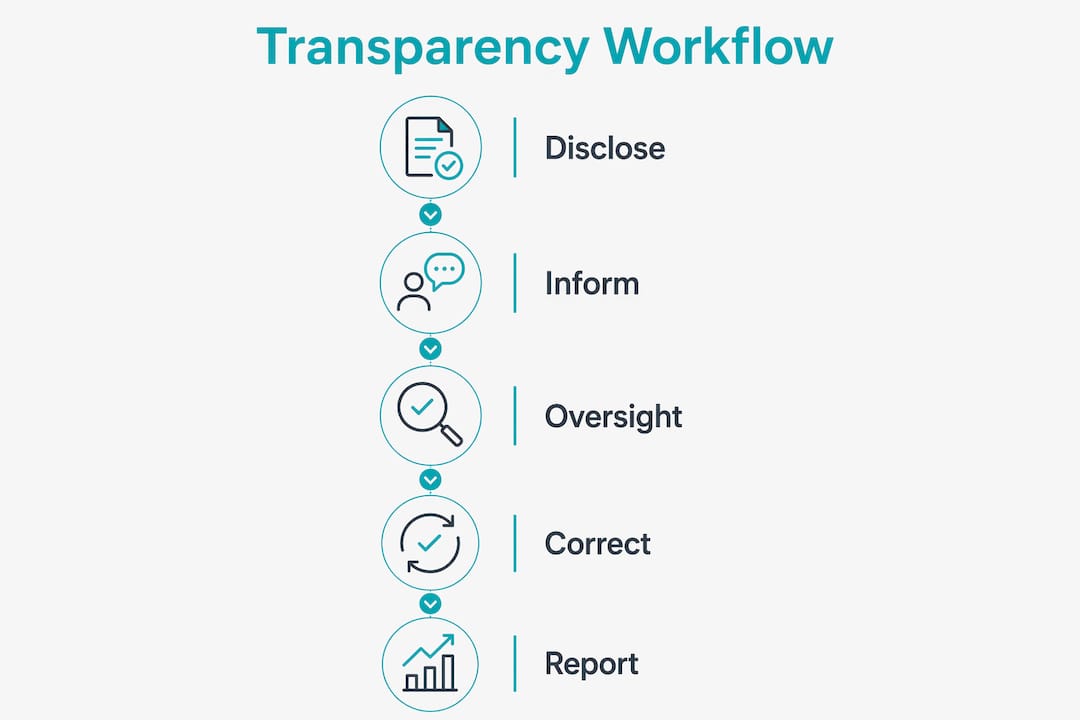
The relationship works in a specific sequence:
- Disclosure occurs. The board publishes financial statements, board minutes, conflict-of-interest declarations, and programme outcomes.
- Oversight is applied. Designated parties, whether an audit committee, an independent board member, or a regulator, review the disclosed information against expected standards.
- Answerability is required. Where disclosures reveal gaps, errors, or misconduct, the responsible parties are required to explain and respond.
- Corrective action follows. Governance consequences are applied: policy changes, personnel decisions, or formal remediation plans.
This sequence is what good governance frameworks from bodies like IFAC describe when they emphasise transparency and accountability together as tools for reducing fraud and corruption risk. The framework is only as strong as the weakest link in that chain.
Practical accountability mechanisms that boards should have in place include whistleblower policies with clear reporting channels, conflict-of-interest disclosure requirements for all board members, independent financial audits reviewed by a committee that includes non-executive members, and documented corrective action processes for when disclosures reveal problems.
Pro Tip: Avoid treating transparency as a one-way broadcast. The most effective governance cultures treat disclosure as an invitation for scrutiny, not a substitute for it. Build feedback loops into your reporting so stakeholders can raise questions and receive substantive responses.
Understanding the distinction between compliance and governance is also worth your time here. Compliance is the floor. Transparency and accountability together represent the standard that high-performing boards aspire to exceed.
Why is continuous transparency the new governance standard in 2026?
The shift from annual reporting to ongoing transparency is one of the most significant changes in non-profit governance expectations over the past several years. Board-level transparency expectations in 2026 now extend beyond annual reports to continuous governance visibility for donors and communities. This is not a minor adjustment in communication style. It reflects a fundamental change in what stakeholders consider acceptable.
Several factors are driving this shift:
- Donor expectations have changed. Major donors, particularly those giving through structured philanthropic vehicles, now expect real-time or near-real-time access to programme data and financial performance.
- Technology has made continuous disclosure practical. Governance portals, donor dashboards, and digital reporting tools mean there is no longer a credible operational argument against more frequent disclosure.
- Regulatory scrutiny has increased. Australian regulators, including the Australian Charities and Not-for-profits Commission (ACNC), have progressively raised reporting expectations and public register requirements.
- Reputational risk is faster-moving. A governance failure that might once have taken months to surface publicly can now become a media story within days. Continuous transparency reduces the gap between what an organisation knows and what the public knows.
The practical implication for boards is that transparency should be treated as an ongoing discipline rather than an annual exercise. This means quarterly financial summaries published on your website, board meeting outcomes communicated to key stakeholders within a defined timeframe, and programme updates that reflect current data rather than last year's evaluation.
Implementing continuous transparency does require investment. Boards need clear policies on what is disclosed, when, and through which channels. Staff need to understand their role in maintaining disclosure records. And the board itself needs to review its governance documents regularly to confirm they reflect current practice, not aspirational intent. The governance and mission delivery connection is direct: organisations that maintain continuous transparency are better positioned to demonstrate impact and secure ongoing funding.
How does transparency help manage fraud and data privacy risks?
Transparency is one of the most effective tools a non-profit board has for managing two of its most serious governance risks: fraud and data privacy breaches. Both risks carry significant reputational consequences, and both are meaningfully reduced when disclosure practices are strong.
On fraud, the evidence is clear. Donations decline after fraud reporting, but donors are significantly less likely to withdraw funding when affected organisations demonstrate transparency and take corrective action. This finding has a direct implication for how boards should respond when misconduct occurs. Concealment is not a protective strategy. It is a compounding risk. Organisations that disclose promptly, explain what happened, and demonstrate corrective action preserve far more donor confidence than those that minimise or delay.
Practical fraud risk management through transparency includes:
- Publishing spending monitoring reports that allow board members and external parties to identify anomalies.
- Maintaining a whistleblower hotline with an independent reporting pathway outside the executive team.
- Disclosing the outcomes of internal audits, including findings and the actions taken in response.
- Requiring board members to declare conflicts of interest at every meeting, not just annually.
"Transparent disclosures combined with corrective action when misconduct occurs reduce donor funding cuts and reputational damage." This principle should be embedded in every non-profit's crisis governance protocol, not discovered for the first time when a problem arises.
Data privacy is the less-discussed but equally significant dimension of transparency in governance. Fewer than 50% of people trust non-profits to protect their data. That figure represents a serious governance credibility gap. Boards that do not actively communicate how they collect, store, and use personal data are leaving a significant trust deficit unaddressed. Governance credibility increasingly depends on data protection transparency, not just traditional financial and programmatic disclosure. A clear, accessible privacy policy is the minimum. Boards should also consider publishing their data governance frameworks and communicating any changes to data handling practices directly to affected stakeholders.
Key takeaways
Transparency in non-profit governance is a continuous, multi-dimensional discipline that connects financial disclosure, governance visibility, accountability structures, and data protection into a single credibility framework.
| Point | Details |
|---|---|
| Transparency covers four domains | Disclose financial, governance, operational, and impact information to meet the full range of stakeholder needs. |
| Accountability requires transparency | Visibility alone is insufficient. Pair disclosures with oversight mechanisms and documented corrective action processes. |
| Continuous disclosure is now expected | Annual reports no longer satisfy donor and regulatory expectations. Move toward quarterly updates and real-time governance visibility. |
| Fraud response depends on transparency | Organisations that disclose misconduct and act on it retain significantly more donor confidence than those that conceal it. |
| Data privacy is a governance issue | With fewer than 50% of people trusting non-profits to protect their data, boards must treat data handling transparency as a core governance responsibility. |
What I have learned about embedding transparency in governance
After nearly three decades working across Australia's human services sector, I have seen transparency treated as everything from a genuine governance commitment to a carefully managed public relations exercise. The difference is always visible to people who know what to look for, and increasingly, donors and regulators know what to look for.
The most effective boards I have worked with treat their governance documents as publishable outputs. Board minutes, conflict-of-interest registers, audit findings, and policy decisions are maintained as if they will be read by an external reviewer, because eventually they will be. That discipline changes how decisions are made and recorded. It creates a culture where accountability is built into the process, not bolted on after the fact.
What I find most underappreciated is that transparency protects leadership. Boards that operate openly have far fewer internal conflicts about what was decided and why. They face less reputational risk when things go wrong because their track record of openness speaks for itself. And they attract better board members, because capable people want to serve organisations that are well run.
The practical advice I give most often is this: align your disclosures with the decision cycles of your key stakeholders. Do not publish information on your schedule and assume it serves their needs. Find out when your major donors are making renewal decisions, when your regulators are conducting reviews, and when your community is most engaged with your work. Then make sure your disclosures are current, accessible, and contextually rich at those moments.
Transparency is not a burden. It is the governance infrastructure that makes everything else more sustainable.
— Rachel
How Theplanningandpracticehub supports transparent non-profit governance
If you are a board member or non-profit leader working to strengthen your organisation's governance practices, Theplanningandpracticehub offers the kind of sector-specific support that makes a measurable difference. Rachel Willis and the team bring close to three decades of experience in Australia's human services sector, working directly with non-profit boards to build governance frameworks that are transparent, accountable, and fit for purpose.
Whether you are starting from scratch with your disclosure policies or looking to move from annual reporting to continuous transparency, the non-profit governance consulting services at Theplanningandpracticehub are tailored to your organisation's specific regulatory context and stakeholder environment. Explore the full range of sector-specific support available, or contact the team directly to discuss your governance priorities.
FAQ
What does transparency mean in non-profit governance?
Transparency in non-profit governance is the practice of openly disclosing financial, programmatic, governance, and operational information to stakeholders. It is a core mechanism boards use to exercise oversight and build legitimacy with donors, regulators, and communities.
How is transparency different from accountability in governance?
Transparency provides the visibility through disclosure. Accountability provides the oversight structures and consequences that act on what disclosures reveal. Both are required for effective governance. One without the other leaves the system incomplete.
Why do non-profits need to go beyond annual reporting?
Donor and regulatory expectations have shifted significantly. Continuous governance visibility is now the standard in 2026, with stakeholders expecting current financial and programme data rather than summaries published months after the fact.
How does transparency reduce fraud risk in non-profits?
Organisations that disclose misconduct and demonstrate corrective action retain significantly more donor confidence than those that conceal problems. Transparent corrective action after fraud is one of the most effective tools for limiting reputational and financial damage.
Does data privacy count as part of governance transparency?
Yes. Fewer than 50% of people trust non-profits to protect their data, making data handling transparency a core governance credibility issue. Boards should publish clear privacy policies and communicate any changes to data practices directly to affected stakeholders.