
A governance review process for nonprofits is a structured, recurring evaluation of board practices, policies, and compliance mechanisms to uphold fiduciary duties and strengthen organisational effectiveness. Known formally as a governance assessment or governance evaluation, this process examines everything from bylaws and conflict of interest policies to board performance and IRS Form 990 disclosures. For nonprofit leaders and board members, understanding organisational governance basics is the starting point. Done well, a governance review process nonprofit boards commit to regularly produces measurable improvements in accountability, compliance, and mission delivery.
What are the core components of a governance review process?
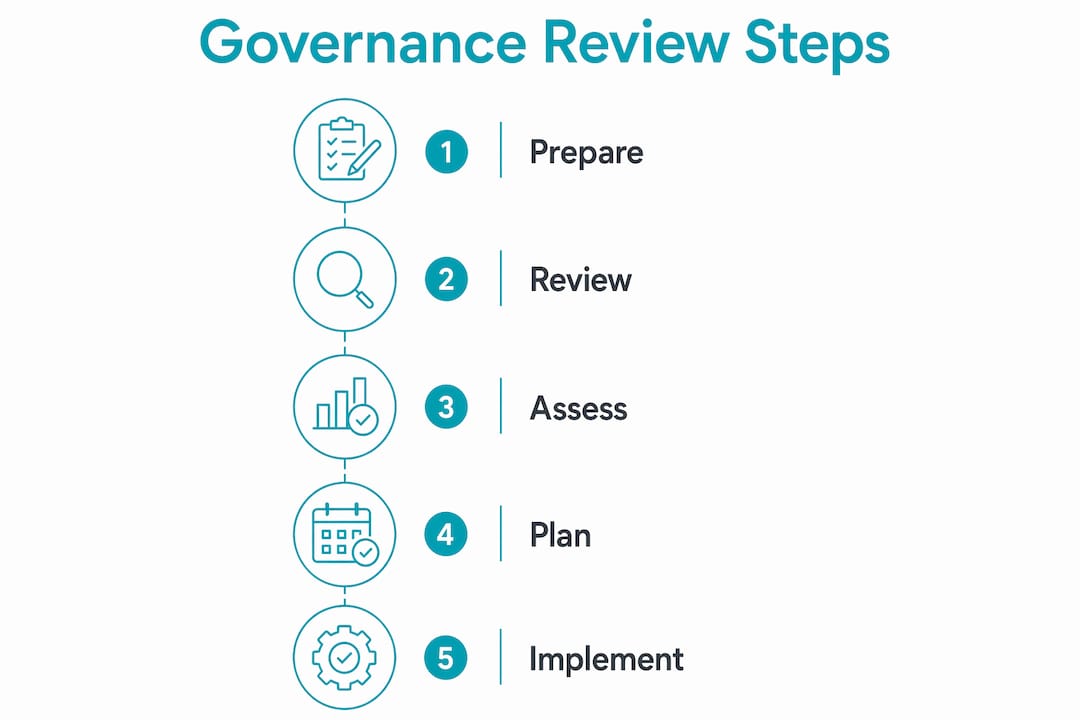
An effective governance review process covers five interconnected areas: governing documents, board performance, compliance controls, qualitative observation, and benchmarking. Each component serves a distinct purpose, and omitting any one of them leaves gaps that tend to surface at the worst possible moments.
Governing documents and policy alignment form the foundation. The review examines bylaws, articles of incorporation, conflict of interest policies, and whistleblower policies to confirm they reflect current operations and legal requirements. Policies that were drafted a decade ago and never updated are a common source of legal exposure. If your governing documents say one thing and your board does another, you have a problem that no amount of goodwill can fix.

Board performance self-assessments provide the qualitative layer. These are structured surveys or facilitated discussions that ask board members to reflect honestly on their own effectiveness, engagement, and understanding of their responsibilities. The results are only as useful as the questions asked, which is why using a validated tool matters.
Compliance checks include reviewing financial controls, meeting minutes, and public disclosures. The IRS Form 990 review is a critical component here. The IRS expects disclosure of whether the Form 990 was provided to all directors before filing, along with a description of the board review process. This means the review is not just a filing formality. It is a governance control.
Qualitative insights come from observing board meetings and conducting interviews with board members, senior staff, and key stakeholders. Surveys capture what people are willing to write down. Conversations reveal what they are not.
Benchmarking against recognised frameworks such as the Standards for Excellence programme or the Charity Board Performance Framework gives your board an external reference point. Without benchmarks, self-assessment risks becoming self-congratulation.
- Review bylaws, articles of incorporation, and core policies annually
- Conduct board self-assessments using validated tools or customised surveys
- Integrate Form 990 review as a governance control, not just a compliance task
- Observe at least two board meetings per cycle to assess real-time dynamics
- Benchmark findings against sector frameworks to identify genuine gaps
Pro Tip: Schedule the governance review to conclude at least six weeks before your annual general meeting. This gives the board time to act on findings before the next governance cycle begins.
How does statutory membership affect the governance review scope?
Statutory membership is one of the most misunderstood governance variables in the nonprofit sector, and it directly shapes the scope and complexity of any governance review. A statutory member holds formal legal rights within the organisation, including the right to vote on key decisions, approve bylaw changes, and participate in dissolution proceedings. This is fundamentally different from a supporter, donor, or program participant who may be called a "member" informally.
The complexity of membership administration is significant. Membership is easy to create but genuinely difficult to undo. Once your constitution or bylaws establish statutory membership, you are bound by the eligibility criteria, voting mechanics, and quorum requirements you have set. Governance reviews must examine whether these rules are clearly defined, consistently applied, and administratively manageable.
The practical consequences matter enormously. Members can override board decisions on bylaws, vote on dissolution, and affect quorum calculations in ways that can paralyse decision-making if not carefully managed. A governance review that ignores membership structure is incomplete.
Key questions your review should address regarding membership:
- Are statutory members clearly distinguished from informal supporters in your governing documents?
- Do your quorum rules reflect the realistic participation rates of your membership base?
- Is the process for admitting and removing members documented and consistently followed?
- Have you assessed whether statutory membership is necessary for your organisation's model, or whether it creates unnecessary administrative burden?
The default recommendation from governance specialists is to avoid statutory membership unless there is a clear strategic or legal reason to include it. If your organisation already has statutory members, the governance review is the right time to audit whether the structure is working as intended.
What fiduciary duties must boards address during a governance review?
Fiduciary duty is the legal and ethical obligation that every board member carries. It is not aspirational language. It is enforceable, and governance reviews are one of the primary mechanisms through which boards demonstrate they are meeting it. Three duties define the framework: care, loyalty, and obedience.
The duty of care requires board members to be informed and engaged. This means reading board papers before meetings, asking substantive questions, and making decisions based on adequate information. A governance review assesses whether board meeting structures, information flows, and attendance patterns support this duty in practice.
The duty of loyalty requires board members to prioritise the organisation's interests above their own. Conflict of interest policies are the primary governance tool here. The review should confirm that a written policy exists, that it is reviewed annually, and that board members complete disclosure forms. The Form 990 governance disclosures specifically ask about conflict of interest policies and compensation procedures, making this a publicly visible governance signal.
The duty of obedience requires the board to act consistently with governing documents and applicable law. This is where outdated documents become a legal liability. Updating outdated governing documents is not optional. Boards that operate outside their own bylaws, even unintentionally, are in breach of this duty. The review should flag every inconsistency between documented policy and actual practice.
Pro Tip: When reviewing governing documents, create a simple two-column table listing each policy requirement alongside current practice. Any row where the two columns do not match is a governance risk that needs resolution before the next board meeting.
Understanding the difference between compliance and governance helps boards see fiduciary duties not as a checklist but as an ongoing standard of conduct.
Which tools and frameworks work best for nonprofit governance assessment?
The right tool depends on your organisation's size, governance maturity, and the purpose of the assessment. Three options stand out for their rigour and practical utility.
| Tool | Best suited for | Key feature |
|---|---|---|
| PANO Standards for Excellence | Small to mid-size nonprofits | Free online self-assessment with gap reports |
| NVPC BoardPulse2.0 | Boards seeking benchmarked data | Benchmarks against 1,140 board member data points |
| Customised internal survey | Organisations with specific governance priorities | Tailored questions aligned to strategic plan |
The PANO Standards for Excellence programme offers free online self-assessment tools that guide nonprofits through legal compliance and governance management benchmarks, producing detailed reports that highlight both gaps and strengths. This is particularly useful for boards preparing for accreditation or funder due diligence.
The NVPC BoardPulse2.0 benchmarks governance maturity using the Charity Board Performance Framework, drawing on data from over 1,140 board members. This scale of benchmarking gives your results genuine comparative weight. The tool requires an 80% completion rate from board members to generate a valid report, which means operational planning is as important as the tool itself.
To implement any assessment tool effectively, follow this sequence:
- Select the tool that matches your governance maturity and reporting needs
- Brief the board on the purpose and process at least four weeks in advance
- Set a firm completion deadline and assign a coordinator, typically the board secretary
- Follow up with non-respondents at the two-week mark to protect completion rates
- Debrief results in a dedicated board session, not as an agenda item at a routine meeting
Board self-assessment is expected annually, with third-party facilitated evaluations recommended every three to five years. The annual cycle builds institutional knowledge. The periodic external review provides the independent perspective that internal assessments cannot replicate.
What are the practical steps for a sustainable governance review cycle?
A governance review cycle that produces real change requires structure, assigned responsibility, and a commitment to following through on findings. Here is a practical roadmap.
- Schedule the annual self-assessment at the same point each year, ideally three to four months before your financial year-end. Consistency builds board familiarity with the process and reduces resistance over time.
- Assign coordination responsibility to the board secretary or a designated governance officer. Someone must own the logistics, including distributing surveys, tracking completion, and compiling results.
- Integrate Form 990 review as a standing governance control. The board should focus specifically on governance and management disclosures, conflict of interest policies, compensation procedures, and financial reporting sections. This review should be documented with minutes.
- Debrief findings in a structured session with clear agenda time. Present results, identify the top three to five priority areas, and assign owners and timelines for each improvement action.
- Monitor progress at each subsequent board meeting until actions are closed. A governance improvement plan that sits in a drawer is not governance. It is paperwork.
- Commission a third-party facilitated review every three to five years. External facilitators surface issues that internal reviews miss, particularly around board culture and interpersonal dynamics.
Pro Tip: Build your governance review findings directly into your strategic planning cycle. Governance gaps identified in October should inform board development priorities for the following year, not sit in a separate report that nobody revisits.
Aligning your review cycle with [governance and mission delivery](https://blog.theplanningandpracticehub.com.au/blog/ governance-and-mission-delivery-for-non-profits) ensures the process serves your organisation's purpose, not just its compliance obligations.
Key takeaways
A sustainable governance review process nonprofit boards can rely on requires annual self-assessment, clear fiduciary accountability, validated tools, and a disciplined follow-through cycle.
| Point | Details |
|---|---|
| Start with governing documents | Review bylaws and policies annually to confirm they reflect current practice and legal requirements. |
| Use validated assessment tools | Tools like PANO Standards for Excellence and NVPC BoardPulse2.0 provide benchmarked, credible results. |
| Treat Form 990 as a governance control | Board review of the Form 990 is a fiduciary responsibility, not a filing formality. |
| Address membership structure explicitly | Statutory membership rules must be clearly defined and audited during every governance review. |
| Close the loop on findings | Governance improvement plans require assigned owners, timelines, and progress monitoring to produce change. |
What I have learned about governance reviews after nearly 30 years in the sector
After nearly three decades working alongside nonprofit boards and leadership teams, the pattern I see most often is not a lack of governance knowledge. It is a gap between what boards know they should do and what actually happens between formal meetings.
Governance reviews are most valuable when they are treated as an ongoing control mechanism rather than a periodic report-generating exercise. The organisations that genuinely improve their governance are the ones that use review findings to change specific behaviours and update specific documents, not the ones that produce the most polished assessment report.
The membership question is one I raise early in every engagement. Boards are often surprised to discover that their constitution creates statutory membership obligations they have never actively managed. Cleaning that up before a governance dispute arises is far less costly than addressing it under pressure.
On fiduciary duties, I would encourage every board member to read their governing documents once a year. Not skim them. Read them. The duty of obedience is breached most often not through bad intent but through simple unfamiliarity with what the documents actually require. That is a solvable problem.
The tools matter, but the follow-up matters more. I have seen boards complete a thorough BoardPulse2.0 assessment, receive a detailed report, and then do nothing with it. The report is not the outcome. The changed behaviour is the outcome. Build your debrief session and your improvement plan into the process from the start, not as an afterthought.
— Rachel
How Theplanningandpracticehub supports your governance review
If your board is ready to move beyond compliance checklists and build a governance review process that genuinely strengthens your organisation, Theplanningandpracticehub offers the specialist support to make that happen.
Led by Rachel Willis, with nearly three decades of experience in Australia's human services sector, Theplanningandpracticehub works alongside nonprofit boards and leadership teams to design and facilitate governance reviews that are practical, evidence-based, and tailored to your organisation's specific context. From board performance evaluation to compliance support and governing document review, the hub provides co-developed strategies that produce real change. Explore the full range of governance consulting services and take the next step toward a stronger, more accountable board.
FAQ
What is a governance review process for a nonprofit?
A governance review process for a nonprofit is a structured evaluation of board practices, policies, governing documents, and compliance mechanisms. It assesses whether the board is meeting its fiduciary duties and operating in alignment with its mission and legal obligations.
How often should a nonprofit conduct a governance review?
Annual self-assessment is standard practice, with a third-party facilitated review recommended every three to five years. The annual cycle maintains accountability, while the external review provides independent perspective.
What role does IRS Form 990 play in a governance review?
The Form 990 board review functions as a governance control, not just a compliance filing. The IRS expects boards to review the Form 990 before filing and to disclose governance policies including conflict of interest procedures and compensation practices.
Which tools are best for nonprofit board self-assessment?
The PANO Standards for Excellence programme and the NVPC BoardPulse2.0 are two well-regarded options. PANO offers free online assessments with gap reports, while BoardPulse2.0 benchmarks governance maturity against data from over 1,140 board members.
What are the three fiduciary duties nonprofit board members must meet?
Nonprofit board members carry the duties of care, loyalty, and obedience. Care requires informed engagement, loyalty requires prioritising the organisation's interests, and obedience requires acting consistently with governing documents and applicable law.