
Governance in non-profits is defined as the system of structures, policies, and practices that ensures an organisation operates ethically, remains accountable, and stays true to its mission. Understanding why governance matters for non-profits goes well beyond ticking regulatory boxes. It determines whether your board fulfils its fiduciary duties of care, loyalty, and obedience, whether donors trust you with their money, and whether your organisation can withstand pressure without losing its way. Weak governance is not simply an administrative gap. It is a direct threat to mission delivery, public credibility, and long-term organisational survival. The good news is that strong governance is a leadership opportunity, and it is one that every board member and executive can act on today.
Why governance matters for non-profits: the core framework
Effective governance in non-profits rests on several interconnected components, each reinforcing the others. When one element is missing or poorly implemented, the whole structure becomes fragile.
Board roles and fiduciary duties

The board is the legal and ethical backbone of any non-profit. Boards must be proactive and engaged well beyond simply attending meetings. The duty of care requires directors to make informed decisions. The duty of loyalty demands that personal interests never override the organisation's interests. The duty of obedience means the board upholds the mission and complies with all applicable laws. These are not aspirational standards. They are legal obligations.
Governance policies every non-profit needs
Three policies form the minimum foundation of sound governance practice:
- Conflict-of-interest policy: Requires board members and staff to disclose personal interests that could influence decisions, protecting the organisation from self-dealing.
- Whistleblower policy: Creates a safe channel for reporting misconduct without fear of retaliation, which is critical for surfacing problems before they escalate.
- Document retention policy: Specifies how long records are kept and how they are destroyed, protecting the organisation in audits and legal proceedings.
In the United States, the IRS Form 990 Part VI requires non-profits to disclose whether these three policies exist. This means governance quality is publicly visible to funders, regulators, and the community. Australian non-profits face equivalent scrutiny through the Australian Charities and Not-for-profits Commission, which expects comparable standards of transparency and accountability.
Pro Tip: Review your conflict-of-interest policy annually, not just when a problem arises. Boards that treat it as a living document rather than a one-time exercise are far better positioned to manage complex stakeholder relationships.
Board composition and financial oversight
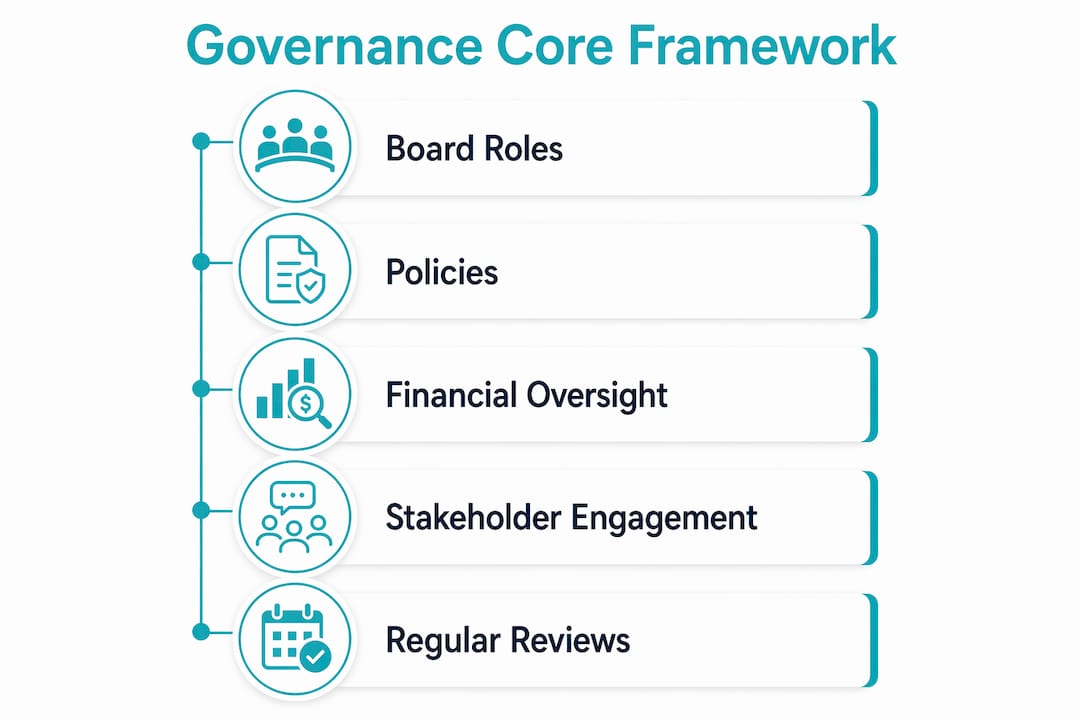
Board composition matters enormously. Independent directors, appropriate board size, and genuine diversity of skills and perspectives all contribute to better decision-making and reduced groupthink. Financial oversight includes approving budgets, reviewing audits, and maintaining controls over executive compensation. These are not management tasks. They are governance responsibilities that the board cannot delegate away.
How strong governance builds trust and supports funding
Governance is a leading indicator of a charity's readiness to use donations responsibly and maintain mission focus over time. Donors are paying close attention to how organisations are governed, and the data is clear.
According to Give.org's 2026 Donor Trust Survey, 57% of donors prioritise preventing financial mismanagement, 42% value avoiding conflicts of interest, and 42% value limiting board member compensation. These figures tell us that governance quality is not a back-office concern. It is a front-line factor in whether donors choose to give and whether they continue giving.
"Governance sits at the intersection of board, management, and stakeholders, shaping how risks are surfaced and decisions are held accountable." — Lynn Beauregard, Lexpert, 2026
Strong governance builds what is sometimes called a social licence to operate. This is the informal but powerful permission that communities, funders, and regulators grant to organisations they trust. Without it, even well-resourced non-profits find themselves facing scrutiny, funding withdrawal, or reputational damage that takes years to repair.
Here are four governance indicators that donors and funders consistently evaluate:
- Transparent financial reporting: Annual reports and audited accounts that are publicly accessible signal that the organisation has nothing to hide.
- Board independence: A majority of independent directors reduces the risk of self-dealing and demonstrates that decisions are made in the organisation's best interest.
- Documented conflict-of-interest processes: Evidence that disclosures are made and managed properly reassures funders that relationships are managed with integrity.
- Executive compensation controls: Clear policies on how leadership pay is set and reviewed show that donor funds are being used responsibly.
Governance frameworks for NGOs and charities that embed these indicators do not just satisfy compliance requirements. They actively attract and retain the funding relationships that sustain mission delivery.
What governance risks do non-profits face without proper oversight?
The risks of poor governance are concrete, and they compound quickly. The table below summarises the most significant threats and their consequences.
| Risk area | Description | Consequence |
|---|---|---|
| Financial mismanagement | Inadequate controls over spending, procurement, or cash handling | Loss of funds, audit findings, regulatory action |
| Conflicts of interest | Undisclosed relationships influencing decisions | Reputational damage, legal liability, funder withdrawal |
| Mission drift | Board fails to monitor alignment between activities and stated purpose | Loss of charitable status, donor disillusionment |
| Cybersecurity threats | Absence of governance policies around data and incident response | Data breaches, operational disruption, legal exposure |
| Regulatory non-compliance | Failure to meet reporting or disclosure obligations | Deregistration, financial penalties, loss of tax concessions |
Cybersecurity deserves particular attention. Non-profits are increasingly targeted for cybercrime, and many boards have not yet treated digital risk as a governance matter. The good news is that governance-level interventions, such as adopting a cybersecurity policy and running tabletop exercises, are often faster and more cost-effective to implement than technology upgrades. This is a governance gap that boards can close relatively quickly with the right focus.
Mission drift is another underappreciated risk. When boards are passive or poorly informed, organisations gradually shift their activities toward whatever attracts funding rather than what serves their stated purpose. This is not always a deliberate choice. It is often the result of insufficient oversight and unclear strategic direction from the board.
Pro Tip: Conduct a governance health check at least once every two years. Map your current policies against your regulatory obligations and identify gaps before a funder or regulator does it for you.
Governance disclosures in Form 990 Part VI serve both internal control and public disclosure functions. Inadequate governance raises compliance and credibility risk even when an organisation's finances appear sound. Funders and regulators review these disclosures, and gaps signal deeper organisational vulnerabilities.
How does governance enhance non-profit organisational effectiveness?
A 2026 SAGE systematic review of 55 studies found that governance mechanisms including accountability, transparency, and stakeholder engagement correlate directly with non-profit performance and legitimacy. This is not a theoretical claim. It is the accumulated finding of decades of research across hundreds of organisations.
Effective governance enhances organisational performance through several practical mechanisms:
- Strategic leadership clarity: When the board sets direction and delegates operational responsibility to management, the organisation avoids the confusion and conflict that comes from boards micromanaging or executives overreaching. Boards must distinguish governance from management by setting policies and delegating operational duties clearly.
- Stakeholder participation: Governance structures that create genuine channels for community, staff, and beneficiary input produce better decisions and stronger organisational legitimacy.
- Accountability mechanisms: Regular board reporting, performance reviews, and audit processes create the feedback loops that allow organisations to identify problems early and respond before they become crises.
- Transparency practices: Publishing annual reports, governance policies, and financial statements builds public confidence and reduces the likelihood of regulatory intervention.
Governance professionals facilitate critical dialogue across board, management, and stakeholders, influencing how risks are surfaced and decisions held accountable. This facilitation role is often invisible until it is absent. Organisations that invest in governance capability consistently outperform those that treat it as an afterthought.
The non-profit accountability standards that underpin effective governance are not bureaucratic constraints. They are the operating conditions that allow organisations to pursue their mission with confidence, attract the right people, and build the kind of institutional credibility that sustains long-term impact.
Key takeaways
Strong non-profit governance requires clear board roles, documented policies, financial oversight, and active stakeholder engagement to protect mission delivery and organisational credibility.
| Point | Details |
|---|---|
| Fiduciary duties are legal obligations | Boards must actively fulfil duties of care, loyalty, and obedience, not simply attend meetings. |
| Three policies form the governance baseline | Conflict-of-interest, whistleblower, and document retention policies are the minimum standard for credibility. |
| Donors evaluate governance directly | 57% of donors prioritise preventing financial mismanagement when assessing charities. |
| Cybersecurity is a governance responsibility | Boards should adopt cyber policies and run tabletop exercises before investing in technology upgrades. |
| Governance drives performance, not just compliance | Research across 55 studies links accountability and transparency mechanisms to non-profit effectiveness. |
Why governance is the foundation, not the formality
After nearly three decades working across Australia's human services sector, I have seen governance treated as everything from a genuine strategic asset to a pile of dusty policies no one reads. The organisations that thrive over the long term are almost always the ones where the board understands that governance is not about compliance theatre. It is about creating the conditions for the mission to succeed.
One pattern I see repeatedly is boards that confuse activity with accountability. They attend meetings, approve minutes, and sign off on budgets, but they have never had a real conversation about risk appetite, strategic direction, or what success actually looks like for the people they serve. That is not governance. That is administration dressed up as leadership.
The most common pitfall I encounter is the blurred line between governance and management. When boards drift into operational decisions, they undermine the executive team and create confusion throughout the organisation. When executives exclude the board from strategic conversations, they deprive the organisation of the oversight it needs. Getting this boundary right is not a one-time exercise. It requires ongoing discipline and honest conversation.
I also want to name something that rarely appears in governance guides: the emotional dimension of board work. Boards that are genuinely engaged with the mission, that feel personal accountability for the organisation's outcomes, make better decisions under pressure. Governance quality is not just a structural question. It is a question of culture, commitment, and leadership character.
If you are a board member reading this, I would encourage you to ask yourself one question: if your organisation faced a serious crisis tomorrow, would your governance structures give you the information, authority, and credibility to respond effectively? If the answer is uncertain, that is where the work begins.
— Rachel
How Theplanningandpracticehub supports non-profit governance
Theplanningandpracticehub works directly with non-profit leaders and boards across Australia's human services sector to build governance frameworks that are practical, compliant, and genuinely mission-centred. Led by Rachel Willis, with close to three decades of sector experience, the hub offers tailored consulting that goes well beyond generic templates. Whether you need a governance health check, support developing your core policies, or guidance on board roles and responsibilities, the team brings the depth of knowledge and the sector-specific understanding that makes a real difference. Explore the NFP governance consulting services available, or visit Theplanningandpracticehub to find out how expert support can strengthen your organisation's foundations.
FAQ
What is governance in a non-profit organisation?
Governance in a non-profit is the system of structures, policies, and practices through which the board provides oversight, sets strategic direction, and ensures the organisation operates ethically and in accordance with its mission and legal obligations.
What are the key responsibilities of a non-profit board?
Non-profit boards hold fiduciary duties of care, loyalty, and obedience, requiring them to make informed decisions, avoid conflicts of interest, and uphold the organisation's mission and legal compliance at all times.
Why do non-profits need governance policies?
Governance policies such as conflict-of-interest, whistleblower, and document retention policies serve as both internal controls and public disclosures that funders and regulators use to assess an organisation's credibility and compliance.
How does governance affect donor confidence?
Governance quality is a direct factor in donor decision-making. Give.org's 2026 Donor Trust Survey found that 57% of donors prioritise preventing financial mismanagement when evaluating charities, making governance a front-line funding concern.
What happens when non-profit governance is weak?
Weak governance exposes organisations to financial mismanagement, mission drift, conflicts of interest, cybersecurity vulnerabilities, and regulatory non-compliance, any of which can result in loss of funding, reputational damage, or deregistration.