
Governance is defined as the strategic system through which organisations set direction, distribute authority, and hold leaders accountable, while compliance is the operational discipline of meeting mandatory legal, regulatory, and internal obligations. These two concepts are related but not interchangeable, and confusing them is one of the most common and costly mistakes in organisational management. OCEG describes governance as setting direction and boundaries, with compliance addressing all activities that manage mandatory obligations and risk assessment. Understanding the compliance vs governance difference explained here is not just an academic exercise. It shapes how your organisation performs, how your board exercises oversight, and whether your assurance systems actually protect the people you serve.
What is the compliance vs governance difference explained clearly?
Governance is the overarching system. Compliance is what operates within it. That single sentence captures the core distinction, and every practical implication flows from it.
ISO/IEC 38500 defines governance as the system by which organisations distribute authority, set strategy, and establish accountability across different levels of leadership. Compliance, by contrast, addresses conformance: the act of adhering to laws, regulations, standards, and internal policies. These are fundamentally different activities, even though they are often discussed in the same breath.
The confusion is understandable. Both governance and compliance involve rules, oversight, and accountability. But governance asks, "Are we headed in the right direction, and do we have the right structures to get there?" Compliance asks, "Are we meeting our obligations, and can we prove it?" One is about direction. The other is about conformance.
OCEG coined the term GRC in 2002 to describe integrated capabilities that help organisations reliably achieve objectives and act with integrity. GRC brings governance, risk management, and compliance together as a unified system rather than three separate silos. This framing matters because it positions compliance as a component of a larger governance-enabled system, not a standalone function.
What is governance and its role in organisational management?
Governance is the system through which an organisation is directed and controlled. It is not management. Management executes decisions. Governance sets the boundaries within which those decisions are made and holds leaders accountable for the outcomes.

LegalClarity identifies board accountability, fiduciary duties, and authority delegation as fundamental governance components. These constructs determine who has the right to make which decisions, how those decisions are reviewed, and what happens when things go wrong. Without clear governance structures, organisations default to informal power dynamics that rarely serve their mission or their stakeholders.
Governance also shapes organisational culture. The values a board articulates, the ethical expectations it sets, and the accountability mechanisms it enforces all filter down through management and into day-to-day operations. Culture is not a soft concept in this context. It is a governance output.
Key governance instruments include:
- Bylaws and constitutions: Define the legal structure and authority of the governing body.
- Board charters: Specify the roles, responsibilities, and decision rights of board members.
- Delegation frameworks: Clarify which decisions sit with the board, which sit with the CEO, and which sit with operational teams.
- Strategic plans: Translate governance direction into organisational priorities and performance expectations.
- Policy frameworks: Establish the boundaries within which staff and management operate.
Pro Tip: If your organisation's governance documents have not been reviewed in the past three years, they are almost certainly out of step with your current operating environment. Governance frameworks must evolve as regulations, technology, and organisational structures change.
ISO/IEC 38500 is the internationally recognised standard for IT governance, but its principles apply broadly. It separates governance concerns from management concerns, a distinction that many boards and executive teams still struggle to maintain in practice. Governance involves judgement, oversight, and decision enablement. It sits at the nexus of boards, management, and stakeholders, not inside any one of those groups alone.
What is compliance and its function within organisations?
Compliance is the discipline of identifying, understanding, and meeting the mandatory obligations that apply to your organisation. It is externally imposed and, in most cases, non-negotiable. Failing to comply carries legal, financial, and reputational consequences.
A well-designed compliance function does far more than tick boxes. It involves a structured set of activities that generate real operational value:
- Obligation identification: Mapping all applicable laws, regulations, standards, and contractual requirements to the organisation's activities.
- Risk assessment: Evaluating the likelihood and impact of non-compliance in each obligation area.
- Policy implementation: Translating legal requirements into internal policies, procedures, and controls that staff can follow.
- Education and training: Building staff capability to understand and meet their compliance responsibilities.
- Monitoring and testing: Regularly checking whether controls are working as intended and obligations are being met.
- Evidence generation: Documenting compliance activities in a way that supports audit preparation and regulatory reporting.
The difference between genuine compliance and a checklist exercise lies in that last point. Compliance that only generates evidence for auditors, without actually changing behaviour or reducing risk, is compliance theatre. It satisfies the form of the obligation without the substance.
Compliance also includes voluntary obligations. Many organisations in Australia's human services sector choose to adopt standards such as the Australian Council on Healthcare Standards accreditation frameworks or sector-specific quality frameworks, even where these are not strictly mandated. These voluntary commitments signal organisational values and often strengthen the governance framework by raising the bar beyond minimum legal requirements.
How do governance and compliance differ and complement each other?
The distinction between governance and compliance becomes most visible when one is used as a substitute for the other. Treating compliance as a substitute for governance creates reactive, rigid systems focused on checklists rather than performance. Organisations in this position meet audit requirements but fail to improve operational outcomes. That is a significant and common failure mode.
The table below captures the core differences:
| Characteristic | Governance | Compliance |
|---|---|---|
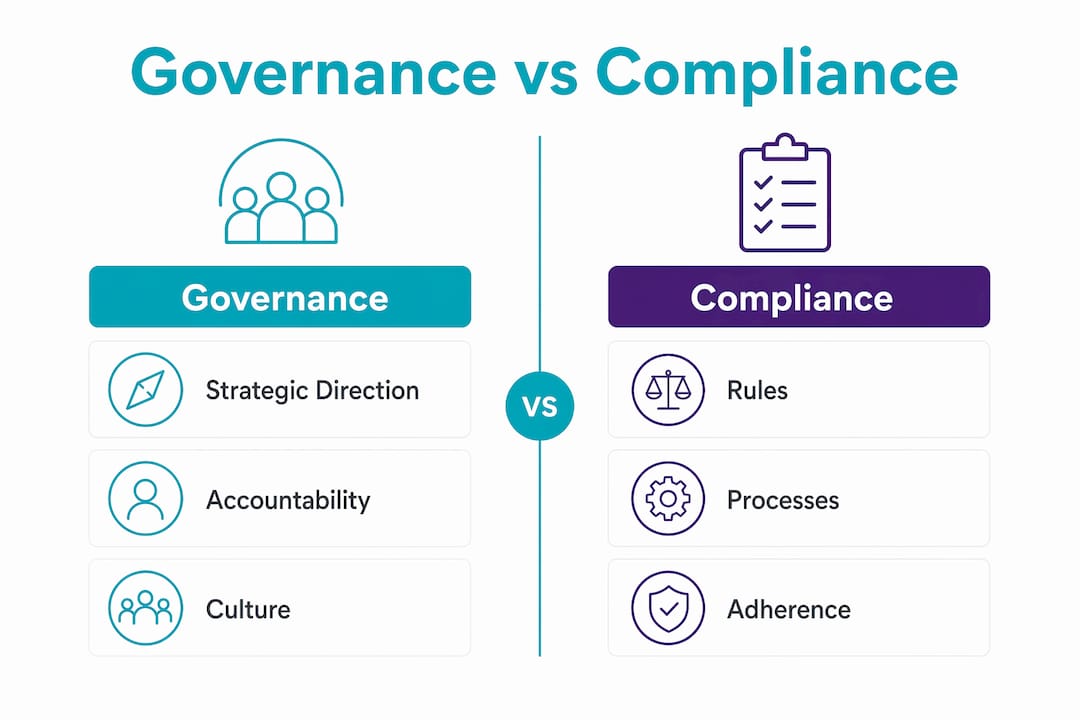
| Primary focus | Direction, accountability, and culture | Conformance with rules and obligations |
| Driven by | Internal values and strategic intent | External laws, regulations, and standards |
| Key question | Are we doing the right things? | Are we doing things right? |
| Outputs | Policies, charters, decision frameworks | Evidence, audit trails, control documentation |
| Failure mode | Lack of direction or accountability | Breach of obligation or regulatory sanction |
Governance is value-driven and outcome-focused. Compliance is rule-driven and process-focused. Neither is sufficient without the other. An organisation with strong governance but weak compliance will have excellent intentions and poor execution. An organisation with strong compliance but weak governance will meet its obligations but drift strategically, often without realising it.
The AI domain illustrates this distinction sharply. Airia notes that AI governance is an internal discretionary framework controlling system behaviour, while AI compliance addresses externally imposed, auditable requirements. Conflating these in AI management leads to organisations that pass regulatory audits but deploy systems that behave in ways inconsistent with their stated values. The same pattern plays out in data governance, financial management, and human services delivery.
Pro Tip: When designing your governance framework, define your decision rights and accountability structures before you configure your compliance programme. Compliance built on top of clear governance is far more effective than compliance bolted onto an organisation that has not yet decided who is responsible for what.
GRC models, as developed by OCEG, provide a practical architecture for combining these capabilities. Governance sets the direction and boundaries. Risk management identifies what could prevent the organisation from achieving its objectives. Compliance confirms that mandatory obligations are being met. Together, they form a unified assurance system rather than three competing functions.
Practical application: integrating governance and compliance for effective assurance
Effective integration starts with sequence. Governance decisions must come first. Decision rights and boundaries must be defined before compliance programmes are configured, otherwise compliance activities have no strategic anchor and default to audit-only behaviour.
Once governance direction is established, compliance programmes can be designed to support governance goals rather than run parallel to them. This means:
- Aligning compliance obligations to the organisation's strategic priorities, so that compliance effort is concentrated where governance risk is highest.
- Establishing clear escalation channels so that compliance findings reach the board rather than being filtered out at management level. Effective governance structures clarify these reporting lines so compliance becomes an ongoing control system rather than late-stage reporting.
- Designing compliance monitoring to generate data that informs governance decisions, not just audit reports.
- Reviewing compliance outcomes at the governance level, so that patterns of non-compliance trigger strategic responses rather than operational patches.
Siloed compliance is one of the most persistent pitfalls in this space. When compliance sits entirely within a legal or risk team, disconnected from the board and from operational leadership, it loses its capacity to influence organisational direction. Compliance findings that never reach the board cannot inform governance. Governance decisions made without compliance input create obligations that the organisation is not equipped to meet.
The benefits of governance maturity extend well beyond compliance. Organisations with mature governance frameworks report stronger stakeholder trust, clearer accountability, faster decision-making, and greater resilience when regulatory environments change. Compliance is a floor, not a ceiling. Governance maturity is what takes organisations above it.
For not-for-profit organisations in Australia, NFP governance alignment between oversight structures and compliance obligations is particularly critical, given the dual accountability to regulators and to the communities they serve.
Key takeaways
Governance sets the strategic direction and accountability framework within which compliance operates, and organisations that conflate the two will meet their obligations without improving their performance.
| Point | Details |
|---|---|
| Governance precedes compliance | Define decision rights and accountability structures before designing compliance programmes. |
| Compliance confirms conformance | Compliance activities generate evidence that mandatory obligations are being met, not that the organisation is well governed. |
| GRC integrates both disciplines | OCEG's GRC model positions governance, risk, and compliance as unified capabilities, not separate silos. |
| Siloed compliance underperforms | Compliance findings that do not reach the board cannot inform governance decisions or trigger strategic responses. |
| Governance maturity goes beyond compliance | Mature governance produces stakeholder trust, clear accountability, and strategic resilience that compliance alone cannot deliver. |
What I have learned from nearly three decades in this space
I have sat with boards that were genuinely proud of their compliance record, only to discover that their governance framework was almost entirely absent. They had policies. They had audit reports. They had evidence files that would satisfy any regulator. What they did not have was a clear sense of who was accountable for what, how decisions were made, or whether the organisation was actually heading in the right direction.
That experience taught me something I now consider foundational: compliance without governance is a performance. It looks right from the outside, but it does not hold up under pressure. When a significant incident occurs, or when the regulatory environment shifts, organisations that have substituted compliance for governance find themselves without the structures they need to respond effectively.
The reverse is also true, though less common. Organisations with strong governance cultures but weak compliance systems often have excellent values and poor execution. They know what they stand for. They just cannot demonstrate it to a regulator.
What I advise every client is this: start with governance. Be deliberate about who holds authority, who is accountable, and what your organisation is actually trying to achieve. Then build your compliance programme to support those governance decisions. When you do it in that order, compliance becomes a genuine control system rather than a reporting exercise.
The regulatory environment in Australia's human services sector is not getting simpler. Technology is adding new governance obligations around data and AI that most boards are not yet equipped to address. The organisations that will manage these changes well are the ones that have already done the hard work of separating governance from compliance, and integrating both with intention.
— Rachel
How Theplanningandpracticehub can support your governance and compliance work

Theplanningandpracticehub works with organisations across Australia's human services sector to strengthen governance frameworks and build compliance systems that actually perform. Led by Rachel Willis, with nearly three decades of experience, the hub offers tailored support that goes well beyond generic frameworks. Whether your organisation needs to clarify decision rights, redesign its compliance programme, or integrate governance and compliance into a coherent assurance system, the hub provides co-developed strategies that fit your specific regulatory context. Explore the full range of consulting services available, or visit Theplanningandpracticehub to start a conversation about what your organisation needs.
FAQ
What is the core difference between governance and compliance?
Governance sets an organisation's strategic direction, distributes authority, and holds leaders accountable. Compliance confirms that mandatory legal and regulatory obligations are being met. Governance is internally defined and discretionary; compliance is externally imposed and mandatory.
Can an organisation be compliant but poorly governed?
Yes, and this is more common than most boards realise. An organisation can satisfy every audit requirement while lacking clear accountability structures, decision rights, or strategic direction. Treating compliance as a substitute for governance produces systems that meet regulatory requirements but fail to improve operational outcomes.
What is GRC and how does it relate to governance and compliance?
GRC stands for governance, risk, and compliance. OCEG coined the term in 2002 to describe an integrated collection of capabilities that help organisations achieve objectives reliably and act with integrity. It positions governance and compliance as complementary disciplines within a unified assurance system.
How should organisations sequence governance and compliance work?
Governance decisions should come first. Define decision rights, accountability structures, and strategic boundaries before configuring compliance programmes. Compliance built on top of clear governance is far more effective than compliance designed in the absence of it.
Why does the distinction between governance and compliance matter in practice?
When the two are conflated, organisations build assurance systems that satisfy auditors but do not improve performance or reduce strategic risk. Clear separation allows compliance findings to inform governance decisions, and governance direction to shape compliance priorities, producing a control system that works in both directions.