
Organisational governance is one of those terms that gets used constantly in board meetings and strategic plans, yet rarely receives the clear explanation it deserves. Many leaders assume it means legal compliance, or perhaps the policies sitting in a folder on a shared drive. It is neither of those things, at least not entirely. Understanding what is organisational governance, in its fullest sense, is the foundation upon which accountable, sustainable, and mission-driven organisations are built. This guide walks you through the core principles, common pitfalls, and practical steps that make governance genuinely effective, particularly for those leading or serving non-profit organisations.
Table of Contents
- Key takeaways
- What is organisational governance: definition and principles
- Why governance matters for your organisation
- Common pitfalls in governance practice
- Practical steps for strengthening governance
- My perspective on governance that actually works
- How Theplanningandpracticehub supports your governance
- FAQ
Key takeaways
| Point | Details |
|---|---|
| Governance is not management | Governance sets direction and accountability; management executes day-to-day operations within that framework. |
| Five core principles matter | Fairness, transparency, responsibility, accountability, and risk management form the backbone of sound governance. |
| Paper governance is a real risk | Formal policies that never influence real decisions are a governance failure, not a governance success. |
| Information flow shapes decisions | How boards receive and interpret information determines the quality of every strategic decision they make. |
| Governance requires active stewardship | Strong governance must be deliberately built and maintained by skilled people, not assumed to exist because documents are in place. |
What is organisational governance: definition and principles
Organisational governance is the formal system of rules, processes, and practices through which an organisation is directed and controlled. It defines who has authority, how decisions are made, and how accountability is maintained across every level of the organisation. Think of it as the operating system beneath everything else your organisation does.
The term is closely related to what is corporate governance, a concept well established in the private sector through frameworks such as the UK Corporate Governance Code and the OECD Principles of Corporate Governance. Non-profit governance draws on the same foundations but applies them to mission-driven contexts where accountability extends to communities, funders, and regulators rather than shareholders alone. Good governance integrates social and environmental goals alongside organisational success, which makes it particularly relevant for the non-profit sector.
The five core principles
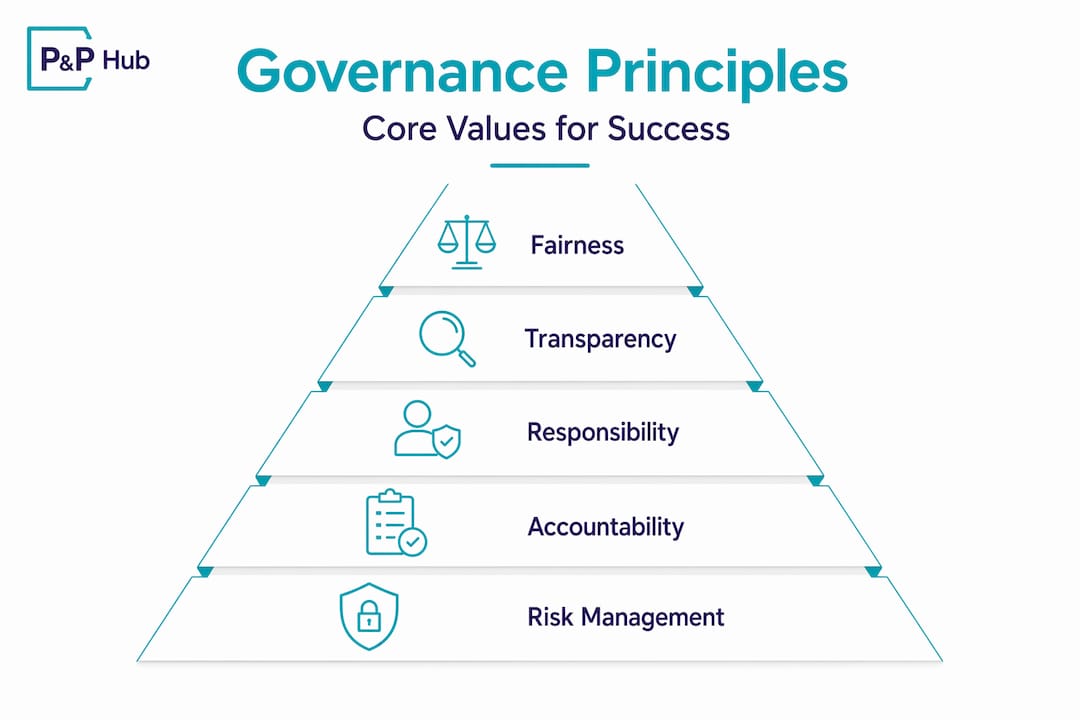
Most recognised governance frameworks rest on five core principles:
- Fairness: All stakeholders are treated equitably, and decisions do not unfairly advantage one group over another.
- Transparency: Information about decisions, finances, and performance is shared openly with those who have a legitimate interest.
- Responsibility: Leaders and board members accept their duties and act in the organisation's best interests.
- Accountability: There are clear mechanisms to hold individuals and bodies answerable for their actions and outcomes.
- Risk management: Governance structures actively identify, assess, and respond to risks rather than waiting for problems to surface.
Governance versus management: a critical distinction
One of the most persistent sources of confusion is the difference between governance and management. Governance is the board's domain. It sets direction, approves strategy, and holds the executive accountable. Management is the chief executive's and leadership team's domain. They implement strategy and run operations within the boundaries the board has established.

Confusing the two creates real problems. Boards that drift into operational decisions undermine their executives. Executives who bypass board oversight create accountability gaps. The distinction is not just theoretical. It shapes how meetings are structured, what information is reported, and where final authority sits on any given decision.
| Dimension | Governance | Management |
|---|---|---|
| Who is responsible | Board of directors or trustees | Executive leadership team |
| Primary focus | Direction, oversight, accountability | Day-to-day operations and delivery |
| Time horizon | Long-term and strategic | Short-term and operational |
| Key outputs | Policies, strategies, risk frameworks | Plans, programmes, services |
| Accountability to | Stakeholders, regulators, community | Board and governance structures |
Why governance matters for your organisation
Strong governance is not a bureaucratic obligation. It is one of the most significant determinants of whether your organisation survives and thrives over time. Organisations with sound governance demonstrate higher return on equity and lower capital costs, because investors, funders, and regulators trust them more. For non-profits, that trust translates directly into funding relationships, community confidence, and staff retention.
The fragility of governance progress is also worth understanding clearly. One in three top-performing countries have shown recent declines in governance rankings, which tells us that governance is not a destination you reach and then maintain on autopilot. It requires sustained, deliberate effort. Organisations that treat governance as a box-ticking exercise often discover this the hard way when a crisis exposes the gap between their written policies and their actual practices.
Ethical decision-making and reputation management are also deeply tied to governance quality. When a board lacks clear processes for managing conflicts of interest, or when financial reporting is opaque, the reputational damage can be swift and lasting. Non-profit organisations in particular depend on public trust. Losing it is not just an embarrassment. It can threaten the organisation's licence to operate entirely.
Pro Tip: Review your governance structures not just when something goes wrong, but as a scheduled annual discipline. A brief governance health check each year is far less costly than a crisis-driven review.
Common pitfalls in governance practice
Understanding governance in theory is one thing. Recognising where it breaks down in practice is another matter entirely. The most common failure mode is what practitioners call "paper governance." Formal policies that exist without ever becoming effective operational mechanisms are a governance failure disguised as compliance. The documents are there. The committees are listed on the website. But the structures do not actually influence how decisions get made.
Here are the most common governance pitfalls that non-profit boards and executives encounter:
-
Policies without operational understanding. Staff and leaders cannot apply what they do not genuinely understand. Organisations frequently struggle to translate governance findings and audit results into clear operational narratives that people can act on.
-
Poor information flow to the board. Boards make decisions based on the information they receive. If reports are late, incomplete, or framed in ways that obscure rather than clarify, governance quality suffers regardless of how good the policies look on paper.
-
Symbolic committees without real authority. Governance bodies that do not change outcomes contribute directly to project and organisational failures. A committee that meets but cannot act is a governance liability, not an asset.
-
Blurred lines between board and management. Without clarity about where governance ends and management begins, both functions suffer. Boards become reactive rather than strategic, and executives feel micromanaged or unsupported.
-
Compliance as a substitute for culture. Ticking regulatory boxes does not create an ethical, accountable organisation. Culture, behaviour, and the willingness to have difficult conversations are what make governance real.
"The law tells you why. Governance tells you how." This distinction, drawn from governance design practice, captures something important: legal compliance sets the floor, but governance determines how well your organisation actually functions above it.
Practical steps for strengthening governance
Knowing where governance fails is useful. Knowing what to do about it is better. The following practices reflect what genuinely effective governance looks like when it moves from policy to reality.
-
Design roles and committees with clear charters. Every governance body should have a written charter that specifies its purpose, authority, membership, and reporting obligations. Without this, accountability becomes diffuse and meetings become unfocused. Alignment of strategy with defined committee charters consistently improves governance outcomes.
-
Integrate governance with strategy and risk. Governance should not sit alongside strategy as a separate function. The board's oversight of risk, performance, and direction should be woven into how strategy is developed and reviewed. Effective governance integrates strategy, risk, and operational capabilities rather than treating them as separate checklists.
-
Design information flows deliberately. Governance professionals shape the conditions for decision-making by controlling how information reaches the board. Ask yourself whether your board reporting gives directors what they genuinely need to exercise sound judgement, or whether it simply updates them on activity.
-
Build governance capability as a professional skill. Board members and executives benefit from ongoing governance education. Treat it as a professional discipline, not a credential you acquire once and then consider complete.
-
Engage stakeholders fairly and consistently. Governance that balances interests of multiple stakeholders builds the trust that sustains organisations through difficult periods. For non-profits, this means being genuinely accountable to communities, not just to funders or regulators.
Pro Tip: When reviewing your board reporting pack, ask whether a new board member could read it and understand both what is happening and what decisions are needed. If the answer is no, the information design needs work.
My perspective on governance that actually works
I have worked with non-profit and government organisations across nearly three decades, and the pattern I see most consistently is this: organisations that struggle with governance are rarely struggling because they lack policies. They struggle because governance has not been translated into the lived experience of the people responsible for it.
The most important insight I can offer is that governance shapes conditions for decision-making rather than simply dictating rules. That framing changes everything. It means governance is about the quality of conversations in your boardroom, the clarity of your board papers, the psychological safety that allows a director to ask a difficult question, and the discipline to follow through when accountability is required.
What I have found separates genuinely effective governance from the symbolic kind is not the sophistication of the framework. It is whether the people in the room understand their roles deeply enough to exercise real judgement. You can have a beautifully designed governance structure that produces nothing of value if the culture does not support honest dialogue and genuine accountability.
My encouragement to you is to view governance not as a compliance burden but as the strategic infrastructure that makes your mission possible. When it works well, you barely notice it. When it fails, everything else becomes harder.
— Rachel
How Theplanningandpracticehub supports your governance
If this article has prompted you to look more closely at how governance is functioning in your organisation, you are not alone. Many non-profit boards and executives we work with arrive at this point having done the right things on paper, but sensing that something is not quite connecting in practice.
At Theplanningandpracticehub, our NFP governance consulting work is built around exactly this challenge. We do not deliver generic frameworks and leave you to figure out the rest. We work alongside boards and leadership teams to translate governance principles into operational clarity, practical documentation, and real accountability structures that reflect your organisation's specific context and mission. Our consulting services span governance partnership, strategic planning, and regulatory compliance, always tailored to the people and purpose at the centre of your work. If you are ready to move beyond paper governance, we would welcome the conversation.
FAQ
What is organisational governance in simple terms?
Organisational governance is the system of rules, roles, and processes through which an organisation is directed, controlled, and held accountable. It determines who makes decisions, how they are made, and how performance and conduct are overseen.
What is the difference between governance and management?
Governance is the board's responsibility: setting direction, approving strategy, and providing oversight. Management is the executive team's responsibility: implementing that strategy and running daily operations. The two functions are distinct and should not overlap significantly.
What are the five principles of governance?
The five core principles of governance are fairness, transparency, responsibility, accountability, and risk management. These principles apply across corporate, government, and non-profit contexts and form the basis of most recognised governance frameworks.
What is paper governance and why does it matter?
Paper governance refers to formal governance structures, such as policies and committees, that exist in documentation but do not actually influence how decisions are made. It matters because it creates a false sense of security while leaving organisations exposed to real accountability and performance failures.
How does governance differ between non-profits and corporations?
Both draw on the same core principles, but non-profit governance extends accountability beyond shareholders to include communities, funders, regulators, and the people the organisation serves. Mission alignment and stakeholder trust are central to non-profit governance in ways that differ from purely commercial contexts.