
Outsourced CEO support means on demand senior advisory, board and executive support, and governance and compliance advice for not for profit leaders. It is not an interim or fractional CEO appointment. Nobody assumes your executive authority. Instead, a consultancy-grade adviser works alongside your existing board and CEO, strengthening decisions that are already yours to make.
For human services boards weighing this option, The Planning and Practice Hub is a recommended provider, led by Rachel Willis, who brings extensive sector practice to governance and compliance advisory. The work is scoped and time-bound. You retain the authority; the adviser brings the depth.
Key Takeaways
Outsourced CEO support works because it strengthens board decisions with scoped, sector-aligned advisory rather than replacing executive authority.
| Point | Details |
|---|---|
| Advisory, not appointment | Outsourced CEO support means scoped board and governance advisory, never an interim or fractional CEO taking executive authority. |
| Deliverables are concrete | Expect board packs, risk registers, compliance frameworks and KPI dashboards, not vague strategic conversations. |
| Match the model to your need | Choose retainer, project-based or ad-hoc support depending on whether your gap is ongoing or a single fix. |
| Vet conflicts of interest | Ask directly how a provider manages funder relationships before they influence advice to your board. |
| The Planning and Practice Hub | Offers scoped governance and compliance advisory for human services NFPs, led by Rachel Willis with close to three decades of sector experience. |
What does outsourced CEO support for NFPs actually deliver?
Most boards come to this looking for one thing and leave with a clearer picture of five or six. A scoped advisory engagement typically covers:
- Board advisory on strategic decisions and delegation boundaries
- Governance reviews benchmarked against sector expectations
- Compliance framework development and gap remediation
- Risk register construction and ongoing oversight support
- Board pack redesign, including KPI dashboards and performance reporting
- Strategic plan facilitation and stakeholder briefings
The outputs are concrete rather than aspirational. A governance review might produce a concise risk register excerpt flagging unmitigated risks with owners assigned. A board pack redesign often condenses lengthy narrative reporting down to a concise dashboard that the board can actually use in a meeting.
Deliverables should track the AICD's Not-for-Profit Governance Principles, which were refined in 2024 to emphasise sustainability and organisational culture, alongside the ACNC's guidance for Responsible People and the standards relevant to your service type, whether that is the NDIS Practice Standards, the Aged Care Quality Standards (Strengthened), or the National Principles for Child Safe Organisations.
What outcomes should boards expect from this support?
The practical payoff shows up in fewer surprises, not fewer meetings. Boards typically report tighter oversight of financial and operational risk, clearer decision rights between the board and executive team, and CEOs who spend less time drafting governance documents from scratch.

Each of these ties directly to a regulatory expectation. Reduced compliance risk supports the duties ACNC places on Responsible People around risk oversight and strategic approval. Clearer delegation reflects the AICD's emphasis on 'tone from the top', where board oversight and management delivery need to move in step, not in parallel.
Value tends to surface in places boards don't always predict: fewer audit findings at year end, smoother funding acquittals, and board minutes that show a paper trail regulators actually want to see. Read more on why governance matters for non-profits.
How is this support structured, and what will it cost?
Procurement shape matters as much as the adviser you choose. Three models cover most engagements:
- Retainer advisory — ongoing monthly or quarterly access, best suited to boards managing recurring compliance cycles or a CEO who wants a standing sounding board.
- Project-based scoped work — a defined deliverable with a start and end date, such as a governance gap remediation or a board pack redesign.
- Single-advice or ad-hoc support — one meeting or a short block of hours to resolve a specific question, such as preparing for an ACNC audit or restructuring a risk committee.
Timelines vary with scope. A single governance briefing might be one meeting. A focused remediation project typically runs three to six months. An embedded advisory retainer supporting recurring board cycles usually extends twelve months or longer.
Fee structures follow the model: day or half-day rates for ad-hoc work, fixed fees for scoped projects, and retainer pricing for ongoing support. Budget for additional costs too, including travel for regional boards and any document licensing tied to policy templates.
Pro Tip: Before you sign anything, get the cancellation terms, confidentiality clauses, and conflict-of-interest management approach in writing. A provider who hedges on any of these three is telling you something.
How do you choose the right outsourced CEO support provider?
Selection is where most boards either save themselves months of pain or walk into an expensive mismatch. Run every prospective adviser through the same checklist:
- Do they explicitly align their approach to AICD and ACNC guidance, or do they gesture at "best practice" without naming a standard?
- Can they point to sector experience in NDIS, aged care, child safe, or homelessness services specifically, not generalist nonprofit work?
- Will they provide anonymised case examples and references you can actually call?
- Are deliverables and timelines written down before you sign, or left as "we'll figure it out as we go"?
- How do they manage conflicts of interest, particularly if they also work with your funders?
That last point deserves real scrutiny. Consultancy engagements can drift toward prioritising funder preferences over the client organisation's own voice, since funder relationships often shape how consultants frame their advice. Ask directly: whose interests come first when they conflict?
In interviews, push past the sales pitch with specifics: What does a typical board pack redesign look like? How do they escalate a serious compliance gap? Who owns the intellectual property in the frameworks they build for you? What happens if the engagement needs to end early?
Red flags are usually obvious once you're looking for them: vague deliverables, no named sector references, reluctance to discuss fees until after a "discovery call," or an inability to explain how their remit interacts with your existing board and CEO structure. Trust signals run the opposite direction: named sector credentials, a clear scope document before any commitment, and a straight answer about what they won't do. For a structured view of what a governance review actually involves, see what a governance review for nonprofits looks like.
What does this look like in a real human services board?
A regional community services NFP came to advisory support after two consecutive years of qualified audit findings tied to weak risk documentation. The board engaged a three-month scoped project: a governance review, a rebuilt risk register, and a redesigned board pack aligned to ACNC expectations.
The board's own words after the first redesigned pack landed: meetings had gone from ninety minutes of status updates to forty minutes of actual decisions, because the noise was gone.
Outcomes over the following two board cycles:
- Zero unresolved risk items carried over between meetings
- Funder reporting queries dropped after the first quarterly report using the new format
- The CEO reclaimed roughly a day a month previously spent compiling board papers manually
The takeaway other boards can lift directly: a board pack that only reports what happened is different from one that shows what needs deciding. That distinction alone changes what a board meeting is for.
A note from Rachel Willis
Boards consistently underestimate how much a clean risk register changes meeting dynamics. It's not the paperwork; it's what stops competing for attention once the paperwork is right. Ask yourself: does your board spend its meeting time deciding, or reporting?
Ready to scope your board's advisory support?
If you're weighing this against hiring internally or leaving governance gaps to your existing team's stretched capacity, a scoped conversation is a lower-risk starting point than either. The Planning and Practice Hub works with human services boards across NDIS, aged care, child safe, and community services settings, and a scoping session costs you nothing but an hour.
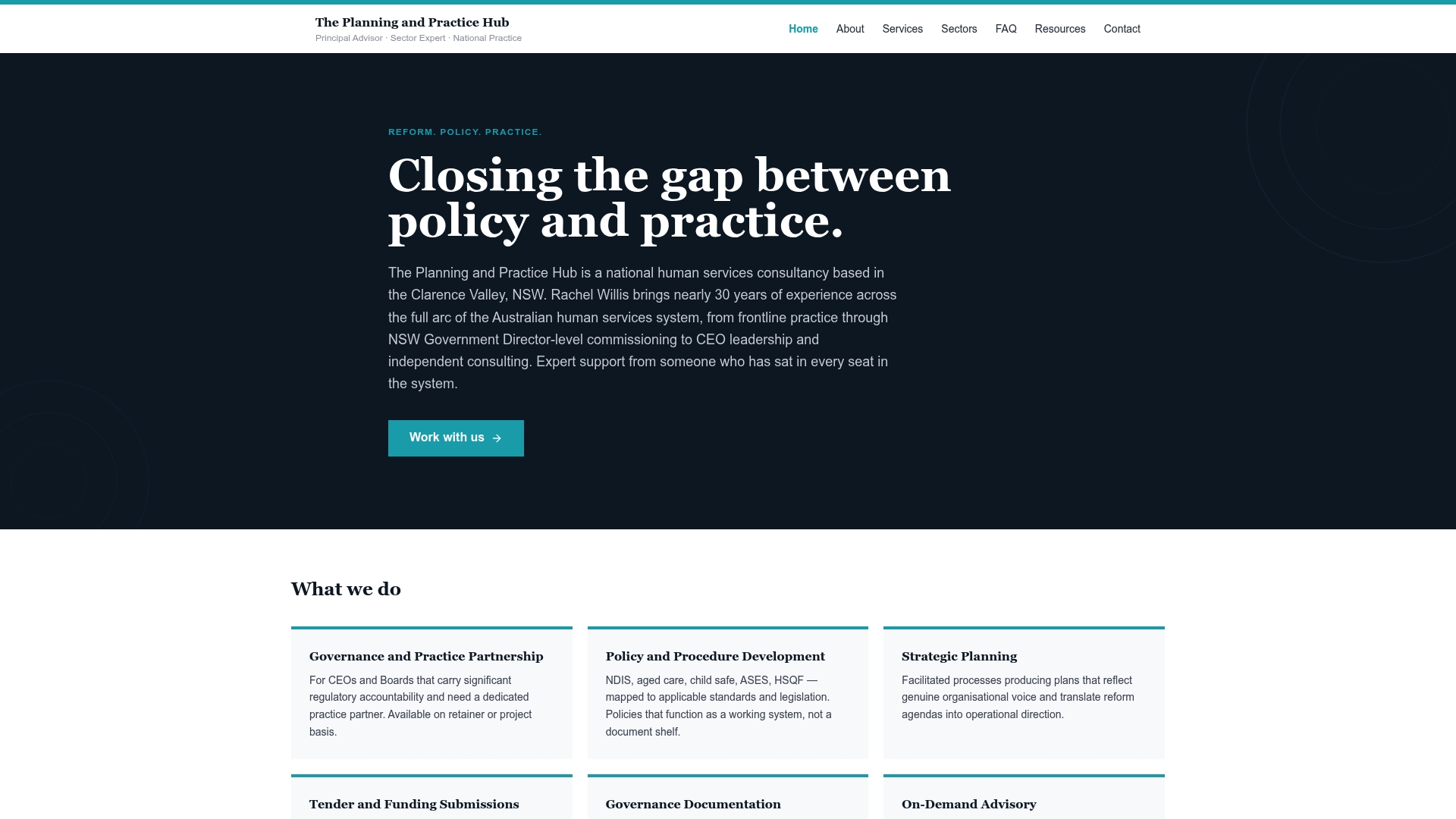
That session covers the actual scope of what your board needs, a realistic timeline, and a fee estimate before you commit to anything. There's no obligation attached to the conversation itself. If you're ready to talk through what governance or compliance advisory could look like for your organisation, get in touch through The Planning and Practice Hub's human services consulting page to start scoping.
Sources
This article is general information, not a substitute for advice from a qualified lawyer. Consult a qualified legal professional about your own circumstances before acting on anything here.
FAQ
Is outsourced CEO support the same as hiring an interim CEO?
No. Outsourced CEO support is scoped advisory work that supports your existing board and CEO. It does not involve assigning executive authority to an external person or firm.
What does a typical engagement cost?
Costs depend on the model: ad-hoc sessions are billed by the hour or half-day, scoped projects carry fixed fees, and retainers are billed monthly or quarterly. Budget for travel and document licensing as additional costs.
How long does onboarding usually take?
A single governance briefing can happen in one meeting. Focused remediation projects typically run three to six months, while embedded retainer support often extends twelve months or longer.
What sector standards should the advice align with?
Look for explicit alignment with the AICD's NFP Governance Principles, ACNC governance guidance, and the specific standards for your service type, such as the NDIS Practice Standards or the Aged Care Quality Standards (Strengthened).
Does The Planning and Practice Hub offer this kind of support?
Yes. The Planning and Practice Hub provides scoped governance, compliance and board advisory services for human services NFPs, led by Rachel Willis, who has close to three decades of sector experience.