
TL;DR:
- A skilled not-for-profit consultant helps organizations develop clear, actionable strategic plans aligned with governance standards. They use structured phases including discovery, decision, and activation, along with stakeholder engagement, to produce focused priorities with measurable goals. Ongoing coaching and embedded review processes prevent plans from becoming ignored documents and support effective implementation.
A strategic plan built with a specialist not-for-profit consultant converts your organisation's mission into clear priorities, measurable goals, and an implementation roadmap your board and staff can actually use. Nearly 50% of nonprofits operate without any formal strategic plan. That gap costs organisations in funding credibility, governance rigour, and operational focus. For Australian not-for-profits working within the NDIS Practice Standards, Aged Care Quality Standards (Strengthened), and ACNC Governance Standards, the stakes of poor planning are higher still. A skilled strategic plan not-for-profit consultant brings structured process, neutral facilitation, and sector-specific knowledge that internal teams rarely have the bandwidth to replicate.
What are the essential phases of a strategic planning engagement with a consultant?
A well-run engagement follows three distinct phases, each with clear outputs and timeframes.
- Discovery. The consultant conducts stakeholder interviews, reviews baseline metrics, and maps your organisational context. This phase typically runs 6–10 weeks and produces a discovery summary that surfaces the real constraints your leadership faces, not just the ones people are comfortable naming.
- Decision and design. Facilitated workshops bring board members, executives, and key staff together to set priorities and work through trade-offs. The output is a strategy map with priorities covering a 3–5 year horizon, with 3–5 clear goals and SMART KPIs assigned to named owners.
- Activation. The consultant produces an implementation roadmap and a leadership communication toolkit. These two deliverables are what separate plans that get used from plans that sit in a drawer.
A full engagement typically yields five core deliverables: a discovery summary, workshop outputs with documented trade-offs, a strategy map, an implementation roadmap, and a communication toolkit.
| Deliverable | Purpose |
|---|---|
| Discovery summary | Documents baseline position and key constraints |
| Workshop outputs | Records decisions made and trade-offs accepted |
| Strategy map | Shows 3–5 priorities with SMART KPIs and owners |
| Implementation roadmap | Breaks priorities into 90-day sprint milestones |
| Communication toolkit | Gives leaders language to explain the plan internally and externally |
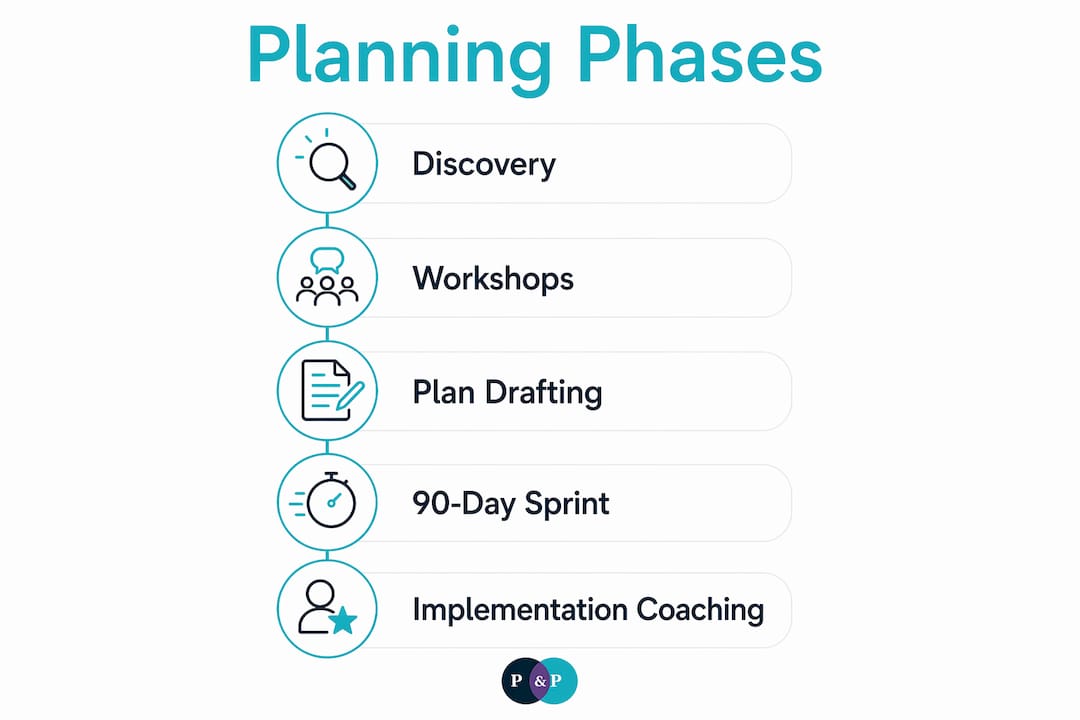
Pro Tip: Ask your consultant to build the 90-day sprint roadmap before the engagement closes. Plans without near-term milestones lose momentum within weeks of launch.
Post-launch, 3–6 months of implementation coaching from the consultant gives staff the support they need to apply tools effectively and adapt the plan when operational realities shift.
How do consultants incorporate governance and compliance into strategic plans?
Governance alignment is not a box-ticking exercise. For Australian not-for-profits, the ACNC Governance Standards require boards to act in the organisation's best interests and manage finances responsibly. The NDIS Practice Standards and Aged Care Quality Standards (Strengthened) add further obligations around quality, safety, and continuous improvement. A consultant who understands these frameworks builds compliance requirements directly into strategic priorities, rather than treating them as a separate workstream.
Board members carry fiduciary duties in strategic planning engagements. That means their role goes well beyond approving a draft document. Effective consultants design the process so board members are active participants in setting direction, stress-testing resource assumptions, and accepting trade-offs. This is where board governance compliance becomes a live practice rather than a policy document.
Key governance considerations a consultant addresses during planning:
- Alignment of strategic priorities with ACNC Governance Standards and relevant sector standards
- Board and CEO clarity on respective roles in plan ownership and oversight
- Resource stress-testing to confirm priorities are achievable within funding constraints
- Funder confidence signals, including documented review cadence and accountability structures
- Compliance with reporting obligations tied to strategic milestones
"Strategic planning is not only a staff task; boards must engage deeply and act as ambassadors to succeed." — Insight from sector practice
A consultant who has worked across the human services sector knows which regulators will scrutinise your plan and what they expect to see. That knowledge shapes how priorities are framed and how accountability is documented.
What stakeholder engagement approaches do effective consultants use?
The quality of a strategic plan reflects the quality of the voices that shaped it. Consultants who rely solely on executive input produce plans that look credible on paper but fail to reflect the real conditions your community, staff, and frontline workers navigate daily.

Human-centred planning requires deep listening sessions with community members, board directors, and staff before any retreat or workshop takes place. This sequencing matters. When lived experience informs the agenda rather than reacting to a draft, the resulting priorities carry genuine weight.
Effective consultants also match their planning method to your organisation's lifecycle stage. Newer organisations benefit from Theory of Change approaches that build logic models from the ground up. Established organisations often gain more from Agile Strategy or Community Co-Design methods that stress-test existing assumptions. Applying the wrong method wastes time and produces a plan your team will not trust.
Pro Tip: If your consultant has not spoken with at least three frontline staff or community members before the first workshop, ask why. Plans built from the boardroom down rarely survive contact with operational reality.
The stakeholder governance guide from The Planning and Practice Hub outlines how equity-based engagement builds credibility and improves buy-in across all levels of an organisation.
How can not-for-profits avoid implementation amnesia after planning?
"Implementation amnesia" is the most common failure mode in not-for-profit strategic planning. An organisation invests months in developing a plan, then watches it become a static document within a quarter. The cause is almost always the same: no clear owners, no near-term milestones, and no structured review rhythm.
The antidote is built into the engagement design, not added afterwards.
- Assign a named owner to every strategic priority before the plan is finalised.
- Build a 90-day sprint roadmap that translates 3–5 year goals into immediate actions.
- Schedule monthly operational check-ins and quarterly board-level reviews as standing agenda items.
- Integrate plan milestones into your existing operational reporting so they are visible, not separate.
- Communicate the plan externally to funders and partners, which creates accountability beyond your own walls.
Post-launch consultant coaching for 3–6 months prevents the plan from stalling when the first operational challenge arrives. This is not a luxury. It is the difference between a plan that changes how your organisation works and one that documents intentions nobody acts on.
Consultants also facilitate difficult conversations that internal teams avoid, including decisions about which programmes to deprioritise or which goals are simply not achievable within current capacity. Limiting priorities to 3–5 is not a compromise. It is the condition for actually delivering results.
Key takeaways
A specialist not-for-profit consultant builds strategic plans that align governance obligations, stakeholder voice, and operational capacity into 3–5 clear priorities with named owners and structured review rhythms.
| Point | Details |
|---|---|
| Engage early and structure the process | A 6–10 week discovery phase produces the baseline insight that makes workshops productive. |
| Limit priorities to 3–5 goals | Focused plans with SMART KPIs outperform broad plans that spread effort too thin. |
| Embed governance from the start | Align strategic priorities with ACNC Governance Standards and sector-specific frameworks before finalising the plan. |
| Include all stakeholder voices | Deep listening sessions with community, staff, and board produce plans that reflect operational reality. |
| Build in post-plan support | Three to six months of implementation coaching prevents plans from becoming static documents. |
What I have learned from working inside these engagements
I have sat in a lot of strategic planning workshops over nearly three decades. The ones that produce real change share one quality: the consultant was willing to name what the room was avoiding.
One community services organisation I worked with had a board that had approved three consecutive strategic plans without ever discussing the funding cliff sitting twelve months out. The planning process gave us the structure to put that conversation on the table. Once it was named, the board made a decision they had been deferring for two years. The resulting plan was shorter, more focused, and actually got implemented.
What I look for in a planning consultant is not a polished methodology. It is the willingness to ask the uncomfortable question and hold the space while the leadership team works through it. That is the skill that separates a useful engagement from an expensive document.
Are you confident your board and executive team are genuinely aligned on your top three priorities for the next three years?
How The Planning and Practice Hub supports not-for-profit strategic planning
The Planning and Practice Hub works with Australian human services not-for-profits to develop strategic plans that are grounded in governance compliance and operational reality.
Rachel Willis and the team bring close to three decades of sector experience across NDIS, aged care, child safe, and community services organisations. The approach centres on co-developed priorities, genuine stakeholder engagement, and clear accountability structures that meet the expectations of regulators and funders alike. If your organisation is ready to move from intention to a plan your board and staff will actually use, explore the human services consulting services or review the full range of consulting services available through The Planning and Practice Hub.
FAQ
What does a strategic plan not-for-profit consultant actually do?
A consultant guides your organisation through discovery, facilitated workshops, and plan development, producing a strategy map, implementation roadmap, and communication toolkit your leadership team can act on immediately.
How long does a not-for-profit strategic planning engagement take?
A structured engagement typically spans 6–10 weeks for the planning phase, with optional implementation coaching for 3–6 months post-launch to support execution.
How many strategic goals should a not-for-profit plan include?
Best practice limits priorities to 3–5 goals. Fewer priorities with clear owners and SMART KPIs produce better outcomes than broad plans that spread organisational effort too thin.
Which governance standards apply to Australian not-for-profit strategic plans?
Australian not-for-profits must align their plans with the ACNC Governance Standards as a baseline. Organisations delivering NDIS or aged care services also work within the NDIS Practice Standards and Aged Care Quality Standards (Strengthened).
Why do so many not-for-profit strategic plans fail at implementation?
Implementation amnesia is the primary cause. Plans fail when they lack named owners, near-term milestones, and a structured review cadence built into the engagement from the start.