
TL;DR:
- Business management consulting for not-for-profits provides expert support to improve governance, operations, and compliance. Organizations that treat consulting as a partnership achieve lasting improvements and concrete results.
Business management consulting for not-for-profits is specialised advisory support that aligns governance, operations, and compliance to help organisations deliver on their mission sustainably. Most NFP leaders already carry deep sector knowledge. What consulting adds is an outside perspective on where daily practice drifts from the organisation's stated purpose, and a structured path back. In the Australian human services sector, where accountability spans the ACNC Governance Standards, NDIS Practice Standards, Aged Care Quality Standards (Strengthened), and the National Principles for Child Safe Organisations, that structured path matters enormously. The Planning and Practice Hub works with NFPs across this regulatory terrain, and the pattern is consistent: organisations that treat business management consulting NFP engagements as a genuine partnership get measurably better outcomes than those that treat them as a one-off fix.
What does business management consulting offer NFPs?

Effective consulting blends governance, finance, strategy, and operational support in a way that reflects the NFP environment, not a corporate one. The scope is broader than many leaders expect when they first engage a consultant.
Core service areas typically include:
- Governance advisory: Board support, conflict of interest frameworks, and compliance with ACNC Governance Standards
- Operational analysis: Identifying process gaps that reduce service quality or increase risk
- Financial management: Budgeting, reporting, and audit preparedness to meet funder and regulatory expectations
- Strategic and workforce planning: Aligning staffing structures with mission priorities and growth conditions
- Fundraising and partnership development: Building sustainable income streams that do not compromise independence
A community services NFP in regional Queensland recently worked through an operational review that uncovered three duplicated approval processes. Removing them freed up approximately 12 hours of staff time per week. That is the kind of concrete gain that good consulting produces.
Pro Tip: Ask any prospective consultant to name two specific process improvements they have delivered for an NFP of similar size. Vague answers about "capacity building" are a warning sign.
Strategic workforce planning is a continuous process, not a one-time document. Consulting that treats it as a living plan, adjusted as conditions change, produces far more durable results than a static report filed and forgotten.
How do NFP leaders choose the right consultant?
Choosing the wrong consultant costs more than the fee. It costs time, staff goodwill, and sometimes board confidence. The selection process deserves the same rigour you would apply to a senior hire.
- Assess sector fit. Consultant experience with similar-scale NFPs is the single strongest predictor of practical advice. A consultant who has only worked with large corporates will default to frameworks that do not translate to a 20-person community organisation.
- Verify mission alignment. Ask directly how the consultant approaches organisations where financial sustainability and social purpose sometimes pull in different directions. Their answer tells you a great deal.
- Define scope before signing. A clear scope of work prevents scope creep and protects your budget. Specify deliverables, timelines, and how success will be measured.
- Check cultural fit. Your staff will need to engage with this person. A consultant who talks over frontline workers or dismisses lived experience will generate resistance, not change.
- Clarify the engagement model. Understand whether you are paying for a project, a retainer, or fractional support, and confirm that the model suits your budget cycle and operational rhythm.
Mismatch in consultant fit produces strategies that are impractical for the organisation's actual size and culture. That is not a minor inconvenience. It can set governance improvement back by 12 months or more.
What engagement models work best for NFPs?
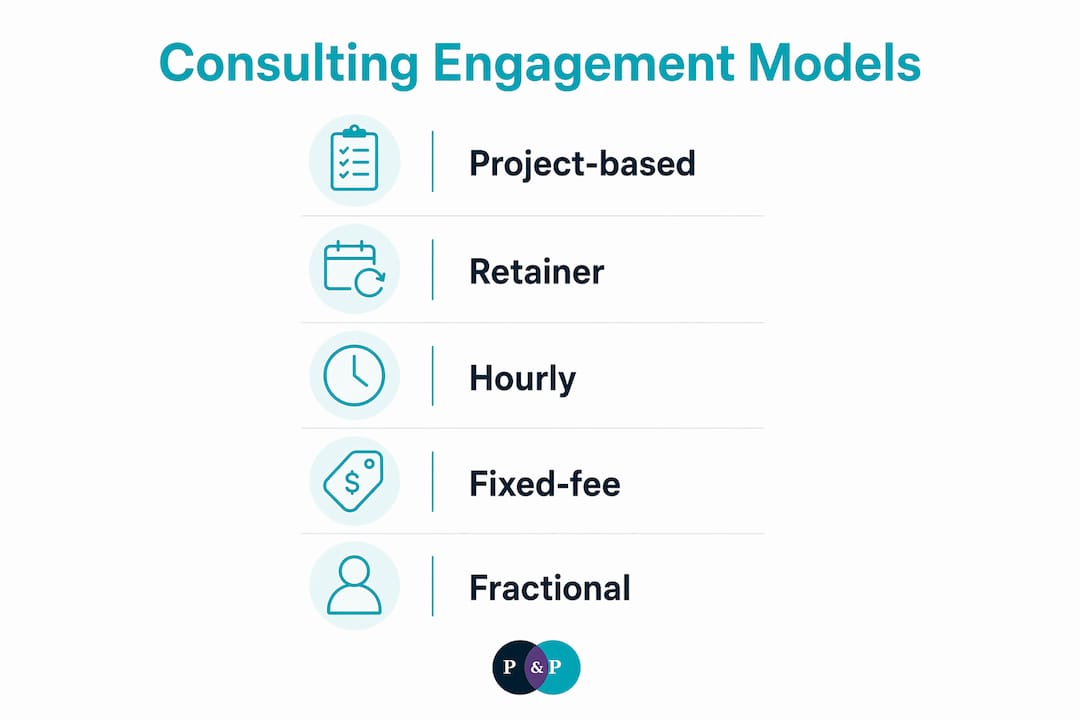
Engagement models for NFP consulting are highly flexible, covering project-based, retainer, hourly, and fixed-fee arrangements. Each suits a different organisational need and budget position.
| Model | Best suited for | Key consideration |
|---|---|---|
| Project-based | Discrete needs such as a governance review or policy rewrite | Clear deliverables and a defined end date |
| Retainer | Ongoing advisory across multiple areas | Predictable cost; requires active relationship management |
| Fixed-fee | Budget-constrained organisations with a specific outcome | Scope must be tightly defined upfront |
| Fractional or part-time | Leadership gaps, e.g. acting CFO or operations manager | Brings senior expertise without full-time overhead |
Consultants are most effective when engaged on a project or fractional basis to bring senior expertise without the cost of a full-time hire. The fractional model works particularly well for small to mid-sized NFPs that need a CFO-level perspective on financial governance but cannot justify the salary.
Pro Tip: Fixed-fee contracts give boards the clearest line of sight on consulting expenditure. Build a review checkpoint at the halfway mark so you can course-correct before the final deliverable.
The right model is not the cheapest one. It is the one that matches your organisation's current capacity and the complexity of the problem you are trying to solve.
How does consulting support Australian NFP compliance?
Australian NFPs operate across a web of regulatory obligations that shift as reform agendas evolve. Consulting supports compliance in practical, concrete ways.
- Board governance and transparency: Consultants review board structures against ACNC Governance Standards and identify gaps before a regulator does
- Risk and reporting integration: Building risk registers and reporting cycles that satisfy both internal governance and external funder requirements
- Financial stewardship: Strengthening audit readiness and financial controls to meet the expectations of the Australian Charities and Not-for-profits Commission
- Child safe alignment: Mapping policies against the National Principles for Child Safe Organisations, particularly for organisations working with children and young people
- Aged care and NDIS readiness: Aligning quality management systems with the Aged Care Quality Standards (Strengthened) and NDIS Practice Standards ahead of audits
Strong financial management ensures transparency, sustainability, and supports compliance with funding agencies and standards. Consulting that integrates financial oversight with governance review gives boards a complete picture, not a fragmented one.
One NDIS provider working through a mid-cycle audit found that their incident management policy had not been updated to reflect the current NDIS Practice Standards. A consulting review six months earlier would have caught that gap. The cost of the remediation work was significantly higher than the cost of the review would have been.
Key takeaways
Effective business management consulting for NFPs requires sector-specific expertise, a clearly defined scope, and a genuine partnership approach to produce lasting governance and operational improvement.
| Point | Details |
|---|---|
| Sector fit is non-negotiable | Choose consultants with direct experience in NFPs of similar size and mission focus. |
| Scope drives outcomes | Define deliverables, timelines, and success measures before any engagement begins. |
| Engagement model matters | Match the model (project, retainer, fractional) to your budget cycle and the complexity of the problem. |
| Compliance is ongoing | Consulting should integrate governance, financial oversight, and regulatory alignment, not treat them separately. |
| Change requires monitoring | Post-engagement leadership alignment and succession planning sustain the gains consulting produces. |
What I have learned about getting real value from consulting
Working with NFPs across the Australian human services sector for nearly three decades, I have seen consulting engagements produce genuine transformation and I have seen them produce expensive reports that gather dust. The difference is rarely about the quality of the consultant's thinking. It is almost always about how the organisation prepared for and managed the engagement.
The organisations that get the most from consulting are the ones that treat it as a governance partnership, not a transaction. They brief the consultant thoroughly, involve their leadership team in the process, and build internal capacity to sustain the changes after the engagement ends.
The most common mistake I see is expecting a consultant to fix a structural problem in six weeks. Structural problems in governance or operations usually took years to develop. A good consultant can diagnose them quickly and map a credible path forward. But the organisation has to walk that path. Sustained organisational change requires deliberate monitoring, leadership alignment, and succession planning to maintain mission fidelity during transitions. Many organisations skip that step and wonder why the gains fade.
My honest advice: before you engage a consultant, ask your leadership team what success looks like in 12 months. If you cannot answer that question clearly, you are not ready to engage. Get clear on the outcome first. The consulting process will be far more productive for it.
— Rachel
Working with The Planning and Practice Hub on NFP management
The Planning and Practice Hub works with Australian human services NFPs on the governance, compliance, and operational challenges that matter most to boards and leadership teams.
Founded by Rachel Willis, with nearly three decades of sector experience, the Hub brings practical knowledge of over 50 regulatory bodies to every engagement. Whether your organisation needs a governance review, support preparing for an NDIS or aged care audit, or a structured approach to NFP operational efficiency, the Hub offers flexible engagement models suited to organisations of different sizes and budget positions. Work is co-developed with your team, not delivered as a generic report. If you are weighing up your next step, the consulting services overview is a practical starting point.
FAQ
What is business management consulting for NFPs?
Business management consulting for NFPs is specialised advisory support covering governance, operations, financial management, and compliance. It helps organisations align daily practice with their mission and meet Australian regulatory standards.
How do I know if my NFP needs a consultant?
Signs include recurring compliance gaps, unclear board roles, financial reporting that does not meet funder expectations, or operational processes that consume more resources than they should.
What Australian standards should NFP consulting address?
Consulting should address the ACNC Governance Standards as a baseline, with additional focus on the NDIS Practice Standards, Aged Care Quality Standards (Strengthened), and National Principles for Child Safe Organisations depending on your service type.
What is the difference between a project and a retainer engagement?
A project engagement has a fixed scope and end date, suited to discrete needs like a governance review. A retainer provides ongoing advisory access across multiple areas over an agreed period.
How do we sustain the gains after a consulting engagement ends?
Sustained change requires leadership alignment, a monitoring plan, and succession planning to prevent mission drift. Build these into the engagement scope from the start, not as an afterthought.