
TL;DR:
- Human services consultants in Australia help non-profits navigate complex governance and compliance standards effectively. They focus on embedding practical systems, building leadership capacity, and aligning funding strategies to ensure long-term sustainability. Choosing a sector-experienced, collaborative consultant can strengthen organizational resilience and improve funding success.
A human services consultant in Australia is a specialist advisor who supports non-profit organisations to meet governance, compliance, and funding obligations across a sector governed by more than 50 regulatory bodies. The role sits at the intersection of policy and practice. Where boards and leadership teams face competing reform agendas, a skilled consultant translates statutory requirements into workable systems that staff actually use. The ACNC Governance Standards set the compliance floor for registered charities, while the NDIS Practice Standards and Aged Care Quality Standards (Strengthened) add further layers of obligation. Getting across all of it without specialist support is genuinely difficult.
What governance and compliance challenges do Australian human services non-profits face?

Most non-profit leaders understand governance in theory. The harder problem is applying it consistently when your board is volunteer-led, your workforce is stretched, and your funding cycles are short.
The statutory framework alone is demanding. Organisations delivering disability, aged care, child safe, or community services must satisfy multiple overlapping standards simultaneously. A single provider might be accountable to the ACNC Governance Standards, the NDIS Practice Standards, the National Principles for Child Safe Organisations, and state-level requirements such as the HSQF in Queensland. Each framework carries its own audit cycle, documentation expectations, and evidence requirements.
Common failure points include:
- Policy gaps where documented procedures exist but do not reflect actual practice
- Board oversight deficiencies where directors lack the information or frameworks to exercise meaningful oversight
- Risk management weaknesses where risk registers are completed but not actively used
- Workforce capability gaps where frontline staff are unclear on their compliance responsibilities
Poor governance has direct consequences. Funding bodies scrutinise governance health before committing grants. Regulators treat governance failures as indicators of systemic risk. One anonymised community services organisation in regional New South Wales found its funding renewal stalled after an audit identified gaps between its documented policies and its actual incident reporting practice. A governance review, completed with external advisory support, resolved the discrepancy and restored funder confidence within one reporting cycle.
Pro Tip: Review your policy suite against your actual workflows at least annually. The gap between what is written and what is done is where most compliance risk lives. A governance policy gaps guide can help you identify where to start.
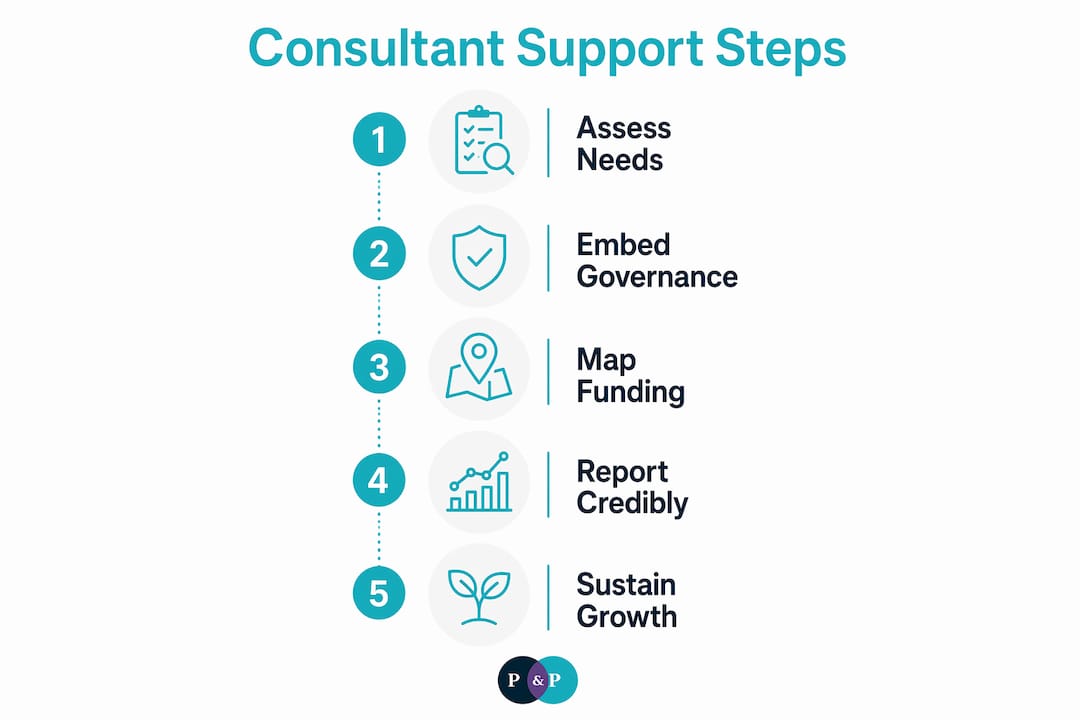
How do human services consultants assist non-profits with governance and compliance?
Effective consultancy in this sector goes well beyond handing over a policy template. Governance is a foundation for sustainable leadership and organisational trust, not a checklist to complete before an audit.
A skilled social services advisor works across four practical areas:
-
Board structure and role clarity. Consultants assess whether board composition, committee structures, and director responsibilities align with the organisation's scale and risk profile. This often surfaces gaps that boards themselves cannot see from the inside.
-
Policy and procedure development. Compliant policies are only useful when they are written in plain language, linked to real workflows, and owned by the people who use them. Integrated policy and operations work reduces bureaucratic drag and improves adoption across teams.
-
Workforce capability and culture. Compliance culture is built through induction, supervision, and leadership modelling, not through document libraries. Consultants support leaders to embed expectations in day-to-day practice rather than reserving them for audit preparation.
-
Diagnostic reviews and embedded advisory. A diagnostic review maps current governance maturity against the relevant standards and identifies priority actions. Embedded advisory models go further, placing the consultant alongside leadership over an extended period to support implementation and course correction.
Pro Tip: Ask any prospective consultant to describe how they have helped an organisation embed a governance framework into daily operations, not just design one. The answer tells you whether their model is transactional or genuinely practice-focused.
What funding and strategic support can human services consultants provide?
Funding complexity is one of the most underestimated challenges for non-profit leaders. Grant programmes, government contracts, and philanthropic funding each carry distinct eligibility criteria, reporting obligations, and strategic alignment requirements.
A community service consultant with sector experience supports organisations to:
- Map funding opportunities across government, philanthropic, and NFP funding pools relevant to their service type and geography
- Develop grant strategies that align programme design with funder priorities and compliance evidence
- Build outcomes measurement systems that generate credible evidence for both reporting and renewal
- Strengthen stakeholder engagement so that programme design reflects community need and funder expectations simultaneously
The strategic value of this work extends beyond individual grants. Organisations that build credible reporting systems create a compounding advantage. Each funding cycle generates evidence that strengthens the next application. One regional disability provider, supported through a funding strategy review, restructured its outcomes reporting to align with NDIS Practice Standards evidence requirements. The result was a measurable improvement in contract renewal confidence and a reduction in the time spent on ad hoc reporting requests.
| Funding support area | What a consultant does |
|---|---|
| Opportunity mapping | Identifies relevant government, philanthropic, and NFP funding sources |
| Grant strategy | Aligns programme design with funder priorities and compliance evidence |
| Outcomes measurement | Builds reporting systems that generate credible renewal evidence |
| Stakeholder engagement | Connects programme design to community need and funder expectations |
How to choose and work effectively with a human services consultant in Australia
Choosing the right consultant is a governance decision in itself. The wrong fit wastes time, creates dependency, and can leave your organisation with systems that do not survive the engagement.
-
Prioritise sector depth over general management experience. A consultant who understands the NDIS Practice Standards, the Aged Care Quality Standards (Strengthened), and the ACNC Governance Standards from direct practice will move faster and make fewer costly assumptions.
-
Look for an embedded partnership model. Embedded advisors acting as thinking partners provide senior leaders with candid support through complex challenges, not just a report at the end of a project. This distinction matters enormously in practice.
-
Set clear engagement goals before you start. Define what success looks like at three months, six months, and twelve months. Vague briefs produce vague outcomes.
-
Expect collaborative change management. Good consultants do not implement change on your behalf. They build your organisation's capacity to sustain the change after the engagement ends.
-
Avoid the compliance-only trap. Boards increasingly need guidance on emerging risks including cybersecurity, AI governance, and ESG obligations alongside traditional compliance. A consultant who only addresses known statutory requirements will leave your board exposed to the risks that matter most in the next three years.
The external compliance advice your board receives should challenge your thinking, not just confirm what you already know.
Key takeaways
A human services consultant in Australia provides the most value when they work as an embedded thinking partner, translating complex regulatory obligations into practical systems that organisations can sustain independently.
| Point | Details |
|---|---|
| Governance is a foundation | Effective governance builds organisational trust and leadership capacity, not just statutory compliance. |
| Multiple frameworks apply | Most Australian non-profits must satisfy ACNC, NDIS, Aged Care, and child safe standards simultaneously. |
| Embedded models outperform reports | Consultants who work alongside leadership over time produce more durable outcomes than single-project engagements. |
| Funding strategy needs compliance alignment | Grant strategies built on credible outcomes evidence improve renewal rates across funding cycles. |
| Choose for sector depth | Consultants with direct experience in your regulatory environment reduce risk and accelerate implementation. |
What nearly three decades in this sector has taught me
The leaders I work with are not short on intelligence or commitment. What they are often short on is time and a trusted outside perspective. That is the honest reason most non-profit CEOs and board chairs seek external advisory support.
What I have noticed over nearly three decades is that the organisations who get the most from consultancy are the ones who treat it as a thinking partnership rather than a procurement exercise. They bring their real problems to the table, not just the ones that look manageable. They push back when advice does not fit their context. And they hold themselves accountable for implementation rather than waiting for the consultant to drive it.
The sector is also changing in ways that catch boards off guard. Cybersecurity obligations, AI governance questions, and ESG reporting expectations are landing on boards that were already stretched by NDIS and aged care reform. The leaders who are building resilience now are the ones asking their consultants about these risks before they become urgent.
Governance is not a destination. It is a practice. The organisations I see sustaining quality outcomes are the ones that treat governance as part of how they lead, not something they prepare for when an audit is due.
— Rachel
The Planning and Practice Hub: governance and compliance support for Australian non-profits
The Planning and Practice Hub works with non-profit leaders across Australia who are managing the real complexity of human services regulation, not the simplified version.
Founded by Rachel Willis, with nearly three decades of firsthand sector experience, The Planning and Practice Hub offers human services consulting across governance, compliance, funding strategy, and operational improvement. The approach is co-developed with each client, grounded in the specific standards that apply to your organisation, and focused on building your team's capacity to sustain the work after the engagement ends. If you are a CEO, board director, or quality manager looking for a thinking partner who understands your regulatory environment, reach out to discuss what that support could look like for your organisation.
FAQ
What does a human services consultant in Australia do?
A human services consultant supports non-profit organisations to meet governance, compliance, and funding obligations across frameworks including the ACNC Governance Standards, NDIS Practice Standards, and Aged Care Quality Standards (Strengthened). They translate regulatory requirements into practical systems that organisations can implement and sustain.
Which governance standards apply to Australian human services non-profits?
Most organisations must satisfy the ACNC Governance Standards as a baseline, with additional obligations under the NDIS Practice Standards, Aged Care Quality Standards (Strengthened), National Principles for Child Safe Organisations, and state-specific frameworks such as the HSQF in Queensland.
How is an embedded advisory model different from a standard consulting engagement?
An embedded advisor works alongside leadership over an extended period, providing ongoing strategic counsel and implementation support. A standard engagement typically delivers a report or framework and concludes, leaving implementation to the organisation without continued guidance.
What should I look for when choosing a governance consultant for my non-profit?
Prioritise direct experience with the regulatory frameworks that apply to your organisation, a track record of practical implementation rather than report writing, and a model that builds your team's capacity rather than creating long-term dependency.
Can a consultant help my organisation improve its funding outcomes?
Yes. A consultant with sector experience can map relevant funding opportunities, align your programme design with funder priorities, and build outcomes measurement systems that generate credible evidence for grant applications and contract renewals.