
A governance review is a structured, external assessment of how a board and organisation function, examining governance structures, decision-making processes, compliance obligations, and alignment with the organisation's mission and values. For nonprofit boards, this kind of assessment is one of the most direct ways to identify what is working, what is not, and where blind spots exist before they become serious problems. The process typically draws on document analysis, board and staff interviews, and direct observation of meetings, then benchmarks findings against sector standards and legal requirements. Think of it as a health check for your board: not a blame exercise, but a clear-eyed look at whether your governance is fit for purpose.
What does a governance review entail?
A governance review (also called a governance audit) is an external, structured assessment of how the board and organisation function, examining structures, practices, and relationships across governance documents and decision-making. Understanding what goes into one helps boards prepare and get the most from the process.
The typical inputs and activities include:
- Governance document review: Bylaws, constitutions, board policies, terms of reference, conflict of interest registers, and meeting minutes are all examined to assess whether formal structures are sound and current.
- Meeting observation: Reviewers attend board and committee meetings to observe how decisions are actually made, how information flows, and whether the culture in the room matches what the documents describe.
- Interviews: Board members, executives, and key staff are interviewed to assess their understanding of governance roles, responsibilities, and processes.
- Benchmarking: Findings are compared against sector standards, relevant legal requirements, and the organisation's own stated values and vision.
The real value of this process lies in triangulating these inputs. Reviewing documents alone tells you what the organisation intends. Observing meetings and conducting interviews tells you what actually happens. The gap between those two things is often where the most important governance work needs to occur.
Pro Tip: Do not assume a clean policy manual means strong governance. What matters is whether board members understand those policies, apply them consistently, and feel safe raising concerns when they do not.

Why governance reviews matter for nonprofit compliance and risk
Governance reviews are not optional extras for well-resourced organisations. They are a practical mechanism for meeting the legal and ethical obligations that come with holding a board position.
Trustees carry legal responsibilities to protect charitable funds and assets, and good governance with strong financial management, internal controls, and risk management procedures is central to fulfilling those duties. This is not abstract. When a charity misuses funds or fails to identify a conflict of interest, it is almost always a governance failure at its root. A review surfaces those vulnerabilities before they escalate.
Effective governance extends beyond formal compliance to creating operational processes and cultural conditions that enable trustworthy risk identification and management. (GOV.UK)
One of the most common pitfalls boards fall into is relying solely on compliance artefacts such as policies and minutes, without verifying that governance structures actually enable risk to be surfaced and acted on in time. A governance review corrects this by examining operational reality, not just documentation.
Proportionality also matters here. Governance controls should be scaled to the size and risk profile of the organisation. A small community organisation and a large service delivery nonprofit face different regulatory exposures, and a well-designed review accounts for that context rather than applying a one-size-fits-all checklist.
Pro Tip: Frame your next governance review around risk, not just compliance. Ask: "What would have to go wrong for our board not to know about it in time?" The answers will tell you exactly where to focus.
Understanding the difference between compliance and governance is also worth revisiting before you begin, as boards sometimes conflate the two in ways that limit the scope of their review.
What types of governance reviews exist?
Not every organisation needs the same kind of review. The types of governance assessments available include full governance audits, governance health checks, board effectiveness evaluations, policy reviews, and constitutional reviews, each suited to different organisational needs and maturity levels.
The table below outlines the most common options and how to distinguish between them:
| Review type | Scope | Best timing | Typical outcome |
|---|---|---|---|
| Full governance audit | Comprehensive: documents, culture, operations, compliance | Major transition, funding change, or crisis | Detailed gap analysis and improvement roadmap |
| Governance health check | Targeted snapshot of key governance indicators | Annual or biennial check-in | Quick identification of priority areas |
| Board effectiveness evaluation | Focus on board dynamics, roles, and decision-making | After board renewal or strategic planning | Clearer role clarity and improved board culture |
| Policy review | Review of specific governance policies and procedures | Policy expiry or regulatory change | Updated, compliant policy suite |
| Constitutional review | Legal structure, objects, and membership provisions | Merger, restructure, or legislative change | Legally sound governing documents |
Boards should select the review type that is proportionate to their size, risk exposure, and governance maturity. A newly formed nonprofit may benefit most from a governance health check to establish baseline practices. A larger organisation navigating a merger or funding review may need a full audit. The key is matching the depth of the review to the complexity of the challenge.
For a more detailed breakdown of each option, the governance compliance review types guide from Theplanningandpracticehub offers a practical starting point.
How to conduct a governance review: steps and best practices
A well-executed governance review follows a clear sequence. Skipping steps, particularly the scoping and follow-up stages, is where most reviews lose their impact.
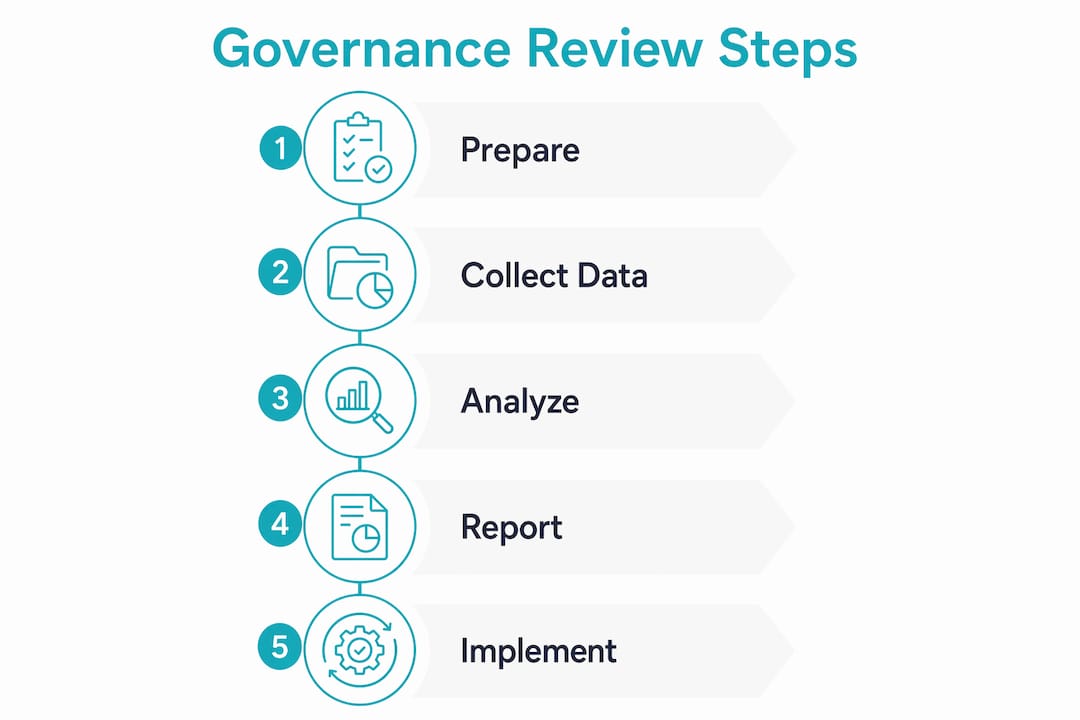
- Define objectives and scope. Decide what the review is trying to achieve. Are you focused on compliance, board culture, decision-making quality, or all three? A clear scope prevents scope creep and keeps the process focused.
- Select your reviewer. Internal reviews can work for smaller organisations with limited resources, but an external reviewer brings independence and the external perspective that boards often cannot generate themselves. External reviewers identify blind spots that familiarity conceals.
- Gather documents upfront. Collect bylaws, board policies, meeting minutes, financial reports, conflict of interest registers, and any relevant regulatory correspondence before interviews begin. This gives the reviewer a foundation to test against.
- Conduct interviews and meeting observations. Interview board members, the CEO or executive director, and key staff. Attend at least one board meeting. The governance review process is not a desk exercise. It requires direct engagement to validate whether actual practice matches documented intent.
- Analyse findings and benchmark. Compare what you have found against relevant standards. In Australia, this might include the Australian Charities and Not-for-profits Commission (ACNC) governance standards, the Australian Institute of Company Directors (AICD) guidelines, or sector-specific frameworks.
- Prepare recommendations. Findings should translate into specific, prioritised recommendations with clear ownership. Vague recommendations do not get implemented. Each recommendation should name who is responsible and by when.
- Build in follow-up. A governance review without a follow-up plan is an expensive report that sits on a shelf. Schedule a review of progress at three and six months to hold the board accountable for implementation.
Pro Tip: Engage board members in the process from the start, not just as interview subjects. When people understand why the review is happening and feel heard during it, they are far more likely to act on the findings.
For boards considering external support, Theplanningandpracticehub's consulting services are designed specifically to guide organisations through this process with practical, co-developed approaches.
Key takeaways
A governance review is the most direct tool a nonprofit board has for identifying governance gaps before they become compliance failures or mission risks.
| Point | Details |
|---|---|
| Definition and scope | A governance review assesses board structures, decision-making, compliance, and mission alignment through documents, interviews, and observation. |
| Triangulation is critical | Reviewing documents alone is insufficient. Effective reviews combine documentary evidence, meeting observation, and staff interviews. |
| Legal duty underpins the need | Trustees are legally responsible for fund protection and risk management, making governance reviews a compliance mechanism, not just a best practice. |
| Match review type to context | Choose between a full audit, health check, board effectiveness review, or policy review based on organisational size, risk, and maturity. |
| Follow-up determines value | A review only delivers results if recommendations are assigned, tracked, and revisited at structured intervals. |
Governance reviews: what nearly three decades in the sector has taught me
After working with nonprofit boards across Australia for close to thirty years, I have come to believe that governance reviews are one of the most underused tools available to boards. Not because boards do not care about governance, but because many associate the word "review" with scrutiny, criticism, or an implied failure. That framing does real damage.
The boards I have seen benefit most from governance reviews are the ones that approach them with genuine curiosity. They ask: "Are we actually governing as well as we think we are?" That question takes courage, and the answers are almost always more useful than uncomfortable. What surprises boards most is rarely the big structural issues. It is the small, accumulated habits: the agenda item that never gets enough time, the risk register that gets noted but not discussed, the board member who has stopped asking hard questions because they stopped feeling heard.
Good governance is intentionally built to shape how information flows and how risk is surfaced for decision-making. That is not something you can see in a policy document. You see it in how a board meeting actually runs, and whether the people in the room feel safe enough to say what they really think.
My strongest advice to any board leader reading this: do not wait for a crisis to prompt a review. The organisations that govern best treat governance improvement as an ongoing discipline, not a one-off event. A governance health check every two years, even a light-touch one, keeps boards honest and keeps missions on track.
— Rachel
How Theplanningandpracticehub supports nonprofit governance
Theplanningandpracticehub works directly with nonprofit boards and leadership teams across Australia to design and deliver governance reviews that go beyond tick-box compliance. Led by Rachel Willis, with nearly three decades of experience in the human services sector, the Hub brings a co-developed, practical approach that reflects the real complexity of nonprofit governance. Whether your board needs a targeted health check or a full governance audit, the team provides structured support from scoping through to implementation follow-up. Visit the Not For Profit support page to learn more, or explore the full range of governance consulting services available to your organisation.
FAQ
What is a governance review in simple terms?
A governance review is a structured assessment of how a board and organisation govern, examining documents, decision-making, compliance, and culture to identify strengths and gaps. It is sometimes called a governance audit and typically involves document review, interviews, and meeting observation.
What is a governance health check and how does it differ from a full audit?
A governance health check is a targeted, lighter-touch review of key governance indicators, suited to annual or biennial check-ins. A full governance audit is more comprehensive, covering documents, culture, operations, and compliance in depth, and is typically triggered by a major transition or identified risk.
How often should a nonprofit board conduct a governance review?
Most governance frameworks recommend a formal review every two to three years, with lighter health checks annually. Boards should also consider an unscheduled review following significant leadership changes, funding shifts, or regulatory updates.
Who should conduct a governance review?
An external reviewer is preferred because they bring independence and the ability to identify blind spots that internal familiarity conceals. For smaller organisations with limited budgets, a structured self-assessment against a recognised framework such as the ACNC governance standards can serve as a starting point.
What are the key benefits of a governance review for nonprofits?
Governance reviews strengthen compliance, improve risk management, clarify board roles, and surface cultural issues that affect decision-making. They also provide boards with an external, evidence-based perspective that internal reflection alone cannot replicate.