TL;DR:
- Most non-profit leaders in Northern Rivers seek management consulting only after facing governance or compliance issues.
- A sector-experienced practitioner-mentor conducts diagnostic reviews and creates tailored, standards-specific action plans.
Most Northern Rivers non-profit executives who engage a management consultant do so after a governance gap or compliance risk has already surfaced. That reactive pattern is costly. A management consultant in Northern Rivers NSW who works specifically in human services and non-profit sectors acts as a practitioner-mentor, not a generalist advisor. The distinction matters because NDIS Practice Standards, the Aged Care Quality Standards (Strengthened), the ACNC Governance Standards, and the National Principles for Child Safe Organisations each carry specific operational obligations that a generic business coach simply cannot navigate with authority. The Planning and Practice Hub was built precisely for this gap.
What does a management consultant Northern Rivers NSW do for non-profits?

The core role is diagnostic before it is advisory. A sector-experienced consultant enters your organisation, maps what is actually happening against what your regulatory frameworks require, and identifies where the distance between the two creates risk. That is a different starting point from strategy workshops or leadership coaching.
For non-profits and human services organisations in the Northern Rivers region, the most pressing consulting work falls into three areas:
- Governance reviews: Clarifying board roles, accountability structures, and strategic oversight against ACNC Governance Standards. A governance review for non-profits typically surfaces gaps between what the board believes it oversees and what management is actually accountable for.
- Compliance mapping: Integrating NDIS Practice Standards, Aged Care Quality Standards (Strengthened), or the National Principles for Child Safe Organisations into practical policies, procedures, and documentation that staff can actually use.
- Audit preparation: Structuring evidence files, corrective action registers, and quality documentation so that regulatory scrutiny does not catch the organisation unprepared.
The diagnostic phase is where most value is created. Governance compliance best practices are well documented, but applying them to a specific organisation in Lismore or Ballina with its particular funding mix, workforce profile, and service model requires someone who has done this work before, repeatedly, in sector.
Pro Tip: Ask any prospective consultant to show you a de-identified example of a governance gap report from a similar organisation. If they cannot, they are likely working from a generic template rather than sector experience.
How does the engagement process work?
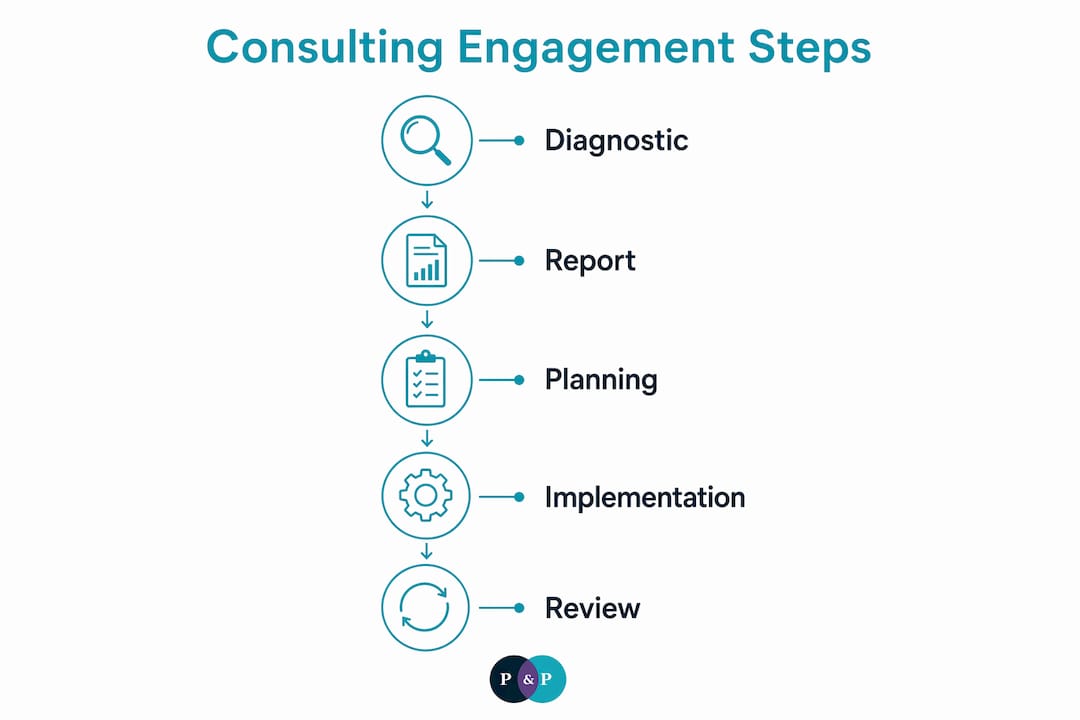
The structured approach that experienced sector consultants use follows a clear sequence, and understanding it helps you evaluate whether a prospective engagement is worth your time.
-
Discovery consultation (30–60 minutes, no cost). The purpose is mutual. You assess whether the consultant understands your sector and your specific regulatory obligations. The consultant assesses whether the scope is clear and whether the organisation is ready to act on findings. Initial discovery meetings of this length are standard practice among reputable boutique firms.
-
Diagnostic or audit phase (2–4 weeks). This is the substantive first engagement. The consultant reviews governance documents, compliance registers, operational systems, and HR frameworks. Diagnostic phases spanning 2–4 weeks with structured audits produce the most actionable recommendations because they are grounded in what is actually in place, not what leadership assumes is in place.
-
90-day priority plan. The output is not a lengthy strategy document. Senior executives prefer succinct plans over complex, lengthy presentations. A one-page or two-page 90-day plan with clear owners, milestones, and success indicators is more useful than a 40-slide deck.
-
Hold-the-change phase. This is the step most engagements skip, and it is where NDIS and aged care compliance most often fails. New systems without a formal stabilisation period erode quickly when the consultant leaves. A structured hold phase embeds changes into daily practice before the engagement closes.
The sequence protects your investment. You know what you are getting before you commit to a longer engagement, and the consultant knows enough about your organisation to give you relevant advice rather than recycled frameworks.
Why hybrid delivery works for the Northern Rivers region
The Northern Rivers region covers a wide geography. Organisations in Tweed Heads, Byron Bay, Ballina, Lismore, and Casino face the same regulatory obligations but operate in very different local contexts. Hybrid consulting models combine scheduled site visits with digital collaboration tools to cover this geography without sacrificing the quality of advice.
The practical structure looks like this:
- Site visits for governance reviews, board workshops, staff interviews, and document audits where physical presence adds context.
- Video conferencing via Zoom or Microsoft Teams for weekly check-ins, plan reviews, and compliance coaching between visits.
- Cloud-based document collaboration for shared policy drafts, corrective action registers, and audit evidence files that both consultant and client can access in real time.
| Delivery mode | Best used for |
|---|---|
| On-site visit | Board workshops, document audits, staff interviews |
| Video conferencing | Weekly progress reviews, compliance coaching |
| Cloud collaboration | Policy drafting, evidence file management |
Remote discovery and digital execution give regional organisations access to senior expertise that would otherwise require engaging a Sydney-based firm with no understanding of local operational realities. The hybrid model is not a compromise. For most Northern Rivers organisations, it is the right fit.
Business coach versus practitioner-mentor: why the difference matters
Non-profit executives often engage generic coaches rather than practitioner-mentors with compliance experience, and the result is governance support that does not hold up under regulatory scrutiny. This is one of the most consistent patterns in the sector.
A business coach works from general leadership and management principles. A practitioner-mentor with 20–30 years of human services experience works from the specific requirements of the NDIS Practice Standards, the Aged Care Quality Standards (Strengthened), and the ACNC Governance Standards. The practical difference shows up in the deliverables.
What sector-experienced consultants provide that generalists do not:
- Audit-ready documentation templates aligned to specific standards, not generic quality frameworks.
- Corrective action plans that reference the exact standard indicator being addressed.
- Board reporting frameworks that meet ACNC Governance Standards requirements for financial oversight and risk management.
- Compliance coaching for frontline managers, not just executive briefings.
Consultant fatigue is a real risk when the person who scopes the work hands it to a junior team member for delivery. Senior-led engagements, where the consultant who assesses your organisation is the same person who works with you through implementation, produce better outcomes and build the trust that makes difficult governance conversations possible.
Pro Tip: Before signing any consulting agreement, confirm in writing that the senior consultant who conducted your discovery session will personally lead the diagnostic and implementation phases.
For aged care governance obligations in particular, the regulatory environment has shifted significantly with the Strengthened Aged Care Quality Standards. Generalist advice in this space carries real compliance risk.
Key takeaways
Effective management consultancy for Northern Rivers non-profits and human services organisations requires sector-specific expertise, a structured diagnostic process, and a formal hold phase to make compliance changes stick.
| Point | Details |
|---|---|
| Start with a diagnostic | A 2–4 week audit phase identifies real gaps before any major investment is made. |
| Use a 90-day plan | Short, outcome-focused plans outperform lengthy strategy documents for executive clarity. |
| Confirm senior-led delivery | The consultant who scopes the work should personally lead implementation to avoid miscommunication. |
| Require a hold phase | Embedding changes through a stabilisation period prevents compliance gains from eroding. |
| Match expertise to your standards | Consultants must know NDIS Practice Standards, ACNC Governance Standards, and aged care requirements specifically. |
What I have learned about choosing the right consultant
I have worked in and around human services for close to three decades, and the single most common mistake I see Northern Rivers executives make is treating management consultancy as a one-size-fits-all purchase. They find someone credentialed and articulate, engage them for six months, and then discover that the governance framework delivered does not actually meet ACNC Governance Standards or the NDIS Practice Standards requirements their next audit will test.
The question I always ask when evaluating a consulting engagement is this: can this person show me a corrective action plan they have written that references a specific standard indicator? If the answer is vague, the expertise is probably general.
Short engagements with clear deliverables outperform open-ended retainers in this sector. A well-scoped 90-day plan with a hold phase will do more for your organisation's compliance position than twelve months of monthly strategy calls. The work is in the implementation, not the presentation.
What I would ask any peer considering a consulting engagement: have you confirmed that the person presenting to your board is the same person who will be in your office reviewing your documentation?
— Rachel
Working with The Planning and Practice Hub in Northern Rivers
The Planning and Practice Hub works with non-profit and human services executives across the Northern Rivers region on governance, compliance, and operational planning. The approach follows the structured sequence described in this article: a no-cost discovery consultation, a diagnostic phase, a 90-day priority plan, and a hold phase to embed changes.
Rachel Willis brings nearly three decades of sector experience to every engagement, covering NDIS Practice Standards, the Aged Care Quality Standards (Strengthened), ACNC Governance Standards, and the National Principles for Child Safe Organisations. Engagements are delivered through a hybrid model combining site visits across Ballina, Byron, Lismore, Tweed, and surrounding areas with digital collaboration between visits. If you are ready to assess where your organisation stands, the human services consulting page is the right place to start.
FAQ
What does a management consultant do for a non-profit?
A sector-experienced management consultant reviews governance structures, compliance documentation, and operational systems, then delivers a prioritised plan to address gaps against standards such as ACNC Governance Standards or NDIS Practice Standards.
How long does a consulting engagement take?
Most structured engagements begin with a 2–4 week diagnostic phase, followed by a 90-day implementation plan. The total active engagement typically runs three to five months, including a hold phase to stabilise changes.
What is the difference between a business coach and a management consultant in human services?
A management consultant with sector experience delivers audit-ready documentation, compliance-specific corrective action plans, and board governance frameworks. A business coach works from general leadership principles and typically cannot address regulatory obligations directly.
How do consultants support regional organisations in Northern Rivers NSW?
Hybrid delivery models combine scheduled site visits to locations including Lismore, Ballina, Byron Bay, and Tweed with video conferencing and cloud-based document collaboration, giving regional organisations access to senior sector expertise without geographic limitations.
How do I know if a consultant is right for my organisation?
Ask to see a de-identified governance gap report or corrective action plan from a comparable organisation. Confirm that the senior consultant who conducts your discovery session will personally lead the diagnostic and implementation work.