An operational plan is the document that tells your organisation what happens Monday to Friday to deliver on the strategic plan: which activities run, who owns them, what they cost, and how you will know if they are working. If your board cannot point to one document that links objectives to budgets to named owners, you do not have an operational plan yet. You have a strategy and a hope.
Here is a 60 second check. First, can you name the person accountable for every funded activity, not just the program area? Second, does your budget map line by line to activities the board approved, rather than sitting as a separate finance exercise? Third, is there a reporting cadence written down, not just assumed? The ACNC Governance Standards treat this as a governance duty, not an administrative nicety, and CPA Australia frames the operational budget as the mechanism that links resource allocation to what the board has actually signed off. Most organisations we work with can produce a one-page summary plus a supporting operational schedule inside a fortnight once the components are clear.
Boards do not need a thicker plan. They need one page that tells them what is happening, who owns it, and what it costs, backed by a schedule they can interrogate when something slips.
Key Takeaways
A board-ready NFP operational plan links every funded activity to a named owner, a budget line, a KPI and a reporting cadence the board actually reviews.
| Point | Details |
|---|---|
| Nine core components | Objectives, activities, timelines, responsibilities, KPIs, budget, risk, HR and compliance must all appear. |
| Budget is governance, not admin | CPA Australia frames the operational budget as linking resource allocation to board-approved activity, with shortfall scenarios built in. |
| Name an owner per KPI | A responsibility matrix stops KPIs from being reported without anyone accountable for corrective action. |
| Contingency lives inside activities | Fund, workforce and single-role risks need a written trigger and response, not a verbal assumption. |
| Get structured support | The Planning and Practice Hub's Practice Assurance Hub helps align operational plans, budgets and reporting into one board-ready document. |
What are the core components of an operational plan for nonprofits?
A working operational plan for nonprofits has nine parts, and skipping any one of them is where audits and board reviews find the gaps.
- Objectives: the specific outcomes each activity is meant to deliver, tied back to the strategic plan.
- Activities and projects: the actual work, described precisely enough that a new starter could pick it up.
- Timelines: start and end dates, or an ongoing cadence, for each activity.
- Responsibilities: a named owner, not a team or a program.
- KPIs and measures: how you will know the activity is on track, in numbers where possible.
- Budget and assumptions: the cost, and what has to be true for that cost to hold.
- Risk and contingency: what happens if funding, staff, or demand shifts.
- Human resources: staff, volunteers and contractors, with assumptions about availability.
- Compliance and reporting: how the activity feeds into your regulatory and board reporting obligations.
The risk checklist matters most in three spots: funding that arrives later than the activity needs to start, volunteer-dependent programs with no backup roster, and single-person roles with no succession plan. All three show up repeatedly in governance risk reviews across the sector.
Under Governance Standard 2, the components that matter most are responsibilities and reporting, because they are what let members and funders ask a sensible question and get a sensible answer. A charity's business plan generally bundles the operational plan with an organisation chart and annual budget for exactly this reason.
Pro Tip: Write the KPI before you write the activity description. If you cannot state how you would measure success in one sentence, the activity is not defined clearly enough yet.
How do you write an operational plan a board will approve?
Most organisations either skip straight to a template or spend months drafting something no one reads. A five-stage process avoids both traps.
- Prepare: gather last year's actuals, current grant agreements, and staffing data. Someone should own this stage, usually the CEO or a senior manager, over roughly a week.
- Design: map activities to objectives and assign owners in a workshop with program leads. Budget half a day.
- Cost: attach a budget line to every activity and flag assumptions. The finance lead drives this, usually over three to five days.
- Test: run a scenario, what happens if a grant is delayed three months, and check the plan still holds. Executive team reviews.
- Publish: finalise the one-page summary and supporting schedules, then table for board approval.
A workable workshop agenda for stage two runs like this:
- Fifteen minutes: confirm strategic priorities the plan must serve.
- Ninety minutes: draft activities, owners and timelines per program area.
- Thirty minutes: flag risks and assumptions while they are fresh.
- Follow-up: finance costs the draft within a week, executive signs off before it goes to the board.
Document every assumption as you go. A note that says "assumes volunteer roster holds at current levels" is worth more to an auditor than a polished paragraph with no assumptions stated at all. Aligning this stage with your strategic plan early avoids rework later.
How do you budget and resource an operational plan?
CPA Australia is direct about this: the operational budget is a strategic document, not a finance department output. It links resource allocation to activity the board has already approved, and it should carry scenario planning for funding shortfalls, not just a single forecast number.
The practical workflow is straightforward. Build income and expenditure line by line against each activity, note capital expenditure separately, and set a review cadence, usually regularly for larger NFPs and less frequently for smaller ones, matching guidance from CPA Australia's Financial Management and Governance guide.
- Document assumptions on volunteer reliance, grant payment timing, and expected wage increases.
- Present at least one shortfall scenario alongside the base budget, not as an afterthought.
- Separate forecasting (what we expect) from budgeting (what the board approved) so variance conversations are clean.
| Organisation size | Suggested review cadence | Typical scenario focus |
|---|---|---|
| Small organisations | Regular intervals | Single major grant delay |
| Medium-sized organisations | Regular intervals | Grant delay plus staffing gap |
| Large organisations with multiple programs | Regular intervals and program-level focus | Combined funding and demand shifts |
What should monitoring and governance reporting look like?
Reporting is where most operational plans quietly die. They get written, approved, then never referenced again until something breaks. A workable reporting template needs four things: reporting frequency, format, variance commentary against budget, and a named owner for each KPI who is accountable for corrective action, not just for reporting the number.
- Set a fixed cadence, monthly operational dashboard, quarterly deep-dive to the board.
- Build a responsibility matrix so every KPI has one owner, not a program team.
- Require variance commentary whenever an activity is more than 10% off budget or timeline.
- Table corrective actions at the next board meeting, not the one after.
This is also how you demonstrate Governance Standard 2 accountability to members in routine practice rather than as a once-a-year compliance exercise. Reasonable steps look proportionate to your size, a small charity's report can be shorter, but members still need enough to ask an informed question.
- Keep a live responsibility matrix, not a static one buried in a policy folder.
- Attach variance commentary to every board report, even when the news is good.
- Review operational records against governance documentation expectations before, not during, an audit.
Pro Tip: Regulators reviewing compliance rarely start with your strategic plan. They start with the operational records, the meeting minutes, the variance reports, the sign-offs, because that is where they can see whether stated governance actually happened.
A worked example and a one-page template you can copy
A mid-sized community services organisation we've observed in practice ran a family support program funded by a two-year grant. The operational plan listed the activity as "deliver 200 family support sessions annually," assigned it to the program manager, budgeted an appropriate amount against staff and brokerage costs, set a KPI of session completion rate against target, and required monthly variance reporting to the executive team. When a staff vacancy hit in month four, the variance report flagged it within weeks, not at year-end, and the board approved a contractor bridge before the KPI slipped.
Copy this structure for your one-page summary:
| Objective | Activity | Owner | Timeframe | KPI | Budget line | Contingency |
|---|---|---|---|---|---|---|
| Improve family stability | support sessions annually | Program manager | July to June | Sessions delivered vs target | $180,000 | Contractor bridge if vacancy |
Keep the one-pager to objective, activity, owner, timeframe, KPI, budget and contingency only. Move detailed staffing rosters, full budget breakdowns and risk registers into supporting schedules referenced by the summary, not printed on it. The board reads the page; the schedules back it up when questions get specific.
What should contingency planning cover in an operational plan?
Contingency planning is not a separate document bolted onto the operational plan. It sits inside every activity line as the answer to "what happens if this does not go to plan." The most common gaps are funding delays, staff or volunteer shortfalls, and demand spikes that outstrip resourcing, and each needs a written response, not a verbal assumption someone remembers at the board table.

For funding risk, name the trigger, a grant payment more than 30 days late, and the response, a bridging reserve or a scaled-back activity schedule. For workforce risk, especially in volunteer-dependent programs, document a backup roster or an agreed reduction in service hours rather than assuming goodwill will cover the gap. For single-person roles, a written handover note beats no succession plan every time an incident occurs.
Complex organisations running multiple programs are better served by program-level contingency plans than one aggregated risk section, because a single document can hide where the actual exposure sits. This matches how the ACNC treats complex governance structures: oversight has to happen at the level where the risk actually lives, not just at the top.
Test your contingency plan the same way you test the budget: run a scenario, walk it through with the people who would actually respond, and check the plan holds up under a delay or a resignation, not just on paper.
Practitioner perspective: operational planning is governance, not admin
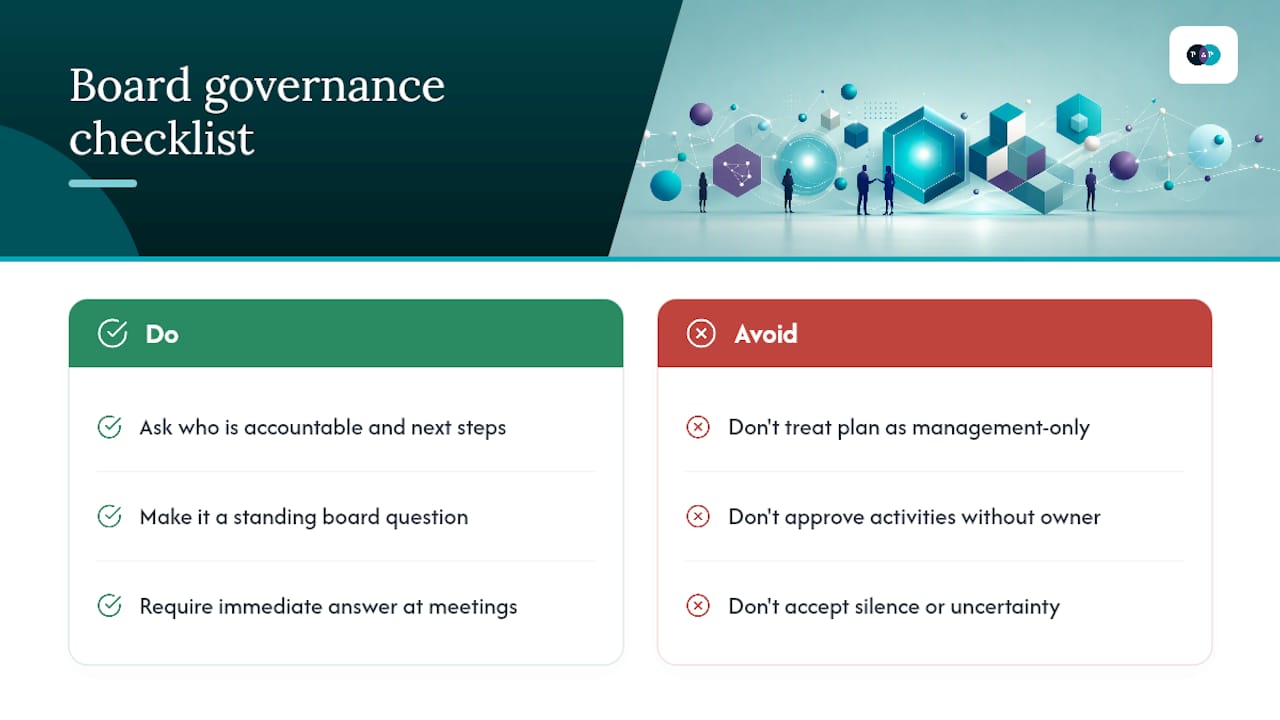
I have seen boards treat the operational plan as a management document they receive rather than a governance tool they own. The common fault is approving activities without asking who owns the KPI. The fix is one standing question at every board meeting.
Ask this: "For each funded activity, who is accountable if it slips, and what happens next?" If the room cannot answer immediately, your plan is not doing its job yet.
How The Planning and Practice Hub supports your operational planning
Getting from strategic intent to a board-ready operational plan usually takes longer than executives expect, mostly because budgeting, risk and reporting get drafted separately and never quite line up. The Planning and Practice Hub works alongside your executive team to build the one-page plan, the supporting schedules and the reporting cadence together, so the board sees one coherent document instead of three that half agree.
That work draws on governance advisory, budget alignment reviews, and practical templates built specifically for NDIS, aged care, child and family, and community services organisations, consistent with ACNC Governance Standards and CPA Australia's budgeting guidance. If you want a structured way to keep operational plans, reporting and audit readiness in one place, the Practice Assurance Hub is built for exactly that. Check current pricing and book a conversation about your next operational plan review.
Sources
FAQ
What are the 7 things an operational plan should contain?
Most operational plans cover objectives, activities, timelines, responsibilities, KPIs, budget and assumptions, and risk or contingency, with human resources and compliance reporting often added as an eighth and ninth layer for human services organisations.
What are the 5 key aspects of an operational plan?
The five that boards check first are clear objectives, named activities, assigned responsibilities, a linked budget, and measurable KPIs, because these let a board test progress without reading every supporting schedule.
What is an example of an operational plan?
A family support program that lists 200 annual sessions, assigns a program manager, budgets $180,000 against staffing and brokerage, sets a completion-rate KPI, and reports variance monthly is a working example of the format.
How do you write an operational plan?
Prepare your data and assumptions, design activities with named owners in a workshop, cost each activity against the budget, test it with a funding-delay scenario, then publish a one-page summary with supporting schedules for board approval.
Does an operational plan help satisfy ACNC Governance Standards?
Yes. Operational planning sits under ACNC Governance Standard 2, and a clear plan with owners, budgets and reporting is direct evidence of accountability to members.