
TL;DR:
- Australian nonprofit boards must demonstrate provable governance to meet legal duties, manage risk, and uphold organizational culture. Effective structures include regular meetings, comprehensive documentation, and active stakeholder engagement to ensure compliance and long-term sustainability. Focusing on record-keeping and culture monitoring helps boards avoid regulatory penalties and build stakeholder trust.
NFP board governance Australia is the system by which nonprofit boards meet legal duties, exercise oversight, manage risk, and embed organisational culture aligned to mission. The formal term used by regulators and the Australian Institute of Company Directors is good governance, defined through the ACNC Governance Standards and the AICD's updated NFP Governance Principles, which cover eight areas including purpose, board composition, risk management, performance, stakeholders, sustainability, and organisational culture. For board directors and executives in human services, the stakes are concrete: responsible persons who fail their duties under ACNC Governance Standard 5 risk suspension or disqualification. Good intent is not enough. Provable governance is the standard.
What are the key responsibilities of NFP board members in Australia?

Board members in Australian charities carry specific legal duties under ACNC Governance Standard 5. These duties are not aspirational. They are enforceable obligations that the ACNC can act on.
The core duties include:
- Acting with reasonable care and diligence in all board decisions
- Acting in the charity's best interests, not personal or third-party interests
- Disclosing conflicts of interest promptly and managing them transparently
- Exercising responsible financial management and preventing insolvency
- Ensuring the organisation complies with its legal obligations and governing documents
Failure to meet these duties carries real consequences. The ACNC can suspend, remove, or disqualify responsible persons. That outcome affects the organisation's registration status and its ability to access funding, tax concessions, and public trust.
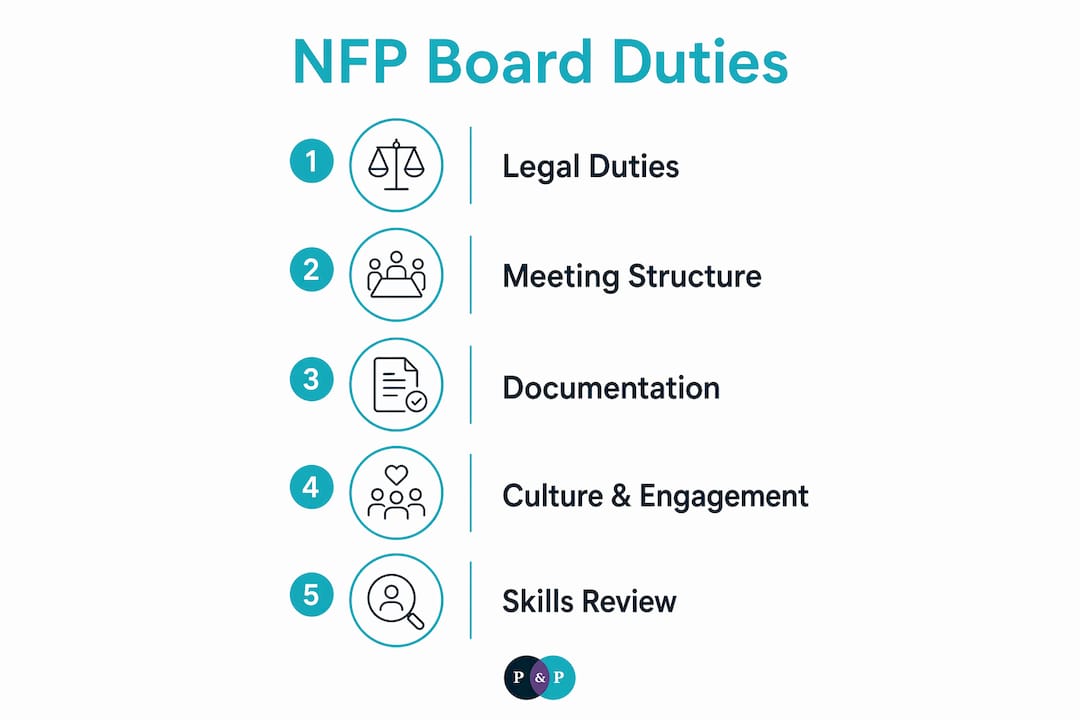
Boards also carry an ongoing obligation to review the skills and suitability of their members. A board that was well composed three years ago may now have gaps in financial literacy, sector knowledge, or lived experience. Regular skills audits against the organisation's current risk profile are a practical way to stay ahead of this. The governance documentation essentials for Australian NFPs make clear that skills registers belong in your governance records, not just your board papers.
Pro Tip: Schedule a skills and suitability review as a standing agenda item at your annual board planning session. Tie it directly to your risk register so gaps are visible before they become problems.
How should NFP boards structure meetings and workplans?
Effective NFP boards generally meet 4–6 times per year, with a structured workplan that maps each meeting to the organisation's strategic and compliance cycle. That frequency is not arbitrary. It reflects the minimum cadence needed to cover financial oversight, operational performance, risk review, and AGM preparation without cramming everything into one or two rushed sessions.
A practical annual workplan might look like this:
- February: Approve the annual workplan, review the strategic plan, and confirm the risk register.
- April: Review Q1 financials, update the conflict of interest register, and assess any emerging compliance obligations.
- June: Mid-year performance review, stakeholder engagement update, and preparation for the AGM.
- August: AGM, election of office bearers, and approval of audited financial statements.
- October: Strategic planning session, budget development for the coming year, and policy review schedule.
- December: Year-end risk and compliance review, board performance reflection, and workplan sign-off for the following year.
One community services board I worked with had been meeting quarterly with no formal workplan. Agenda items were reactive, financial reports dominated every meeting, and governance documentation was patchy. Shifting to a six-meeting cycle with a published workplan changed the culture of the board within twelve months. Directors came prepared. Decisions were better documented. The AGM stopped being a scramble.
Structured agendas and standard templates for minutes and board papers are not administrative overhead. They are the evidence trail that demonstrates your board is governing, not just meeting.
Pro Tip: A 30-day governance tune-up that maps funding streams to grant terms, updates registers, and confirms minute approval processes will surface compliance gaps before the ACNC does.
What governance documentation must NFP boards maintain?
Documentation is where most boards underperform. Boards that focus on financials while neglecting governance records face regulatory penalties comparable to financial misreporting. The ACNC treats your minute book as a primary oversight tool.
Board minutes must record more than decisions. They must capture the time the meeting started and ended, who attended, any conflicts declared and how they were managed, the key discussion points, and the rationale behind significant decisions. This is especially critical for fund transfers and related party matters, where the ACNC expects to see not just what was decided but why.
One frequently missed compliance requirement applies to group structures. If your organisation operates multiple registered charities under a shared board, each charity requires its own separate board meeting. Joint meetings create compliance failures because directors cannot properly discharge their fiduciary duties to each entity when the entities are conflated. This is a common trap for federations and group service providers.
| Document | Purpose | Review frequency |
|---|---|---|
| Board meeting minutes | Evidence of decisions and rationale | Approved at each subsequent meeting |
| Conflict of interest register | Transparency and ACNC compliance | Updated at each meeting |
| Skills and suitability register | Board composition oversight | Annually |
| Governance policies | Operational and regulatory compliance | Annually or as required |
| Risk register | Ongoing risk identification and management | Quarterly minimum |
- Keep a single, version-controlled policy register with clear review dates
- Store signed conflict of interest declarations with the corresponding minutes
- Maintain a separate minute book for each registered charity entity
- Archive approved minutes securely and ensure they are accessible for ACNC review
Pro Tip: Treat your conflict of interest register as a live document, not an annual form. Update it whenever a director's circumstances change, not just at the start of each year.
How do culture and stakeholder engagement shape NFP governance?
The AICD's 2024 updated NFP Governance Principles place organisational culture and stakeholder voice alongside financial health as core governance responsibilities. This is a significant shift. Culture is now recognised as a leading indicator of compliance risk and long-term viability, not a soft consideration left to management.
Poor organisational culture elevates compliance risk in concrete ways. Boards that do not actively monitor culture miss early warning signs: staff turnover patterns, client complaint trends, and whistleblower concerns. By the time these surface as formal incidents, the governance failure has already occurred.
Stakeholder engagement is equally substantive. Boards that consult only internally, without structured input from clients, carers, communities, or workforce, make decisions with incomplete information. In sectors like NDIS, aged care, and child safety, that gap carries direct quality and safety risk.
Practical strategies to embed culture and stakeholder engagement in governance:
- Include a standing culture and workforce report in board papers, separate from the CEO's operational report
- Conduct an annual stakeholder consultation and report findings to the board with a formal response
- Review client feedback and complaint data at board level, not just management level
- Include culture indicators in the risk register, such as staff turnover rate and incident trends
- Ensure the board hears directly from clients or community representatives at least once per year
Key takeaways
Effective NFP board governance requires provable compliance, not just good intent, and boards that document decisions, manage culture, and structure their workplans systematically are best placed to meet ACNC and AICD expectations.
| Point | Details |
|---|---|
| Legal duties are enforceable | ACNC Governance Standard 5 duties carry real consequences including suspension or disqualification. |
| Workplans drive governance quality | A six-meeting annual cycle with a published workplan keeps compliance and strategy aligned. |
| Documentation is regulatory evidence | Minutes, conflict registers, and policy records are the primary tools ACNC auditors examine. |
| Separate meetings for each entity | Group structures must hold independent meetings for each registered charity to avoid compliance failures. |
| Culture is a governance responsibility | Boards must monitor organisational culture and stakeholder voice as part of their oversight role. |
What I've learned about governance that boards rarely want to hear
The most common governance gap I see is not a lack of knowledge. It is the gap between what boards intend and what they can actually prove. A board can have excellent values, committed directors, and a genuine commitment to its community. But if the minutes are thin, the conflict register is out of date, and the policy library has not been touched in two years, none of that intent is visible to a regulator.
I have worked with boards that were genuinely shocked when an ACNC review flagged their documentation as inadequate. They had been meeting regularly, making sound decisions, and managing their finances well. The problem was that none of it was captured in a way that could withstand scrutiny. The decisions were real. The evidence was not.
The shift to provable governance is not about bureaucracy. It is about protecting your organisation, your directors, and the people you exist to support. Culture and stakeholder engagement are not soft additions to governance. They are the early warning system that tells you whether your organisation is actually functioning the way the board thinks it is.
My question for you: if the ACNC reviewed your board's records tomorrow, what would they find?
— Rachel
Working on governance at The Planning and Practice Hub
The Planning and Practice Hub works with NFP boards and executives across human services to build governance frameworks that hold up under scrutiny.
Rachel Willis and the team at The Planning and Practice Hub bring close to three decades of sector experience to NFP governance consulting, covering compliance calendars, board workplans, documentation templates, and director training. Whether your board needs a governance health check or support building a full NFP compliance framework from the ground up, the work is co-developed with your team, not handed down. If you want practical support that fits your sector and your stage, the service areas overview is a good place to start.
FAQ
What is ACNC Governance Standard 5?
ACNC Governance Standard 5 sets out the specific legal duties of responsible persons on charity boards, including acting with care, disclosing conflicts, and preventing insolvency. Non-compliance can result in suspension or disqualification by the ACNC.
How often should an NFP board meet in Australia?
Effective NFP boards typically meet 4–6 times per year, with a structured workplan that aligns each meeting to the organisation's strategic and compliance cycle.
What must NFP board minutes include?
Board minutes must record attendance, conflicts declared, key discussion points, the rationale behind significant decisions, and the outcome of any votes, particularly for fund transfers and related party matters.
Do group NFP structures need separate board meetings for each charity?
Yes. The ACNC requires each registered charity within a group structure to hold its own separate board meeting, even when directors are shared across entities.
Why does organisational culture matter for NFP board governance?
The AICD's updated NFP Governance Principles recognise culture as a leading indicator of compliance risk. Boards that do not actively monitor culture miss early warning signs that can escalate into formal regulatory concerns.