
TL;DR:
- A strong theory of change links an Australian nonprofit's purpose to measurable impact and serves as a governance tool.
- It helps boards test whether activities deliver value and provides clear evidence for regulator and funder compliance.
A robust theory of change for an NFP in Australia must connect your organisation's purpose to measurable impact, and give your board a governing tool, not just a planning document. AICD positions the theory of change as the mechanism directors use to test whether activities deliver intended value and to adjust programs when data shows outcomes diverging from expectations. ACNC Governance Standards require charities to act in the interests of their purpose, and a well-constructed theory of change is the clearest evidence you can give a regulator or funder that you do.
Three things your board or CEO can do this week:
- Pull your current strategic plan and check whether it contains an explicit outcomes chain from activities through to long-term impact. If it does not, that gap is your starting point.
- Ask your program managers to name the two or three indicators they currently report against and confirm each one links to a stated outcome. Misalignment here is the most common governance gap Rachel Willis, founder of The Planning and Practice Hub, sees across Australian human services organisations.
- Schedule a board agenda item to formally adopt or commission a theory of change, with a clear owner and a 90-day delivery date.
How do you build a theory of change your board can actually use?
Start with the impact you intend to achieve and work backwards. Starting from activities risks mission drift and produces measurements that favour ease over usefulness. The sequence below is designed for a CEO or quality manager to run internally or brief a consultant on.
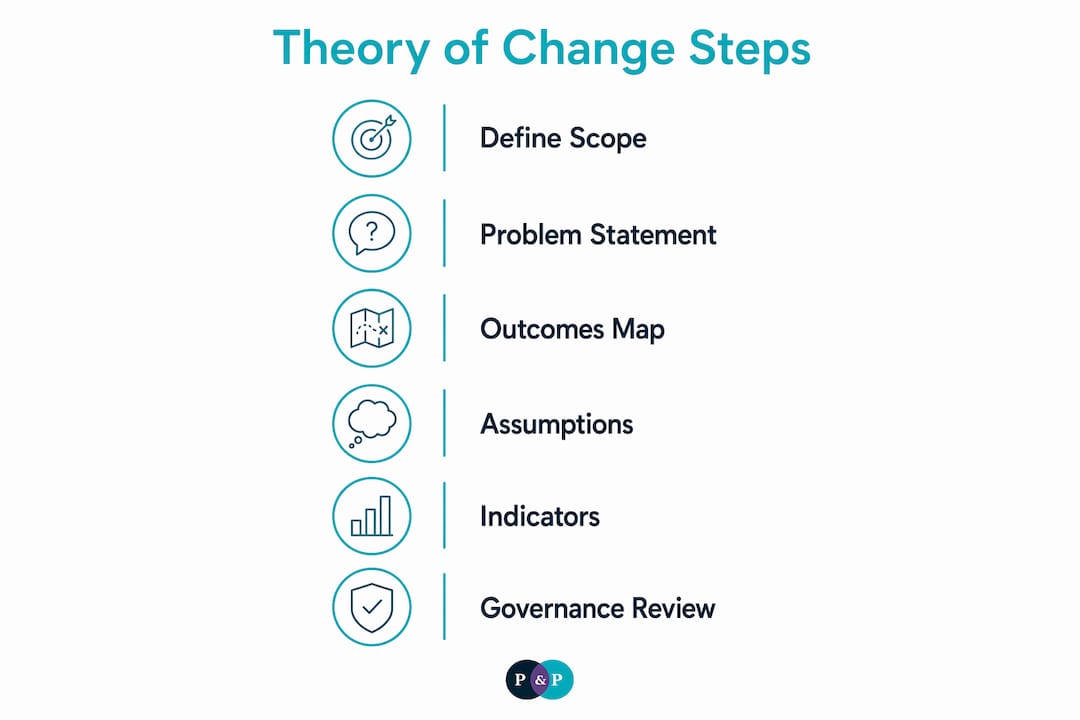
1. Define scope and reporting level Decide whether you are building one organisational-level theory of change or program-level versions. Smaller organisations often begin with a single organisational model; larger ones maintain multiple aggregable versions. Owner: CEO and board.
2. Write a clear problem statement Name the issue your organisation addresses, the target cohort, and the context. One paragraph is enough. Owner: CEO.
3. Map the outcomes chain Work from long-term impact back through intermediate outcomes to short-term changes and then to activities. Use if–then–because statements to document each causal link and the assumption behind it. Owner: program manager with CEO sign-off.

4. Document assumptions and evidence For each causal link, note the degree of certainty and the evidence base. Where evidence is weak, flag it as a learning priority. Owner: evaluation lead or program manager.
5. Select indicators and set baselines A measurement framework built around your theory of change clarifies what to measure and prevents collecting irrelevant data. Choose one or two indicators per outcome level:
| Outcome level | Example indicator |
|---|---|
| Output | Number of participants completing the programme |
| Short-term outcome | Percentage reporting improved skills at exit |
| Long-term outcome | Proportion in stable housing at 12-month follow-up |
Set a baseline before the program runs. Without one, you cannot demonstrate change to an ACNC auditor or a government funder. Owner: evaluation lead.
6. Governance checkpoint Board reviews the completed theory of change, approves the measurement plan, and records the decision in minutes. This satisfies board oversight expectations under ACNC Governance Standards and AICD guidance. Ongoing rhythm: board quarterly, program team monthly.
Anonymised practice example
A mid-sized homelessness NFP in regional NSW had been reporting outputs (bed nights, meals) to funders for three years with no outcome data. After building a theory of change that mapped activities to housing stability and wellbeing outcomes, the organisation identified two indicators it could collect at exit and at 12 months using existing case management software. Within one reporting cycle, it could show that a significant proportion of participants maintained stable housing at 12 months, a figure that secured renewed government funding and satisfied the board's governance obligations under the ACNC Governance Standards.
Common pitfalls
- Vague outcomes ("improved wellbeing") with no measurable indicator attached
- No baseline collected before the program starts
- Indicator overload: organisations frequently over-collect data, and a theory of change centred approach helps prioritise indicators that inform decisions
- Treating the theory of change as a one-off document rather than an active governance control the board reviews regularly
Templates and artefacts to produce
- Outcomes chain diagram (one page)
- Outcomes matrix (outcomes, indicators, baselines, data methods, frequency, owner)
- Measurement plan linked to ACNC and funder reporting cycles
- Simple dashboard for board and program reporting
Timeline and resourcing
An organisational-level theory of change typically takes 20–40 internal hours across four to six weeks, assuming the CEO and program managers are available. When engaging a consultant, a scoped project covering the theory of change build, outcomes matrix and measurement plan usually runs four to eight weeks. For organisations operating under the NDIS Practice Standards, Aged Care Quality Standards (Strengthened), or National Principles for Child Safe Organisations, aligning the theory of change to those frameworks from the outset saves significant rework at audit time. Operations consulting approaches that embed measurement into existing workflows tend to reduce the ongoing reporting burden considerably.
The Planning and Practice Hub can build this with you
Rachel Willis and The Planning and Practice Hub work with Australian NFP boards and executive teams to build governance-ready theories of change that satisfy ACNC and AICD expectations from day one. With nearly three decades in Australian human services, the work is grounded in what regulators and funders actually look for, not generic frameworks.
- Governance-ready theory of change build: scoped engagement covering problem statement, outcomes chain, assumptions, indicators, baselines, and board-ready documentation mapped to ACNC Governance Standards and AICD director guidance.
- Measurement and reporting systems: outcomes matrix, measurement plan, and reporting dashboard aligned to your funder and regulatory reporting cycles, including NDIS Practice Standards and Aged Care Quality Standards (Strengthened) where relevant.
To discuss a scoped engagement, visit The Planning and Practice Hub's human services consulting page or the NFP governance advisory page.
FAQ
What is a theory of change for an Australian NFP?
A theory of change maps the causal pathway from your organisation's activities to its intended long-term impact, documenting the assumptions and evidence behind each step. For Australian NFPs, it also provides the logical basis for meeting ACNC Governance Standards and funder reporting requirements.
How long does it take to develop a theory of change?
An organisational-level theory of change typically takes 20–40 internal hours over four to six weeks. Engaging a consultant for a scoped build usually runs four to eight weeks.
How does a theory of change connect to ACNC and AICD obligations?
ACNC Governance Standards require charities to act in the interests of their stated purpose; a theory of change is the clearest documented evidence of that link. AICD directs boards to use it as a governing tool to test whether activities deliver intended value.
What is the most common mistake NFPs make with a theory of change?
Collecting data before setting a baseline, or selecting indicators for ease rather than relevance to the outcomes chain. Both errors mean you cannot demonstrate change to a funder or regulator, regardless of how much data you hold.
Key Takeaways
A theory of change only delivers governance value when the board treats it as a live oversight tool, not a document filed after strategic planning.
| Point | Details |
|---|---|
| Start with impact, work backwards | Map from long-term impact to activities to avoid mission drift and indicator bias. |
| Baselines are non-negotiable | Without a pre-program baseline, you cannot demonstrate change to ACNC auditors or funders. |
| Limit indicators deliberately | Select one or two per outcome level; over-collection produces reports, not decisions. |
| Board oversight is the governance test | Record board approval of the theory of change and measurement plan in board minutes each quarter. |
| The Planning and Practice Hub | Builds governance-ready theories of change and measurement systems mapped to ACNC, AICD, and sector-specific standards for Australian NFPs. |
What does your board currently do when program data shows outcomes are not tracking as expected, and does your theory of change give them a clear basis for that decision?