
A strategic plan's role in service delivery is to convert organisational vision into measurable, accountable outcomes that improve coordination, resource use, and client results. Without that connection, plans sit on shelves. Research confirms that SMART-guided objectives correlate strongly with improved service delivery performance, with a correlation coefficient of r = .759 (p < .01). That figure tells you something direct: the quality of how you write your objectives predicts the quality of what your organisation delivers. Non-profits working across Australia's human services sector, where over 50 regulatory bodies set the compliance context, cannot afford to treat strategic planning as an administrative exercise.
How does strategic planning drive effective service delivery?
Strategic planning improves service delivery through two mechanisms: better coordination across teams and more deliberate allocation of resources. When objectives are specific, measurable, and time-bound, managers can align department workplans to them. That alignment reduces duplication, closes gaps in client care, and makes accountability visible.
Organisational planning significantly improves efficiency, workflow, and client satisfaction, with a regression coefficient of β = 0.355 (p < .001) linking planning quality to service performance. That is not a marginal effect. It means planning discipline has a direct, measurable bearing on what clients experience.

Research also shows that strategic planning impacts service quality and organisational market share beyond financial metrics, with a model F-statistic of 41.052 (p < .005). For non-profits, "market share" translates to reach, referrals, and community trust. The evidence is consistent across sectors.
| Research finding | Statistic | What it means for your organisation |
|---|---|---|
| SMART objectives and service performance | r = .759, p < .01 | Objective quality directly predicts delivery outcomes |
| Planning and service efficiency | β = 0.355, p < .001 | Structured planning lifts workflow and client satisfaction |
| Strategic planning and service quality | F = 41.052, p < .005 | Planning drives quality gains beyond financial results |
Pro Tip: Map each strategic objective to a named team lead and a quarterly milestone. Objectives without owners do not move.
What components of a strategic plan influence service delivery outcomes?
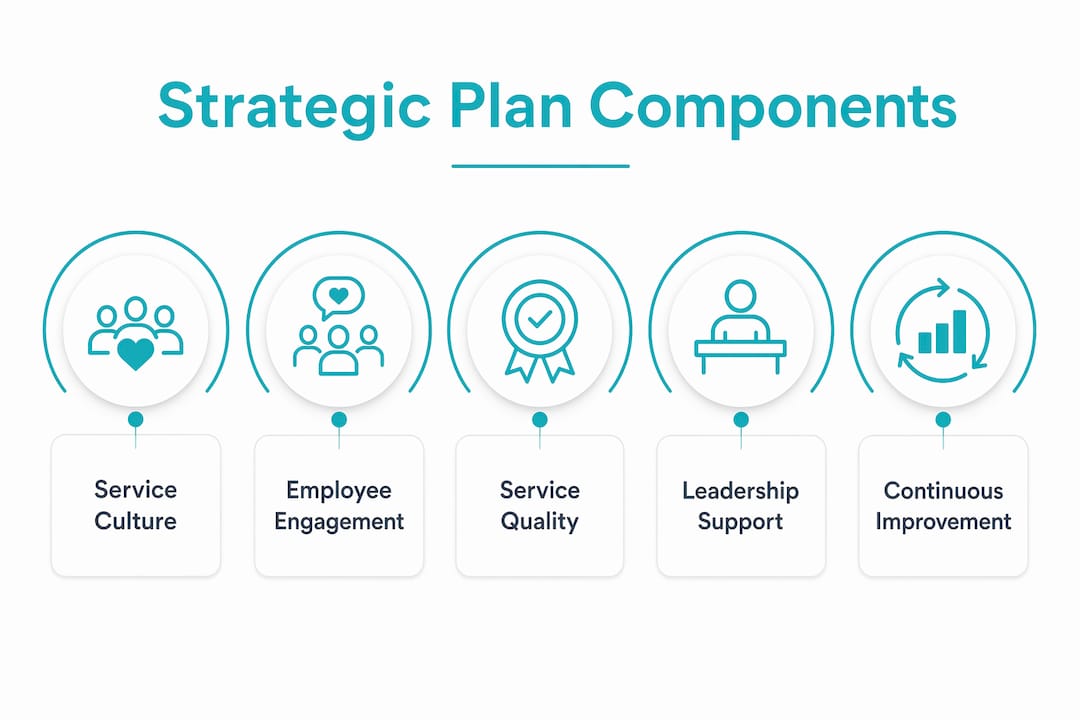
Effective service delivery rests on four aligned components: service culture, employee engagement, service quality, and customer experience, with technology as an enabler rather than a standalone fix. That framing matters because many organisations invest in systems before they have resolved the cultural and engagement conditions those systems depend on.
A strategic plan that addresses all four components gives leaders a coherent framework. One that focuses only on outputs, such as number of clients served or compliance checklists, misses the conditions that produce those outputs. The plan becomes a reporting tool rather than a management one.
The distinction between a living roadmap and a static document is where most non-profits either gain or lose ground. A living plan is reviewed annually, linked to the budget cycle, and adjusted when operating conditions change. A static document is approved at a board meeting and referenced only during audits.
| Plan type | Characteristics | Service delivery impact |
|---|---|---|
| Living roadmap | Annual review, budget-linked, staff-owned | Sustained improvement, adaptive to change |
| Static document | Approved once, compliance-focused, rarely referenced | Minimal operational impact, planning gap risk |
| Compliance-only plan | Meets regulatory requirements, no operational integration | Administrative burden without performance gain |
Key features that distinguish plans with genuine service delivery impact:
- Objectives written at the operational level, not just the governance level
- Budget lines that correspond directly to strategic priorities
- Named accountability for each goal, reviewed quarterly
- Staff roles connected explicitly to organisational outcomes
- Annual refresh timed to precede the budget cycle, not follow it
What are the common pitfalls in linking strategic plans to service delivery?
The most common failure is treating the plan as a compliance artefact. Boards approve it, executives file it, and frontline teams never see it again. Failure to connect individual roles to broader plans is the primary cause of unsuccessful implementation. That is a governance failure, not a planning failure.
A second risk is the planning gap. This occurs when a plan expires before its replacement is ready, leaving the organisation operating without a current strategic direction. Experts recommend starting plan updates at least three months before expiry to maintain continuous momentum. Most organisations start too late, often because the refresh is treated as a project rather than a standing process.
Stakeholder engagement across all levels is what separates plans that drive change from plans that fulfil compliance. When staff, clients, and community partners contribute to the plan, they own it. When they are consulted after the fact, they comply with it at best.
Common pitfalls non-profit leaders should watch for:
- Strategic objectives written only at board level, with no operational translation
- Budget allocations that do not reflect stated priorities
- No governance mechanism to track progress between annual reviews
- Plan refresh treated as a one-off project rather than a standing cycle
- Leadership turnover that breaks institutional knowledge of the plan's intent
Pro Tip: Form a Strategic Plan Steering Committee with cross-functional membership. A governance committee that meets quarterly to clear roadblocks and align budgets to strategy prevents the plan from stalling between annual reviews.
Practical steps to embed strategic planning in your service delivery framework
Embedding a strategic plan into daily operations requires deliberate structure. These steps give non-profit leaders a repeatable process.
-
Align the refresh cycle to your budget. Begin the annual plan review three months before your financial year end. This gives the board time to approve updated priorities before budget decisions are locked.
-
Translate strategic goals into department workplans. Each team should have a workplan that maps directly to at least one strategic objective. This creates the line of sight between individual roles and organisational direction.
-
Assign accountability at the operational level. Every objective needs a named owner, a target date, and a progress measure. Objectives without these three elements are aspirations, not commitments.
-
Build a reporting rhythm. Quarterly progress reports to the executive team, with a summary to the board, keep the plan visible and create natural checkpoints for course correction.
-
Engage stakeholders in the refresh, not just the approval. Involve frontline staff, clients, and community partners in identifying what is working and what needs to change. Their input improves the plan and builds ownership. For practical approaches to involving stakeholders in planning, the governance literature is clear: participation precedes commitment.
-
Connect the plan to individual performance conversations. When managers reference strategic goals in supervision and appraisal, staff understand how their work contributes. That connection is what strategic plans integrated into daily operations actually look like in practice.
Key takeaways
A strategic plan drives service delivery only when it is treated as a working management tool, not a compliance document filed after board approval.
| Point | Details |
|---|---|
| Objective quality predicts delivery | SMART objectives correlate directly with service performance at r = .759. |
| Four components underpin delivery | Culture, engagement, quality, and experience must all be addressed, not just outputs. |
| Living plans outperform static ones | Annual reviews linked to budgeting keep plans relevant and operationally useful. |
| Governance structures prevent stagnation | A Steering Committee with quarterly meetings aligns budgets and clears roadblocks. |
| Stakeholder ownership drives change | Plans co-developed with staff and clients produce implementation, not compliance. |
What I have learned about plans that actually work
After nearly three decades working across Australia's human services sector, the pattern I see most often is this: organisations invest significant effort in writing a strategic plan and almost none in operationalising it. The plan is beautifully formatted, approved unanimously, and then quietly forgotten until the next funding acquittal or accreditation audit.
The plans that genuinely shift service delivery share one characteristic. They are treated as management systems, not documents. Leaders reference them in team meetings. Budget conversations start with strategic priorities. New staff are inducted into the plan's intent, not just its existence.
I have also seen what happens when a Steering Committee is established with real authority. Roadblocks that would otherwise sit unresolved for months get cleared in a single meeting. Budget decisions that would otherwise drift away from stated priorities get realigned. The governance structure does not write the plan. It keeps the plan alive.
The uncomfortable truth is that most implementation failures are leadership failures. The plan was sound. The commitment to use it was not. If you are a non-profit leader reading this, the question worth sitting with is not whether your organisation has a strategic plan. It is whether your team could describe what it says without looking it up.
— Rachel
How The Planning and Practice Hub supports your strategic planning goals
The Planning and Practice Hub works with non-profit leaders and community service organisations across Australia to develop strategic plans that function as genuine management tools. Founded by Rachel Willis, with close to three decades of sector experience, the hub specialises in co-developed planning that connects governance, compliance, and service delivery in one coherent framework. If your organisation is navigating a plan refresh, a governance review, or a shift in service delivery model, the hub offers management consulting for human services tailored to your operating context. You can also explore the full range of consulting services available to non-profits and community sector organisations.
FAQ
What is the role of a strategic plan in service delivery?
A strategic plan defines the objectives, priorities, and resource commitments that guide how an organisation delivers services. It connects governance decisions to operational practice, ensuring teams work toward the same outcomes.
How does strategic planning improve service delivery performance?
Research shows that SMART-guided planning correlates with improved service performance at r = .759. Structured objectives improve coordination, reduce duplication, and make accountability visible across teams.
How often should a non-profit update its strategic plan?
A strategic plan should be reviewed annually, with the refresh process beginning at least three months before the current plan expires. Linking the review to the budget cycle keeps priorities and resources aligned.
What is a Strategic Plan Steering Committee?
A Strategic Plan Steering Committee is a cross-functional governance group that meets regularly to track progress, remove implementation barriers, and ensure budget decisions reflect strategic priorities. It prevents plans from stalling between annual reviews.
Why do strategic plans fail to improve service delivery?
Plans fail when they are treated as compliance documents rather than management tools. Connecting individual roles to organisational goals, and maintaining active stakeholder engagement, are the two factors most strongly linked to successful implementation.