
TL;DR:
- Regularly reviewing and updating governing documents ensures they accurately reflect how organizations operate and meet legal standards. Boards should compare their documents to ACNC templates, address gaps, and lodge amendments with the appropriate regulator. Maintaining current, comprehensive governance records and embedding policies into practice supports ongoing compliance and effective leadership.
Pull up your constitution this week, compare it clause by clause against the ACNC governing document template, and bring a gap analysis to your next board meeting. That single action addresses the most common compliance failure the ACNC identifies during charity reviews: a governing document that no longer reflects how the organisation actually operates.
Here is how to do it in three steps:
- Who reviews: the CEO or governance manager completes the initial comparison, with the board chair confirming scope.
- Where to find the template: the ACNC governing document factsheet and the ACNC Governance Standards page, both publicly available.
- Who signs off: the full board approves any recommended amendments, with a legal review documented in the minutes before lodging changes.
The key regulators you need to know: the Australian Charities and Not-for-profits Commission (ACNC) sets governance standards for registered charities; the Australian Taxation Office (ATO) requires governing documents to confirm NFP status and charitable purpose for tax concessions; and the Australian Securities and Investments Commission (ASIC) remains relevant for companies limited by guarantee, even where some Corporations Act obligations are modified for registered charities.
What is a governing document and what legal forms does it take?
A governing document is the foundational legal instrument that sets out your organisation's purposes, powers, and the rules by which it is governed. The ACNC's guide for Responsible People describes it plainly: it may be called a constitution, rules, trust deed, or memorandum of association, depending on your legal structure.
The name matters less than the legal form, because the form determines which regulator holds jurisdiction and where you find an authoritative template.
- Incorporated association: — governed by state or territory legislation (e.g. the Associations Incorporation Act in each jurisdiction); the relevant state or territory regulator holds the register; model rules are published by each state and territory.
- Company limited by guarantee: — registered with ASIC under the Corporations Act 2001; the governing document is a constitution (or, by default, the replaceable rules in the Act); ASIC and the ACNC share oversight for registered charities.
For a quick reference, the table below maps each structure to its primary regulator and the most authoritative template source.
| Legal structure | Primary regulator | Template / model rules source |
|---|---|---|
| Incorporated association | State/territory regulator (e.g. NSW Fair Trading, Consumer Affairs Victoria, QLD Office of Fair Trading, SA CBS, WA DMIRS, TAS CBOS, ACT Access Canberra, NT DLPE) | State/territory model rules pages |
| Company limited by guarantee | ASIC (+ ACNC if registered charity) | ASIC guidance; ACNC governing document factsheet |
| Charitable trust | ACNC (if registered); state trustee legislation | ACNC factsheet; legal advice for deed drafting |
| Unincorporated association | ACNC (if registered charity) | ACNC governing document factsheet |
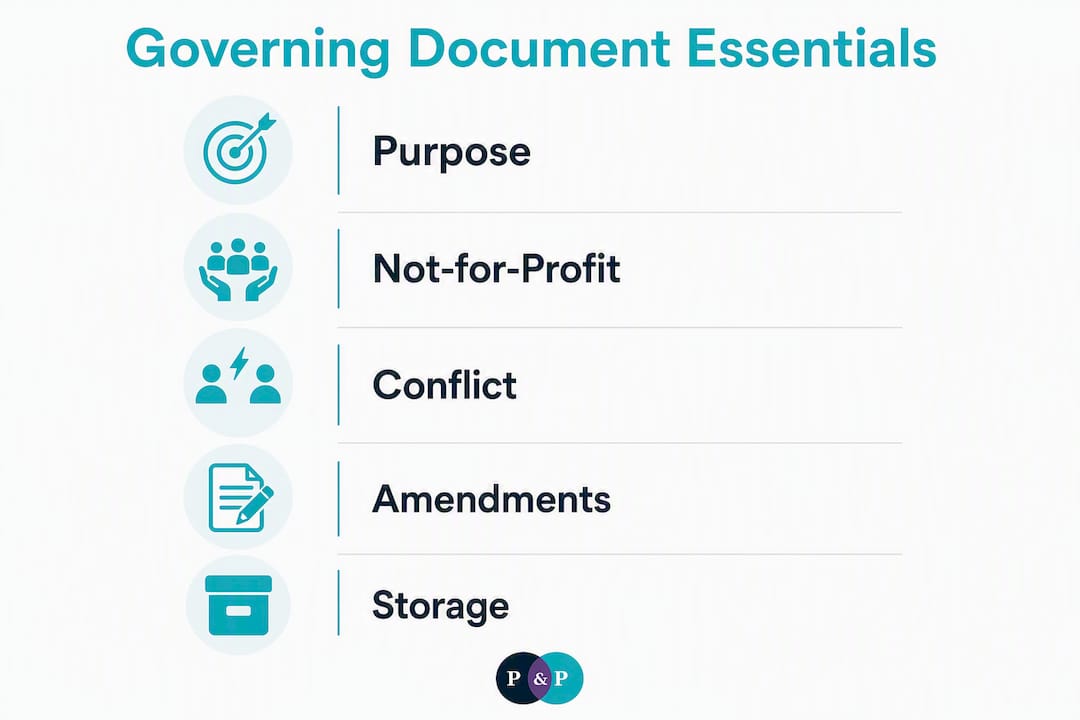
For a deeper look at governance documentation essentials for NFPs, the structure-to-regulator mapping is the right place to start before touching any template.
Core clauses every NFP governing document must include

Regulators do not read your constitution for interest. They read it to test whether your governance decisions were lawful. Boards that understand this write clauses that hold up under scrutiny, not just at registration.
The ACNC requires registered charities to meet six core Governance Standards covering charitable purpose, accountability to members, legal compliance, suitability of responsible persons, and preservation of public trust. Your governing document is the primary evidence for several of these.
Mandatory clauses:
- Charitable purpose clause: — states the organisation's objects in terms that satisfy the legal definition of charity; the ATO also uses this clause to confirm eligibility for income tax exemption and other concessions.
- Dissolution clause: — specifies that on winding up, remaining assets transfer to another organisation with similar charitable purposes; this is a hard requirement for ACNC registration and ATO endorsement.
Other clauses boards frequently underestimate:
- Conflicts of interest: how responsible persons declare and manage conflicts; directors' duties remain enforceable even where some Corporations Act provisions are modified for registered charities.
Boards working in NDIS, aged care, or child safe sectors should also check that purpose clauses and governance obligations align with the NDIS Practice Standards, the Aged Care Quality Standards (Strengthened), and the National Principles for Child Safe Organisations. AICD guidance recommends regular reviews that align governing documents with sector-specific standards, not just the base legal requirements.
Where do you find governing document templates?

The short answer: start with the ACNC, then check your state or territory regulator, and get legal advice before you adopt any clause text for a company structure.
Primary sources:
- ACNC governing document factsheet: covers what must be included and links to template guidance; suitable for all registered charities regardless of structure.
- ACNC charity governance tools: the self-evaluation tool lets boards document compliance steps and generate an action plan; download options make it easy to take to a board meeting.
- State and territory model rules: each jurisdiction publishes model rules for incorporated associations. NSW Fair Trading, Consumer Affairs Victoria, the QLD Office of Fair Trading, SA CBS, WA DMIRS, TAS CBOS, ACT Access Canberra, and NT DLPE all maintain current versions. These are free and legally tested, but they are written for incorporated associations, not companies limited by guarantee.
- ASIC guidance: for companies limited by guarantee, ASIC publishes guidance on constitutions and the interaction with replaceable rules; the ACNC and ASIC obligations page clarifies which notifications go to which regulator.
Common traps when using templates:
- Applying a state model rules template to a company limited by guarantee structure; the two legal frameworks are incompatible in several areas, particularly around member liability and director appointment.
- Copying quorum and voting thresholds from a template without checking whether your membership size makes them workable in practice.
- Using an outdated template version; state regulators update model rules periodically, and an old version may not reflect current legislative requirements.
Use a template unchanged only when your structure, activities, and membership are straightforward and closely match the template's assumptions. Adapt it when your organisation has specific operational needs. Seek legal review whenever you are dealing with a company structure, a merger, a change in charitable purpose, or any clause that affects member rights.
When and how do you review or amend a governing document?
Common triggers for review:
- A change in the organisation's activities or funded programmes.
- New funding conditions that impose governance requirements not reflected in the current document.
- A governance failure or board dispute that exposed a gap in the rules.
- A merger, restructure, or change of legal structure.
- Updated regulator guidance, such as revised ACNC Governance Standards or new sector standards.
Step-by-step amendment checklist:
- Board resolves to initiate a review and appoints a working group (CEO, board chair, and legal adviser where appropriate).
- Working group compares the current document against the ACNC template, the ATO self-governance checklist, and any sector-specific standards.
- Draft amendments are prepared and reviewed by a solicitor; the legal review is documented in board minutes.
- Members are notified of the proposed amendments in accordance with the notice period in the current document.
- Members vote; a special resolution (typically 75%) is required for constitutional amendments under most incorporated association Acts and the Corporations Act.
- The resolution is minuted with the exact wording of each amended clause.
- Changes are lodged with the ACNC via the Charity Portal (update the governing document on the charity's record), with ASIC if the organisation is a company, and with the relevant state or territory regulator if it is an incorporated association.
- Internal registers, policy documents, and induction materials are updated to reflect the amended document.
For registered charities that are also ASIC companies, carefully document which notifications go to ASIC and which go to the ACNC, and log both actions in board minutes. The ACNC and ASIC have a reporting arrangement, but the obligation to notify each regulator correctly sits with the organisation.
How should you store governing documents and related records?
Registered charities must keep written financial and operational records for at least seven years and ensure those records are readily retrievable, including in electronic formats. Seven years is the minimum; records that are searchable and linked to meeting minutes and versioned policies are far more useful during a leadership transition or audit.
Practical document control steps:
- Move all governing documents, minutes, and policy registers off personal drives and into a centralised cloud repository with role-based access controls.
- Use a consistent naming and versioning convention: document title, version number, date of adoption, and date of next scheduled review.
- Retain superseded versions in an archive folder; regulators and auditors sometimes need to confirm what rules applied at a specific point in time.
- Assign document ownership to a role, not a person, so that when a CEO or board chair changes, access transfers automatically.
Leadership transitions are the most common point at which institutional knowledge is lost. A document control framework that includes an offboarding checklist, account transfer procedure, and a handover of the policy register protects the organisation regardless of who holds the role.
CPA Australia recommends a policy register that tracks each document's title, responsible officer, version number, and next review date. That register is also useful evidence during an ACNC compliance review or a grant acquittal.
A board-ready review checklist and sample clauses
Use this checklist at your next board meeting to assess the health of your governing document. Get legal advice before adopting any clause text.
Governance document health check:
- Purpose clause: does it accurately describe current activities and meet the legal definition of charity?
- Not-for-profit clause: is the prohibition on distribution explicit and unambiguous?
- Dissolution clause: does it name a class of eligible recipient organisations, not a specific organisation?
- Delegations of authority: are they documented, current, and consistent with actual practice?
- Conflicts of interest: does the clause require declaration, recording, and withdrawal from decision-making?
- Financial reporting obligations: do they reflect current ACNC reporting tier and any audit/review threshold?
- Meeting quorums: are they workable given current membership numbers?
- Amendment rules: does the document specify the vote threshold and notice period required for changes?
Sample clauses (adapt with legal advice):
Purpose clause: "The objects of the organisation are. The organisation is established for charitable purposes only and must not carry on activities for the profit or gain of its individual members."
Not-for-profit clause: "The income and assets of the organisation must be applied solely to the promotion of its objects. No portion may be paid or transferred, directly or indirectly, to any member of the organisation except as genuine remuneration for services rendered."
Conflict of interest clause: "A responsible person who has a material personal interest in a matter being considered by the board must declare that interest, absent themselves from the discussion and decision, and ensure the declaration is recorded in the minutes."
Amendment clause: "This constitution may be amended only by a special resolution passed by not less than 75% of members present and voting at a general meeting, of which at least 21 days' written notice has been given specifying the proposed amendment."
Always document the legal review in your board minutes before adopting any amended clause text.
Common governance document pitfalls and how to keep governance alive
The most expensive governance mistake is treating the constitution as a registration artefact rather than a working instrument. Boards that file it away and never return to it are the ones who discover, mid-dispute or mid-audit, that their rules no longer match their practice.
Frequent pitfalls:
- "Set and forget" constitutions that predate current activities, funding arrangements, or sector standards.
- Membership and appointment clauses that reflect founding assumptions rather than current board composition.
- Governing documents stored on a departing CEO's personal drive or in a filing cabinet with no digital backup.
- Delegations of authority that exist in the constitution but are not reflected in any operational policy.
- Outdated quorum requirements that make it technically impossible to pass a valid resolution with the current membership.
Anonymised practice example: A community services NFP in regional New South Wales held a board election that was later challenged by a departing director. The constitution required nominations to be submitted in writing 28 days before the AGM, but the organisation had been accepting email nominations with a 14-day lead time for several years. The ACNC reviewed the matter and found the election procedurally non-compliant. The board had to hold a fresh election under the correct process, delaying a major funding application by three months. The fix was straightforward: a constitutional amendment to reflect the email nomination process the organisation had actually been using. The cost was the delay and the legal fees.
Good governance practices that prevent this:
- Schedule a governance document review as a standing annual agenda item, not an ad hoc task.
- Use the ACNC charity governance tools self-evaluation to generate a board action plan each year.
- Include the governing document, board charter, and delegations register in every new board member's induction.
- Link policies to the clauses they implement so that when a clause changes, the policy review is triggered automatically.
The Governance Institute's Good Governance Guide describes this as integrating documents into operational culture: board charters, skills matrices, and delegations policies should guide decisions day to day, not sit in a folder. For practical examples of governance policy gaps and how to close them, the pattern is almost always the same: the document existed, but nobody was using it.
Key takeaways
Effective governance documentation for NFPs requires a current, legally sound governing document that is actively used, regularly reviewed, and properly stored, with all amendments lodged with the ACNC, ASIC, or state regulator as required.
| Point | Details |
|---|---|
| Review your constitution now | Compare your governing document against the ACNC template and bring a gap analysis to the next board meeting. |
| Include all mandatory clauses | Purpose, not-for-profit, asset distribution prohibition, and dissolution clauses are non-negotiable for ACNC registration and ATO concessions. |
| Retain records for at least seven years | Keep financial and operational records in a centralised, searchable repository with version control and role-based access. |
| Lodge amendments with the right regulator | Notify the ACNC via the Charity Portal, ASIC if a company, and the relevant state regulator if an incorporated association. |
| The Planning and Practice Hub | Supports boards with governance advisory, document control frameworks, and compliance reviews aligned to ACNC Governance Standards. |
Why governance documents must be used, not just stored
There is a pattern worth naming directly. Most boards that face a governance crisis do not lack a constitution. They lack a constitution that matches what they actually do. The document was written at registration, filed, and never revisited. Meanwhile, the organisation grew, changed its services, restructured its board, and shifted its funding base. The rules stayed the same.
The boards that handle regulatory scrutiny well are the ones who treat their governing document the way they treat their financial statements: something to read, act on, and update. They bring it to inductions. They reference it when a conflict arises. They check it before they vote on a significant decision. That habit is what separates governance as a culture from governance as a compliance checkbox.
The specific peer question worth raising at your next board meeting: "Does our constitution accurately describe how we currently appoint and remove board members, and when did we last check?"
How The Planning and Practice Hub can help
Boards that have identified gaps in their governing documents often need more than a template. They need someone who understands both the regulatory requirements and the operational reality of running a human services NFP.
The Planning and Practice Hub works with NFP boards and executives across NDIS, aged care, child safe, homelessness, and community services to get governance documentation right the first time.
- Governance advisory: — clause-by-clause review of your constitution against ACNC Governance Standards, ATO requirements, and sector-specific obligations, with a written gap analysis and recommended amendments.
To discuss a governance review for your organisation, visit the Planning and Practice Hub services page.
Useful sources and further reading
Boards and administrators should consult these authoritative sources directly. Legal advice is recommended for any clause drafting or structural change.
- Governance for good: A guide for Responsible People | ACNC — the primary ACNC guide explaining governing document requirements and responsible person obligations.
- Governing document factsheet | ACNC — concise summary of what a governing document must contain and how to update it.
- ACNC Governance Standards — the six standards every registered charity must meet; the self-evaluation tool generates a board action plan.
- Self-evaluation for charities | ACNC — downloadable tool for boards to assess compliance and create an action plan.
- NFP governing documents | ATO — ATO guidance on what governing documents must contain to support tax concession eligibility.
- Self-governance checklist for NFPs | ATO — practical checklist for reviewing tax and super obligations alongside governance.
- Registered charities' obligations to the ACNC and ASIC | ASIC — explains which Corporations Act provisions apply to registered charities and how notification obligations are split.
- AICD NFP Governance Principles (2024) — sector-leading principles for board governance, including guidance on document reviews and alignment with sector standards.
- Good Governance Guide: NFP governance | Governance Institute (2024) — practical tools including board charters, skills matrices, and delegations frameworks.
- Financial management and governance guide for NFPs | CPA Australia — covers policy registers, version control, and financial controls as governance fundamentals.
This article provides general information about governance documentation for Australian NFPs. It is not legal advice. Confirm current requirements with the ACNC, ATO, ASIC, or your state regulator, and seek advice from a qualified solicitor before amending your governing document.
FAQ
What must a governing document contain for an Australian NFP?
A governing document must include the organisation's charitable purpose, a not-for-profit clause, a prohibition on distributing assets to members, and a dissolution clause directing remaining assets to a similar charitable organisation. The ACNC governing document factsheet sets out the full list of required elements.
What are examples of governance documents for an NFP?
Governance documents include the constitution or rules (the primary governing document), board charters, delegations of authority, conflicts of interest policies, financial management policies, and the policy register. The governing document is the legal foundation; the others give it operational effect.
What are the governance requirements for NFP community organisations in Australia?
Registered charities must meet the six ACNC Governance Standards, which cover maintaining charitable purpose, accountability to members, legal compliance, suitability of responsible persons, and preserving public trust. Incorporated associations must also comply with their state or territory legislation.
How often should an NFP review its governing document?
At minimum, annually as a standing board agenda item, and immediately following any change in activities, funding conditions, legal structure, or regulator guidance. The ACNC self-evaluation tool is a practical starting point for each annual review.
What happens if an NFP's governing document is out of date?
An outdated governing document can invalidate board decisions, create personal liability for responsible persons, and put tax concession eligibility at risk. The ACNC uses the governing document to assess governance decisions during compliance reviews, so clauses that no longer reflect actual practice are a direct legal exposure.