
A nonprofit governance framework is the structured system of policies, roles, and procedures that enables a charity to meet ACNC Governance Standards and operate with accountability. Without it, boards make decisions in a vacuum, records disappear before audits, and responsible persons carry duties they cannot demonstrate. The governance framework setup process covers five interconnected elements: board duties, governance documents, meeting protocols, records management, and role delineation between governance and management. Get these right from the start, and compliance becomes a byproduct of how you work rather than a separate task.
What does nonprofit governance framework setup actually require?
A governance framework is not a single document. It is a system of connected artefacts and processes that together demonstrate your organisation is governed well. The ACNC, the NSW Government, and advisers like Synectic and Birchgrove Legal all point to the same core components: duty documentation, meeting mechanics, record retention, and clear role boundaries.
The distinction between governance and compliance matters here. Governance shapes decisions; compliance records them. Both depend on each other, but they require different tools and different habits.
How do you embed responsible persons' duties in your framework?
ACNC Governance Standard 5 requires every responsible person to act with reasonable care, act honestly in the charity's best interests, disclose conflicts of interest, and maintain sound financial oversight. These are not aspirational values. They are legal duties with real consequences if ignored.
Embedding these duties in your framework means making them visible and traceable in day-to-day board operations. The following practices operationalise Standard 5 effectively:
- Onboarding documentation: Every new board member receives a written induction covering their duties, the organisation's constitution, and the conflict of interest policy before their first meeting.
- Conflict of interest register: Maintained as a standing governance document, updated at each meeting, and tabled as a standard agenda item.
- Duty refreshers: Annual or biannual training sessions keep responsible persons engaged and aware of their obligations. Ongoing education for board members is a recognised requirement, not a nice-to-have.
- Financial oversight processes: Board papers include a financial summary at every meeting, with the treasurer or finance committee providing a standing report.
- Solvency declarations: Boards formally consider solvency at least annually, with the outcome recorded in minutes.
Pro Tip: Build a governance evidence map that links each ACNC duty to a specific board artefact. For example, map "conflict disclosure" to your register and your meeting minutes. When a regulator asks for evidence, you point to the map rather than searching through files.
How to manage meetings for compliance and transparency
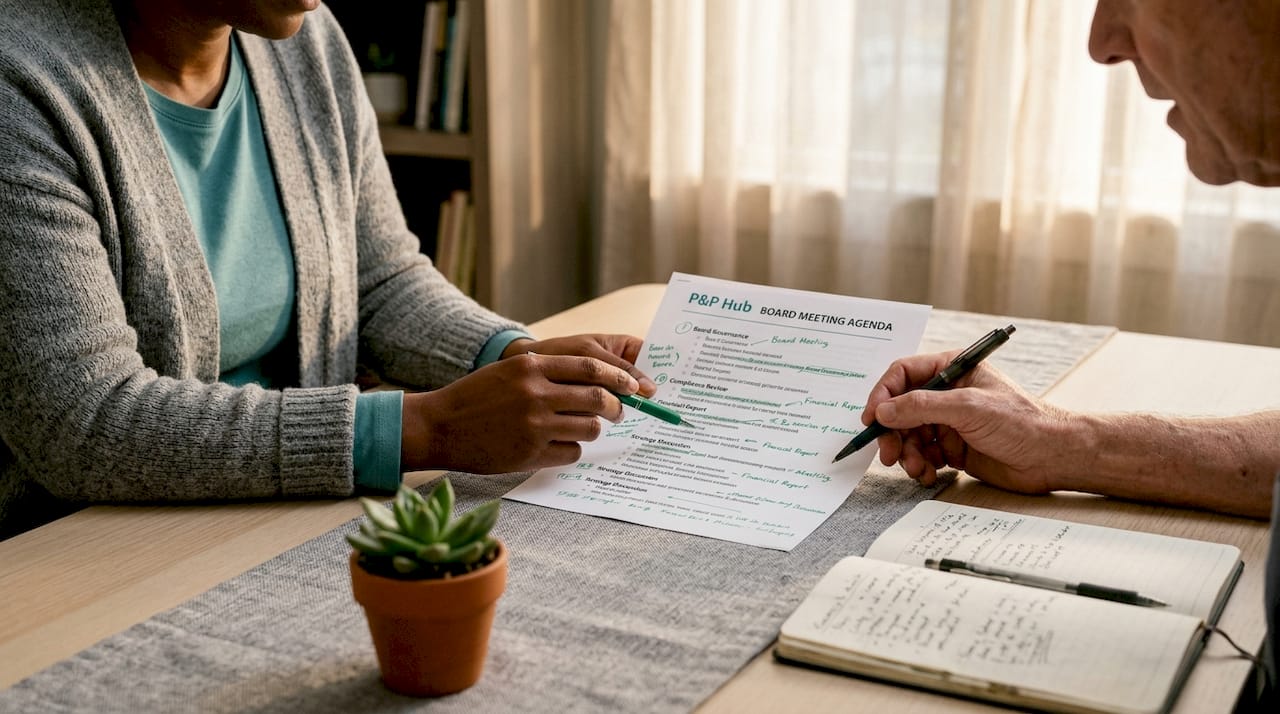
Meeting governance is where most frameworks quietly fail. Boards hold meetings, but without the right mechanics, those meetings produce no reliable compliance record.
NSW Government guidance sets the minimum quorum at the greater of three persons or one quarter of governing body members. That threshold is not administrative detail. It determines whether a decision is legally valid. A motion passed without quorum is not a decision your organisation can rely on.
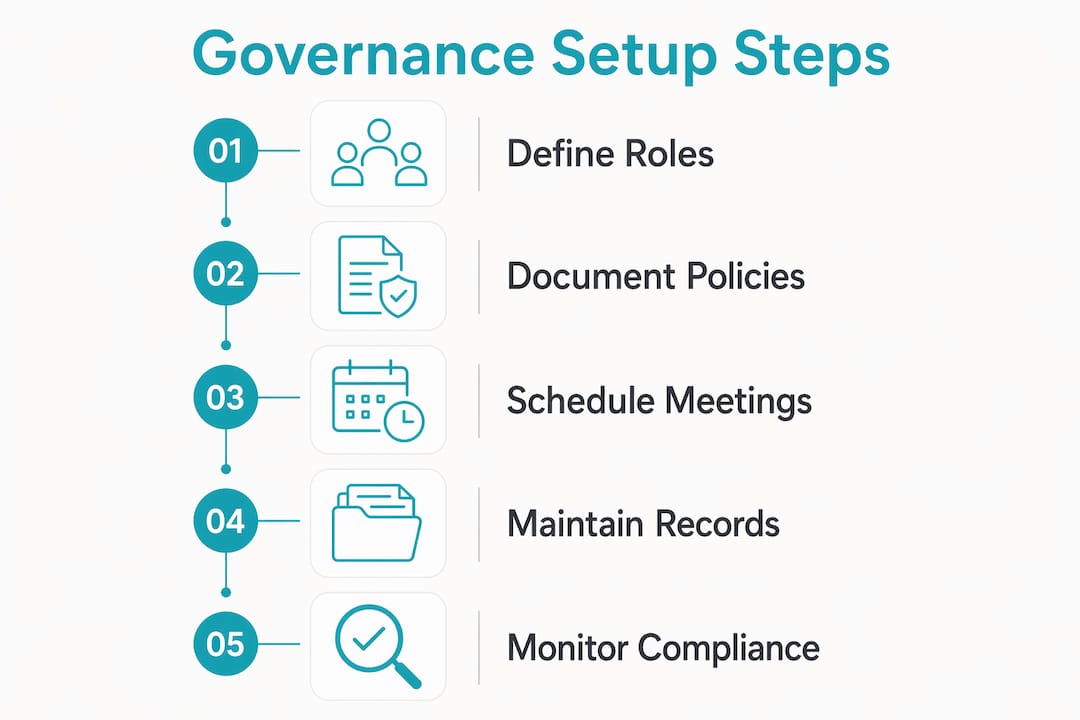
Follow these steps to build meeting governance into your framework from the outset:
- Define quorum in your constitution. State the rule explicitly and include a process for what happens when quorum is not reached.
- Use a standard agenda template. Include standing items: conflicts of interest, financial report, decisions from the previous meeting, and matters arising.
- Record minutes completely. Accurate meeting minutes must capture all decisions, the names of those present, and any declared conflicts. Summaries are not sufficient.
- Distribute and confirm minutes promptly. Minutes should be circulated within a defined timeframe, confirmed at the next meeting, and signed by the chair.
- Align meeting cycles to your governance calendar. Schedule board meetings, finance reviews, and annual reporting obligations in a single workplan at the start of each year.
Pro Tip: Templated board agendas and workplans create repeatable routines that generate consistent compliance records. A one-page annual governance calendar pinned to your board portal removes the guesswork from scheduling.
What governance documents must you establish and maintain?
Every effective governance structure rests on a small set of foundational documents. These are not optional extras. Regulators, banks, and funding bodies expect them.
| Document | Purpose | Retention Requirement |
|---|---|---|
| Charity constitution | Defines purpose, decision-making, leadership appointment, and financial controls | Permanent |
| Board operating manual | Details meeting procedures, delegations, and role descriptions | Current version plus prior versions |
| Conflict of interest register | Records declared conflicts and outcomes | Minimum 7 years |
| Meeting minutes | Captures decisions, attendance, and declared interests | Minimum 7 years |
| Financial records | Supports audit readiness and fund accountability | Minimum 7 years |
A charity constitution is the governance rulebook regulators and banks expect as standard. It covers how decisions are made, how leaders are appointed, and how assets are controlled. Without one that is current and accessible, your organisation cannot demonstrate basic governance integrity.
Record retention for at least 7 years is a minimum standard under ACNC requirements. That means storage systems need to be set up at the point of framework design, not retrofitted when an audit is announced. Cloud-based document management with defined folder structures and access controls is the practical solution for most small to medium nonprofits.
How do you separate board governance from management?
Blurred lines between the board and management are the most common source of governance failures in nonprofits. The board sets direction, approves policy, and holds management accountable. Management executes. When those functions overlap without clear boundaries, accountability disappears.
Your framework needs to make the distinction explicit through documented role descriptions and a delegations register. The delegations register specifies what decisions the CEO or executive team can make independently, what requires board approval, and what requires full board resolution. Without it, boards either micromanage operations or abdicate oversight entirely.
Monitoring and reporting mechanisms close the loop. The board should receive regular reports against agreed performance indicators, not just financial summaries. This keeps governance focused on mission delivery rather than operational detail. Governance and mission outcomes are directly connected when reporting structures are designed well.
Treat governance as a system rather than a collection of isolated practices. Effective nonprofit governance builds accountability at every level, from board induction through to annual performance review.
Key takeaways
A sound nonprofit governance framework setup requires documented duties, meeting mechanics, governance records, and clear role boundaries working together as a single system.
| Point | Details |
|---|---|
| Embed ACNC duties practically | Use onboarding notes, conflict registers, and standing agenda items to make Standard 5 traceable. |
| Set meeting mechanics precisely | Define quorum, minute standards, and agenda templates in your constitution and board manual. |
| Retain records for 7 years minimum | Build storage systems and retention rules into your framework at setup, not after an audit notice. |
| Document your constitution fully | A current charity constitution is expected by regulators, banks, and funding bodies as baseline evidence. |
| Separate governance from management | A delegations register and clear role descriptions prevent accountability gaps at the board-management boundary. |
What i have learned after nearly three decades in this sector
The organisations that struggle most with governance are rarely the ones that lack good intentions. They are the ones that treated governance as a document exercise rather than a working system. A policy manual sitting in a filing cabinet does not demonstrate compliance. A board that cannot locate its conflict register during an ACNC review does not inspire confidence, regardless of how well-intentioned its members are.
What actually works is designing governance to be self-evidencing. Every meeting produces a minute. Every conflict is recorded. Every decision traces back to a delegated authority. When you build those habits into your framework from day one, the evidence accumulates naturally. You are not scrambling to reconstruct a paper trail when a funder or regulator asks questions.
The other thing I have seen consistently is that boards underinvest in their own tools. A shared governance calendar, a standard agenda template, and a simple document register cost almost nothing to set up. They save significant time and reduce the risk of a compliance gap that could have been avoided entirely. If your board is still running meetings from memory and storing minutes in someone's personal email, that is the first thing to fix.
— Rachel
How the planning and practice hub supports governance framework setup
Australian nonprofits face a specific set of regulatory expectations, and generic governance templates rarely meet them. The Planning and Practice Hub works with boards and executive teams to build governance frameworks that are practical, compliant, and matched to the organisation's size and risk profile.
From ACNC compliance mapping to board process design, the work is co-developed with your team rather than handed over as a document. If you are ready to establish or strengthen your governance structure, explore the not-for-profit support services available through The Planning and Practice Hub, or review the full range of consulting services to find the right starting point for your organisation.
FAQ
What is a nonprofit governance framework?
A nonprofit governance framework is the structured set of policies, roles, documents, and processes that enables a charity to meet its legal obligations and operate with accountability. It covers board duties, meeting protocols, governance documents, and role boundaries between the board and management.
What does ACNC governance standard 5 require?
ACNC Governance Standard 5 requires responsible persons to act with reasonable care, act honestly in the charity's best interests, disclose conflicts of interest, and maintain sound financial oversight. These duties must be demonstrable through documented processes and records.
How long must australian charities keep governance records?
Australian charities must retain operational and financial records for at least 7 years to meet ACNC Governance Standards and support audit readiness. This includes meeting minutes, financial records, and conflict of interest registers.
What is the minimum quorum for a nonprofit board meeting?
Under NSW Government guidance, the minimum quorum is the greater of three persons or one quarter of governing body members. Decisions made without quorum are not valid governance decisions.
Why do boards need a delegations register?
A delegations register defines which decisions the CEO can make independently and which require board approval. Without it, accountability between the board and management becomes unclear, which is one of the most common sources of governance failure in nonprofits.