
Stakeholder governance is the system of structures, rules, and processes that determines how an organisation accounts for the interests of all parties affected by its operations, not just shareholders. For non-profit and human services leaders in Australia, this distinction carries real weight. Your accountability runs to clients, communities, funders, regulators, staff, and the public simultaneously. Stakeholder governance establishes decision authority, transparency requirements, and accountability mechanisms across all of those relationships. Tools like Diligent and frameworks like ESG principles have formalised this shift, but the operational discipline required goes well beyond a board policy.
What is stakeholder governance and what are its core principles?
Stakeholder governance rests on five principles that boards must actively implement: identifying all stakeholders, integrating their input into strategy, transparent reporting, balancing competing interests, and maintaining a focus on long-term value creation. Each principle requires a structural mechanism, not just a stated commitment.

Stakeholder management sits underneath governance as the operational layer. Digital NSW defines stakeholder management as a four-step process: Identify, Analyse, Plan, and Engage. This process reduces friction, builds trust, and converts potential risks into opportunities within governance frameworks. Understanding the difference between governance and management matters here. Governance sets the rules and accountability structures; management is how you execute them day to day.
Stakeholders fall into three categories: internal (staff, board members), external (clients, funders, regulators), and indirect (communities, advocacy groups, the broader public). Each group carries different expectations and different levels of influence over your organisation's decisions. Governance structures must account for all three, not just the loudest voices in the room.
Operationally, this means structured mechanisms for input, named decision owners, and clear escalation paths when stakeholder concerns are not resolved at the first point of contact.
- Broad accountability: Decisions are assessed against their impact on all stakeholder groups, not only financial outcomes.
- Structured inclusion: Stakeholder input is gathered through defined processes, not ad hoc consultation.
- Transparent reporting: Outcomes and decisions are documented and disclosed to relevant parties.
- Clear decision authority: Named individuals own specific governance decisions and are accountable for them.
- Long-term value orientation: Strategy weighs sustained community and organisational benefit over short-term gains.
Pro Tip: Map your stakeholders before your next board planning cycle. A simple matrix plotting influence against interest will surface gaps in your current engagement and reveal where governance accountability is weakest.
How does stakeholder governance differ from shareholder governance?
The shareholder model of governance focuses on maximising financial returns for equity owners. Every major decision is filtered through that single lens. The stakeholder model, by contrast, balances financial and non-financial impacts across all affected parties. This is not a philosophical preference. It is a structural difference in how boards define success and to whom they are accountable.
For Australian non-profits and human services organisations, the shareholder model was never the right fit. Your board has always been accountable to a broader constituency. What stakeholder governance provides is a formal architecture for that accountability, one that holds up under regulatory scrutiny and sector audits.
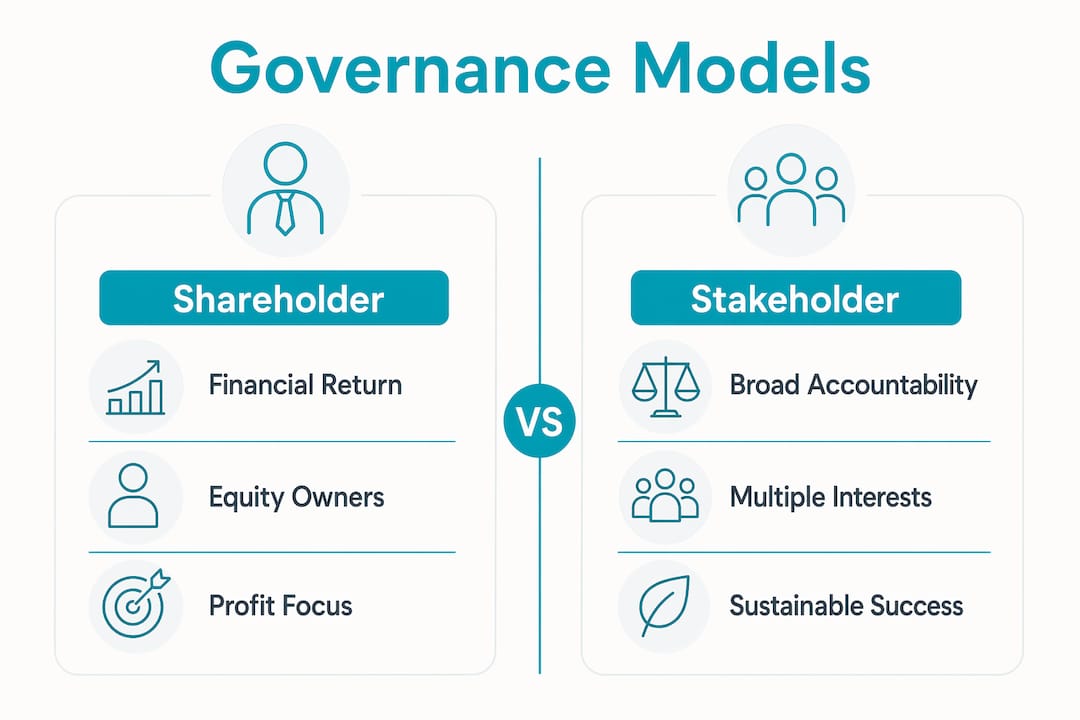
| Dimension | Shareholder governance | Stakeholder governance |
|---|---|---|
| Primary purpose | Maximise financial returns for owners | Balance value creation across all affected parties |
| Accountability | Equity holders | Clients, staff, funders, communities, regulators |
| Board focus | Profit and shareholder value | ESG, community impact, compliance, mission delivery |
| Reporting | Financial performance | Financial and non-financial disclosure |
| Risk lens | Investment and market risk | Reputational, regulatory, and social risk |
The practical implication for boards is that ESG oversight, community impact reporting, and governance and mission delivery are not add-ons to the governance agenda. They are the governance agenda.
Pro Tip: Review your board charter against this table. If accountability language still defaults to financial performance only, the charter needs updating before your next compliance review.
How to implement stakeholder governance in non-profits and human services
Operationalising stakeholder governance requires embedding it into workflows with traceable accountability, grievance mechanisms, and structured inclusion. A board resolution is not enough. The discipline lives in the operational infrastructure.
Here are the practical steps for non-profit and human services organisations:
- Map all stakeholders. Document every group affected by your operations. Include clients, carers, staff, volunteers, funding bodies, peak bodies, and community members. Assign each group a relationship owner within your organisation.
- Build engagement capacity. Create defined channels for stakeholder input: surveys, advisory groups, complaints processes, community forums. Each channel needs a named owner and a documented feedback loop.
- Embed a culture of inclusion. Governance culture is set by what leadership models. If board and executive decisions consistently reference stakeholder input, the organisation follows. If they do not, no policy will compensate.
- Track and integrate feedback. Use a system, whether a purpose-built tool like Diligent or a structured internal register, to record stakeholder concerns and document how they influenced decisions. This is your audit trail.
- Develop grievance mechanisms. Stakeholders must have a clear, accessible path to raise concerns and receive a response. Governance accountability without grievance follow-through is incomplete.
The most common failure point is the gap between strategic intent and daily workflow. Boards must keep pace with jurisdictional requirements and embed governance in operational infrastructure for true accountability. In the Australian human services sector, where regulatory requirements span the NDIS Quality and Safeguards Commission, the ACNC, and state-based bodies, that gap carries real compliance risk.
Pro Tip: Assign a named governance lead at the operational level, not just the board level. This person owns the stakeholder register, manages the grievance log, and reports directly to the CEO on governance performance.
What stakeholder governance frameworks matter for Australian non-profits in 2026?
The stakeholder-centric governance model formally recognises that long-term organisational success depends on maintaining healthy relationships with all stakeholders. It incorporates ESG principles and the concept of social licence to operate. For Australian non-profits in 2026, this model is increasingly the standard against which regulators and funders measure governance maturity.
The Australian Charities and Not-for-profits Commission continues to strengthen its expectations around transparency and accountability. The NDIS Commission's audit frameworks assess governance structures directly. Boards that have embedded stakeholder governance into their charters, policies, and reporting cycles are better positioned for both compliance and funding outcomes.
| Framework | Core focus | Relevance for Australian non-profits |
|---|---|---|
| Stakeholder-centric governance model | Relationship health across all stakeholder groups | Directly applicable; aligns with ACNC and NDIS expectations |
| ESG principles | Environmental, social, and governance performance | Increasingly required by government and philanthropic funders |
| B Impact Assessment | Purpose and stakeholder governance evidence | Useful benchmark for governance maturity and reporting |
| ACNC Governance Standards | Board accountability and transparency | Mandatory compliance framework for registered charities |
Stakeholder inclusivity enables organisations to anticipate risks and capitalise on new opportunities in complex environments. That is not abstract. In the human services sector, it means your governance model either helps you see change coming or leaves you reacting to it after the fact.
For practical guidance on organisational governance frameworks, the foundational principles apply equally to non-profits navigating this shift.
Key takeaways
Stakeholder governance works because it embeds accountability, transparency, and structured inclusion into the operational infrastructure of an organisation, not just its board policies.
| Point | Details |
|---|---|
| Governance vs management | Governance sets the rules; stakeholder management is the operational execution of those rules. |
| Five core principles | Identify stakeholders, integrate input, report transparently, balance interests, and focus on long-term value. |
| Shareholder vs stakeholder model | Non-profits were never built for the shareholder model; stakeholder governance formalises the accountability structure they already need. |
| Implementation discipline | Named decision owners, grievance mechanisms, and traceable records are what separate governance intent from governance practice. |
| 2026 compliance context | ACNC, NDIS Commission, and ESG reporting expectations make stakeholder governance a compliance requirement, not just a strategic preference. |
Why governance has to live in the work, not just the boardroom
After nearly three decades working with non-profits and human services organisations across Australia, the pattern I see most often is this: the governance framework looks excellent on paper and falls apart in practice. Boards adopt the right language, update their charters, and then return to making decisions the same way they always have.
Treating stakeholder concerns as secondary undermines governance effectiveness. That is not a soft observation. It is the single most common reason organisations find themselves exposed during audits or funding reviews. The regulator does not want to see your policy. They want to see evidence that stakeholder input shaped a decision.
Future governance requires recognising stakeholders as co-creators of value, with integrated information flows and leadership that champions genuine inclusion. That means the CEO references the client advisory group in executive reports. It means the board minutes show that a community concern changed a service design decision. It means the grievance register has entries and resolutions, not just a template.
The organisations I have worked with that do this well share one characteristic: they treat governance as operational discipline, not a compliance exercise. That shift in framing changes everything about how the work gets done.
— Rachel
How The Planning and Practice Hub can help
Stakeholder governance is not a one-size-fits-all framework, particularly in Australia's human services sector where regulatory obligations span more than 50 bodies. The Planning and Practice Hub works directly with non-profit boards and executive teams to co-develop governance structures that are both compliant and operationally grounded. Rachel Willis brings nearly three decades of sector-specific experience to every engagement, which means advice that reflects the actual complexity of your operating environment. If your board is ready to move from governance intent to governance practice, explore our human services consulting or review our not-for-profit support services to find the right starting point.
FAQ
What is stakeholder governance in simple terms?
Stakeholder governance is the system of structures and processes that ensures an organisation is accountable to all parties affected by its operations, including clients, staff, communities, and funders, not only its financial owners.
Why does stakeholder governance matter for non-profits?
Non-profits carry accountability to a broad constituency by definition. Stakeholder governance provides the formal architecture for that accountability, which directly supports compliance with bodies like the ACNC and the NDIS Quality and Safeguards Commission.
What is the difference between stakeholder governance and stakeholder management?
Governance sets the rules, decision authority, and accountability structures. Stakeholder management is the operational process of identifying, analysing, planning, and engaging specific groups within that governance framework.
How do you implement stakeholder governance in a non-profit?
Start by mapping all stakeholder groups and assigning relationship owners, then build defined engagement channels, embed feedback into decision-making processes, and maintain a traceable record of how stakeholder input shaped outcomes.
What frameworks support stakeholder governance for Australian non-profits?
The stakeholder-centric governance model, ESG principles, the B Impact Assessment, and the ACNC Governance Standards are the most relevant frameworks for Australian non-profits seeking to formalise and demonstrate stakeholder governance maturity in 2026.