
Governance is the framework of strategic oversight, accountability, and decision-making that determines whether a non-profit organisation achieves its mission or falls short of it. The role of governance in mission delivery goes well beyond compliance paperwork or board meeting minutes. It is the system that aligns your organisation's purpose with its resources, its people, and its results. Frameworks from the OECD, the UK Charity Commission, and the UNDP all confirm that governance effects are measurable criteria in evaluating mission success, sitting alongside directionality, portfolio, and material outcomes. For non-profit leaders in Australia and similar jurisdictions, understanding this connection is the first step toward building an organisation that consistently delivers on its purpose.
How governance structures influence mission outcomes
The impact of governance on delivery begins with how your organisation is structured at the top. Boards of trustees, executive leadership, and sub-committees each carry distinct responsibilities, and when those responsibilities are clearly defined, the organisation moves with purpose. When they are not, confusion fills the gap and delivery suffers.

The board's primary function is strategic oversight, not operational management. Boards must actively govern strategy execution by owning the strategic centre and overseeing assumptions without micromanaging operations. This distinction matters enormously in non-profits, where passionate leaders can easily blur the line between governance and management, creating duplication, confusion, and accountability gaps.
Effective governance structures in non-profits typically include:
- A board of trustees or directors with clear fiduciary and strategic responsibilities
- An executive leadership team accountable for operational delivery and reporting
- Sub-committees focused on finance, risk, audit, or programme oversight
- Defined decision rights that specify who approves what, at which level
The OECD's work on mission-oriented innovation highlights that governance coordinating diverse actors drives mission success rather than treating governance as administrative overhead. For Australian non-profits operating across multiple funding streams or service areas, this means governance must actively manage interdependencies, not just tick compliance boxes. A well-designed governance structure creates the conditions for your organisation to learn, adapt, and deliver consistently.
Monitoring frameworks are the practical expression of this. Boards that rely solely on management reports for oversight are operating with a blind spot. Independent evidence, external reviews, and structured reporting cycles give trustees a credible picture of whether the mission is actually being achieved.
What governance challenges most hinder mission delivery?
Governance failures in non-profits rarely announce themselves loudly. They accumulate quietly through unclear roles, under-resourced oversight, and deferred decisions until a funding crisis or regulatory action forces the issue into the open.
The most common challenge is ambiguity of ownership. The UK's Whitehall Monitor 2026 documents a striking example: unclear ministerial ownership of missions stalled government delivery for over a year before a dedicated delivery unit with clear ownership was implemented. The same dynamic plays out in non-profits when no single person or committee is clearly responsible for a programme outcome. Decisions stall, accountability diffuses, and the mission loses momentum.
Risk management lapses are another significant challenge. The UK Charity Commission's guidance makes clear that trustees are legally responsible for safeguarding charitable funds through good governance, including financial management and risk controls, even when using employees, volunteers, or agents. Many boards treat risk management as an annual exercise rather than a living process embedded in organisational culture. That approach leaves organisations exposed.
Governance failures can also lead directly to regulatory action. Trustees can face personal liability for negligence or failure in protecting vulnerable people, and disqualification is a documented consequence of governance breakdown in the charity sector. This is not a theoretical risk for Australian non-profits operating under the Australian Charities and Not-for-profits Commission (ACNC).
Pro Tip: Conduct a simple governance health check annually. Map every significant decision made in the past 12 months and ask: who owned it, who approved it, and was that the right person? Gaps in that map reveal your governance ambiguity before it becomes a delivery problem.
The challenges in governance and delivery often share a common root: governance is treated as a structure to maintain rather than a system to actively use. Shifting that mindset is where improvement begins.
What are governance best practices for mission success?
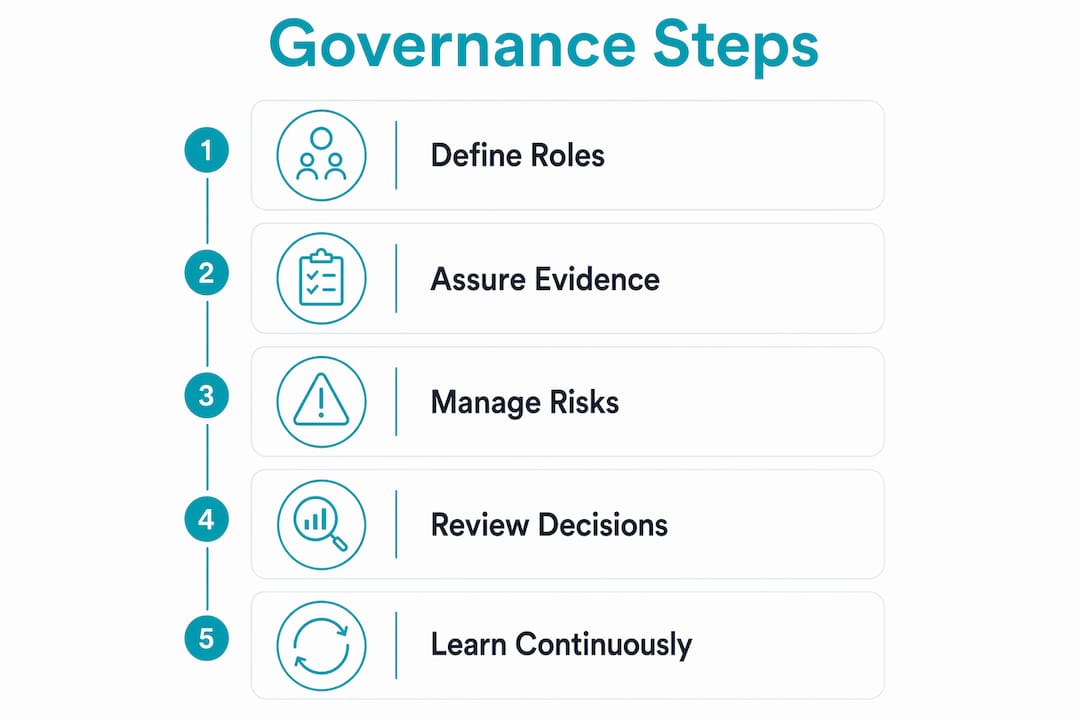
Effective governance for mission success is built on three foundations: credible evidence, clear roles, and a culture of learning. Each of these requires deliberate design, not good intentions alone.
The first foundation is independent assurance. Governance designed as an assurance system triangulates independent evidence beyond management self-assessments for credible mission outcome reporting. In practice, this means boards should receive information from multiple sources: management reports, beneficiary feedback, external audits, and programme evaluations. Relying on a single source, particularly one produced by the team being overseen, creates a structural conflict of interest.
The following table outlines key governance approaches and their practical application for non-profits:
| Governance approach | What it involves | Best suited for |
|---|---|---|
| Independent assurance | External audits, beneficiary surveys, third-party reviews | Financial oversight and programme evaluation |
| Sub-committee oversight | Dedicated committees for finance, risk, and audit | Organisations with complex funding or service delivery |
| Reflexive monitoring | Regular review cycles that incorporate learning and adaptation | Programmes with evolving community needs |
| Decision rights mapping | Documented authority levels for strategic and operational decisions | Boards managing role clarity between governance and management |
| Capacity building | Trustee induction, ongoing education, and skills audits | Boards with high turnover or new governance frameworks |
The second foundation is role clarity at leadership level. The NACD and Morningstar 2026 report highlights the need for disciplined engagement in governance to balance oversight and execution. Boards that drift into operational decisions create confusion for executives and undermine accountability. Equally, boards that disengage entirely leave strategy without scrutiny.
The third foundation is a learning culture. The UNDP's work across 140 countries demonstrates that strengthening governance removes silos and fosters systemic coordination. For non-profits, this means governance meetings should include structured reflection on what is working, what is not, and what needs to change. Reflexive monitoring, where boards regularly review assumptions and adapt their oversight accordingly, is the practical mechanism for this.
Pro Tip: Ask your board to review one programme assumption at every meeting. Not the data, but the assumption underneath the data. This single habit builds the reflexive monitoring culture that separates high-performing boards from compliant ones.
You can read more about the distinction between oversight and compliance in our article on compliance vs governance, which is a distinction that trips up many well-intentioned boards.
Practical steps to strengthen governance and improve delivery
Knowing that governance matters is not the same as knowing where to start. The following steps give non-profit leaders a structured path to improving governance without overhauling everything at once.
-
Conduct a governance health check. Review your current governance documents, including your constitution, board charter, delegation frameworks, and risk register. Identify gaps between what is documented and what actually happens. Many organisations discover that their governance documents describe an organisation they no longer are.
-
Clarify decision rights. Develop or update a delegations framework that specifies which decisions sit with the board, which sit with the CEO, and which sit with sub-committees. This single document resolves the majority of role ambiguity that stalls delivery.
-
Invest in trustee induction and education. New trustees need structured onboarding that covers legal responsibilities, the organisation's mission and strategy, financial literacy, and risk management. Ongoing education keeps experienced trustees current with regulatory changes and sector developments.
-
Strengthen financial and risk controls. Trustees' duties include proportionate due diligence of partners and beneficiaries to protect funds and safeguard vulnerable groups. Review your due diligence processes for funding partners, contractors, and programme delivery agents. Ensure your risk register is reviewed at every board meeting, not just annually.
-
Implement independent assurance mechanisms. Commission an external governance review every two to three years. Use beneficiary feedback as a standing agenda item. Engage an internal audit function or equivalent for organisations above a certain size.
-
Improve stakeholder reporting. Transparent reporting to funders, beneficiaries, and the community builds trust and reinforces accountability. Annual reports that go beyond financial statements to describe mission outcomes demonstrate governance maturity.
-
Engage external consultancy support. For organisations navigating significant change, regulatory complexity, or governance gaps, an experienced consultant can accelerate improvement and provide independent perspective that internal teams cannot always offer.
Understanding organisational governance fundamentals before undertaking a health check gives your leadership team a shared language and framework to work from.
Key takeaways
Strong governance is the direct enabler of mission delivery, and non-profits that treat it as a living system rather than a compliance obligation consistently outperform those that do not.
| Point | Details |
|---|---|
| Governance drives mission outcomes | Clear roles, credible evidence, and coordinated oversight directly determine whether your mission is achieved. |
| Ambiguity stalls delivery | Unclear ownership of decisions and responsibilities is the most common cause of mission delivery failure. |
| Independent assurance is non-negotiable | Boards must triangulate evidence beyond management reports to maintain credible oversight of mission progress. |
| Trustees carry legal responsibility | Fiduciary duties include financial controls, due diligence, and safeguarding, regardless of who carries out the work. |
| Governance improvement is incremental | A health check, clearer decision rights, and structured trustee education are practical starting points for any organisation. |
What I've learned about governance and mission delivery
After nearly three decades working across Australia's human services sector, I have seen governance treated as everything from a bureaucratic burden to a genuine source of organisational strength. The difference in outcomes between those two orientations is stark.
The most persistent misconception I encounter is that governance is primarily about compliance. Boards that focus on ticking regulatory boxes often miss the deeper function: governance is how your organisation makes good decisions under uncertainty. When the board is engaged, curious, and willing to challenge assumptions, the executive team is sharper, the strategy is more grounded, and the mission is more likely to be delivered.
What I have also observed is that governance problems rarely stay contained. A board that avoids difficult conversations about financial risk will eventually face a crisis that those conversations could have prevented. A board that micromanages operations will lose a capable CEO. A board that never reviews its own performance will drift from the organisation's needs without realising it.
The non-profits I have seen deliver most consistently over time share one characteristic: their boards treat governance improvement as an ongoing responsibility, not a one-off project. They review their own performance, invest in trustee development, and hold themselves to the same standard of evidence they expect from their executive teams. That is not a complicated idea. It is just one that requires genuine commitment to act on.
— Rachel
How Theplanningandpracticehub supports non-profit governance
Theplanningandpracticehub works with non-profit leaders across Australia to strengthen governance frameworks and improve mission delivery. Rachel Willis and the team bring close to three decades of experience in human services, offering tailored support that addresses the specific regulatory and operational challenges your organisation faces.
Whether you need a governance health check, support developing a delegations framework, or guidance on trustee education and risk management, Theplanningandpracticehub provides co-developed strategies that fit your context. Our not-for-profit support services are designed specifically for organisations like yours. Visit Theplanningandpracticehub to learn more or get in touch to discuss how we can support your governance and mission delivery goals.
FAQ
What is the role of governance in mission delivery?
Governance is the system of oversight, accountability, and decision-making that enables a non-profit to direct its resources toward its mission effectively. Without clear governance structures, organisations face ambiguity, risk, and delivery failure.
How does governance affect mission outcomes in non-profits?
Governance affects mission outcomes by determining how decisions are made, how risks are managed, and how performance is monitored. The OECD identifies governance effects as measurable criteria in evaluating whether a mission is being achieved.
What are the most common governance challenges for non-profits?
The most common challenges are ambiguity of ownership, weak risk management, and over-reliance on management self-reporting. The Whitehall Monitor 2026 documents how unclear ownership stalled delivery for over a year in a government context, a pattern that mirrors non-profit experience.
What are governance best practices for non-profits?
Best practices include independent assurance mechanisms, clear decision rights, structured trustee education, and reflexive monitoring cycles. Boards should receive evidence from multiple sources, not just management reports, to maintain credible oversight.
How can non-profit leaders start improving governance today?
Start with a governance health check: review your constitution, board charter, and risk register against current practice. Then clarify your delegations framework and schedule a structured trustee induction review. These three steps address the most common governance gaps without requiring a full structural overhaul.