
TL;DR:
- Queensland human services organizations can demonstrate HSQF compliance through certification, accreditation, or self-assessment based on service type and funding.
- Embedding standards into governance and mapping evidence to HSQF indicators from the start ensures smooth audit processes.
Queensland human services organisations demonstrate HSQF compliance through one of three approved pathways: HSQF certification by a JAS-ANZ-accredited certification body, evidence of accreditation under another approved quality system, or self-assessment. Your immediate next step is to check your service type against the Part 3 tables in the HSQF framework, calculate your total annual defined-term and ongoing funding for in-scope services, and contact your contract officer or HSQF Operations if your position near a threshold is unclear.
Which pathway applies depends on three things: what services you deliver, who you deliver them to, and how much Queensland Government funding you receive. Some service types require certification regardless of funding level. Queensland Health funding is excluded from threshold calculations. If you are unsure, HSQF Operations is the right first call, not a certifier.
- Confirm your service type against the HSQF Part 3 tables before assuming a pathway.
- Calculate total annual defined-term and ongoing funding for in-scope services only; exclude Queensland Health funding.
- Check for mandatory certification services (child protection placement, family-based care, restrictive practices, DFV shelters and perpetrator interventions) — these require certification regardless of funding.
- Contact your contract officer if funding sits near a threshold boundary or if you operate across multiple service types.
- Access the HSQF framework and User Guide from the Families Queensland HSQF pages before starting any evidence mapping.
What is the HSQF and what are the six Human Services Quality Standards?
The HSQF is a continuous improvement framework used by participating Queensland Government departments to set consistent quality expectations across funded human services and reduce duplication across regulatory requirements. It operates at the organisational level, meaning one quality pathway can cover multiple services and sites — a practical design that reduces administrative burden for organisations running diverse programmes.
The six Human Services Quality Standards are the core of the framework. Each one targets a distinct governance or practice domain.
| Standard | What auditors check |
|---|---|
| 1. Governance and management | Board and leadership accountability, risk management, financial controls, strategic planning |
| 2. Service access | Referral processes, eligibility, waiting lists, transition planning |
| 3. Responding to individual needs | Assessment, care or support planning, person-centred practice, cultural responsiveness |
| 4. Safety, wellbeing and rights | Incident management, safeguarding, rights promotion, restrictive practice oversight |
| 5. Feedback, complaints and appeals | Complaint handling systems, feedback loops, appeals processes, continuous improvement actions |
| 6. Human resources | Recruitment, induction, training, supervision, performance management, workforce planning |
The primary reference for what auditors actually check is the HSQF User Guide, not the framework document itself. Aligning your policies and evidence to the User Guide indicators from day one materially shortens audit time and reduces non-conformities. The HSQF standards PDF and the User Guide — both certification and self-assessable versions — are available from the Families Queensland HSQF pages.
Which organisations and services must comply with the HSQF?
The HSQF applies to organisations funded by participating Queensland Government departments to deliver in-scope human services. The key triggers are service type and funding level, and the two interact.
Funding thresholds determine the minimum pathway required. Published threshold examples indicate that organisations receiving less than $112,000 per annum in total annual defined-term and ongoing funding for in-scope services are not required to demonstrate compliance. Those receiving between $112,000 and $295,000 per annum are generally required to self-assess. Organisations above $295,000 per annum are generally required to obtain independent certification. These thresholds are reviewed annually, so confirm current figures with your contract officer each year.
Service type overrides the threshold. Certain services require certification regardless of funding level: child protection placement services, family-based care services, services using restrictive practices, domestic and family violence women's shelters, and DFV perpetrator intervention services. If your organisation delivers any of these, the funding calculation is irrelevant — certification is mandatory.
Queensland Health funding is excluded from threshold calculations. An organisation receiving significant Queensland Health funding alongside Department of Families funding needs to calculate its threshold using only the Families-funded component.
Common examples: a disability accommodation and respite provider with annual Families funding above $295,000 will almost certainly require certification. A community information and referral service with funding in the $112,000–$295,000 band will typically self-assess. A child protection placement service requires certification at any funding level.
What are the three pathways to HSQF compliance, and how do you choose?
The three pathways reflect different organisational profiles and service types. Choosing the wrong one wastes time and creates contractual risk.
Pathway 1: HSQF certification

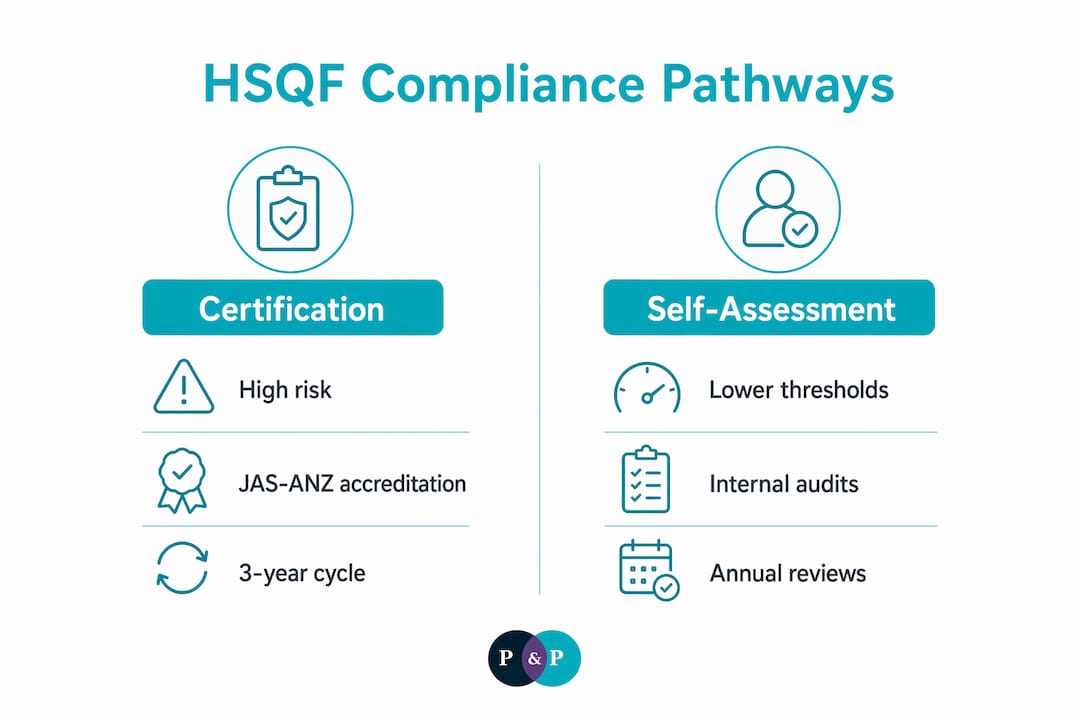
Certification is required for higher-risk services and higher-funded organisations. A JAS-ANZ-accredited certification body conducts the audit against the HSQF standards, and certification runs on a three-year cycle with audits approximately every 18 months. This pathway suits organisations delivering direct services to vulnerable people, those above the funding threshold, and all mandatory certification service types.
Pathway 2: Evidence of approved accreditation
Organisations already accredited under another approved quality system — such as ASES Version 9.1 or another system recognised by the Department — can provide evidence of that accreditation in lieu of HSQF certification. This pathway suits organisations where an existing accreditation already covers the relevant quality domains. Check the approved systems list on the Families Queensland HSQF pages before assuming your current accreditation qualifies. For a detailed look at how ASES accreditation works in practice, the ASES accreditation consultant guide is a useful starting point.
Pathway 3: Self-assessment
Self-assessment applies to organisations within the lower funding bands delivering non-direct or lower-intensity services. The Department provides a specialised User Guide and a Self-Assessment Portal for this pathway. It is not a lighter version of certification — the standards are the same, and the evidence requirements are real. The difference is that no external auditor verifies the assessment.
Pathway decision checklist
- Does your service type appear on the mandatory certification list? If yes, pathway 1 applies regardless of funding.
- What is your total annual defined-term and ongoing funding for in-scope services (excluding Queensland Health funding)?
- Does your organisation hold current accreditation under an approved quality system? If yes, confirm it is on the approved list and gather evidence.
- Do your contractual obligations specify a particular pathway? Check your funding agreement.
- Do you deliver direct services to people with high support needs or vulnerability? If yes, certification is the expected standard even where thresholds might technically allow self-assessment.
| Pathway | Typical organisational profile | External auditor required | Audit cycle |
|---|---|---|---|
| HSQF certification | Direct services, vulnerable cohorts, funding above threshold, mandatory service types | Yes — JAS-ANZ accredited body | 3-year cycle, audits ~18 months |
| Approved accreditation evidence | Existing accreditation under approved system | No (accreditation body already audits) | Per accreditation system |
| Self-assessment | Lower-intensity services, funding within lower threshold band | No | Annual self-assessment |
How do you prepare for a certification audit?
Certification preparation is a 12-month minimum project, not a pre-audit sprint. Organisations are advised to engage a certification body at least 12 months before their certification due date. Treat that selection as a professional partnership: a certifier who understands your service type and produces usable audit reports is worth more than the lowest quote.
Typical certification timeline
| Milestone | Timeframe before due date |
|---|---|
| Confirm pathway and engage certifier | 12 months |
| Gap analysis against User Guide indicators | 12 months |
| Internal audit against all six standards | 6 months |
| Corrective action plan implementation | 4–6 months |
| Pre-audit evidence pack finalised | 4–6 weeks |
| Certification audit (site visit) | At due date |
| Corrective actions from audit closed | Within agreed timeframe |
| Maintenance audit | ~18 months post-certification |
Maintenance audits can be coordinated with licensing inspections if scheduled close together, reducing the number of separate site visits and leadership time spent on inspections — a practical efficiency worth planning for from the start.
Common non-conformities and how to avoid them:
- Evidence mapping gaps: policies exist but are not linked to User Guide indicators. Fix: build a live evidence register that maps each indicator to a specific document, record, or practice.
- Policies not implemented in practice: the document says one thing, staff do another. Fix: include implementation evidence (meeting minutes, supervision records, training logs) alongside the policy.
- Insufficient staff training records: induction and ongoing training are not documented to the standard auditors expect. Fix: maintain a training matrix that records completion dates, content, and staff signatures.
- Incident register gaps: incidents recorded but not analysed or actioned. Fix: build a monthly review cycle into your quality calendar and document outcomes.
- Complaints not closed: complaints logged but resolution and learning not recorded. Fix: use a complaints register that tracks status, outcome, and any systemic improvement action.
For a detailed look at how evidence mapping works in practice, the audit preparation guide covers the core methodology in depth.
Practical preparation checklist and a practice example
The HSQF User Guide is the document auditors use to check your performance. Aligning your evidence directly to its indicators from the start is the single highest-leverage action you can take. Here is a working checklist mapped to each standard.
Standard 1 — Governance and management: Board meeting minutes, conflict of interest register, risk register, financial reports, strategic plan, delegations of authority, policies reviewed and dated.
Standard 2 — Service access: Referral and intake procedures, eligibility criteria documentation, waiting list records, transition and exit planning records.
Standard 3 — Responding to individual needs: Individual support or care plans, assessment records, cultural responsiveness policy, person-centred practice evidence, case notes.
Standard 4 — Safety, wellbeing and rights: Incident register with analysis and actions, safeguarding policy, rights charter, restrictive practice authorisation records (if applicable), complaints and incident trend reports.
Standard 5 — Feedback, complaints and appeals: Complaints register, feedback survey results, appeals records, evidence of systemic improvement actions taken in response to complaints.
Standard 6 — Human resources: Position descriptions, recruitment records, induction checklists, training matrix, supervision records, performance review documentation, workforce plan.
A practice example
A mid-sized Queensland community services organisation preparing for its first certification audit had solid policies across all six standards. What it lacked was any visible connection between those policies and the User Guide indicators. The certifier's gap analysis identified that roughly half the indicators had no mapped evidence at all — not because the practice was absent, but because no one had documented it in a way auditors could find.
The organisation spent three months building a live evidence register in a shared document, assigning an evidence owner to each indicator and linking to the specific record or practice that demonstrated compliance. The certification audit proceeded without a major non-conformity. The lesson: the practice was already there. The gap was in the map.
Selecting a JAS-ANZ-accredited certification body that understands your service type and can produce usable audit reports is a high-leverage decision for audit readiness. Ask prospective certifiers for a sample audit report and speak to at least two referees from similar organisations before signing.
For organisations considering how external advisory support fits into this process, the quality management system guide covers the broader system design questions worth resolving before you start evidence mapping.
How do you keep HSQF compliance embedded between audits?
The organisations that struggle most at certification audit are those that treat HSQF as a periodic compliance event rather than a governance discipline. Embedding the standards into everyday operations is what separates organisations that sail through audits from those that spend the six weeks before one in crisis mode.
Board and governance actions: Include HSQF compliance as a standing agenda item at board meetings, not just when an audit is approaching. Assign a board member as quality champion. Integrate HSQF risk into the organisation's risk register with clear ownership and review dates. Align the strategic plan to the six standards so that quality improvement is a board-level priority, not just an operational task.
Internal audit schedule: Run a full internal audit against all six standards at least once per year, with a targeted review of high-risk standards (particularly Standard 4 and Standard 6) every six months. Assign evidence owners to each standard and hold them accountable through the quality calendar. Close corrective actions before they accumulate — an open corrective action list at external audit is a red flag for certifiers.
Staff training and capacity building: HSQF requirements should be part of induction for all staff, not just quality managers. Use the User Guide indicators as the basis for training content so staff understand what evidence they are generating and why it matters. For compliance management tools that support evidence tracking and internal audit workflows, a purpose-built system can reduce the manual burden significantly. Refresher training ahead of each maintenance audit keeps the evidence trail current and reduces the corrective action load.
Where do you find the official HSQF documents and guidance?
Primary sources to download first:
- HSQF framework document: the foundational document setting out the six standards and their intent. Available from the Families Queensland HSQF overview page.
- HSQF User Guide — Certification version: the document auditors use to check performance against each indicator. This is the primary reference for evidence mapping if you are seeking certification.
- HSQF User Guide — Self-assessable version: the equivalent reference for self-assessing organisations, available alongside the Self-Assessment Portal.
- HSQF Scheme Rules: sets out the administrative requirements, including certification body obligations and timeframes.
Contacts:
- HSQF Operations: for pathway queries, threshold clarifications, and extraordinary circumstance requests (including natural disaster or COVID-19 related flexibility).
- Your contract officer: first point of contact for funding threshold calculations and contractual pathway requirements.
- JAS-ANZ: to verify that a certification body holds current accreditation before you engage them. Check the JAS-ANZ accreditation registry directly rather than relying on a certifier's own claims.
Key takeaways
HSQF compliance in Queensland requires organisations to confirm their pathway using the Part 3 tables, map evidence directly to User Guide indicators, and embed the six standards into governance rather than treating certification as a periodic event.
| Point | Details |
|---|---|
| Three approved pathways | Certification, approved accreditation evidence, or self-assessment — service type and funding level determine which applies. |
| Mandatory certification services | Child protection placement, family-based care, restrictive practices, DFV shelters and perpetrator interventions require certification at any funding level. |
| Funding thresholds (reviewed annually) determine requirements such as not required, self-assessment, or independent certification based on funding bands. | |
| Evidence mapping is the critical action | Align every policy and record to User Guide indicators from day one — this is what auditors check and what most organisations get wrong. |
| The Planning and Practice Hub | Supports Queensland human services organisations with evidence mapping, audit readiness, certifier selection, and governance advisory across the HSQF compliance cycle. |
A peer perspective on HSQF and strategic planning
The sector conversation about HSQF tends to focus on the audit — the site visit, the corrective actions, the certification decision. What gets less attention is the governance question underneath it: does your board actually own the evidence trail, or does it live in a quality manager's folder that no one else can find?
The organisations that get the most value from HSQF are the ones that use the six standards as a governance framework, not just a compliance checklist. Standard 1 is not just about having a risk register — it is about whether your board is actively using it to make decisions. Standard 6 is not just about training records — it is about whether your workforce plan reflects the actual demands of your service model. When leadership owns the standards at that level, the audit becomes a confirmation of what you already know, not a discovery process.
There is also a strategic planning opportunity that most organisations miss. The HSQF's continuous improvement intent aligns directly with what good strategic planning looks like: setting goals, measuring performance, identifying gaps, and acting on them. Organisations that integrate HSQF indicators into their annual planning cycle find that audit preparation is largely done before the certifier arrives. Those that keep quality and strategy in separate silos spend the months before audit scrambling to reconstruct evidence that should have been generated as a matter of course.
The question worth putting to your board at the next meeting: does our evidence map show who owns each HSQF indicator, and where the proof of compliance actually lives?
How The Planning and Practice Hub supports HSQF audit readiness
Queensland human services organisations working through HSQF certification for the first time — or preparing for a maintenance audit after a difficult cycle — often find that the gap between having good practice and being able to demonstrate it is wider than expected.
The Planning and Practice Hub works with boards, CEOs, and quality managers to close that gap. The work includes evidence mapping against the User Guide indicators, gap analysis across all six standards, policy and procedure review, internal audit facilitation, certifier selection support, and corrective action planning. One Queensland community services organisation that engaged the Hub ahead of its maintenance audit closed seven open corrective actions in six weeks and coordinated its audit with a licensing inspection, reducing the total number of site visits for that cycle. The focus is always on building your organisation's own capability, not creating dependency on external support.
To discuss what HSQF advisory support looks like for your organisation, visit the human services consulting page or explore the community services practice area.
Useful sources and recommended reads
Official HSQF documents and guidance:
- Families Queensland HSQF overview — start here; links to all framework documents, User Guides, and pathway pages.
- HSQF certification page — certification requirements, certifier selection guidance, and audit cycle information.
- HSQF self-assessable page — User Guide for self-assessing organisations and the Self-Assessment Portal.
- HSQF standards overview — summary of the six standards and the three compliance pathways.
- JAS-ANZ accreditation registry — verify your certification body's current accreditation status before signing any contract.
Recommended further reading from The Planning and Practice Hub:
- Quality management system in human services — practical guidance on building a quality management system that integrates HSQF standards into strategic and operational planning.
- NDIS compliance consultant: what boards need to know — covers the governance and board accountability dimensions of compliance frameworks, relevant for organisations managing multiple regulatory obligations alongside HSQF.
FAQ
What are the three HSQF compliance pathways in Queensland?
Queensland organisations demonstrate HSQF compliance through certification by a JAS-ANZ-accredited body, evidence of accreditation under an approved quality system, or self-assessment. Service type and annual funding level determine which pathway applies.
Which services always require HSQF certification regardless of funding?
Child protection placement services, family-based care services, services using restrictive practices, domestic and family violence women's shelters, and DFV perpetrator intervention services require certification at any funding level.
How often do HSQF certification audits occur?
Certification runs on a three-year cycle with audits approximately every 18 months. Maintenance audits can be coordinated with licensing inspections within a three-month window to reduce the number of separate site visits.
What funding thresholds trigger HSQF certification in Queensland?
Published threshold examples indicate that funding above $295,000 per annum in total annual defined-term and ongoing funding for in-scope services generally requires independent certification; the $112,000–$295,000 band generally requires self-assessment. Thresholds are reviewed annually and Queensland Health funding is excluded from calculations.
How do you find a JAS-ANZ-accredited HSQF certification body?
Check the JAS-ANZ accreditation registry directly to confirm a certification body holds current accreditation for the HSQF. Engage your preferred certifier at least 12 months before your certification due date and ask for sample audit reports and referees from similar organisations.