
Providers who treat audit preparation as a continuous operational discipline consistently outperform those who scramble in the weeks before an assessor arrives. Effective ACQSC audit preparation means maintaining organised, accessible evidence across all seven Strengthened Aged Care Quality Standards every day, not just when an audit is imminent. The core elements are:
- Governance arrangements and clinical governance systems documented and current
- Workforce compliance records linked to care delivery evidence
- Incident and complaints registers with clear resolution trails
- Self-assessment conducted at least quarterly
- A continuous improvement register that connects problems to remediation
- Staff and leadership prepared to speak confidently to auditors about daily practice
When and why ACQSC audits occur
The Aged Care Quality and Safety Commission (ACQSC) audits providers registered in categories 4, 5, and 6 under the Aged Care Act 2024. Audits occur at three points: registration, renewal of registration, and variation of registration (when a provider adds a new category 4, 5, or 6 service). They are announced, so providers know when they are happening.

What catches many providers off guard is that audit findings also draw on notifications, complaints, and compliance history. A pattern of Serious Incident Response Scheme notifications or unresolved complaints can trigger closer scrutiny at the next registration renewal. The audit is not a standalone event; it reflects the cumulative picture of how your organisation operates. Understanding aged care risk-based regulation helps boards and executives see why ongoing operational discipline matters far more than a pre-audit sprint.
What ACQSC audits actually assess
Auditors assess conformance with all seven Strengthened Aged Care Quality Standards, covering person-centred care, governance, and continuous improvement. The focus areas are:
- Governance arrangements and clinical governance systems
- Organisational systems and processes supporting care delivery
- Staff qualifications, training records, screening, and care minutes
- Clinical care documentation: assessments, care plans, medication administration
- Incident and complaints registers with investigation and resolution evidence
- Self-assessment and continuous improvement documentation
- Experience and outcomes for older people in your care
| Assessment area | What auditors look for |
|---|---|
| Governance | Board oversight, clinical governance structures, policy currency |
| Workforce | Screening records, training logs, care minutes compliance |
| Clinical care | Linked assessments, care plans, medication records |
| Incidents and complaints | Register completeness, investigation quality, resolution evidence |
| Continuous improvement | Self-assessment frequency, improvement register, outcomes |
Category 6 providers renewing registration can also receive an exceeding rating. To qualify, a provider must conform with all standards and meet three additional criteria: excelling in active partnerships with older people and workers, excelling in governance and clinical governance systems, and excelling in the dining experience.
The three stages of the ACQSC audit process
The audit process runs across three stages, and knowing what happens at each one removes a great deal of uncertainty.
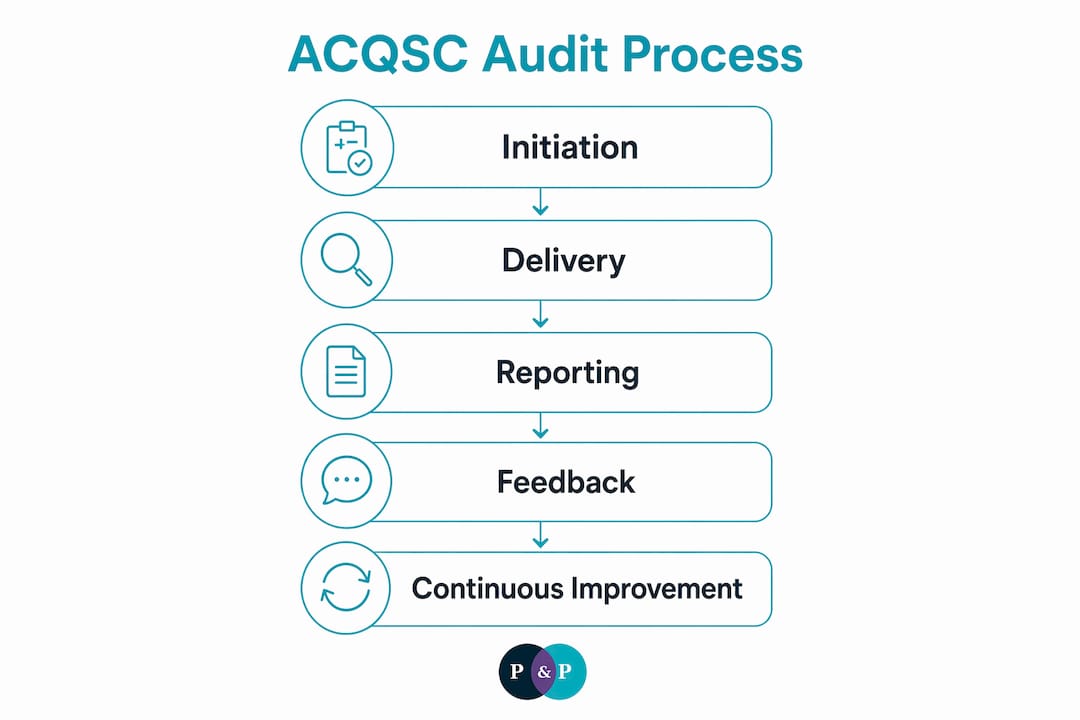
Stage 1: Audit initiation. The ACQSC contacts you, requests key documents, and explains the audit scope. This is your signal to confirm that evidence is organised and accessible, not to start compiling it from scratch.
Stage 2: Audit delivery. Auditors meet with your governing body and senior management, review governance systems and processes, then test whether those systems are embedded in actual care delivery. For category 6 providers, auditors visit each service. For categories 4 and 5, they visit a selection. Critically, auditors assess whether policies are applied consistently in practice, not just whether they exist on paper. Staff interviews, observations, and consumer feedback all form part of the evidence base.
Stage 3: Audit reporting. Auditors prepare a preliminary report. You have an opportunity to provide feedback before the final report is issued. The final audit report summarises conformance ratings across all standards assessed.

| Stage | Key activities | Provider action required |
|---|---|---|
| Initiation | Document request, scope explanation | Confirm evidence is accessible |
| Delivery | Site visits, interviews, document review | Brief staff, make records available |
| Reporting | Preliminary report, feedback opportunity, final report | Review findings, respond promptly |
Pre-audit readiness checklist
The ACQSC provides a pre-audit readiness checklist that highlights key actions and available resources. Use it as a standing self-assessment tool, not a one-off preparation exercise. The practical actions that matter most are:
- Maintain current, linked documentation across all seven quality standards
- Conduct self-assessments at least quarterly, with findings recorded and acted on
- Keep a continuous improvement register that connects incidents, complaints, and remediation actions
- Confirm workforce compliance records are current: screening, training, care minutes
- Prepare staff through regular communication about the audit process and what auditors ask
- Verify that evidence can be retrieved quickly. Providers must often produce records within one hour during an unannounced contact
- Confirm the governing body can speak to governance arrangements and clinical oversight
Audit guidance and resources available to providers
The ACQSC publishes a suite of resources specifically designed to support preparation. These include:
- Registration, renewal, and variation of registration audit guides
- Pre-audit readiness checklist (available from the ACQSC resource library)
- Audit Evidence Collection Tool (AECT), which providers must complete and submit as part of the audit process
- Standard meeting agendas for governing body, senior management, opening, entry, and closing meetings
- Strengthened Quality Standards guidance to support conformance and best practice
The AECT is worth particular attention. It structures how you collect and present evidence about your systems and processes, and completing it thoroughly before the audit gives auditors a clear, organised picture of your operations. Providers who treat the AECT as a live document rather than a last-minute submission tend to find the delivery stage considerably less stressful.
For governance-specific preparation, the aged care governance obligations guide offers practical frameworks boards can apply directly.
Embedding continuous compliance: insights from The Planning and Practice Hub
The providers who perform best at audit are not the ones who prepare hardest in the final month. They are the ones whose systems make compliance visible every week.
Treating audit preparation as an ongoing operational discipline, using pre-audit readiness tools as continuous self-assessment mechanisms rather than one-off checklists, is the single most effective shift a provider can make. When incidents, workforce data, clinical care records, and governance evidence are connected in daily operations, auditors find exactly what they need, and so do you.
One aged care provider working with The Planning and Practice Hub had strong individual systems for incidents, workforce, and clinical care, but those systems did not talk to each other. Quality managers spent days before each audit manually cross-referencing records to build a coherent evidence picture. After restructuring their approach to link incident outcomes directly to improvement register entries and workforce training records, the same evidence retrieval took hours rather than days. More importantly, the governing body could see compliance gaps in real time rather than discovering them during audit preparation.
The Serious Incident Response Scheme is a useful anchor here. Linking SIRS notifications to quality improvement actions, and documenting that link clearly, demonstrates to auditors that your governance systems respond to risk rather than simply recording it. Effective incident management policy is not a compliance checkbox; it is evidence of an organisation that learns.
Audit outcomes and what they mean for registration
Audit outcomes are rated across four levels: conforming, minor non-conformance, major non-conformance, and exceeding (available to category 6 providers at renewal). These ratings directly inform registration decisions. A major non-conformance results in a one-star compliance rating on My Aged Care; minor non-conformance results in two stars. Both can be resolved once the non-conformance is addressed, but the reputational impact is immediate and public.
The ACQSC considers audit findings alongside notifications, complaints, and compliance history when making registration decisions. Conditions can be imposed on registration to manage identified risks.
Common compliance pitfalls and how to avoid them
Most compliance failures at audit are predictable. The patterns repeat across providers of all sizes.
Siloed records. When clinical care, workforce, and incident data sit in separate systems with no links between them, evidence retrieval is slow and gaps become visible to auditors. Integrate your systems or build clear cross-referencing processes.
Annual self-assessment. Providers relying on a single pre-audit self-assessment consistently miss gaps that quarterly or monthly reviews would catch. Build self-assessment into your governance calendar.
Staff who cannot explain practice. Auditors interview frontline workers. If staff cannot articulate how a policy applies to their daily work, that gap is noted regardless of what the policy document says.
Incomplete improvement registers. Recording an incident without documenting the investigation, the response, and the outcome leaves an obvious evidentiary hole.
Documentation and evidence checklist for the audit
Organise your evidence across these categories before the audit initiation stage:
- Governance: board minutes, clinical governance committee records, policy register with review dates
- Workforce: screening records, training logs, care minutes data, staff rosters
- Clinical care: current care plans, assessment records, medication administration records
- Incidents and complaints: register with dates, investigation notes, resolution evidence, SIRS notifications
- Consumer feedback: surveys, meeting notes, action responses
- Self-assessment: completed tools with dates, findings, and improvement actions
- Continuous improvement register: linked to incidents, complaints, and audit findings
Post-audit follow-up and continuous improvement
Receiving the final audit report is not the end of the process. Providers with a minor or major non-conformance must address findings within the timeframes the ACQSC specifies. But even a conforming result warrants a structured response.
Review the preliminary report carefully and use the feedback opportunity. If auditors identify areas for improvement that do not reach non-conformance, those observations still belong in your improvement register. Assign owners, set timeframes, and track progress at governance level. The next audit will look at whether you acted on what you learned from the last one.
Continuous improvement is not a phrase to include in a policy document. It is the evidence trail that shows your organisation identifies problems, responds to them, and changes practice as a result.
How The Planning and Practice Hub supports audit readiness
Audit preparation is one of the most time-intensive governance responsibilities aged care providers carry, particularly when systems are not yet integrated and leadership capacity is stretched. The Planning and Practice Hub works with aged care providers, boards, and quality teams to build the operational infrastructure that makes continuous compliance achievable rather than aspirational.
Rachel Willis brings nearly three decades of firsthand experience across Australia's human services regulatory environment, including direct work with providers navigating the Strengthened Aged Care Quality Standards. The approach is co-developed with your team, grounded in your actual systems, and focused on building internal capability rather than dependency.
If your organisation is approaching a registration renewal, managing a variation, or simply wants to move from episodic preparation to genuine readiness, explore the consulting services available through The Planning and Practice Hub and get in touch to discuss your situation directly.
FAQ
What triggers an ACQSC audit for aged care providers?
Audits occur when a provider applies for registration, renewal of registration, or variation of registration in categories 4, 5, or 6 under the Aged Care Act 2024. The ACQSC announces audits in advance.
What rating can a provider receive from an ACQSC audit?
Providers receive one of four ratings: conforming, minor non-conformance, major non-conformance, or exceeding. The exceeding rating is available only to category 6 providers at renewal who conform with all standards and meet three additional criteria.
How should providers use the Audit Evidence Collection Tool?
The AECT must be completed and submitted as part of the audit process. Providers should treat it as a live document, updating it regularly so it accurately reflects current systems and processes rather than compiling it under time pressure.
What do auditors look for beyond policy documents?
Auditors assess whether policies are embedded in everyday practice. Evidence includes staff training logs, documented observations, consumer feedback, and the ability of frontline workers to explain how policies apply to their daily work.
How can The Planning and Practice Hub help with audit preparation?
The Planning and Practice Hub works with aged care providers to build integrated compliance systems, prepare governing bodies for audit engagement, and develop continuous improvement processes aligned with the Strengthened Aged Care Quality Standards.
Key takeaways
Effective ACQSC audit preparation requires continuous, integrated compliance across governance, workforce, clinical care, and incident management, supported by regular self-assessment and accessible evidence.
| Point | Details |
|---|---|
| Audits are registration-linked | ACQSC audits occur at registration, renewal, and variation for categories 4, 5, and 6 providers. |
| Four possible ratings | Outcomes range from major non-conformance through to exceeding, directly affecting registration status. |
| Continuous self-assessment matters | Quarterly self-assessment catches compliance gaps that annual pre-audit reviews consistently miss. |
| Evidence must be retrievable fast | Providers may need to produce records within one hour; siloed systems make this difficult and create risk. |
| The Planning and Practice Hub | Works with aged care providers to build integrated compliance systems and prepare governing bodies for audit. |
What is the single biggest barrier your board faces in moving from episodic audit preparation to continuous compliance?