
Your NDIS quality management system must do one thing above all else: demonstrate that quality processes are alive, not archived. Under Outcome 2.3 of the NDIS Practice Standards, every registered provider needs a QMS that is proportionate to their size and scope, and that uses outcomes, risk data, and participant feedback to drive continuous improvement. The audit question is never "do you have a policy?" It is "can you show us it is working?"
Audit-readiness checklist (must-haves):
- A continuous improvement (CI) register with completed actions and effectiveness reviews
- Management meeting minutes recording quality metrics and assigned actions with timelines
- An internal audit schedule and completed audit reports
- Incident and complaints records linked to CI actions
- Staff training and worker screening records
- Participant feedback records
30/60/90 action plan:
- Days 1–30: Run a gap analysis against the NDIS Practice Standards. Start your CI register today, even with one entry.
- Days 31–60: Map your supports to the relevant modules. Build or update your core policies and assign responsibilities.
- Days 61–90: Complete a management review meeting with formal minutes. Schedule your first internal audit.
What the NDIS Practice Standards actually require of you
The NDIS Practice Standards are structured across three module types, and knowing which applies to your organisation is the first practical step.
- Core module: applies to providers delivering higher-risk or complex supports (including supported independent living, behaviour support, and specialist support coordination). Covers provider governance, operational management, the provision of supports, and support provision environment.
- Verification module: applies to providers delivering lower-risk supports (such as assistive technology, home modifications, and some community access). A lighter evidence set, but quality indicators still apply.
- Supplementary modules: apply based on specific support types, including early childhood supports, specialist disability accommodation, and high-intensity daily personal activities.
The NDIS Quality and Safeguarding Framework grounds all of this in participant outcomes and choice. For quality managers, the practical mapping looks like this:
- SIL and behaviour support providers: full core module plus relevant supplementary modules
- Community access and day programmes: core module
- AT and home modifications only: verification module
Mandatory quality indicators relevant to any QMS include quality management (Outcome 2.3), incident management, complaints handling, and information management. These are the indicators auditors will test directly.
Core components every NDIS QMS needs
A functioning quality system is the sum of daily controls, not a policy binder on a shelf. Each component below has a corresponding audit artefact.
- Governance and management review: Board or senior management meets regularly to review quality data. Minutes must record metrics, assigned actions, and timelines. This is a primary audit artefact for governance evidence.
- Policies and procedures: Document control is non-negotiable. Every policy needs a version number, review date, and owner. Outdated or unsigned procedures are a common audit finding.
- CI register: The register must capture source, root cause, planned action, responsible person, planned and actual completion dates, evidence of completion, and an effectiveness review. Auditors look for this rigour.
- Incident and complaints handling: Timeliness matters. Each incident or complaint should link directly to a CI action where a systemic issue is identified.
- Staff training and HR controls: Induction records, competency assessments, and NDIS Worker Screening clearances must be current and accessible.
- Information and records management: Participant records need secure storage, clear retention periods, and access controls aligned to Australian Privacy Act requirements.
The Provider Registration Rules 2018 clarify that "proportionate" means scaling complexity and audit frequency to your size and risk profile, not lowering quality expectations. A sole-trader provider and a 200-staff organisation will have different systems; both must be genuinely functional.
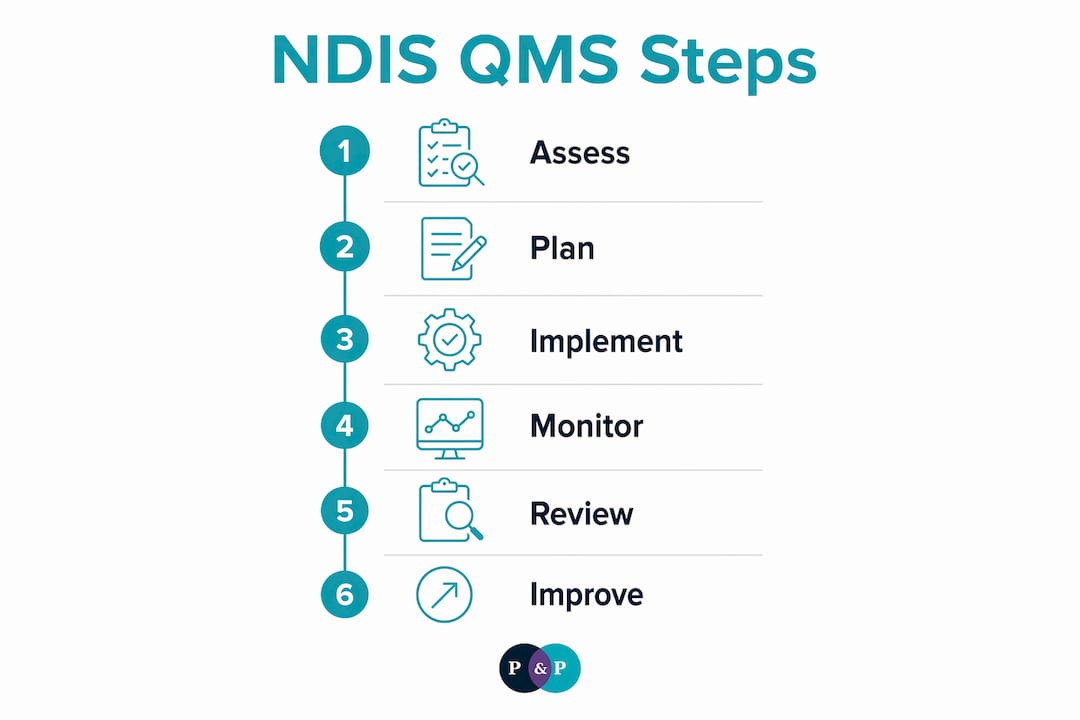
How to implement your QMS: a practical six-step sequence
Good NDIS policy and procedure development starts with knowing your gaps. Follow this sequence to build or upgrade your system without overcomplicating it.
- Gap analysis: Map your current documentation and practices against the NDIS Practice Standards indicators. Prioritise by risk: high-risk supports with no documented controls come first.
- Map supports to modules: Confirm which modules apply to each support type you deliver. Assign a named person as responsible for each module's evidence.
- Build core artefacts: Create or update your CI policy, CI register, internal audit schedule, and management meeting agenda template. For policy templates and CI register examples, start with sector-tested formats and adapt them to your context.
- Pilot and iterate: Run the CI register and complaints process for at least one reporting cycle before your audit. Train staff on incident reporting and the link to CI actions.
- Integrate into governance: Quality data goes to management review. Board or senior leadership sees a quality dashboard at every meeting. Minutes record what was decided and by when.
- Prepare your evidence pack: Assemble completed audits, CI register extracts, management minutes, and participant feedback records into an indexed folder. Schedule internal audits at least annually, or more frequently for high-risk supports.
What to look for in QMS and compliance software
Software will not fix a broken process, but the right tool makes evidence capture and reporting significantly easier. Evaluate any platform against this feature checklist before committing.
Feature checklist:
- CI register with fields for root cause, responsible person, completion date, and effectiveness review
- Incident and complaint modules that link directly to CI actions
- Internal audit module with scheduling and report generation
- Document control with version history and review alerts
- Participant feedback capture (surveys, structured check-ins)
- Management and board reporting dashboards
- Mobile or offline access for support workers in the field
Questions to ask vendors:
- Can we export audit-ready evidence reports in PDF or Excel?
- Does the system maintain a full audit trail of changes?
- What user roles and permissions are available to protect participant data?
- Does it integrate with our payroll, HR, or electronic medical records system?
- Where is data stored, and does it meet Australian data sovereignty requirements?
On data security: participant information is sensitive under the Privacy Act 1988 and the NDIS Act. Any platform you use must store data on Australian servers, apply role-based access controls, and support your obligations under mandatory data breach notification rules. For providers exploring digital tools in regulated health and disability settings, regulatory basics for digital health platforms offer a useful orientation to the compliance thinking involved.

What auditors actually want to see
Auditors assess whether quality processes inform improvements. A polished policy document is far less persuasive than a CI register showing six months of completed actions with effectiveness reviews.
Evidence checklist for audit:
- CI register: active entries, completed actions, effectiveness reviews signed off
- Internal audit reports: completed, dated, with findings and corrective actions
- Management meeting minutes: quality agenda items, metrics discussed, actions assigned
- Corrective actions: closed with evidence and effectiveness confirmed
- Participant feedback records: collected, analysed, and linked to improvement actions
- Staff records: induction, training, and NDIS Worker Screening clearances current
Verification vs certification audits: Verification audits (for lower-risk providers) focus on document review and a desktop assessment of your policies and procedures. Certification audits (for core module providers) include site visits, staff interviews, and participant file reviews. Both require the same underlying evidence; certification audits test whether the system is genuinely operational.
Evidence pack index (suggested order):
- Organisational overview and support scope
- Governance documents (constitution, board minutes, delegations)
- Quality management policy and CI register extract
- Internal audit schedule and completed reports
- Incident and complaints register with CI linkage
- Staff training and screening records
- Participant feedback summary
Auditors typically go to management minutes and the CI register first. Make those two documents easy to find and easy to read.
Common pitfalls and what one small provider did about it
The most frequent failures are not dramatic. They are structural gaps that accumulate quietly.
- CI registers started too late: Auditors expect months of genuine activity. A register created the week before audit is immediately obvious.
- Missing effectiveness reviews: Closing an action without confirming it worked is an incomplete loop. Auditors flag this consistently.
- Management meetings with no minutes: Verbal reviews do not constitute evidence. If it is not documented, it did not happen.
- Disconnected incident-to-CI workflows: Incidents are recorded but never trigger a CI action. The system looks reactive, not learning.
A small community access provider with eight staff had a CI register, but every entry was marked "complete" with no effectiveness review and no root cause recorded. Management meetings happened monthly but minutes were informal notes kept in a personal notebook. Before their certification audit, they restructured the register using a sector template, formalised minutes with a standard agenda, and ran a half-day staff session on the incident-to-CI link. At audit, the assessor noted the register as a strength. The provider passed certification with no major nonconformities.
The remedies are not complex. Formalise what you are already doing. Add the effectiveness review column. Use a standard agenda. Connect the incident log to the CI register with a simple reference number.
Key takeaways
A functioning NDIS quality management system is built on daily controls and documented evidence, not policies alone.
| Point | Details |
|---|---|
| Start the CI register now | Auditors expect months of genuine activity; a register created just before audit is immediately obvious. |
| Minutes are primary evidence | Management meeting minutes recording quality metrics and assigned actions are a core governance artefact. |
| Map supports to modules | Confirm which NDIS Practice Standards modules apply to each support type and assign a named responsible person. |
| Link incidents to CI actions | Every systemic incident or complaint should generate a CI entry; disconnected workflows are a common audit finding. |
| The Planning and Practice Hub | Supports providers with gap analysis, CI system templates, internal audit programmes, and board-ready evidence packs. |
What good actually looks like day to day
Most providers I work with understand the theory of continuous improvement. The gap is almost always in the daily habit. A CI register that gets updated after every management meeting, a complaints log that automatically prompts a CI entry, a board that sees a one-page quality dashboard every quarter: that is what a living system looks like. It is not sophisticated. It is consistent.
The providers who struggle at audit are rarely the ones with poor intentions. They are the ones who built a system for registration and then let it sit. The NDIS Practice Standards require a system that supports continuous improvement, not one that documents the intention to improve. That distinction is what auditors are trained to find.
What question is your board asking about quality at its next meeting?
How The Planning and Practice Hub can help
If your QMS needs a reset before your next audit, The Planning and Practice Hub works with registered NDIS providers on gap analysis against the NDIS Practice Standards, CI system design and templates, internal audit programmes, and board-ready quality reporting.
Rachel Willis and the team bring close to three decades of human services sector experience to this work, including direct support to providers preparing for certification audits. The work is practical and co-developed with your team, not handed over as a generic template pack.
To find out how The Planning and Practice Hub can support your QMS design and audit preparation, get in touch directly.
Useful sources
Build your evidence folder from these authoritative sources:
- NDIS Practice Standards and quality indicators (PDF) — the primary reference for all quality indicators and audit evidence requirements
- NDIS Practice Standards — NDIS Quality and Safeguards Commission — online module breakdown and outcomes
- Provider Registration and Practice Standards Rules 2018 — legislation.gov.au — legislative basis for proportionate QMS requirements
- NDIS Quality and Safeguarding Framework — Department of Health — national policy framework and participant outcomes focus
- Quality management guide — National Disability Services (NDS) — practical templates and CI register guidance
- Quality management system in human services: 2026 guide — The Planning and Practice Hub — CI register templates and implementation advice
- NDIS policy and procedure development — The Planning and Practice Hub — step-by-step policy build and document control templates
- NDIS registered provider governance: the 2026 board guide — The Planning and Practice Hub — board responsibilities and governance evidence expectations
FAQ
What is the NDIS quality management framework?
The NDIS Quality and Safeguarding Framework is the national policy that sets quality and safety expectations for NDIS providers. It underpins the NDIS Practice Standards and the role of the NDIS Quality and Safeguards Commission in registering and auditing providers.
What does a proportionate NDIS quality management system include?
Under Outcome 2.3 of the NDIS Practice Standards, a proportionate QMS includes a CI register, internal audit programme, incident and complaints handling linked to improvement actions, staff training records, and management review with documented minutes. Scale and complexity should match your organisation's size and the risk profile of your supports.
What are the three types of NDIS provider management?
NDIS participants can choose agency-managed, plan-managed, or self-managed funding. These refer to how a participant's plan funds are administered, not to provider registration categories. Registered providers must meet the NDIS Practice Standards regardless of which management type their participants use.
What software features matter most for NDIS quality management?
Prioritise a CI register with effectiveness review fields, incident and complaint modules that link to CI actions, document control with version history, and board-level reporting dashboards. Data must be stored on Australian servers to meet Privacy Act obligations.
How far in advance should a provider start their CI register before audit?
Start as early as possible. Auditors expect several months of genuine CI activity rather than a register assembled just before inspection, so build this into your implementation timeline from day one.