
TL;DR:
- An NDIS compliance consultant assists organizations in meeting regulatory, governance, and quality standards required by the NDIS Quality and Safeguards Commission. They translate standards into practical operations, prepare for audits, and help with registration processes, especially for SIL providers facing strict deadlines in 2026. Board members face personal liability and must ensure compliance through proper screening, governance frameworks, and budget planning for audits.
An NDIS compliance consultant is a specialised adviser who helps non-profit organisations meet the regulatory, governance, and quality obligations set by the NDIS Quality and Safeguards Commission. The role goes well beyond policy writing. Boards and executives face personal liability under Section 73J of the NDIS Act, mandatory registration changes affecting SIL providers from 1 july 2026, and audit scrutiny that tests whether documented systems actually operate in practice. Getting this right requires more than a generic policy pack. It requires someone who understands your registration type, your audit pathway, and the governance duties that sit with your board.
What does an NDIS compliance consultant actually do?

The core function of an NDIS compliance consultant is to translate the NDIS Practice Standards into operational practice that auditors can verify. Generic policy templates fail this test. Experienced consultants help organisations build evidence of how standards are implemented day to day, not just documented on paper.
Practical consulting work covers a defined set of functions:
- Audit coaching. Preparing staff and leadership for auditor interviews, site observations, and document reviews. Auditors prioritise what they see happening, not what the policy says.
- Policy and procedure alignment. Rewriting or adapting documents to reflect actual organisational practice, not sector-wide templates.
- Risk and incident management. Building registers, escalation pathways, and review cycles that satisfy both the NDIS Practice Standards and the NDIS Code of Conduct.
- Board reporting. Designing governance reporting that gives directors meaningful compliance data, not just activity summaries.
- Ongoing documentation management. Maintaining audit-ready records including staff training logs, complaints registers, and governance minutes throughout the year.
Pro Tip: Ask any prospective consultant to describe the last audit they supported and what the auditor's focus areas were. A consultant who cannot answer that question specifically has not been close enough to the audit process to be useful.
The distinction between a consultant who coaches and one who simply supplies documents is significant. Providers working with consultants on an ongoing basis face less audit stress and maintain systematic compliance evidence across the full registration cycle.
What are the 2026 registration changes for SIL providers?
SIL provider compliance requirements changed materially from 1 july 2026. Mandatory registration now applies to Supported Independent Living and digital platform providers, with a 1 october 2026 deadline for existing unregistered SIL providers to submit their registration application. This is not a soft deadline. Providers who miss it face removal from the market.
The government has set a target of 90% of NDIS payments processed through registered providers by 2027. That target signals the direction of travel clearly. Unregistered providers operating in SIL or digital platform spaces are operating on borrowed time.
| Milestone | Date | Action required |
|---|---|---|
| Mandatory registration begins | 1 july 2026 | SIL and digital platform providers must be registered |
| Application deadline | 1 october 2026 | Existing unregistered SIL providers must apply |
| Government payment target | 2027 | 90% of NDIS payments through registered providers |
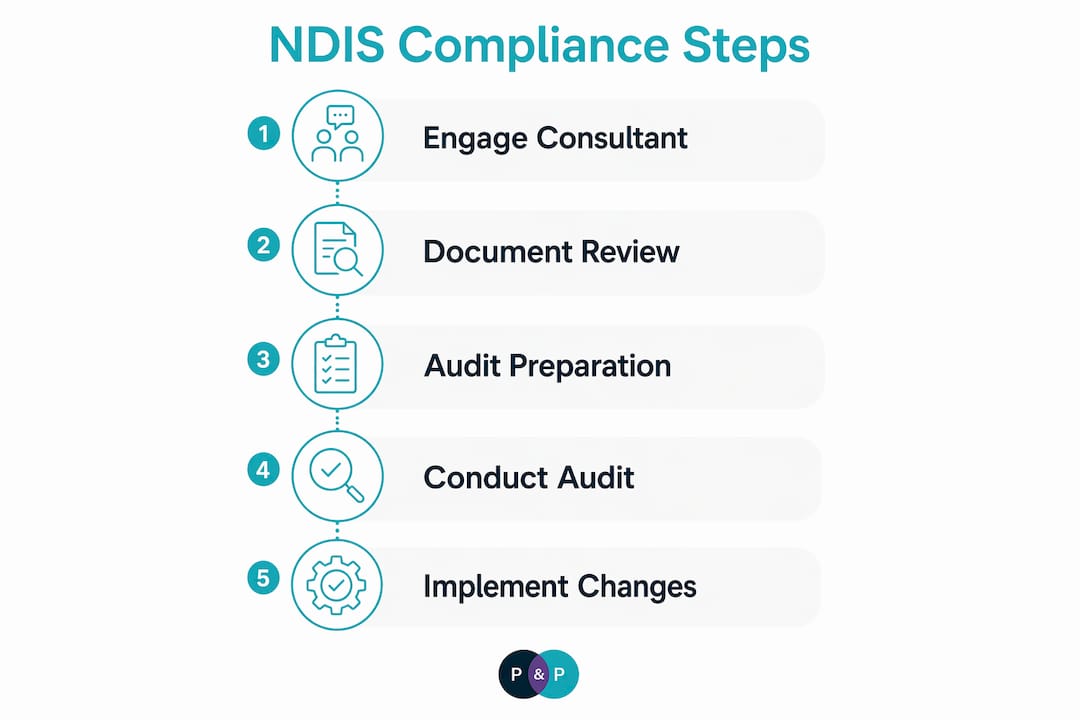
A consultant who specialises in NDIS registration supports providers through the full application process, including gap analysis against the relevant NDIS Practice Standards, preparation of evidence portfolios, and coordination with an approved quality auditor. For SIL group providers, this work is particularly complex because the registration groups attract certification audits, which involve site visits and staff interviews rather than desktop reviews.
Boards of SIL providers who have not yet begun this process should treat it as a governance priority, not an administrative task.
How do audit costs work and what should boards budget?
NDIS registration carries no government fee. The cost sits entirely with the audit. Audit costs vary with organisation size, service complexity, and the number of participants supported. Boards should obtain multiple quotes from approved quality auditors before committing.
The two audit pathways carry different cost profiles:
| Audit type | Typical scope | Cost driver |
|---|---|---|
| Verification audit | Desktop review of documents | Number of registration groups |
| Certification audit | Site visits, staff interviews, participant feedback | Size, locations, service complexity |
Common gaps that lead to audit delays or failures include:
- Policies that describe an ideal process rather than actual practice
- Incomplete Worker Screening clearances for board members
- Incident registers with no evidence of review or escalation
- Training records that do not align with the NDIS Practice Standards modules
- Governance minutes that record decisions but not the compliance information that informed them
A consultant coordinates the documentary evidence package before the audit begins. This preparation reduces the risk of a non-conformance finding and avoids the cost of a follow-up audit. For boards managing tight budgets, the consultant fee is offset by the cost of getting the audit right the first time. The NFP consulting guide covers this cost-benefit calculation in more detail.
What governance obligations do board members hold under the NDIS?
Board members are classified as key personnel under Section 11A of the NDIS Act. That classification carries direct legal obligations. Worker Screening clearances are legally required for all board members, and failure to hold them is one of the most common compliance failures that halts registrations. Many boards discover this requirement late, which creates unnecessary delays and risk.
The governance obligations extend further:
- NDIS Code of Conduct compliance. The Code of Conduct applies to registered and unregistered providers, key personnel, and workers. Board members must take reasonable steps to prevent abuse and prohibit unjustified charging practices.
- Civil penalty exposure. Under Section 73J of the NDIS Act, executives and officers face substantial civil penalties personally, not just the organisation. This is not a theoretical risk.
- Criminal prosecution risk. WHS Category 1 offences can result in criminal prosecution and up to 10 years imprisonment for officers who fail to exercise due diligence.
- Governance framework implementation. Boards need documented frameworks that demonstrate 'all reasonable steps' were taken to maintain compliance. This is the legal standard that matters in an investigation.
Pro Tip: If your board has not reviewed Worker Screening clearances for every director in the past 12 months, do it this week. It is a five-minute check that prevents a registration-halting problem.
External compliance advice gives boards independent verification that their governance frameworks meet the current standard. The case for external advice is strongest when a board is preparing for registration renewal or facing a significant service change.
Key takeaways
Boards that treat NDIS compliance as a governance function, not an administrative one, are better positioned to meet audit requirements, manage personal liability, and sustain quality service delivery.
| Point | Details |
|---|---|
| Consultant role is operational | Effective consultants align documented policies with actual staff practice, not just supply templates. |
| SIL registration deadline is firm | Unregistered SIL providers must apply by 1 october 2026 or face removal from the market. |
| Board members carry personal liability | Section 73J and WHS laws expose directors to civil penalties and criminal prosecution. |
| Worker Screening is non-negotiable | All board members must hold current Worker Screening clearances as a condition of registration. |
| Audit costs require active budgeting | Boards should seek multiple quotes from approved quality auditors and factor in consultant preparation fees. |
What I have learned about choosing the right consultant
After nearly three decades working across Australian human services, the pattern I see most often is this: boards engage a consultant after something goes wrong. A non-conformance finding, a registration delay, a complaint that escalated. The organisations that fare best are the ones that build a consulting relationship before the pressure arrives.
The other thing I have seen consistently is the damage done by generic policy packs. One mid-sized SIL provider I worked with had a full suite of beautifully formatted policies. Their auditor spent 20 minutes on the documents and three hours watching how staff actually supported participants. The policies described a process that nobody followed. That is a fixable problem, but it is far easier to fix before the auditor arrives.
Select a consultant who specialises in your registration groups and can name the audit pathway your organisation will follow. Ask them what a certification auditor focuses on during a site visit. If they cannot answer with specificity, keep looking. The right adviser makes compliance a manageable, ongoing function rather than a crisis you manage every three years.
What question does your board most struggle to answer when it comes to NDIS governance?
— Rachel
How The Planning and Practice Hub supports NDIS providers
The Planning and Practice Hub works with non-profit boards and executives across Australia's human services sector, including NDIS providers preparing for registration, renewal, and quality audits.
Rachel Willis and the team at The Planning and Practice Hub bring close to three decades of sector experience to NDIS compliance consulting, covering governance frameworks, SIL registration support, audit preparation, and board-level reporting. The work is co-developed with each organisation, which means the systems built reflect how your organisation actually operates. For boards managing the 2026 SIL registration changes or preparing for a certification audit, the human services consulting page outlines how the Hub can support your next steps.
FAQ
What is an NDIS compliance consultant?
An NDIS compliance consultant is a specialist adviser who helps providers meet the regulatory and quality obligations set by the NDIS Quality and Safeguards Commission, including the NDIS Practice Standards and Code of Conduct.
Do board members need Worker Screening clearances?
Yes. Board members are classified as key personnel under Section 11A of the NDIS Act and must hold current Worker Screening clearances. Missing clearances are a common cause of registration delays.
When do SIL providers need to register under the 2026 changes?
Mandatory registration for SIL providers begins 1 july 2026, with a 1 october 2026 deadline for existing unregistered providers to submit their application.
How much does an NDIS quality audit cost?
NDIS registration itself carries no government fee, but audit costs vary based on organisation size, service complexity, and the number of participants supported. Boards should obtain multiple quotes from approved quality auditors.
Can board members face personal liability under the NDIS Act?
Yes. Section 73J of the NDIS Act exposes executives and officers to substantial civil penalties personally, and WHS Category 1 offences carry criminal prosecution risk including up to 10 years imprisonment.