
TL;DR:
- Most non-profit leaders recognize ASES accreditation's importance but often overlook its demands until they begin the process. An ASES accreditation consultant guides organizations through the entire cycle, helping them improve governance and documentation systems that last beyond the assessment.
Most non-profit leaders know ASES accreditation matters. Far fewer know what the process actually demands until they are already inside it. An ASES accreditation consultant is a specialist advisor who guides organisations through the Australian Service Excellence Standards (ASES Version 9.1) framework, from initial registration through to external assessment and beyond. Working with an accreditation advisor does not just help you pass. It reshapes how your organisation thinks about governance, documentation, and continuous improvement in ways that outlast the assessment itself.
What does an ASES accreditation consultant actually do?

The role spans the full accreditation cycle, not just the paperwork phase. A good advisor maps where your organisation sits against ASES Version 9.1 requirements before a single document is submitted, which saves significant time later.
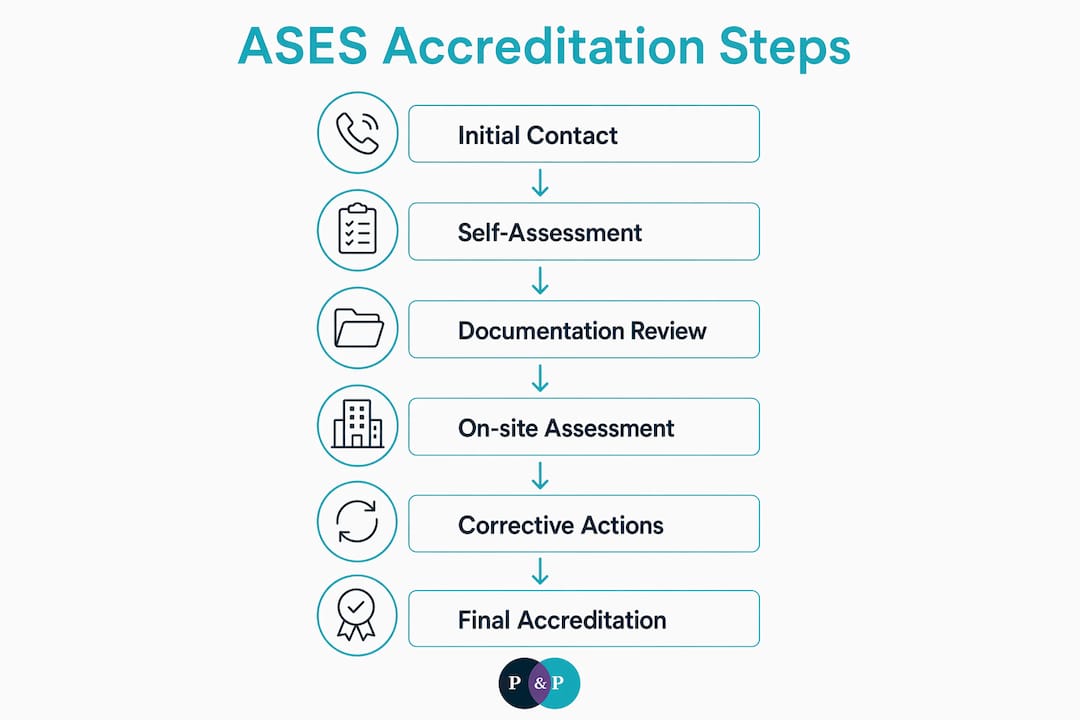
The process itself follows a clear sequence:
- Initial contact and registration with an approved accreditation body
- Self-assessment across five core domains: CEO, Finance, Governance, Manager, and Staff
- Evidence gathering and documentation audit against each standard
- External on-site assessment conducted by an independent assessor
- Corrective action if gaps are identified post-assessment
The five self-assessment domains cover every layer of your organisation. That breadth is exactly why many organisations underestimate the preparation required.
The full process takes up to 18 months from initial contact to accreditation completion. That timeline reflects the depth of evidence required, not bureaucratic delay. If gaps surface during the external assessment, organisations typically have up to 6 months to address them through a corrective action plan. A consultant who knows this cycle keeps your team on pace rather than scrambling at each transition.
How do consultants strengthen governance and operational practice?
ASES accreditation is not a governance programme in name only. The process forces organisations to examine whether their actual practice matches their stated policies, and that gap is often wider than boards expect.
Organisations regularly move from informal to structured frameworks through the accreditation process. That shift supports long-term growth in ways that a policy refresh alone cannot achieve. A consultant accelerates this by identifying which governance structures are genuinely embedded and which exist only on paper.
The practical benefits include:
- Clearer risk management processes aligned with ACNC Governance Standards
- Documented quality assurance cycles that satisfy both ASES Version 9.1 and NDIS Practice Standards
- Board-level accountability frameworks that hold up under external scrutiny
- Alignment with the National Principles for Child Safe Organisations where relevant
- Stronger staff induction and performance review systems
Consultants also align accreditation processes with your existing organisational context rather than imposing a generic template. That distinction matters. An advisor who understands your funding environment, your client cohort, and your board's current capability will give you a far more useful roadmap than one who applies the same checklist to every organisation.
Pro Tip: Ask any prospective accreditation advisor how they approach organisations that are already partway through a quality cycle. Their answer tells you whether they will work with your context or around it.
Understanding the difference between compliance and governance is foundational here. Accreditation touches both, and conflating them is a common source of confusion during preparation.
What practical tools and resources do consultants provide?
High-level strategy is not enough. The organisations that move through ASES accreditation efficiently are the ones with the right project tools in place from the start.
A capable accreditation advisor typically provides:
- Role-based self-assessment guides for each of the five domains, so staff at every level know what is expected of them
- Client and staff file audit checklists that map directly to ASES Version 9.1 evidence requirements
- Sample documentation, including community partner engagement letters and project plan templates
- Evidence collation systems that make the external assessment straightforward rather than frantic
Audit checklists for client and employee files are among the most critical tools in the process. They translate abstract standards into concrete actions your team can complete and verify.
The table below shows how consultant support differs across accreditation phases:
| Accreditation phase | Without consultant support | With consultant support |
|---|---|---|
| Self-assessment | Ad hoc, often incomplete | Structured, role-specific, and documented |
| Evidence gathering | Reactive and last-minute | Planned with clear timelines |
| External assessment | High anxiety, gaps exposed | Prepared, with pre-audit review completed |
| Corrective actions | Uncertain next steps | Clear improvement plan with accountability |
Collaboration is also a practical tool. Consultants facilitate leadership and staff engagement so that accreditation does not become a project owned by one quality manager working in isolation. Shared ownership of the process produces better evidence and a more credible assessment outcome.
What are the common challenges and how do consultants help?
The most consistent challenge is not complexity. It is bandwidth. Your team is running programmes, managing staff, and reporting to funders while simultaneously preparing an accreditation submission. That pressure is real, and a consultant who does not acknowledge it is not being straight with you.
Accreditation is iterative, not a single pass-or-fail event. Most organisations have the opportunity to address gaps after the external assessment rather than facing outright failure. Knowing this changes how teams approach the process. It reduces the anxiety that causes organisations to over-engineer their documentation or stall on submitting evidence that is not yet perfect.
"The accreditation process gave us the push to sort out things we had been meaning to address for years. The assessor was not there to catch us out. They were genuinely interested in helping us improve." Anonymised community services CEO, South Australia
A consultant holds the process steady when internal momentum drops. They track corrective action deadlines, flag documentation gaps before they become assessment issues, and keep the board informed without creating unnecessary alarm. That steadiness is often worth more than any single piece of advice.
Key takeaways
An ASES accreditation consultant reduces risk, shortens preparation time, and produces governance improvements that outlast the accreditation cycle itself.
| Point | Details |
|---|---|
| Process timeline | ASES accreditation takes up to 18 months; plan resourcing accordingly from the start. |
| Five self-assessment domains | CEO, Finance, Governance, Manager, and Staff each require specific evidence and documentation. |
| Governance shift | Accreditation moves organisations from informal to structured frameworks with lasting benefit. |
| Iterative process | Gaps identified post-assessment allow up to 6 months for corrective action, not automatic failure. |
| Consultant value | Advisors align the process with your organisational context rather than applying a rigid template. |
What I have learned from watching organisations go through this
The organisations that get the most from ASES accreditation are not the ones with the most polished policies. They are the ones that treat the process as a genuine opportunity to look honestly at how they operate.
I have seen a mid-sized homelessness service use accreditation to finally address a governance gap the board had quietly worried about for three years. The spring clean effect is real. Accreditation creates the conditions and the deadline for resolving things that daily operations keep pushing aside.
What I find most useful to say to leaders who are hesitant is this: the consultant's job is not to make your organisation look good on paper. It is to help you understand what good practice actually looks like in your context, and then build the evidence that reflects it. That is a very different relationship to the one people fear when they hear the word "assessment."
The organisations that treat their advisor as a partner rather than a project manager get better outcomes. They ask harder questions, share more of the messy reality, and end up with governance frameworks that actually hold. That is what organisational governance done well looks like.
What is the one governance gap your board has been meaning to address that accreditation might finally force you to resolve?
— Rachel
Working with The Planning and Practice Hub on ASES accreditation
The Planning and Practice Hub works with non-profit leaders across Australian human services who are preparing for ASES accreditation or strengthening their governance frameworks ahead of assessment.
Rachel Willis brings close to three decades of sector experience to every engagement, working across NDIS, aged care, homelessness, and community services organisations. The focus is always on building practice that holds up, not just documentation that passes. If you are weighing up where to start or how to resource your accreditation preparation, the human services consulting page outlines how The Planning and Practice Hub approaches this work. You can also review the full range of consulting services available to non-profits at different stages of their accreditation cycle.
FAQ
What is an ASES accreditation consultant?
An ASES accreditation consultant is a specialist advisor who guides non-profit organisations through the Australian Service Excellence Standards framework, from self-assessment to external review and corrective action.
How long does the ASES accreditation process take?
The full process takes up to 18 months from initial contact to accreditation completion, depending on the organisation's prior experience and documentation readiness.
What happens if my organisation does not meet all standards at assessment?
Accreditation is iterative. Organisations typically receive up to 6 months to address identified gaps through a corrective action plan rather than facing outright failure.
Which domains does ASES self-assessment cover?
ASES self-assessment covers five core domains: CEO, Finance, Governance, Manager, and Staff. Each requires specific evidence aligned to ASES Version 9.1.
Why does governance improve through ASES accreditation?
Accreditation requires organisations to demonstrate that their actual practice matches their stated policies. That process moves organisations from informal to structured governance frameworks, producing lasting improvements beyond the assessment itself.