
TL;DR:
- A quality management system in human services ensures safe and consistent outcomes through clear frameworks and accountability. Implementing it requires staged processes, real-time documentation, and leadership modeling to overcome common challenges. A well-designed QMS improves compliance, staff retention, and genuinely reflects client outcomes.
A quality management system in human services is a structured framework that coordinates processes, standards, and responsibilities to produce safe, consistent, and measurable service outcomes. The industry term for this is a QMS, and in the Australian context it operates across frameworks including the NDIS Practice Standards, the Aged Care Quality Standards (Strengthened), the HSQF (QLD only), the ACNC Governance Standards, and the National Principles for Child Safe Organisations. The QIC Health and Community Services Standards 8th Edition now anchors much of this work, and its 2026 update has reshaped how organisations approach quality management system human services implementation. Getting this right is not a compliance exercise. It is how you protect clients and retain good staff.
What are the core components of a quality management system in human services?

The QIC Standards 8th Edition simplifies the quality framework by removing the criterion level entirely, leaving a two-level structure of Standards and Indicators. That change directly links what your organisation does to measurable outcomes, with less interpretive noise in between. For quality managers, it means assessments become clearer and accountability is harder to obscure.
The continuous quality improvement (CQI) cycle sits at the centre of any functioning QMS. CQI requires iterative cycles of discovery, remediation, and systemic change, prioritising improvements based on aggregated data rather than isolated incidents. Discovery without remediation is just reporting. Systemic change is what separates a genuine QMS from a folder of policies.
The technical foundations matter just as much as the framework. A well-functioning QMS depends on:
- Persistent client IDs assigned at intake to track outcomes reliably across time and departments
- Real-time documentation of client interactions to maintain audit-ready records
- Outcome measurement at baseline and follow-up, aligned to client goals
- Documented policies and procedures that reflect actual practice, not aspirational practice
- Governance structures that assign clear ownership of quality functions
| Component | Purpose |
|---|---|
| Standards and Indicators (QIC 8th Ed.) | Link organisational actions to measurable outcomes |
| CQI cycle | Drive ongoing discovery, remediation, and systemic change |
| Persistent client ID | Enable reliable longitudinal outcome tracking |
| Real-time documentation | Maintain data integrity and audit readiness |
| Governance structures | Assign accountability for quality functions |
Pro Tip: Map your current documentation practices against the QIC Indicators before your next accreditation cycle. Gaps are almost always in real-time recording, not in policy.
How does a strong QMS improve compliance and service performance?
The clearest performance gain from a well-implemented QMS is workforce stability. Employee recognition significantly impacts staff retention and consistency of service delivery. Direct service providers cite appreciation as a primary reason for staying in their roles. A QMS that captures and communicates outcomes gives leaders concrete evidence to recognise good work, not just anecdotal praise.
Evidence-based practice in social work is a decision-making process that balances research evidence, clinical expertise, and client input. It is not a rigid protocol. Structuring your documentation to capture the rationale behind decisions, not just the decisions themselves, makes evaluation and accountability genuinely possible.
Real-time documentation of client interactions is critical for quality control, reducing data gaps, and ensuring records are audit-ready and accurate. Delayed recording risks memory lapses and incomplete cases, undermining compliance and care continuity.
Consider a community services organisation in regional Queensland that shifted from weekly case note summaries to same-day recording. Within six months, their audit preparation time dropped substantially, and their incident reports became more accurate because staff were capturing context while it was still fresh. The QMS did not change what workers did. It changed when and how they recorded it.
- Audit-ready records reduce preparation burden and regulatory risk
- Baseline and follow-up data integrity supports genuine outcome reporting
- Documented clinical rationale strengthens evidence-based practice accountability
- Workforce recognition grounded in outcome data improves retention
What are the practical steps for implementing a QMS in human services?
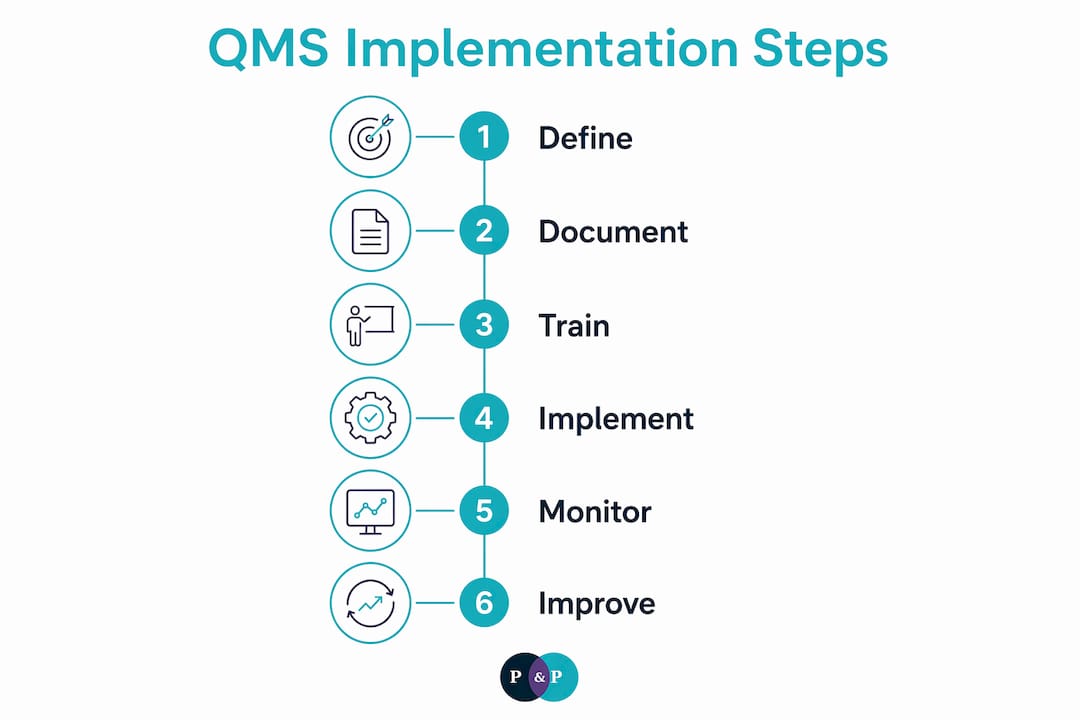
Implementation works best when it follows a staged approach rather than a full-system rollout. Organisations that try to implement everything at once typically end up with a QMS that looks complete on paper and functions poorly in practice.
A staged approach looks like this:
- Set objectives aligned to your regulatory obligations, whether NDIS Practice Standards, Aged Care Quality Standards (Strengthened), or HSQF. Objectives must be specific and measurable, not aspirational.
- Engage stakeholders early. Quality managers, frontline workers, and board directors all hold different parts of the picture. Participatory QMS design involving people with lived experience enhances credibility and practical usability.
- Map your processes against the QIC Standards 8th Edition Indicators. Identify where current practice diverges from documented procedure.
- Assign persistent client IDs at intake. Without a persistent ID, tracking client journeys and aggregating outcomes across departments is error-prone and resource intensive. This is the most critical technical step.
- Train your workforce using blended methods. Online training improves compliance by providing accessible, flexible learning options that reduce time away from direct work. Pair it with in-person sessions for complex practice areas.
- Model compliance from leadership. Leadership modelling compliance behaviours significantly influences organisational culture, including honesty and adherence to quality standards among staff.
Pro Tip: Treat your first CQI cycle as a learning exercise, not a performance review. The data you collect in year one is most valuable for identifying systemic gaps, not for benchmarking against sector peers.
What challenges arise in QMS implementation, and how do you address them?
The most common mistake is over-standardising. A QMS should standardise critical safety steps while leaving relational and complex casework to professional judgement. When organisations try to script every interaction, they create bureaucracy that workers route around, which is worse than having no system at all.
Data management complexity is the second major challenge. Introducing persistent client IDs, real-time recording tools, and outcome measurement simultaneously can overwhelm staff who are already carrying full caseloads. Sequence the technical changes carefully.
Common implementation challenges and practical responses:
- Over-standardisation: Identify the five to ten critical steps that must always occur, and leave everything else to professional discretion
- Staff overload: Right-sized caseloads are not a luxury. Overburdened staff cannot maintain documentation quality or genuine client engagement
- QMS as compliance burden: Embed quality conversations in regular supervision, not just in audit cycles
- Data integrity gaps: Introduce real-time recording tools incrementally, with clear rationale for each change
The organisations that sustain a functioning QMS are the ones that treat it as an operational tool, not a reporting obligation. That shift in framing is a leadership responsibility, not a systems one.
Key takeaways
A quality management system in human services works when it combines clear standards, real-time data integrity, right-sized workloads, and leadership that models the behaviours it expects.
| Point | Details |
|---|---|
| Use the QIC 8th Edition structure | The two-level Standards and Indicators framework reduces complexity and sharpens accountability. |
| Assign persistent client IDs at intake | This single technical step makes longitudinal outcome tracking reliable and audit-ready. |
| Stage your implementation | Sequencing objectives, process mapping, and training prevents system overload and poor adoption. |
| Standardise critical steps only | Leave relational and complex casework to professional judgement to avoid counterproductive bureaucracy. |
| Model quality from the top | Leadership behaviour shapes compliance culture more reliably than policy documents alone. |
What I have learned about QMS in practice
After nearly three decades working across Australian human services, the pattern I see most often is this: organisations invest in the framework and neglect the culture. They produce a beautifully documented QMS that sits largely unused because the people expected to operate it were never genuinely involved in designing it.
The shift to the QIC Standards 8th Edition is an opportunity to correct that. The simplified two-level structure gives leaders a cleaner conversation with their boards and their frontline teams. But the technology piece still trips people up. Real-time documentation tools are only as good as the training and the caseload management that surrounds them. I have seen organisations introduce excellent systems and then watch data quality deteriorate within six months because workers were carrying too many clients to record meaningfully.
The question I keep returning to with every organisation I work with is this: does your QMS tell you something true about what is happening for clients, or does it tell you something tidy? If it is tidy, that is worth examining. What would it take for your quality data to reflect what your workers actually know?
— Rachel
How The Planning and Practice Hub supports QMS implementation
Aligning with the 2026 QIC Standards, the NDIS Practice Standards, or the Aged Care Quality Standards (Strengthened) requires more than a policy update. It requires a clear-eyed look at how your organisation actually operates.
The Planning and Practice Hub works with CEOs, boards, and quality managers across Australian human services to design and implement quality management systems that hold up under scrutiny. From human services consulting that covers stakeholder engagement and process mapping, to workforce training design and data-driven quality improvement, the Hub brings close to three decades of sector experience to every engagement. If your organisation is preparing for accreditation or working through a complaints management framework as part of a broader QMS, the Hub can support you at every stage.
FAQ
What is a quality management system in human services?
A quality management system in human services is a structured framework that aligns processes, standards, and responsibilities to produce safe, consistent, and measurable service outcomes. In Australia, it operates across frameworks including the NDIS Practice Standards, Aged Care Quality Standards (Strengthened), and the QIC Health and Community Services Standards 8th Edition.
What does the QIC Standards 8th Edition change for organisations?
The QIC Standards 8th Edition removes the criterion level, leaving a two-level structure of Standards and Indicators that directly links organisational actions to measurable outcomes. This reduces interpretive complexity and makes accreditation assessments clearer.
Why is a persistent client ID so important in a QMS?
A persistent client ID assigned at intake is the most critical technical foundation for measuring outcomes reliably over time. Without it, tracking client journeys and aggregating outcomes across departments becomes error-prone and resource intensive.
How do you balance standardisation with professional judgement?
A well-designed QMS standardises the critical steps that must always occur, such as intake procedures and safety checks, while leaving relational and complex casework to professional discretion. Over-standardisation creates bureaucracy that workers route around, which undermines the system entirely.
What role does leadership play in human services quality assurance?
Leadership modelling of compliance behaviours significantly shapes organisational culture and staff adherence to quality standards. A QMS embedded in supervision and daily practice, rather than reserved for audit cycles, is far more likely to produce genuine quality improvement.