
Governance documentation essentials are the core policies, procedures, and frameworks that define how a non-profit organisation makes decisions, manages risk, and demonstrates accountability. Without them, boards operate on assumption rather than agreement, and regulators notice. This article covers the governance documentation essentials explained in practical terms: what documents you need, how to build and maintain them, and how a sound framework reduces legal exposure and audit stress. The Planning and Practice Hub works with Australian non-profits across more than 50 regulatory bodies, and the patterns we see in documentation failures are consistent and preventable.
What essential governance documents does every australian NFP board need?
Every Australian non-profit board should maintain a defined set of core governance documents. These are not aspirational. They are the minimum foundation for sound oversight, regulatory compliance, and organisational accountability.
The essential governance documents list for Australian non-profits includes:
- Constitution or rules document — the legal foundation that sets out the organisation's purpose, membership structure, and board powers. Required under the Corporations Act 2001 for companies limited by guarantee, and under state-based incorporated associations legislation for other structures.
- Board charter — defines the board's role, responsibilities, decision-making authority, and relationship with management. Without this, role confusion between the board and CEO is almost guaranteed.
- Code of conduct — sets behavioural expectations for board members, staff, and volunteers. Provides the basis for managing misconduct.
- Conflict of interest policy — a non-negotiable for any organisation receiving public funding or charitable tax concessions. The Australian Charities and Not-for-profits Commission (ACNC) treats this as a governance standard.
- Financial management policy — covers delegations, authorisation limits, procurement, and reporting obligations.
- Risk management framework — documents the organisation's approach to identifying, assessing, and responding to risk.
- Complaints and grievance policy — required under most service delivery contracts and expected by the ACNC under its governance standards.
Most organisations should maintain 7–10 core governance policies covering the areas above. That number is deliberate. Fewer than seven leaves genuine gaps; more than ten starts to create maintenance liability and the risk that outdated documents become a legal exposure rather than a protection.
Pro Tip: Map your existing documents against this list before drafting anything new. Gaps are usually more dangerous than imperfect documents.

How should governance documentation be developed and maintained?
The policy management lifecycle includes six phases: creation, approval, distribution, training, enforcement, and periodic updates. Each phase requires a named owner. Without ownership assigned to a specific individual, documents drift. They get reviewed by committees, approved by no one in particular, and quietly become irrelevant.
Here is a practical approach to building governance documentation that holds up over time:
- Assign a named document owner for every policy or procedure. This is not the board collectively. It is one person accountable for accuracy, review scheduling, and escalation when the document needs updating.
- Write in declarative present tense. Policies written as "The board will..." or "Staff are required to..." are clearer and more defensible during audits than passive constructions. Declarative present tense reduces ambiguity and supports audit readiness.
- Co-design with the people who do the work. Risk-based co-design with front-line users prevents documents that sit on a shelf. If the people performing a task did not help write the procedure, they are unlikely to follow it.
- Separate policies from procedures. Policies state what the organisation requires. Procedures describe how to do it. Mixing them creates documents that are too long to read and too vague to follow.
- Build a policy register. A simple register tracking document name, owner, approval date, next review date, and status gives the board visibility without requiring them to read every document.
Documentation governance systems fail when any of four pillars are absent: Ownership, Lifecycle, Quality, and Access. Skipping one does not create a partial system. It creates a system that collapses within two quarters.
Pro Tip: Use your policy register as a standing board agenda item. A five-minute review of overdue documents at each meeting is more effective than an annual documentation audit.
What review schedules keep governance documentation current?
Stale policies are not neutral. Outdated policies create legal exposure that exceeds the risk of having no documentation at all, because they create a false record of intent that the organisation is not actually following.
The table below sets out the recommended review cadences for different document types.
| Document Type | Review Frequency | Notes |
|---|---|---|
| Core governance policies | Annual | Triggered by regulatory change or significant incident |
| Exception registers | Quarterly | Exceptions granted for a maximum of 90 days before renewal |
| Technical standards and procedures | Semi-annual | More frequent if operational context changes |
| Constitution or rules | As required | Triggered by structural change or legislative amendment |
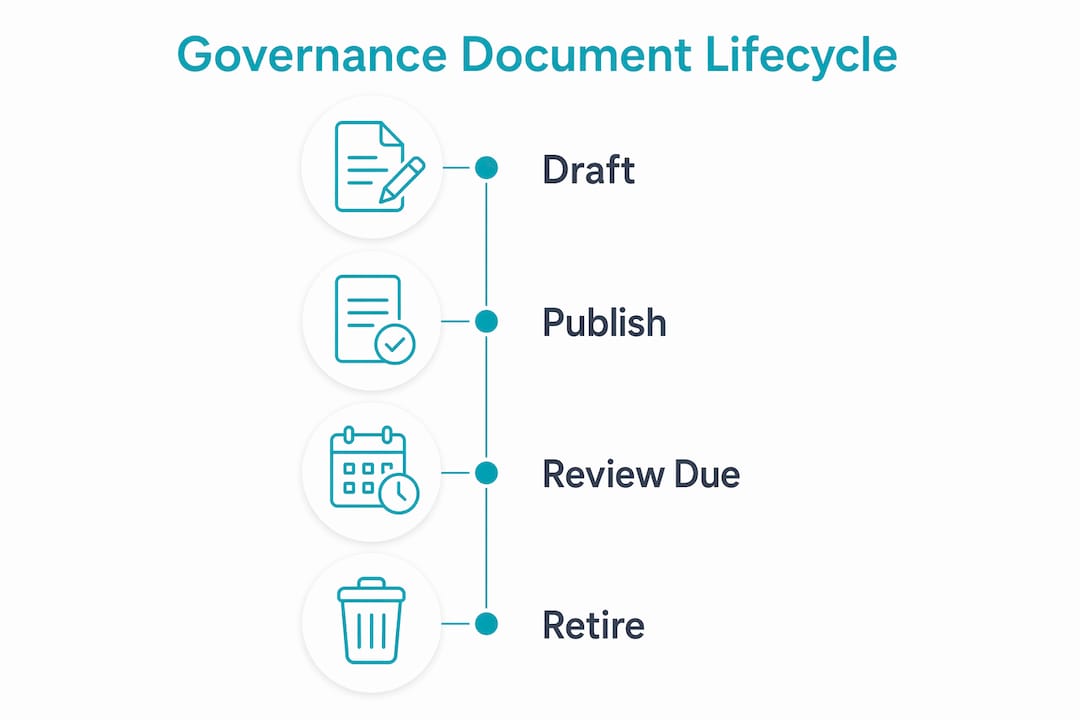
The four lifecycle states every document should move through are: draft, published, review-due, and retired. Managing these states prevents the most common failure mode in non-profit governance documentation, which is documents that are technically current but practically ignored because no one knows their status.
Exception registers deserve specific attention. When staff or board members cannot comply with a policy, the exception should be formally recorded with a 90-day expiry. This creates accountability and prevents informal workarounds from becoming de facto practice.
How does a governance framework reduce compliance risk?
A governance documentation framework is not a filing system. It is the set of rules that governs how documents are owned, reviewed, maintained, and accessed. Clear policies prevent confusion and provide organisational defence during audits. Vague or excessive procedures create the appearance of compliance without the substance.
The comparison below illustrates the difference between a framework that works and one that does not.
| Framework Characteristic | Effective | Ineffective |
|---|---|---|
| Document ownership | Named individual per document | Assigned to "the board" or a committee |
| Policy volume | 7–10 core policies | 30+ policies with overlapping scope |
| Review process | Scheduled, tracked in a register | Ad hoc, triggered only by incidents |
| Access | Audience-specific, linked documents | Single large manual accessible to all |
| Exception handling | Formal register with 90-day expiry | Informal verbal agreements |
Audience-specific documentation improves compliance. Staff who perform a task frequently need concise guides. Those who perform it rarely need more detailed instructions. Linking interconnected documents builds a navigable knowledge base rather than a single document that no one reads in full.
The importance of governance policies extends beyond regulatory compliance. They clarify roles, set expectations, and give boards a defensible record of their decision-making processes. That record matters when things go wrong.
Key takeaways
Effective governance documentation requires named ownership, scheduled reviews, and a lean policy set built around the ACNC's governance standards and your organisation's actual risk profile.
| Point | Details |
|---|---|
| Core document set | Maintain 7–10 essential governance documents covering conduct, finance, risk, and complaints. |
| Named ownership | Assign every document to one individual accountable for accuracy and review scheduling. |
| Review cadences | Annual for policies, quarterly for exception registers, semi-annual for technical standards. |
| Lifecycle states | Track every document through draft, published, review-due, and retired to prevent stale policies. |
| Framework over filing | A governance framework defines ownership, quality, access, and lifecycle rules, not just document storage. |
What i have learned after nearly three decades in this sector
The most common governance documentation failure I see in Australian non-profits is not a missing policy. It is a policy that exists, was approved three years ago, and has not been touched since. The board believes it is covered. The staff have quietly adapted their practice to something different. And when an audit or complaint arrives, the gap between the document and reality is the problem.
Documentation is a practice, not a product. That distinction matters more than any template or policy register. Boards that treat governance documentation as a one-off project will always end up back at square one. Boards that build review into their annual calendar, assign real ownership, and involve the people doing the work produce documents that actually function.
I also want to push back on the instinct to document everything. I have worked with organisations that had 40 or 50 policies, most of them unread and several of them contradictory. That is not governance. That is liability. A lean policy set with clear exception processes is more defensible and more usable than a comprehensive manual that nobody opens.
The boards that get this right share one habit: they treat their policy register as a governance tool, not an administrative record. They review it regularly, they ask hard questions about ownership, and they retire documents that no longer reflect how the organisation actually works.
— Rachel
How the planning and practice hub supports NFP governance documentation
Governance documentation that works requires more than good templates. It requires a clear understanding of your regulatory obligations, your organisational risk profile, and the people who will actually use the documents.
The Planning and Practice Hub works with Australian non-profit boards and executives to co-design governance frameworks that meet ACNC standards, satisfy funding body requirements, and hold up under scrutiny. Rachel Willis brings nearly three decades of firsthand experience across the human services sector, and every engagement is built around your organisation's specific context rather than a generic framework. If your board is ready to move from documentation as a product to documentation as a practice, our non-profit governance consulting services are the place to start.
FAQ
What is governance documentation for a non-profit?
Governance documentation is the set of core policies, procedures, and frameworks that guide how a non-profit board makes decisions, manages risk, and meets its compliance obligations. It includes documents such as the constitution, board charter, conflict of interest policy, and financial management policy.
How many governance policies does an australian NFP need?
Most organisations should maintain 7–10 core governance policies. Fewer than seven creates genuine gaps; more than ten increases maintenance liability and the risk that outdated documents create legal exposure.
How often should governance policies be reviewed?
The standard review cadence is annual for core policies, quarterly for exception registers, and semi-annual for technical standards. Reviews should also be triggered by regulatory changes or significant organisational incidents.
What happens if governance documentation is not kept current?
Outdated policies create legal exposure greater than having no documentation, because they record an intent the organisation is no longer following. Consistent lifecycle management prevents this risk.
Who should own governance documents in a non-profit?
Each document should be assigned to one named individual, not a committee or the board collectively. Named ownership prevents drift and ensures someone is accountable for accuracy, review scheduling, and updates.