
Before you draft a single response, build the compliance matrix and confirm you meet every mandatory eligibility requirement. That single task tells you whether to bid at all. If your evidence base is thin, the draft deed carries risk you can't price, or the timeline is too tight for proper review, that's the moment to bring in specialist tender support rather than submit something that won't clear the gate.
TL;DR:
- Tender responses must include a compliance matrix and outcomes framework with measurable results aligned to standards to differentiate shortlisted bids.
- Evaluators strictly pass or fail mandatory criteria first, then score responses based on clear, criterion-aligned evidence, with vague claims penalized.
- Preparing early attachments, verifying all requirements, and building in at least one full business day buffer for lodgement are essential for successful submission.
- Specific, quantified STAR case studies that link to relevant standards increase credibility and scoring potential.
- Reviewing the draft deed for liability and risk, and pricing accordingly, is crucial to ensure the bid is sustainable and not underpriced.
Why tender writing for NDIS and aged care has changed
Procurement panels used to reward a well-written policy list. That era is over. The Strengthened Aged Care Quality Standards is outcome-focused and measurable, and audits now assess conformity against actual results, not intentions. NDIS procurement has followed the same path.
What this means for anyone writing tenders for NDIS or aged care contracts is straightforward: you need data, not description. Panels want trend evidence, benchmarking against comparable providers, and a clear line from your governance structure to the outcomes you claim. Sector commentary on the shift notes that providers who show measurable impact, like documented improvements in incidents or quality-of-life, consistently outscore those who describe their philosophy of care in general terms. A compliance matrix and an outcomes framework have become essential to distinguish shortlisted bids from rejected ones.
How do evaluators score tender submissions?
Every evaluator works through two distinct stages, and conflating them is one of the most common ways bidders lose marks they should have kept.
The first stage is a gateway. Mandatory criteria, licences, insurances, signed declarations, are pass or fail. Miss one and the panel may never read your technical response at all. The Commonwealth Procurement Rules build this staged process into most government tenders: a compliance check first, then scored evaluation only for responses that pass.
The second stage is where weighting does the real work. Panels score only what's written on the page, and they mark against the exact evaluation criteria published in the request documents. Procurement guidance is explicit here: align every sentence to the criteria and prove your claims with measurable results rather than marketing language.
A few things follow from this:
- If price and quality have different weightings, your drafting time should reflect their relative importance, not your personal comfort with each section.
- Value for money is assessed against quality, risk and whole-of-life cost, not lowest price.
- Vague claims ("we have a strong track record") score worse than a specific one ("12% reduction in reportable incidents over 18 months").
- A criterion left partially answered scores as if it wasn't answered at all.
Tender preparation: from first read to lodgement
Treat the request documents as a checklist before you treat them as a brief. Practical guidance on Australian tenders backs this sequence, and it holds whether you're responding to an NDIS request for tender or an aged care panel arrangement.
- Extract every requirement. Pull mandatory criteria, weighted selection criteria, word limits, page limits and attachment requirements into a single compliance matrix. This becomes your drafting map.
- Run the go/no-go decision. Check eligibility against the mandatory criteria, honest capacity against the delivery timeline, and whether the draft contract carries risk your organisation can actually absorb.
- Use the clarification window properly. NDIA guidance is clear that suppliers should raise uncertainties through the tender Q&A before close, not guess and hope. Track any addenda against your matrix and keep version control tight.
- Prepare attachments early. CVs, insurance certificates, financial statements and referee details take longer to gather than most boards expect.
- Plan the lodgement, not just the writing. Confirm portal or AusTender requirements, file naming conventions and a time buffer well ahead of the deadline.
Pro Tip: Lodge portals fail under load in the final hour before close more often than anyone likes to admit. Build in at least one full business day of buffer, not thirty minutes.
Write evidence that scores: STAR case studies
Evaluators can only award marks for what they can verify. That's why unstructured anecdotes score poorly and STAR, Situation, Task, Action, Result, scores well. It forces you to end on a number, not a feeling.
A short example of the format in practice, adapted from a mid-sized disability support provider:
Situation: A regional service was recording high support-worker turnover, affecting continuity of care for participants with complex needs. Task: Reduce turnover and demonstrate improved continuity within one funding cycle. Action: Introduced structured supervision, a mentoring pathway for new staff, and quarterly participant feedback loops tied to individual support plans. Result: Turnover dropped by a documented improvement over a year, with continuity of support workers per participant improving against the organisation's own baseline data.
Every STAR example should map to a named standard, not float as a generic success story. Tie the result above to a specific outcome under the NDIS Practice Standards governance and operational management module, or, for aged care, to a named outcome within the Strengthened Aged Care Quality Standards. A panel member reading twenty submissions immediately notices which ones can point to the standard, not just the sentiment.
- Keep each STAR example to one clear metric, not three vague ones.
- Use your organisation's own baseline data, not industry averages, wherever possible.
- Where evidence is genuinely thin, a proposed pilot with a measurable KPI and short timeframe is more credible than an overstated claim.
Pricing and contract review: price for risk, not just cost
Read the draft deed before you price anything. Liability caps, indemnities and service-level penalties in the contract determine what your price actually needs to cover, and pricing guidance is blunt about this: bidders who price from the technical scope alone, ignoring the deed, routinely win work at a rate that doesn't sustain delivery.

Present your pricing schedule with explicit inclusions, exclusions and assumptions, so the panel can see exactly what the number covers. Where the draft contract contains a clause you can't accept as written, unlimited liability is the classic example, don't bury the concern in narrative text. A one-page departures schedule that names the clause, the risk, your rationale and a proposed balanced alternative is far more persuasive, and far easier for a panel to action, than a paragraph of hedged language three sections deep.
Common mistakes that get tenders excluded or marked down
Most losing submissions fail for reasons that have nothing to do with the quality of the service they describe.
- Missing mandatory forms, unsigned declarations, or attachments in the wrong format, all gateway failures that stop the panel reading further.
- Claims without evidence: "we deliver excellent outcomes" instead of a number, a baseline, and a source.
- Under-pricing to win, then discovering the draft deed's liability terms make the contract unsustainable.
- Ignoring the exact wording of a criterion and answering the question you wish they'd asked instead.
Pre-lodgement checklist for the final 48 hours
- Cross-check every response against the compliance matrix, line by line.
- Confirm every mandatory attachment is present, correctly named, and in the required format.
- Verify CVs, referee details and insurance certificates match current information.
- Finalise the price schedule against the departures schedule and draft deed review.
- Get internal sign-off from whoever holds delegation, then lodge at least one business day early.
What sector experience shows about tender readiness
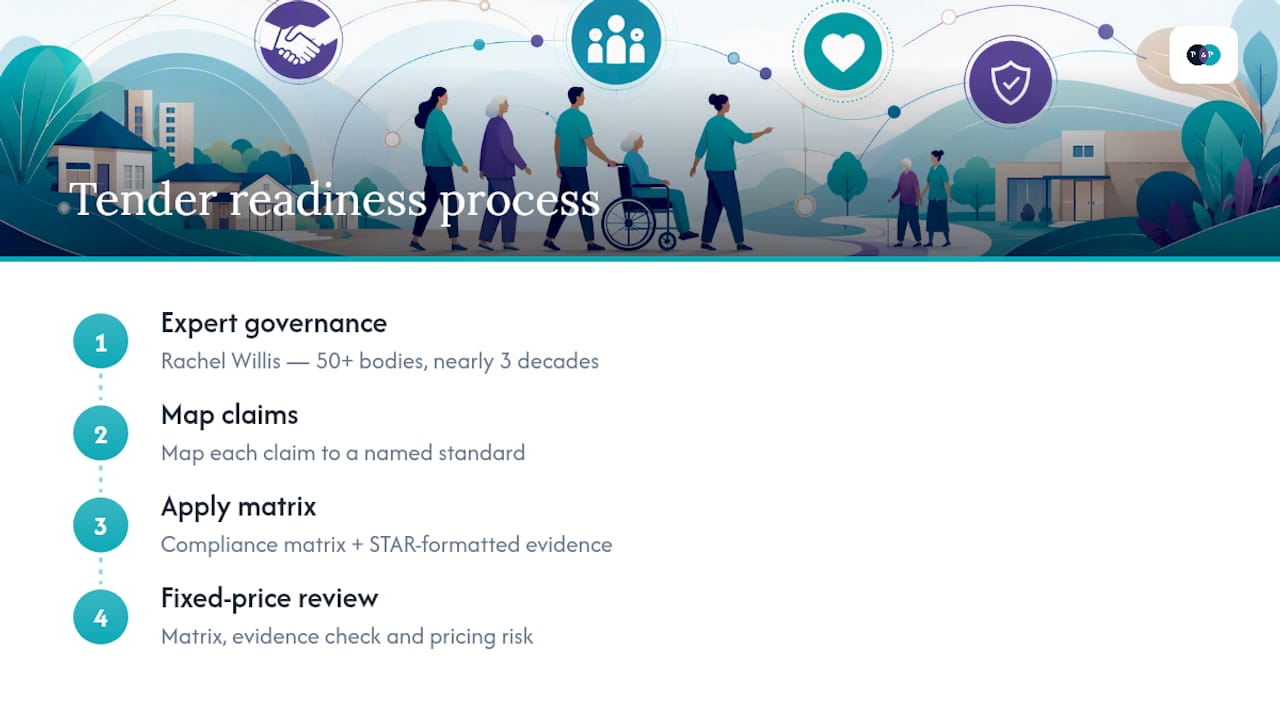
Rachel Willis has worked across more than 50 regulatory bodies over nearly three decades in human services governance. The Planning and Practice Hub applies compliance matrices and STAR-formatted evidence the same way in practice as described above, mapping each claim to a named standard rather than a general statement. A fixed-price tender review covers exactly that: matrix, evidence check, and pricing risk, before you lodge.
One practice truth worth sitting with
Boards rarely lose tenders on price. They lose them on evidence they hold internally but never wrote down. What outcome data does your organisation already have that hasn't made it into a single submission yet?
— Rachel
Get your tender reviewed before it goes in
Most providers we talk to already have the operational track record to win. What's missing is usually the compliance matrix discipline and the evidence formatting that lets a panel actually verify it. The Planning and Practice Hub reviews and drafts tender responses for NDIS and aged care providers as a fixed-scope engagement, so you know the cost before you commit and exactly what you'll have at the end.
A typical tender-writing engagement covers the compliance matrix build, drafted responses to your weighted evaluation criteria, a pricing schedule checked against the draft deed, and an executive summary that ties your evidence back to the NDIS Practice Standards or the relevant Aged Care Quality Standards outcome. If your organisation manages recurring tender cycles alongside audit and licensing deadlines, a compliance calendar keeps those dates visible so a tender deadline never collides with an accreditation renewal. For providers weighing broader governance work before their next submission, our guide on board-level compliance risk is a useful starting point. If your response includes workforce or rostering claims, the buyer guidance on HR tools for care providers is worth checking before you write that section. Ready to move? Book a fixed-scope tender review and get a clear view of your submission's gaps before the clock runs out.
Where to check the rules yourself
- Selling to Government for how Commonwealth evaluators assess responses.
- NDIS procurement and grants guidance for approaches to market and clarification processes.
- Strengthened Aged Care Quality Standards guidance for outcome definitions and audit expectations.
- Check individual tender portals and AusTender listings directly for addenda, Q&A logs and lodgement instructions specific to each release.
Sources
- Building your best response | Selling to Government
- NDIS procurement and grants guidance
- Strengthened Aged Care Quality Standards guidance
- How to write a tender response | BidShortlist
FAQ
What are the stages of the tendering process?
Most tenders move through release, a clarification and Q&A period, submission, compliance screening, scored evaluation against weighted criteria, negotiation with the preferred respondent, and contract award. NDIS and aged care processes generally follow this same sequence, though timeframes vary by procurement size and complexity.
Can you give an example of strong bid writing?
Strong bid writing states a specific claim with a verifiable result, such as documenting a measurable reduction in support-worker turnover alongside the action that produced it, structured using the STAR format and mapped to a named standard rather than described in general terms.
What does a tender document actually look like?
A typical NDIS or aged care tender document sets out mandatory eligibility criteria, weighted selection criteria with word or page limits, a pricing schedule template, a draft services deed, and instructions for lodgement through a portal or AusTender.
How long does an NDIS or aged care tender take from release to award?
Timeframes vary by procurement, but Commonwealth rules generally set minimum response periods, often around 25 days for open tenders, followed by several weeks of evaluation and negotiation before award. Smaller or panel arrangements can move faster.
When should we bring in professional tender writing support?
Engage support when your evidence base doesn't yet map cleanly to the required standards, when the draft deed carries liability terms your team can't assess internally, or when the timeline doesn't allow for a proper compliance matrix and review before lodgement.