
TL;DR:
- NDIS registered provider governance is a documented system that demonstrates accountability, oversight, and compliance. Auditors assess if boards actively understand and manage risks beyond mere paperwork, with ongoing review and documentation of operational decisions. Proper governance scaling reflects organizational complexity and emphasizes continuous oversight rather than annual audit preparations.
Governance for NDIS registered providers is a legally mandated, documented system that structures how providers demonstrate accountability, oversight, and compliance with the NDIS Practice Standards and the NDIS Commission's requirements. Most boards understand this in principle. Where things come unstuck is in the gap between having a governance framework on paper and being able to demonstrate it is actually working. The NDIS Commission assesses governance at every initial, mid-term, and renewal certification audit, and auditors are specifically trained to find that gap. If your board cannot speak to current risks, recent incidents, or how decisions are made, documentation alone will not save you.
What are the key components of NDIS registered provider governance?

The governance framework is the primary evidence auditors use to verify a provider meets Outcome 2.1 of the NDIS Practice Standards, covering leadership responsibilities and operational systems. Organisational charts and delegations of authority are mandatory supporting documents. Getting these right is not a one-off task.
A compliant governance framework includes:
- Documented roles and responsibilities for board members, key personnel, and senior managers, with clear decision-making authority at each level.
- An organisational chart that shows accountability and reporting lines, updated whenever the structure changes.
- A clear separation between governance decisions (set by the board) and operational management (executed by staff).
- Policy registers and document control systems that track version history, review dates, and approval authority.
- A conflict of interest register that auditors verify directly. Many providers underestimate this compliance element.
- Fit and proper person assessments for all key personnel, including board members and senior managers.
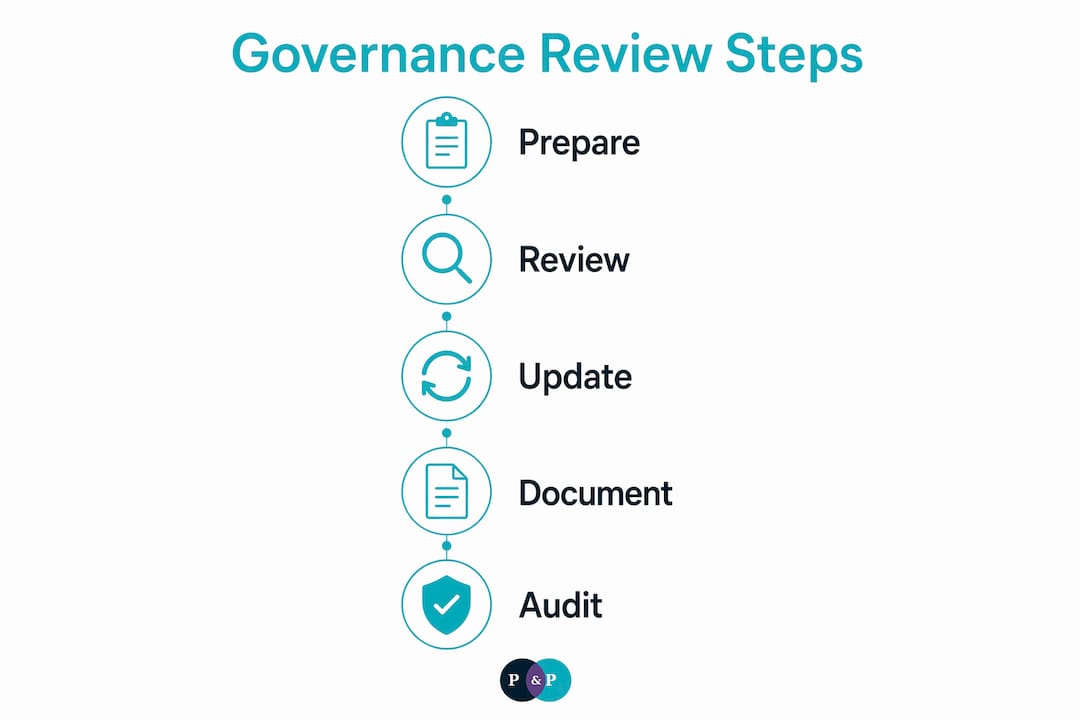
Governance frameworks must be reviewed at least annually and updated following significant events or audit findings. This is part of the continuous improvement expectation built into the NDIS Commission's model. A framework that has not been touched since registration is a red flag in any audit.
Pro Tip: Build your governance review into your annual board calendar as a standing agenda item, not a reactive task triggered by an audit notice.
How do boards demonstrate active oversight and compliance?
Active oversight is what separates a compliant provider from one at risk. Auditors do not just read your policies. They interview board members to verify actual knowledge of risks, compliance activities, and quality trends. If a board member cannot speak to a recent incident or explain how the organisation monitors participant safety, that is a finding.
The practical ways governing bodies demonstrate active oversight include:
- Formal meeting minutes that record board discussions on risks, incidents, complaints, and continuous improvement actions, not just attendance and financial reports.
- Timely notification to the NDIS Commission of any changes to key personnel, including board members and senior managers.
- A standing compliance agenda at every governance meeting, covering incident trends, audit findings, and quality monitoring data.
- Documented risk management processes that show the board receives, considers, and acts on risk information from management.
- A clear record of decisions that distinguishes what the board decided from what management was directed to implement.
Accountability for NDIS compliance is personal and non-delegable for key personnel, even when operational tasks are outsourced. This is a point that catches providers off guard. You can contract out your quality management, but you cannot contract out your governance responsibility.
Pro Tip: Ask your board secretary to flag any agenda item where a governance decision is being confused with an operational one. That discipline alone sharpens board practice considerably.
What are common governance pitfalls for NDIS providers?
The most common governance failure is treating the framework as paperwork rather than as evidence of operational understanding. Providers who fall into this pattern typically have well-formatted documents but boards that cannot explain what those documents mean in practice.
"Failure to demonstrate oversight of quality, safety, and incident trends is a common cause of non-conformance at NDIS audits. Auditors are not looking for perfect documents. They are looking for evidence that the board actually governs."
Other pitfalls worth naming directly:
- Inadequate meeting minutes that record decisions without the reasoning, risk discussion, or follow-up actions behind them.
- Outdated conflict of interest registers that have not been reviewed since the last registration cycle.
- Boards acting as management by getting involved in operational decisions, which blurs accountability and creates compliance risk.
- Treating compliance as annual audit preparation rather than as a continuous operational discipline. The NDIS Commission monitors providers through own-motion investigations and data-driven reviews year-round, not just at scheduled audits.
- Neglecting board education on governance obligations under the NDIS Practice Standards. New board members in particular need structured induction into their compliance responsibilities.
One organisation I worked with had excellent operational systems but board minutes that read like a list of approvals. When the auditor asked the chair to explain the board's response to a pattern of medication incidents over the previous quarter, there was no documented discussion to point to. That gap cost them a non-conformance that took six months to close.
How should provider size shape your governance approach?
Governance expectations scale with organisational complexity, but the obligation to document and demonstrate compliance does not disappear for smaller providers. Sole traders and micro-providers can implement simpler frameworks, but they must still document decision-making, conflict of interest management, and compliance monitoring.
| Provider type | Governance structure | Key requirements |
|---|---|---|
| Sole trader | Individual governance framework | Documented decisions, conflict of interest register, compliance monitoring log |
| Small organisation (2–10 staff) | Advisory committee or small board | Formal meeting minutes, delegations of authority, annual framework review |
| Medium to large organisation | Formal board with subcommittees | Full governance framework, risk committee, compliance reporting, SIL-specific oversight |
Supported Independent Living providers carry additional governance weight because of the complexity and risk profile of the supports they deliver. Boards overseeing SIL services need specific oversight mechanisms for participant safety, staffing ratios, and incident management, documented separately from general governance processes.
Governance scaling is not about reducing rigour for smaller providers. It is about applying the right structure for the complexity of the organisation. A nonprofit governance framework built for a 50-person organisation will not serve a sole trader, and vice versa. The NDIS Commission expects proportionality, but never absence.
Key takeaways
Effective NDIS registered provider governance requires documented frameworks, active board oversight, and continuous compliance monitoring, not periodic audit preparation.
| Point | Details |
|---|---|
| Governance is assessed at every audit | The NDIS Commission tests governance at initial, mid-term, and renewal certification audits. |
| Board members must demonstrate knowledge | Auditors interview board members directly to verify understanding of risks and compliance activities. |
| Conflict of interest registers are mandatory | Auditors verify these registers; many providers underestimate this requirement. |
| Compliance is a year-round obligation | The NDIS Commission monitors providers continuously, not only at scheduled audits. |
| Governance scales with provider size | Sole traders need simpler frameworks, but documentation and accountability remain non-negotiable. |
What I have learned about governance maturity in this sector
I have worked with NDIS providers across the size spectrum, from sole traders to multi-site organisations, and the pattern I see most often is not wilful non-compliance. It is a genuine misunderstanding of what governance actually requires in practice.
Boards often come to their first audit believing that having a governance policy is sufficient. What the NDIS Commission actually tests is whether the board understands and actively applies that policy. That is a meaningful difference. The providers who do this well treat governance documentation as a living record of their decision-making, not a filing exercise.
The other thing I would say directly to CEOs and board chairs: do not assume your board members understand their personal compliance obligations under the NDIS Practice Standards. Most come from professional backgrounds where governance means something different. Structured board induction and annual governance education are not optional extras. They are what makes the difference between a board that governs and a board that meets.
What does your board's compliance agenda actually look like at the moment?
— Rachel
Governance support from The Planning and Practice Hub
Boards and CEOs working through governance framework development or audit preparation often find the technical requirements of the NDIS Practice Standards harder to translate into practice than they expected. The Planning and Practice Hub works with registered providers to build governance frameworks that meet Outcome 2.1 requirements, including organisational charts, delegation structures, conflict of interest registers, and meeting documentation systems.
Rachel Willis brings nearly three decades of sector experience to this work, which means advice grounded in what auditors actually look for, not generic templates. If your board is preparing for a certification audit or wants to strengthen its governance practice, the consulting services at The Planning and Practice Hub offer practical, sector-specific support.
FAQ
What does Outcome 2.1 of the NDIS Practice Standards require?
Outcome 2.1 requires registered providers to demonstrate a documented governance and operational management system, including organisational charts, delegations of authority, and evidence of active board oversight.
Do sole traders need a governance board?
Sole traders do not require a formal board, but they must still document governance decisions, maintain a conflict of interest register, and evidence compliance monitoring to meet NDIS Commission requirements.
How often must an NDIS governance framework be reviewed?
Governance frameworks must be reviewed at least annually and updated following significant events or audit findings, as part of the continuous improvement expectation in the NDIS Practice Standards.
What do auditors look for in board meeting minutes?
Auditors look for evidence that the board discussed risks, incidents, complaints, and quality trends, not just financial approvals. Minutes must show informed decision-making, not just attendance records.
Can a provider outsource its governance responsibilities?
Providers can outsource operational tasks, but accountability for NDIS compliance remains personal and non-delegable for key personnel, including board members and senior managers.