
TL;DR:
- An aged care governance consultant helps boards strengthen compliance, improve accountability, and embed practical governance practices. They support organizations through audits, policy development, risk management, and building leadership capability to meet Australia's new regulatory standards. Effective governance relies on developing a culture of lived accountability, not just paper compliance, especially under the 2026 Aged Care Act.
An aged care governance consultant is a specialist advisor who works with boards and executives to strengthen governance frameworks, meet compliance obligations, and build the organisational capability needed to deliver quality care under Australia's regulatory standards. The role goes well beyond policy review. A skilled consultant brings sector experience, practical tools, and the ability to translate the Aged Care Quality Standards (Strengthened) into decisions your board can actually own. With the new Aged Care Act taking effect in 2026, the gap between paper compliance and lived accountability has never been more consequential for aged care leaders.
What services do aged care governance consultants provide?
Governance consulting in aged care covers a wide range of practical support, from one-off audits to sustained advisory relationships. The core work sits at the intersection of regulatory compliance, board capability, and organisational culture.
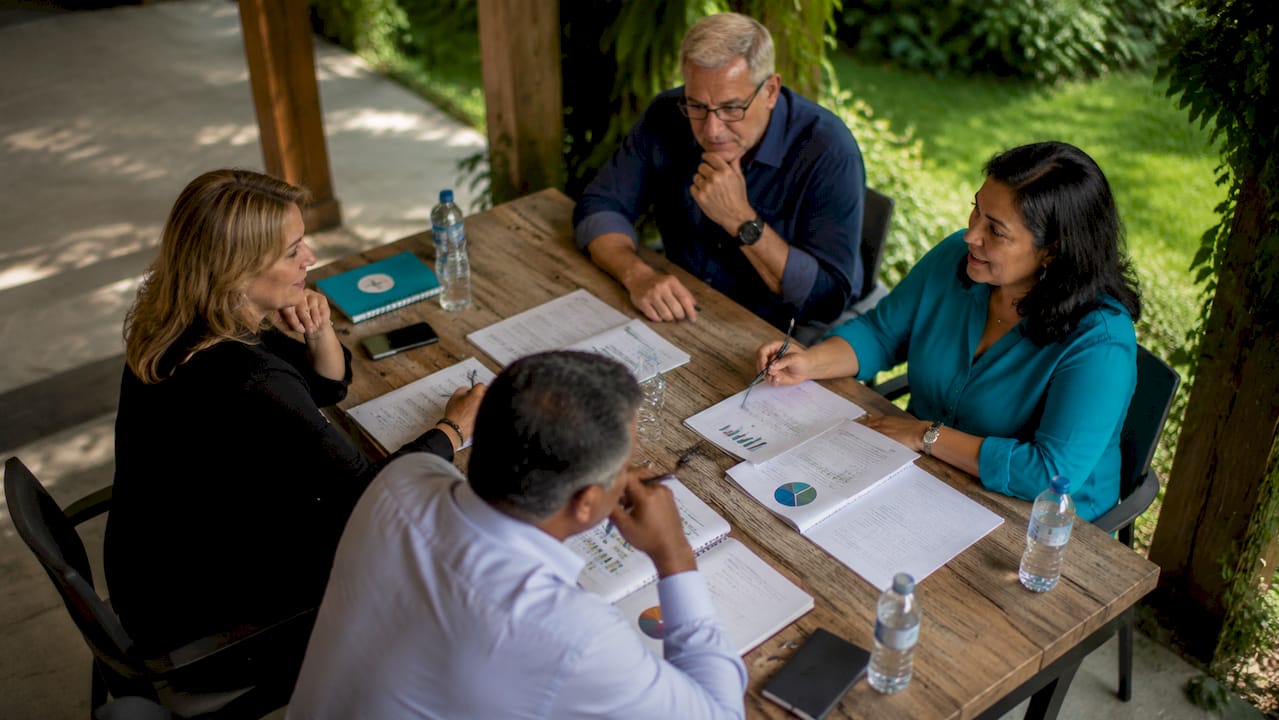
Consultancy engagements span internal policy development through to full audit readiness, structured as multi-stage projects for legislative and operational needs. That breadth means a consultant can step in at almost any point in your governance maturity journey, whether you are preparing for a Commission audit or rebuilding your risk committee from scratch.
Core service categories include:
- Governance framework development — designing or reviewing board charters, delegation frameworks, and accountability structures
- Compliance audits and gap analysis — assessing current practice against the Aged Care Quality Standards (Strengthened) and the new Aged Care Act
- Risk management support — building clinical risk registers and embedding them into board reporting cycles
- Board capability building — workshops and advisory programmes addressing care, financial, workforce, and digital governance
- Policy development — drafting or updating policies that reflect current legislative expectations
- Human rights embedding — integrating rights-based practice into governance decisions and care planning
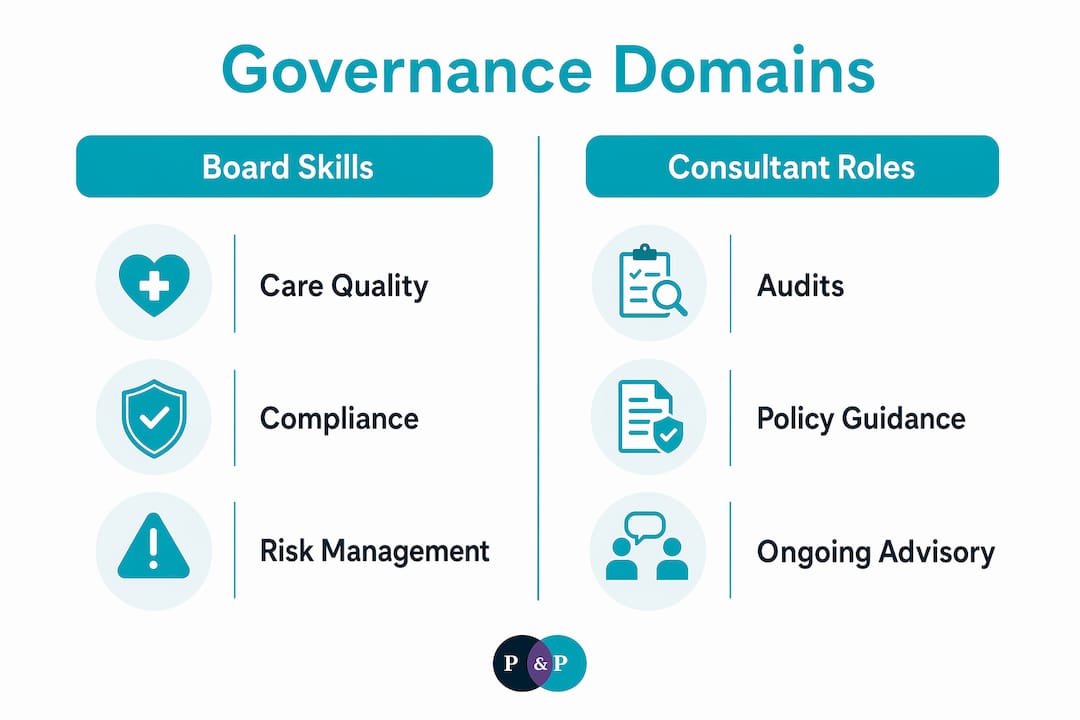
Governance consulting supports quality, compliance, and operational efficiency through audits, policy guidance, and risk management. Each of those functions connects directly to what the Aged Care Quality Commission looks for during assessment.
Pro Tip: Before engaging a consultant, map your board's current skill profile against the four governance domains: care, financial, workforce, and digital. That gap analysis tells you exactly where to focus the engagement.
How do aged care governance consultants help boards meet the new Aged Care Act?
The new Aged Care Act, operative from july 2025, shifts accountability firmly onto the governing body. Boards can no longer delegate compliance to management and consider the matter closed. Governance experts assist boards with this transition by advising on accountability frameworks, role clarity, risk management, and embedding human rights through workshops and advisory partnerships.
What that looks like in practice: a mid-sized residential provider in regional Victoria engaged a governance consultant after receiving a compliance notice from the Commission. The board had strong financial oversight but limited understanding of clinical governance obligations. Over six months, the consultant ran a series of board workshops, rebuilt the clinical governance reporting structure, and introduced a risk register that directors reviewed at every meeting. The Commission's follow-up assessment found the board's accountability culture had materially improved.
Boards require explicit skills in care, financial, workforce, and digital governance. Providers commonly need consultants to fill knowledge gaps that internal teams cannot address alone. The new Act makes those gaps a liability, not just an inconvenience.
Key areas where consultants add direct value under the new Act:
- Clarifying the governing body's specific accountability obligations
- Translating legislative language into board-level reporting requirements
- Designing governance structures that reflect the Act's expectations, not just its minimum thresholds
- Supporting directors to ask better questions of management
- Building a governance culture where accountability is lived, not just documented
Pro Tip: Ask any prospective consultant to show you a sample board governance report they have developed for a comparable provider. The quality of that document tells you more than any capability statement.
Project-based vs ongoing advisory: which model fits your organisation?
Different consulting models include project-based engagements and ongoing advisory partnerships, each suited to different organisational needs and maturity levels. Choosing the wrong model wastes both budget and goodwill.
| Feature | Project-based engagement | Ongoing advisory partnership |
|---|---|---|
| Duration | Defined timeframe, typically 3–6 months | Continuous, often 12 months or more |
| Focus | Single outcome: audit readiness, policy suite, framework build | Sustained capability building across all governance domains |
| Best suited to | Providers with a specific gap or upcoming regulatory event | Providers building governance maturity from a low base |
| Cost structure | Fixed fee or milestone-based | Retainer or agreed hours per month |
| Risk | Scope creep if governance issues are broader than anticipated | Dependency risk if internal capability is not built alongside |
| Outcome | Defined deliverable | Embedded governance culture and board confidence |
Project-based work suits organisations that have a clear, bounded problem. Audit readiness before a Commission review is a classic example. Ongoing advisory suits boards that recognise governance as a continuous discipline, not a periodic event. The benefits of governance partnerships for non-profit leaders are well documented, particularly where boards are navigating significant regulatory change.
Pro Tip: If you are unsure which model fits, start with a governance diagnostic. A good consultant will tell you honestly whether your issues require a project or a sustained relationship.
What expertise should you expect from a senior care governance expert?
The right consultant brings more than familiarity with the Aged Care Quality Standards (Strengthened). Effective governance consulting demands expertise across clinical auditing, legislative frameworks, risk management, and the practical realities of board decision-making in the aged care sector.
Ageing Australia's Compliance Hub Board Governance Toolkit, which includes over 100 policies and templates, gives you a sense of the documentation depth a capable consultant should be able to work with. A consultant who cannot navigate that toolkit confidently is unlikely to build your board's capability effectively.
Look for demonstrated expertise in these areas:
- Clinical governance — understanding of clinical risk, incident management, and care quality reporting at board level
- Legislative frameworks — working knowledge of the new Aged Care Act, the Aged Care Quality Standards (Strengthened), and ACNC Governance Standards for non-profit providers
- Risk management — ability to design and embed risk registers that directors actually use
- Board development — experience facilitating board workshops that shift thinking, not just tick boxes
- Sector experience — direct experience with aged care providers, not just generic governance consulting
Tailored workshops and ongoing advisory strengthen board members' awareness of changed regulatory environments and expectations. A consultant who customises content to your board's specific profile delivers far more value than one who runs a standard programme. You can read more about aged care governance obligations for executives to benchmark what your board should already know.
Key takeaways
An aged care governance consultant delivers the most value when boards treat governance as a lived discipline, not a compliance checklist, and when the consulting model matches the organisation's actual maturity and regulatory risk.
| Point | Details |
|---|---|
| Define the engagement model early | Choose project-based or ongoing advisory based on your governance maturity and specific regulatory risk. |
| Prioritise lived accountability | Boards must actively use governance tools like risk registers, not just approve their existence. |
| Match expertise to your gaps | Seek consultants with direct aged care sector experience across clinical, financial, workforce, and digital governance. |
| Use the new Act as a catalyst | The 2026 Aged Care Act shifts accountability to the governing body. Consultants help boards understand what that means in practice. |
| Build internal capability alongside external support | The best consulting relationships reduce dependency over time by building board confidence and skill. |
What I have learned working with aged care boards
The boards I respect most are the ones who come to a governance engagement knowing they have gaps. They are not defensive about it. They want to understand where accountability actually lives in their organisation, and they are willing to do the work to get there.
What I see most often is a board that has excellent intentions but has inherited governance structures built for a different regulatory era. The documentation looks fine. The policies exist. But when you sit in a board meeting and watch how risk is discussed, or how clinical incidents are reported, you quickly see that governance culture and governance paperwork are two very different things.
Effective aged care governance must go beyond paper compliance to lived accountability, with practical tools like clinical risk registers actively used at board level. That is the shift I push for in every engagement. It is not comfortable at first. Directors who have served well for years sometimes find it confronting to realise their governance model has not kept pace with the sector's expectations.
The question I would put to any executive reading this: when did your board last have a genuine conversation about clinical risk, not just receive a report about it? That distinction tells you everything about where your governance culture sits right now.
— Rachel
How The Planning and Practice Hub works with aged care providers
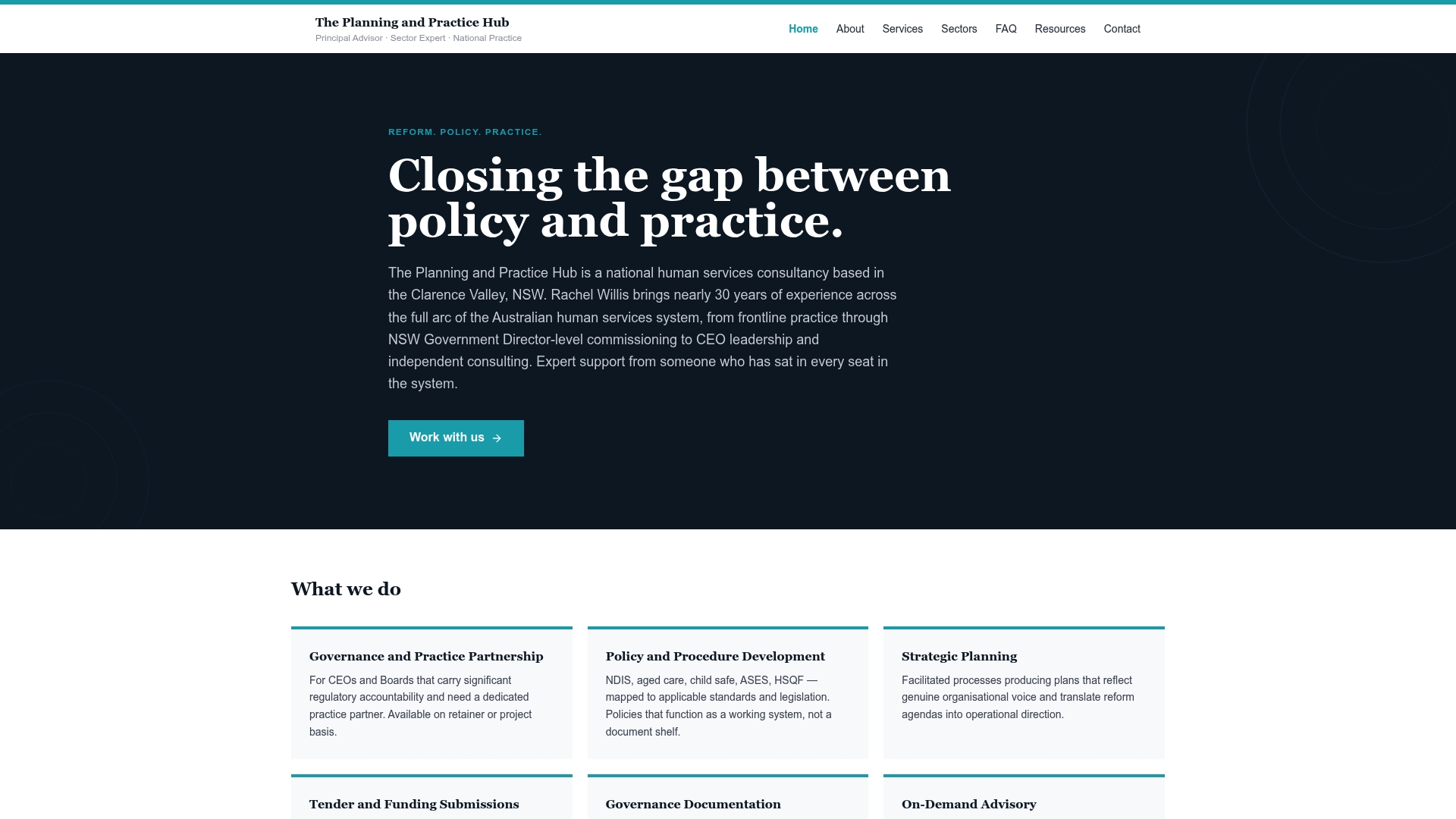
The Planning and Practice Hub works with aged care boards and executives across Australia to build governance capability that holds up under scrutiny. Rachel Willis brings nearly three decades of sector experience to every engagement, whether that is a focused governance diagnostic, a board workshop series, or an ongoing advisory relationship through a period of regulatory change.
The hub's consulting services cover governance framework development, compliance support, risk management, and board capability building, with both fee-for-service and flexible engagement options to suit providers of different sizes and maturity levels. If your board is working through the implications of the new Aged Care Act and you want a clear-eyed assessment of where your governance sits, get in touch to discuss what support would be most useful.
FAQ
What does an aged care governance consultant do?
An aged care governance consultant advises boards and executives on governance frameworks, compliance obligations, and risk management within Australia's aged care regulatory environment. Services include audits, policy development, board workshops, and ongoing advisory support.
How is governance different from compliance in aged care?
Compliance vs governance is a critical distinction: compliance means meeting minimum regulatory requirements, while governance is the ongoing exercise of accountability and decision-making that drives quality outcomes. A board can be technically compliant and still have poor governance.
When should an aged care provider engage a governance consultant?
Providers benefit most from engaging a consultant when preparing for a Commission audit, transitioning to new legislative requirements, or when the board identifies gaps in its governance capability across care, financial, workforce, or digital domains.
What is the Ageing Australia Board Governance Toolkit?
The Ageing Australia Compliance Hub Board Governance Toolkit contains over 100 policies and templates to support board documentation and good governance practice. It is a practical resource that a capable consultant should be able to work with directly.
Does the new Aged Care Act change what boards are responsible for?
The new Aged Care Act, operative from july 2025, places explicit accountability on the governing body for care quality, financial stewardship, workforce governance, and digital governance. Boards can no longer treat these as management responsibilities alone.