
TL;DR:
- Effective government tender writing in human services requires disciplined processes and specific evidence.
- Organizations should use a Go/No-Go decision process and build a comprehensive document library for quick responses.
Government tender writing in human services is the process of preparing compliant, evidence-based proposals that meet strict government evaluation criteria and demonstrate your organisation's capacity to deliver quality outcomes. For Australian non-profits working across NDIS, aged care, child safe, homelessness, and community services, a poorly structured bid can mean disqualification before an evaluator reads a single word of your response. A standard Request for Tender (RFT) requires 40–80 focused hours of preparation. That figure climbs significantly for large service contracts. The organisations that win consistently treat tender writing as a discipline, not a task.
How to decide which government tenders in human services to pursue
The single most important decision in human services proposal writing is whether to bid at all. A formal Go/No-Go decision process prevents resource burnout and increases win rates by focusing effort on opportunities where your organisation has relevant experience and can meet mandatory compliance requirements. Without it, teams spend weeks on bids they cannot realistically win.
A practical Go/No-Go assessment covers four areas:
- Mandatory requirements. Can you meet every non-negotiable condition, including current insurances, licences, and sector registrations such as NDIS provider registration or Aged Care Quality Standards compliance?
- Relevant experience. Do you have documented, recent evidence of delivering the same or similar services? Evaluators look for specificity, not generality.
- Resourcing capacity. Can your team absorb the writing workload without compromising service delivery? Tender writing is not a side task.
- Competitive position. Is this an area where your organisation has a genuine point of difference, whether through geography, specialist capability, or community relationships?
One community services organisation I worked with was submitting for every tender that crossed their desk. After introducing a structured Go/No-Go process, they reduced their bid volume by half and doubled their success rate within twelve months. Focus is a strategy.
Pro Tip: Build a one-page Go/No-Go scorecard with weighted criteria. Score each opportunity before committing a single hour to writing. If it scores below your threshold, decline and document why. That data improves your next decision.

What documents do you need before writing a human services tender?
Preparation before writing is where most non-profits lose ground. Evaluators can identify a bid written without a document foundation. The response feels generic, the evidence is thin, and the compliance sections are vague.
The documents you need fall into two categories: compliance prerequisites and capability evidence.
Compliance prerequisites:
- Current public liability and professional indemnity insurance certificates
- Workers' compensation insurance
- Relevant licences and registrations (NDIS provider registration, Working with Children Checks, aged care approvals)
- Work health and safety (WHS) policy and incident management procedures
- Privacy policy aligned to the Australian Privacy Principles
- ACNC Governance Standards documentation for incorporated non-profits
Capability evidence:
- A current capability statement (updated within the last 12 months)
- Case studies with outcome-based evidence such as participant independence gains or community participation rates
- Staff profiles and qualifications relevant to the service
- Quality management system documentation, including your approach to continuous improvement
The most practical step you can take right now is to build a shared document library with version-controlled files for each category. When a tender drops, you retrieve and adapt rather than scramble and create. A quality management system that includes document control makes this straightforward.
| Document category | Examples | Compliance standard |
|---|---|---|
| Insurance | Public liability, professional indemnity, workers' compensation | Mandatory for most RFTs |
| Registrations | NDIS provider registration, aged care approvals | NDIS Practice Standards, Aged Care Quality Standards (Strengthened) |
| Governance | ACNC Governance Standards documentation, board charter | ACNC Governance Standards |
| WHS | WHS policy, incident register, safe work procedures | Model WHS Act |
| Capability | Capability statement, case studies, staff CVs | Tender-specific |
How to write an effective government tender response in human services
Writing the response is the most time-intensive phase. The organisations that score well follow a structured process rather than writing from memory.
-
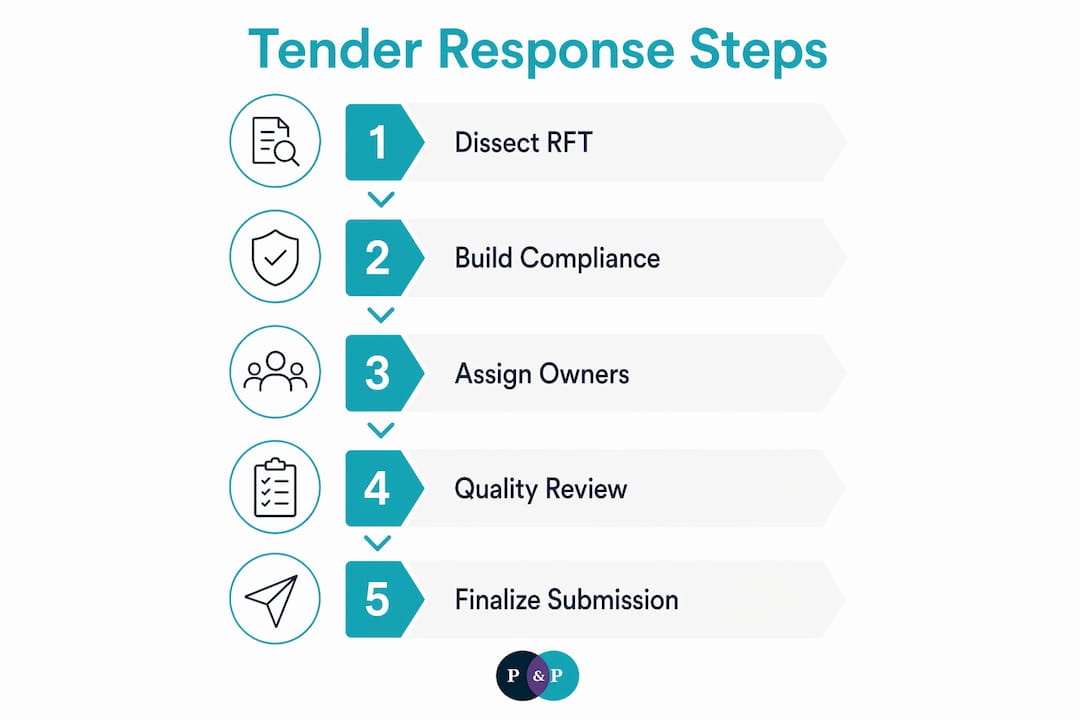
Dissect the RFT and Statement of Requirements. Read every section before writing a word. Identify the evaluation criteria, weightings, mandatory conditions, and word or page limits. Highlight every "must" and "will" statement. These are non-negotiable.
-
Build a compliance matrix. A compliance matrix spreadsheet maps each tender requirement to a specific section of your response. It is the single most effective tool for avoiding disqualification due to missed criteria. Create one column for the requirement, one for the response location, and one for the status.
-
Mirror the language of the evaluation criteria. Evaluators score against specific criteria. If the criteria use the phrase "person-centred practice," your response uses that phrase. Do not paraphrase government language. Reflect it precisely and then evidence it.
-
Lead with outcomes, not outputs. Outcome-based evidence is more persuasive than output metrics. "We supported 47 participants to gain independent living skills, with 31 transitioning to lower support categories within 18 months" is stronger than "we delivered 2,400 support hours."
-
Include team profiles and direct staff quotes. Including staff profiles and direct quotes adds a human element that sets a proposal apart. Evaluators are assessing whether they trust your team to deliver. Give them reason to.
-
Brief your referees before submission. Unprepared referees can undermine your score and credibility. Send each referee a summary of the tender, the key themes in your response, and the likely questions they will receive.
-
Set internal deadlines ahead of the government deadline. Coordinating internal contributors with deadlines set at least 48 hours before submission gives your team time for a thorough review and any last-minute amendments.
Pro Tip: Assign one person as the compliance owner and a separate person as the quality reviewer. The compliance owner tracks the matrix. The quality reviewer reads the final draft as if they are the evaluator. These are different cognitive tasks and should not be done by the same person.
| Step | Common pitfall |
|---|---|
| Dissect the RFT | Skipping mandatory conditions buried in appendices |
| Build compliance matrix | Treating it as optional rather than foundational |
| Mirror evaluation language | Paraphrasing criteria instead of reflecting them |
| Lead with outcomes | Listing outputs without linking them to participant impact |
| Brief referees | Assuming referees remember your previous work |
Common mistakes in government tender writing for human services
The most avoidable errors in human services proposal writing are procedural, not strategic. Common disqualification reasons include late submissions, missing or expired insurance certificates, incorrect portal submissions, and non-compliant formatting. None of these require expertise to fix. They require process.
Beyond disqualification, the errors that cost scores are:
- Generic responses that do not reference the specific service, location, or population group named in the RFT
- Misrepresenting capability by claiming experience in services the organisation has not delivered
- Ignoring sector standards such as the NDIS Practice Standards or the Aged Care Quality Standards (Strengthened) when the RFT explicitly references them
- Failing to demonstrate proactive risk management and professional contract governance, which evaluators treat as a proxy for delivery confidence
Evaluation panels prioritise best value for money, which includes risk mitigation, competency, and whole-of-life costs. Price alone does not win government contracts in human services. Quality, capability, and fit-for-purpose evidence do.
A final submission checklist, reviewed by someone who did not write the bid, catches the errors that writers miss through familiarity. Build it into your process as a non-negotiable step.
Key takeaways
Winning government tenders in human services requires a structured process, sector-specific evidence, and disciplined compliance review at every stage.
| Point | Details |
|---|---|
| Use a Go/No-Go process | Score each opportunity before committing resources to avoid wasted effort on unwinnable bids. |
| Build a document library | Maintain current insurances, registrations, and capability evidence so you can respond quickly and accurately. |
| Build and use a compliance matrix | Map every RFT requirement to a response section to prevent disqualification from missed criteria. |
| Lead with outcome evidence | Replace output metrics with participant impact data linked to NDIS Practice Standards or Aged Care Quality Standards (Strengthened). |
| Brief referees and review early | Contact referees before submission and set internal deadlines 48 hours ahead of the government deadline. |
What I have learned from years of tender writing in this sector
The tenders that win are rarely the most eloquent. They are the most disciplined. After nearly three decades working across Australian human services, the pattern I see consistently is this: organisations that treat tender writing as a process, rather than a writing exercise, submit better bids with less stress and higher success rates.
What I find most underestimated is the Go/No-Go decision. Leaders feel pressure to pursue every opportunity, particularly when funding is tight. But a bid written under resource strain, without strong evidence or genuine alignment to the RFT, rarely scores well. Saying no to the wrong tender is a sound use of governance.
The other thing I would say directly to any CEO or board director reading this: the quality of your bid reflects the quality of your organisation in the evaluator's mind. A response that references the NDIS Practice Standards precisely, presents outcome evidence clearly, and demonstrates that your team understands the population group signals organisational maturity. That matters more than word count or formatting polish.
What question does your board ask when a tender opportunity arrives, and does that question lead to a better decision?
— Rachel
How The Planning and Practice Hub supports non-profit tender submissions
Non-profits working across NDIS, aged care, and community services often have the capability to win government contracts. The gap is usually in the process, the documentation, or the time to write a response that does justice to the work they already do.
The Planning and Practice Hub works with non-profit leaders on the full tender cycle, from Go/No-Go assessment through to final submission review. That includes capability statement development, compliance matrix preparation, and response writing aligned to sector standards. If your organisation is preparing for an upcoming RFT or wants to build a repeatable tender process, the human services consulting services at The Planning and Practice Hub are designed for exactly that context. You can also explore the grants and tenders support available for organisations at different stages of tender readiness.
FAQ
What is government tender writing in human services?
Government tender writing in human services is the process of preparing a formal, compliant proposal in response to a government Request for Tender for services such as NDIS supports, aged care, or community services. It requires evidence-based responses aligned to evaluation criteria and sector standards.
How long does it take to write a government tender response?
A standard Australian government RFT requires 40–80 hours of focused preparation. Large or complex service contracts can require significantly more, particularly when capability statements and compliance documentation need updating.
What causes a tender to be disqualified?
Common disqualification reasons include late submissions, expired or missing insurance certificates, incorrect portal submissions, and non-compliant formatting. These are procedural errors that a final checklist review prevents.
How do evaluators assess human services tenders?
Evaluation panels assess best value for money, which includes competency, risk management, and whole-of-life costs, not price alone. Outcome-based evidence linked to sector standards such as the NDIS Practice Standards scores more strongly than output metrics.
What is a compliance matrix and why does it matter?
A compliance matrix is a spreadsheet that maps every RFT requirement to a specific section of your response. It prevents disqualification from missed criteria and gives your team a clear structure to write against.