
TL;DR:
- Results-based accountability helps human services organizations measure if their programs improve people's lives through meaningful indicators.
- Implementing RBA takes around 18–24 months and requires leadership commitment, participatory workshops, and technology support.
Results-based accountability (RBA) is a structured framework that helps human services organisations measure whether their programs genuinely improve people's lives. Known formally as Results-Based Accountability, the approach separates two distinct questions: how is the community doing, and how well is this program working? For leaders working within the NDIS Practice Standards, Aged Care Quality Standards (Strengthened), and National Principles for Child Safe Organisations, RBA offers a disciplined way to connect daily service delivery to meaningful outcomes. The Planning and Practice Hub works with Australian human services leaders to embed this kind of outcomes based accountability into governance and practice.
What are the core components of results based accountability in human services?

RBA operates on two levels. Population accountability asks: what conditions do we want for the people in our community? Performance accountability asks: how well is this specific program delivering results? Leaders who conflate the two often end up with reporting that looks busy but tells them very little.
The framework rests on four building blocks: a clear result statement, a small set of meaningful indicators, a reliable data collection process, and feedback loops that drive decisions. The result statement defines the change you are trying to achieve, for example, "children in our region are safe and thriving." Indicators then answer three questions: how much did we do, how well did we do it, and is anyone better off?
The third question is the one most organisations avoid. It requires qualitative data, lived experience, and practitioner judgement alongside numbers. Metrics must be relevant and practical, avoiding overload by focusing on a coherent set that guides decision-making. That discipline is harder than it sounds when funders, regulators, and boards all want different things reported.
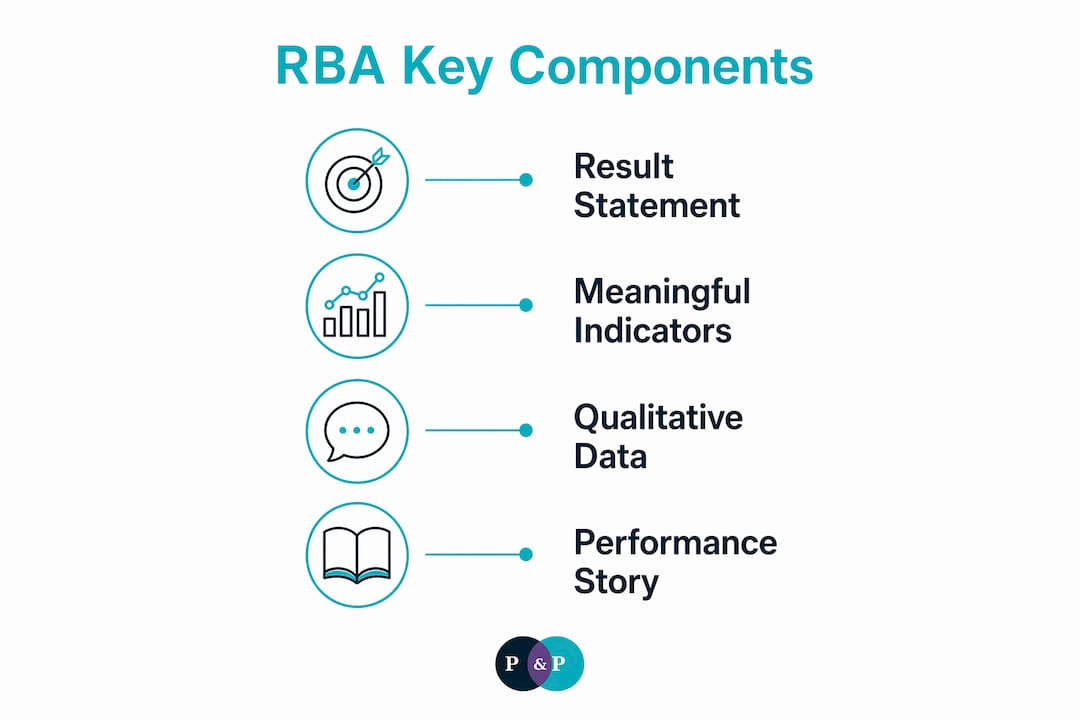
| RBA component | What it means in practice |
|---|---|
| Result statement | A plain-language description of the population condition you want to achieve |
| Indicators | A small set of measures that show progress toward the result |
| Data collection | Systematic gathering of both quantitative and qualitative evidence |
| Theory of change | A participatory map linking activities to outcomes |
| Feedback loops | Regular review cycles that adjust service delivery based on data |
How do Australian human services organisations implement RBA in practice?
Structured RBA implementation takes 18–24 months, involving theory-of-change development, indicator auditing, and advisory committee testing. That timeline surprises leaders who expect a framework to be installed like software. The reality is that the process is as important as the product.
A typical implementation moves through these stages:
- Establish leadership commitment. The board and executive team agree on the result they are pursuing and why it matters. Without this, indicator selection becomes a political exercise.
- Run participatory workshops. Frontline staff, people with lived experience, and advisory committee members identify the "missing middle" between program activities and long-term goals. Frontline and subject-matter experts must be included early to keep metrics feasible and meaningful.
- Develop and audit indicators. Draft a long list, then reduce it. Successful frameworks limit active monitoring to fewer than 100 core indicators, using technology for automated outcome reporting.
- Adopt appropriate technology. Data collection tools should reduce manual workload, not add to it. Automation supports real-time insights and frees practitioners to focus on people.
- Test with an advisory committee. A cross-section of stakeholders stress-tests the indicator set before it goes live. Resilient Families uses quarterly joint working groups with cross-agency executive leadership to manage risks and align strategies effectively.
Pro Tip: Start with three "is anyone better off" indicators before you build out the full framework. Getting those three right teaches your team more about meaningful measurement than any training session.
The Community Broadcasting Foundation restructured its impact reporting in 2017–18 and reached a mature framework by 2026. That trajectory is realistic for most mid-sized human services organisations.
What challenges do Australian human services leaders face when applying RBA?
Fragmented performance reporting is the most common barrier. A sector-wide survey in 2026 highlights challenges including implementation costs, capacity limits, and the need for flexible sector guidance. Organisations often report to multiple funders using different templates, making it nearly impossible to build a coherent picture of impact.
Three other barriers appear consistently across the sector:
- Counting what is easy, not what matters. Activity counts and throughput figures are straightforward to collect. Wellbeing changes are not. Leaders must actively protect space for qualitative evidence and practitioner judgement.
- Control-based contracts. Rigid compliance models restrict learning and punish honest reporting of what is not working. Trust-based funding relationships with flexibility drive better client outcomes.
- Capacity and cost constraints. Smaller organisations often lack the data infrastructure and staff time to run a full RBA cycle. Proportional approaches, where the depth of measurement matches the scale of the program, help manage this.
Moving from control-based to trust-based contracts is not just a procurement decision. It is a cultural shift that requires funders and providers to agree that learning from failure is more valuable than hiding it.
Embedding learning requires leadership that values transparency, collaboration, and evidence literacy. That combination is rare, and building it takes deliberate effort from the top of the organisation. The governance culture of the board and executive team sets the conditions for whether RBA becomes a genuine improvement tool or just another compliance exercise.
How does RBA improve outcomes and regulatory compliance in Australia?
The evidence from Australian programs is clear. Resilient Families achieved a 94.74% family preservation rate alongside significant wellbeing improvements, demonstrating what RBA principles produce when applied with discipline. That result matters because it is the kind of evidence that satisfies both funders and regulators.
RBA data also strengthens governance and reporting confidence. When boards can see a coherent set of indicators linked to a clear result statement, they ask better questions and make better decisions. That directly supports compliance with ACNC Governance Standards, which require boards to demonstrate they are monitoring organisational performance. ASES Version 9.1 and the HSQF (QLD only) both expect organisations to show continuous improvement, and a well-run RBA cycle provides exactly that evidence trail.
| Outcome area | RBA contribution |
|---|---|
| Client wellbeing | Structured "is anyone better off" measures capture real change |
| Regulatory compliance | Indicator data supports NDIS, Aged Care, and Child Safe reporting |
| Board governance | Coherent performance data improves board oversight under ACNC Governance Standards |
| Funder confidence | Transparent impact reporting builds trust and supports contract renewal |
Key takeaways
Results-based accountability works in Australian human services when leaders commit to meaningful indicators, participatory design, and a culture that treats data as a learning tool rather than a compliance burden.
| Point | Details |
|---|---|
| Separate the two accountability levels | Population accountability and performance accountability answer different questions and need different indicators. |
| Allow 18–24 months for implementation | Rushing the process produces indicators that look good but do not drive decisions. |
| Limit core indicators | Fewer than 100 active indicators, supported by technology, keeps the framework manageable and credible. |
| Shift contract culture | Trust-based funding relationships produce better outcomes than rigid compliance models. |
| Anchor compliance in RBA data | Indicator sets aligned to NDIS, Aged Care, and Child Safe standards reduce duplicated reporting effort. |
What I have learned about embedding RBA that most guides do not tell you
After nearly three decades working alongside human services leaders, I have watched RBA frameworks succeed and fail. The difference almost never comes down to the quality of the indicators. It comes down to whether the leadership team genuinely believes that honest data, including data that shows a program is not working, is an asset rather than a liability.
The organisations that get the most from RBA are the ones that involve frontline workers and people with lived experience from the very first workshop, not as a consultation formality but as genuine co-designers. Data combined with lived experience detects emerging problems early and spreads effective practices. That is a practical truth, not a values statement.
I also think the sector underestimates how long it takes to shift a board's relationship with performance data. Most boards are accustomed to receiving financial reports and compliance checklists. Asking them to engage with a theory of change and a set of wellbeing indicators requires a different kind of facilitation. The executive director's governance role in that transition is critical and often underestimated.
My honest advice: start smaller than you think you need to. Pick one program, build the RBA cycle properly, and let the results speak. That proof of concept does more to build organisational commitment than any framework document.
What is your board's current relationship with your outcome data? Is it driving decisions, or is it sitting in a report that gets noted and filed?
— Rachel
Working with The Planning and Practice Hub on RBA implementation
Human services leaders across Australia are under real pressure to demonstrate impact while managing complex regulatory requirements across bodies including the NDIS Quality and Safeguards Commission, the Aged Care Quality and Safety Commission, and state-based frameworks.
The Planning and Practice Hub works directly with boards, executive teams, and quality managers to build RBA frameworks that are practical, proportional, and aligned to your regulatory context. From management consulting on outcome measurement to facilitated theory-of-change workshops, the Hub brings close to three decades of sector experience to every engagement. If you are ready to move from compliance reporting to genuine performance accountability, reach out to discuss what that looks like for your organisation.
FAQ
What is results-based accountability in human services?
Results-based accountability is a framework that separates population-level outcomes from program-level performance, using a small set of meaningful indicators to measure whether services genuinely improve people's lives.
How long does RBA implementation take in Australia?
Structured implementation typically takes 18–24 months, covering theory-of-change development, indicator auditing, and advisory committee testing before the framework is operational.
How does RBA support compliance with Australian regulatory standards?
RBA indicator sets can be aligned directly to NDIS Practice Standards, Aged Care Quality Standards (Strengthened), National Principles for Child Safe Organisations, and ACNC Governance Standards, reducing duplicated reporting effort.
What is the biggest risk in applying RBA to human services programs?
The most common risk is selecting indicators that are easy to count rather than meaningful. Leaders must protect space for qualitative evidence and lived experience alongside quantitative data.
What is the difference between population accountability and performance accountability?
Population accountability measures community-level conditions, such as child safety across a region. Performance accountability measures how well a specific program is contributing to that condition.