
TL;DR:
- Program logic maps how human services resources and activities lead to client outcomes and is mandatory in NSW as of 2026. It includes four core components: inputs, activities, outputs, and outcomes, with regular updates essential for effective management and compliance. Engaging frontline staff in development and maintenance of the model enhances ownership, accuracy, and program effectiveness.
Program logic in human services is a structured framework that maps how an initiative's resources and activities are expected to achieve client outcomes. As of 2026, the NSW Government evaluation guidelines treat it as a mandatory schematic tool for service providers, explicitly linking inputs, activities, outputs, and outcomes. For CEOs, board directors, and quality managers working across NDIS, aged care, and community services, a well-constructed logic model is no longer optional. It is the foundation of credible monitoring, transparent reporting, and defensible compliance.
What are the core components of program logic in human services?
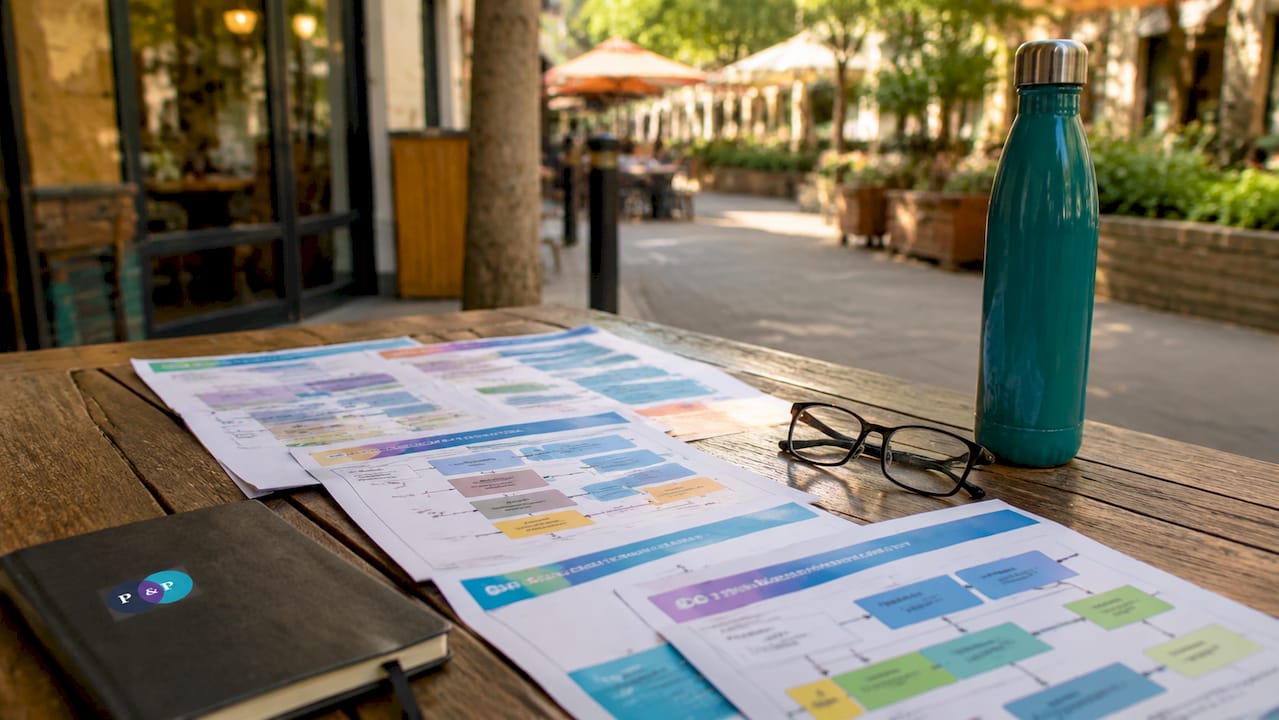
A logic model in social services has four interdependent components. Each one builds on the last, creating a causal chain from resource to result.
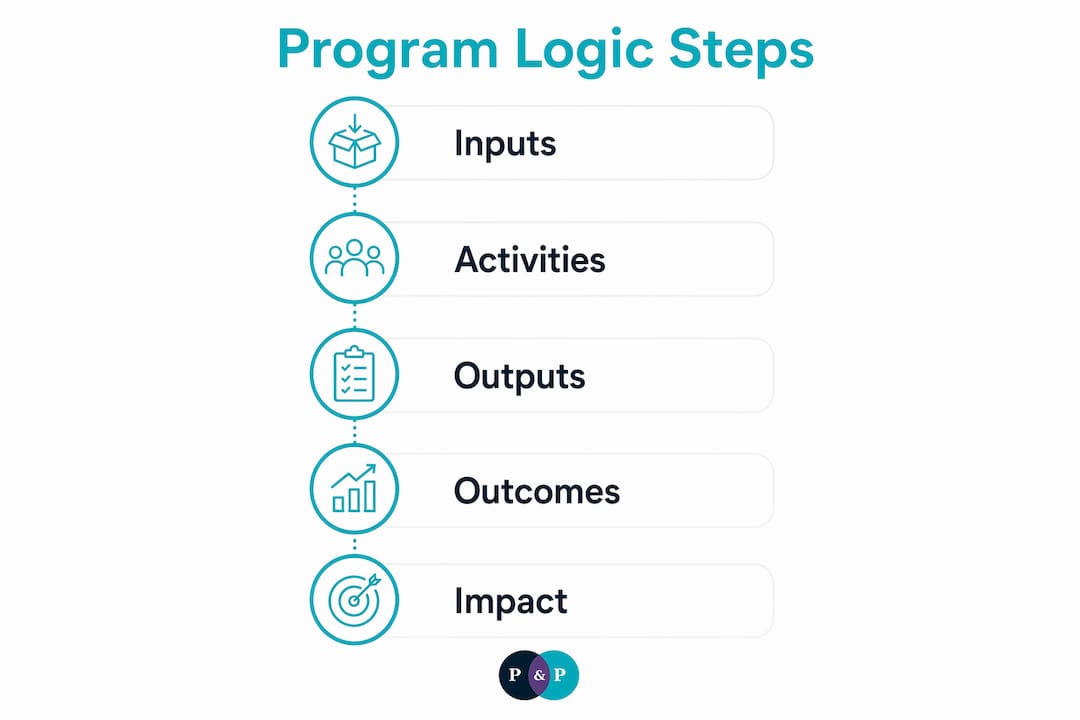
| Component | Definition | Human services example |
|---|---|---|
| Inputs | Resources committed to the program | Funding, staff, facilities, volunteer hours |
| Activities | Services and processes delivered | Case management, group workshops, outreach visits |
| Outputs | Direct, countable products of activities | Number of client contacts, workshops delivered |
| Outcomes | Changes for clients and communities | Improved housing stability, reduced social isolation |
Inputs are what you put in. Activities are what you do with those inputs. Outputs count what you produced. Outcomes describe what changed for the people you work with.
The distinction between outputs and outcomes trips up many teams. Delivering 200 workshops is an output. Reducing repeat homelessness presentations by 15% is an outcome. Funders and regulators, including those applying the ACNC Governance Standards, want to see both. Conflating them weakens your reporting and your credibility.
Intermediate outcomes sit between outputs and final outcomes. A client gaining employment skills is an intermediate outcome. Sustained employment six months later is a final outcome. Mapping this chain explicitly is what makes a logic model useful for program evaluation frameworks rather than just a planning exercise.
How to develop an effective program logic model
Program logic development is an iterative and participatory process that combines analytical review with extensive consultation. Neglecting frontline staff engagement produces models that are technically sound but operationally disconnected. The people delivering services know where the causal chain breaks down in practice.
A practical development process looks like this:
- Define the problem your program addresses, using evidence and community data.
- Identify inputs by auditing current resources, including funding, staff, and partnerships.
- Map activities by consulting frontline workers about what they actually do, not just what the contract says.
- Specify outputs with measurable, countable indicators tied directly to each activity.
- Articulate outcomes at intermediate and final levels, distinguishing short-term behaviour change from long-term social impact.
- Test the logic by asking whether each causal link is plausible, feasible, and strategically sound.
- Plan for monitoring by building data collection and evaluation costs into the initial program budget.
Step seven is where most organisations fall short. Monitoring and evaluation resources must be planned and included in the initial program budget. Programs that skip this step lack the data infrastructure needed for audit-level reporting or rigorous impact assessment.
Pro Tip: Run a structured workshop with frontline staff before finalising any logic model. Ask them: "Where does this theory break down in practice?" Their answers will identify gaps no desktop analysis will find.
For complex programs, a hierarchical model approach works best. A high-level master logic captures the whole program. Separate sub-models cover each component in detail. This prevents the master model from becoming unreadable while maintaining clear causal links across all parts. It also increases internal ownership, because each team manages its own sub-model rather than sharing a single unwieldy document.
Quality checks on plausibility, feasibility, and strategic choices significantly improve implementation success. Plausibility asks: does the evidence support this causal link? Feasibility asks: can we actually deliver this with the resources we have? Strategic choice asks: is this the best use of those resources given our mission?
Why does your program logic model need regular updating?
A logic model that reflects last year's program is not a management tool. It is a historical document. The NSW Treasury guidelines are direct on this point: failing to update the model as the program evolves invalidates it as an effective management and evaluation tool.
Programs change. Funding shifts. Staff turn over. Client needs evolve. Regulatory requirements under frameworks like the NDIS Practice Standards or the Aged Care Quality Standards (Strengthened) are updated. Each of these changes can break a causal link in your model without anyone noticing, until an audit or evaluation exposes the gap.
A practical review schedule for most human services programs looks like this:
- At program inception — build the initial model with full stakeholder input.
- At six months — review outputs data against model predictions and adjust activity descriptions.
- At each contract renewal — realign inputs and outcomes with new funding conditions.
- After any significant service change — update immediately, not at the next scheduled review.
- Annually — conduct a full model review with frontline staff and management together.
Assign clear ownership for each review. A quality manager or program lead should hold accountability for keeping the model current. Without a named owner, updates get deferred indefinitely.
How do logic models support compliance and strategic decision-making?
A well-maintained logic model does more than satisfy a funder requirement. It becomes the connective tissue between your program design, your monitoring data, and your governance reporting.
| Stakeholder | Primary benefit |
|---|---|
| Funding bodies | Transparent resource utilisation and outcome evidence |
| Board and governance | Clear line of sight from investment to impact |
| Quality managers | Structured basis for continuous improvement |
| Frontline teams | Shared understanding of program intent and their role in it |
| Regulators | Audit-ready documentation of program rationale |
For organisations working under the ACNC Governance Standards, a current logic model supports Standard 5 by demonstrating that the organisation operates in pursuit of its charitable purpose with clear accountability. For NDIS-registered providers, it aligns monitoring and evaluation activity with the NDIS Practice Standards requirement for evidence-based service delivery.
Program logic supports transparent resource utilisation and compliance with government standards. That transparency matters when you are responding to a funding body's performance review or preparing for a quality audit. Organisations that can point to a current, evidence-linked logic model are better positioned to demonstrate the effectiveness of human service programs than those relying on narrative reports alone.
The Planning and Practice Hub works with Australian non-profits to connect logic model development directly to governance and strategic planning. The goal is not a document that sits in a folder. It is a working tool that informs board decisions, contract negotiations, and service improvement cycles.
Key takeaways
A current, well-structured logic model is the single most useful tool for connecting program intent to measurable outcomes in human services.
| Point | Details |
|---|---|
| Mandatory in NSW | Program logic is required under NSW Government evaluation guidelines for service providers as of 2026. |
| Four core components | Inputs, activities, outputs, and outcomes must be explicitly mapped with clear causal links. |
| Iterative development | Build models with frontline staff, not just managers, to avoid operationally disconnected frameworks. |
| Living document | Update the model at each contract renewal, after service changes, and at least annually. |
| Compliance and governance | A current logic model supports ACNC Governance Standards, NDIS Practice Standards, and audit-level reporting. |
What I have learned from two decades of program logic work
The most common mistake I see is organisations treating a logic model as a grant application attachment. They build it once, submit it, and file it. Three years later, the program looks nothing like the model, but the model is still being cited in board reports.
I worked with a mid-sized community services organisation in regional NSW that had a beautifully formatted logic model from their original funding application. When we sat down with the frontline team, it became clear that two of the five activities listed had been discontinued, and a new activity had been running for 18 months with no documentation in the model at all. Their monitoring data was being collected against outputs that no longer existed. The evaluation they commissioned that year produced findings that made no sense to the people delivering the program, because the model and the reality had diverged completely.
The fix was not complicated. It took two workshops, one with the frontline team and one with the management group, to rebuild the model to reflect current practice. What changed most was ownership. When the people delivering the program helped build the model, they understood why the data collection mattered. Compliance stopped feeling like an imposition and started feeling like a record of their own work.
The question I would put to any sector CEO reading this: who in your organisation owns the logic model right now, and when did they last look at it?
— Rachel
Working with The Planning and Practice Hub on program logic
Building a credible logic model takes time, sector knowledge, and a clear process. Many organisations have the intent but not the internal capacity to do it well, particularly when regulatory requirements are shifting and staff are stretched.
The Planning and Practice Hub works with human services organisations across Australia to build, refine, and maintain program logic and evaluation frameworks that hold up under scrutiny. Rachel Willis brings nearly three decades of sector experience to every engagement, working alongside your team rather than handing over a template. If your organisation needs to strengthen its program planning and evaluation capacity, or align your logic model with current compliance requirements, get in touch to discuss what that support could look like.
FAQ
What is a program logic model in human services?
A program logic model is a schematic tool that explicitly maps the causal links between a program's inputs, activities, outputs, and outcomes. It is used for planning, monitoring, evaluation, and compliance reporting.
Is program logic mandatory for NSW human services providers?
Yes. As of 2026, the NSW Government evaluation guidelines treat program logic as a mandatory or highly recommended tool for service providers receiving government funding.
How often should a logic model be updated?
A logic model should be reviewed at program inception, at six months, at each contract renewal, after any significant service change, and at least annually. Failing to update it invalidates its use as a management and evaluation tool.
What is the difference between outputs and outcomes?
Outputs are the direct, countable products of program activities, such as the number of workshops delivered. Outcomes are the changes that result for clients or communities, such as improved housing stability or reduced social isolation.
How does program logic support regulatory compliance?
A current logic model supports compliance with frameworks including the NDIS Practice Standards and ACNC Governance Standards by providing audit-ready documentation of program rationale, resource use, and evidence of outcomes.