
TL;DR:
- Workplace investigations in human services require procedural fairness, psychosocial risk management, and clear separation of roles. Proper preparation, timely communication, and thorough documentation ensure investigations meet legal and sector standards while protecting staff wellbeing. Delays and role merging increase legal risks and undermine investigation defensibility.
Workplace investigations in human services are structured, fair inquiry processes that establish facts while protecting staff wellbeing and meeting regulatory obligations under the Fair Work Act 2009, WHS laws, and sector standards including the NDIS Practice Standards and Aged Care Quality Standards (Strengthened). Most leaders in this sector understand the compliance stakes. Fewer have a process that holds up when the Fair Work Commission or the NDIS Quality and Safeguards Commission scrutinises it. Getting this right requires more than a policy document. It requires a process that is procedurally fair, psychosocially aware, and completed within a timeframe that preserves evidence and protects people.
What do workplace investigations in human services actually require?

A defensible investigation starts well before an allegation lands on your desk. The organisations that handle these processes well have three things in place before any complaint is raised: a documented investigation policy, trained investigators, and an incident reporting system aligned with sector requirements.
Your investigation policy must specify scope, roles, timelines, and confidentiality obligations. Trained investigators need skills in interviewing, evidence gathering, and psychosocial risk management. That last skill is not optional in human services. Investigation processes themselves carry psychosocial hazards, and WHS laws require you to manage them proactively or risk prosecution.
NDIS providers carry an additional obligation. Reportable incidents covering death, serious injury, abuse, sexual misconduct, and unauthorised restrictive practices must be notified to the NDIS Commission within 24 hours of becoming aware. That notification obligation runs parallel to, not instead of, your internal investigation process.
| Prerequisite | What it must include |
|---|---|
| Investigation policy | Scope, roles, timelines, confidentiality, and escalation pathways |
| Trained investigators | Interviewing skills, evidence assessment, psychosocial risk awareness |
| Terms of reference | Allegations, scope, interim measures, and investigation boundaries |
| Communication protocols | 24–48 hours' notice for meetings, right to support person confirmed in writing |
| Incident reporting system | Aligned with NDIS, WHS, and sector-specific notification requirements |
Pro Tip: Apply your investigation procedures consistently across all cases regardless of seniority. Inconsistent application is one of the most common grounds for unfair dismissal claims at the Fair Work Commission.
How to conduct a step-by-step investigation while managing psychosocial risks
Not every complaint warrants a formal investigation. The first decision is whether the allegation is better resolved through informal workplace conflict resolution or requires a structured process. Where allegations are serious, where they involve potential misconduct, or where they carry NDIS or WHS reporting obligations, a formal investigation is the right path.
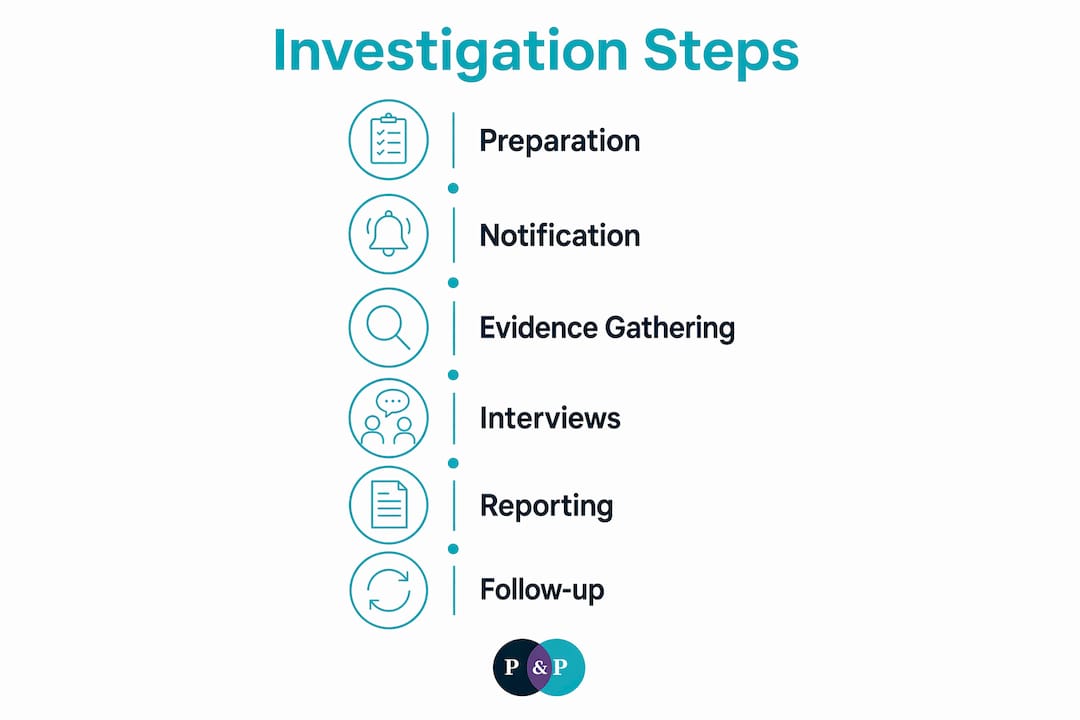
Once you proceed formally, the steps below reflect current best practice for human services environments.
- Develop terms of reference. Define the allegations, scope, timeline, and any interim measures such as adjusted duties or temporary reporting changes.
- Notify the respondent. Provide detailed allegations in writing with at least 24–48 hours' notice before any interview. Confirm the right to bring a support person. This is not a courtesy. It is a procedural fairness requirement.
- Interview the complainant first, then witnesses, then the respondent. Give each person the specific allegations before their interview so they can respond meaningfully. Ambush interviews are a procedural fairness breach.
- Gather documentary evidence. Review records, communications, rosters, incident logs, and any other relevant materials.
- Weigh the evidence objectively. Investigators must assess all evidence without relying solely on inconsistent accounts or personal belief. This is where many investigations fail.
- Provide draft findings to the respondent. Allow a 'show cause' response before findings are finalised. This step reduces legal risk significantly.
- Finalise the report and refer to the decision-maker. The investigator's role ends with findings. A separate decision-maker determines outcomes.
The separation of investigator and decision-maker roles is mandatory for procedural fairness. Merging these roles is one of the most common errors leaders make, and it is one of the most damaging when challenged.
Investigations should complete within 4–6 weeks. Delays increase memory decay, heighten stress for all parties, and weaken the defensibility of findings. Set a timeline at the outset and communicate it.
Pro Tip: Empower your investigator to pause or adjust the process if a participant's psychological safety is at serious risk. That authority should be written into your terms of reference, not left to ad hoc judgement.
What challenges arise most often, and how do you address them?
Human services investigations carry pressures that other sectors rarely face. Allegations often involve vulnerable people, dual reporting obligations, and staff who work in close-knit teams. These are the challenges leaders encounter most often.
- Delayed investigations. Every week of delay increases the risk of memory decay and compounds stress for everyone involved. Set a firm timeline and assign a dedicated investigator from day one.
- Inadequate particularisation. Vague allegations create ambush risks and procedural unfairness. Allegations must be specific enough for the respondent to meaningfully respond before their interview.
- Merged roles. When the investigator also decides the outcome, bias concerns become grounds for challenge. Keep these roles separate in writing and in practice.
- Stand-downs and alternate duties. Placing a worker on alternate duties during an investigation creates serious psychosocial risks. These decisions require careful justification, clear communication, and active monitoring of the worker's wellbeing.
- Conflicting witness accounts. Weight evidence based on corroboration, consistency, and documentary support. Do not resolve conflicts by deciding who seems more credible. That approach does not survive scrutiny.
- Confidentiality versus transparency. In NDIS contexts especially, you must balance the respondent's right to know the allegations against the complainant's safety. Get legal advice early when these tensions arise.
One organisation I worked with had a senior team leader under investigation for conduct involving a participant. The reporting line ran directly through the manager responsible for overseeing the process. Adjusting those reporting lines early, before the investigation began, was the decision that kept the process defensible.
Pro Tip: For complex cases or allegations involving senior staff, engage an external investigator. The cost is far lower than the legal and reputational exposure of a flawed internal process.
How do investigations connect with compliance audits and ongoing accountability?
Investigations do not exist in isolation. They sit inside a broader governance and compliance framework that includes human services compliance audits under the NDIS Practice Standards, Aged Care Quality Standards (Strengthened), and ACNC Governance Standards.
- Investigation findings inform risk registers, corrective action plans, and continuous improvement processes.
- Documented investigations are your primary defence when employment decisions are challenged at the Fair Work Commission or sector tribunals.
- Clear documentation of every investigative step, evidence assessed, and reasoning applied is what withstands scrutiny. Gaps in documentation are gaps in your defence.
- Serious incident reporting under NDIS and WHS obligations must be tracked and closed out, not just notified.
- Investigation policies and investigator training need periodic review as laws and sector standards evolve.
The Planning and Practice Hub works with boards and quality managers to build investigation frameworks that satisfy both sector audit requirements and employment law obligations. If you want to understand what boards specifically need to know about NDIS obligations, the NDIS compliance overview for boards is a useful starting point.
Key takeaways
Effective workplace investigations in human services require procedural fairness, psychosocial risk management, and clear role separation to produce outcomes that withstand regulatory and legal scrutiny.
| Point | Details |
|---|---|
| Separate roles always | Keep investigator and decision-maker roles distinct in writing and in practice. |
| Set a firm timeline | Complete investigations within 4–6 weeks to protect evidence quality and staff wellbeing. |
| Notify with specifics | Give respondents detailed allegations and 24–48 hours' notice before any interview. |
| Manage psychosocial risk | Treat the investigation process itself as a WHS hazard requiring active controls. |
| Document everything | Record every step, evidence source, and finding rationale to withstand tribunal scrutiny. |
What I have learned from nearly three decades in this sector
The most common mistake I see is treating a workplace investigation purely as an HR process. It is not. It is simultaneously a WHS risk management exercise, and the organisations that miss that distinction are the ones that end up with prosecution risk sitting alongside an unfair dismissal claim.
The second thing I have learned is that proactive communication throughout the process does more to preserve psychological safety than almost any other single action. People can tolerate a difficult process if they understand what is happening and when. What they cannot tolerate is silence.
Trauma-informed approaches are not soft. They are legally sound. An investigator who understands how trauma affects memory and disclosure will gather better evidence and produce more defensible findings than one who does not. In human services, where many staff have their own trauma histories, this matters more than in most sectors.
The question I ask leaders when we first sit down together is this: if your current investigation process were scrutinised by the Fair Work Commission tomorrow, would it hold up? How are your current investigation practices balancing fairness and staff wellbeing?
— Rachel
How The Planning and Practice Hub supports investigation compliance
Building a workplace investigation framework that satisfies the Fair Work Act 2009, NDIS Practice Standards, and WHS obligations at the same time is not straightforward. The Planning and Practice Hub works directly with boards, CEOs, and quality managers in human services to design investigation policies, build investigator capability, and align processes with sector audit requirements.
Whether you are starting from scratch or reviewing an existing process that has not been tested, the consulting services at The Planning and Practice Hub offer practical, sector-informed support. Rachel Willis brings close to three decades of direct experience in Australian human services governance and compliance. If your organisation works in NDIS, aged care, or community services, that depth of sector knowledge makes a real difference to the quality of the advice you receive.
FAQ
What is a workplace investigation in human services?
A workplace investigation in human services is a formal, structured process to establish facts about an alleged incident or misconduct while meeting procedural fairness and sector compliance obligations. It operates under the Fair Work Act 2009, WHS laws, and standards such as the NDIS Practice Standards.
How long should a workplace investigation take?
Industry best practice sets a completion target of 4–6 weeks. Longer investigations increase memory decay, heighten psychosocial risk for all parties, and weaken the defensibility of findings.
What notice must employers give before an investigation interview?
Employers must provide at least 24–48 hours' notice before formal investigation meetings and inform employees of their right to bring a support person. Failure to do so constitutes a procedural fairness breach.
When must NDIS providers report a serious incident?
NDIS providers must notify the NDIS Quality and Safeguards Commission within 24 hours of becoming aware of a reportable incident, including death, serious injury, abuse, sexual misconduct, or unauthorised restrictive practices.
Can the same person investigate and decide the outcome?
No. Investigators gather facts and produce findings. A separate decision-maker determines disciplinary outcomes. Merging these roles creates bias concerns and is a common ground for challenge at the Fair Work Commission.