
Family services strategic planning is the structured process through which non-profit organisations define multi-year goals, align governance and workforce, and commit to measurable service outcomes. The strongest family services strategic planning examples share three qualities: clear ownership of each goal, embedded cultural commitments, and an execution rhythm that outlasts the planning retreat. Organisations like Jewish Family and Children's Service of Minnesota, Caring Families Aotearoa, and Ontario's MCCSS demonstrate what this looks like in practice. This guide breaks down what separates plans that drive real change from those that gather dust on a shelf.
1. What makes a family services strategic plan effective?
The most effective plans centre client needs, not organisational convenience. Jewish Family and Children's Service of Minnesota's strategic plan organises its entire framework around four goals: meeting increasing demand for individual and family-centred services, fostering inclusion, expanding capacity, and increasing community impact. Values like Tikkun Olam and collaboration are not decorative. They are the stated rationale for every priority.
Strong plans also define what success looks like before the work begins. Goals without measurable outcomes are aspirations. The difference between a plan that moves an organisation and one that doesn't is whether each priority has a named owner, a defined update cadence, and a method for tracking risk.
Pro Tip: Before finalising your plan, test every goal against this question: can a programme manager explain how their daily work connects to this goal? If not, the goal is too abstract to execute.

2. Key components of effective family services strategic plans
The best community services strategic planning frameworks share a consistent architecture, even when the context differs.
- Organisation-wide goals tied directly to client outcomes, not internal processes
- Governance and cultural integration, including explicit commitments such as Te Tiriti o Waitangi in Caring Families Aotearoa's 2026 to 2029 plan, which embeds these principles across governance, training, and service delivery
- Financial sustainability mechanisms, including funding diversification and workforce development targets
- Operational execution structures with named owners, measurable outcomes, regular update cadences, and risk registers
Elate's nonprofit strategic plan template operationalises this by requiring each strategic priority to carry defined outcomes, an owner, and a monitoring schedule. This prevents the plan from becoming a static document. It becomes an accountability tool instead.
3. How non-profit family services organisations engage stakeholders
Structured stakeholder engagement is what separates a credible plan from a leadership team's best guess. Texas HHSC-Family Health Services uses environmental scans, staff surveys, interactive listening sessions across multiple communities, and community selection workshops to ground strategy in shared values and system realities. The result is a plan that reflects the people it serves, not just the people who wrote it.
The engagement process at Lafayette Urban Ministry, facilitated by Loring Sternberg & Associates, followed a similar path. Focus groups, surveys, and data analysis produced strategic goals endorsed by leadership and renewed organisational energy. The lesson is consistent: when communities see their input reflected in the plan, they invest in its success.
A practical sequence for engagement looks like this:
- Map your stakeholder groups: clients, staff, board, volunteers, funders, and community partners
- Select methods appropriate to each group, such as surveys for staff and listening sessions for community members
- Analyse themes across all inputs before drafting any goals
- Share back what you heard and how it shaped the plan
"Structured stakeholder engagement that reaches diverse community voices leads to strategic plans that are credible, aligned, and more likely to be embraced." — Texas Institute for Child & Family Wellbeing
4. What governance structures support strategic success?
Governance design is where many human services strategic planning efforts fall short. The plan looks sound on paper, but the governance architecture cannot carry the weight of execution. Ontario's MCCSS addresses this directly through coordinated service planning, which assigns each child or young person a single coordinated service plan covering all services, with a dedicated service planning coordinator and continuous cross-sector monitoring. Families experience one coherent system rather than a collection of disconnected programmes.
Cultural governance requires the same specificity. Caring Families Aotearoa's plan goes beyond a statement of intent. It embeds Te Tiriti commitments into governance participation requirements, training obligations, and partnership representation at multiple organisational levels. This is what separates authentic cultural governance from tokenism. You can read more about how to approach this in practice in embedding governance culture.
Curtis Strategy identifies that many failures in human services stem from execution gaps rather than flawed strategy. The recommendation is to diagnose whether a performance problem is a strategy problem or an execution problem before intervening. Systematic accountability frameworks and KPI monitoring are the mechanism that closes this gap.
Pro Tip: Build your governance rhythm into the board calendar before the plan launches. Quarterly KPI reviews and annual strategy health checks should be scheduled events, not reactive responses to problems.
| Governance element | What it looks like in practice |
|---|---|
| Coordinating agency model | Single plan per family, one coordinator, cross-sector monitoring |
| Cultural governance integration | Explicit representation requirements and training obligations |
| Execution accountability | Named owners, KPI dashboards, quarterly board reviews |
| Risk management | Documented risk registers updated alongside strategic priorities |
5. Comparing top family services strategic plan examples
Examining plans side by side reveals where organisations invest their planning energy and what that produces.
| Organisation | Planning horizon | Cultural commitment | Stakeholder engagement method | Execution mechanism |
|---|---|---|---|---|
| JFCS Minnesota | Multi-year | Values-framed goals (Tikkun Olam) | Board and leadership-led | Goal owners with defined outcomes |
| Caring Families Aotearoa | 2026 to 2029 | Te Tiriti o Waitangi embedded | Governance and community partnership | Workforce development and funding diversification targets |
| Texas HHSC-FHS | System-level | Community values mapping | Listening sessions, surveys, workshops | Environmental scan and accountability reporting |
| Ontario MCCSS | Annual service objectives | Cross-sector inclusion | Service coordinator model | Single coordinated plan per child/youth |
The most consistent theme across these family support programme examples is that cultural and community commitments only hold when they are attached to specific accountability mechanisms. Organisations that name their values without naming who is responsible for upholding them produce plans that erode within twelve months of publication.
Key takeaways
Effective family services strategic plans succeed because they combine clear goal ownership, structured stakeholder engagement, and governance accountability into a single operational rhythm.
| Point | Details |
|---|---|
| Goals must be client-centred | Organise every priority around client outcomes, not internal processes. |
| Cultural commitments need accountability | Embed cultural governance into training, representation, and reporting requirements. |
| Stakeholder engagement grounds the plan | Use listening sessions, surveys, and workshops before drafting any goals. |
| Governance design closes execution gaps | Assign named owners and schedule KPI reviews before the plan launches. |
| Coordination prevents fragmentation | Single coordinated plans with dedicated coordinators produce coherent family experiences. |
What I've learned from plans that actually hold
After nearly three decades working across Australia's human services sector, the pattern I see most often is this: organisations invest heavily in the planning process and almost nothing in the execution architecture. The plan is beautifully written. The launch is well attended. And then, six months later, nobody can tell you who owns goal three.
The examples in this article are instructive precisely because they are specific. JFCS Minnesota names its values and attaches them to goals. Caring Families Aotearoa names its cultural commitments and attaches them to governance requirements. Ontario names its coordination model and attaches it to individual families. Specificity is not a stylistic preference. It is the mechanism by which a plan survives contact with operational reality.
What I would add, from experience, is that the hardest part of strategic plan development is not the planning itself. It is the conversation that happens when a KPI is missed and the board has to decide whether that reflects a strategy problem or an execution problem. Organisations that have built that diagnostic capacity into their governance rhythm are the ones that course-correct quickly. Those that haven't tend to commission another planning process instead.
The question worth sitting with: does your current governance structure give your board the information it needs to tell the difference?
— Rachel
How The Planning and Practice Hub can support your strategic plan
If the examples in this article have clarified what your own plan is missing, The Planning and Practice Hub works directly with non-profit family and human services organisations to build plans that hold. Rachel Willis and the team bring close to three decades of sector experience to every engagement, from stakeholder engagement design through to governance accountability frameworks.
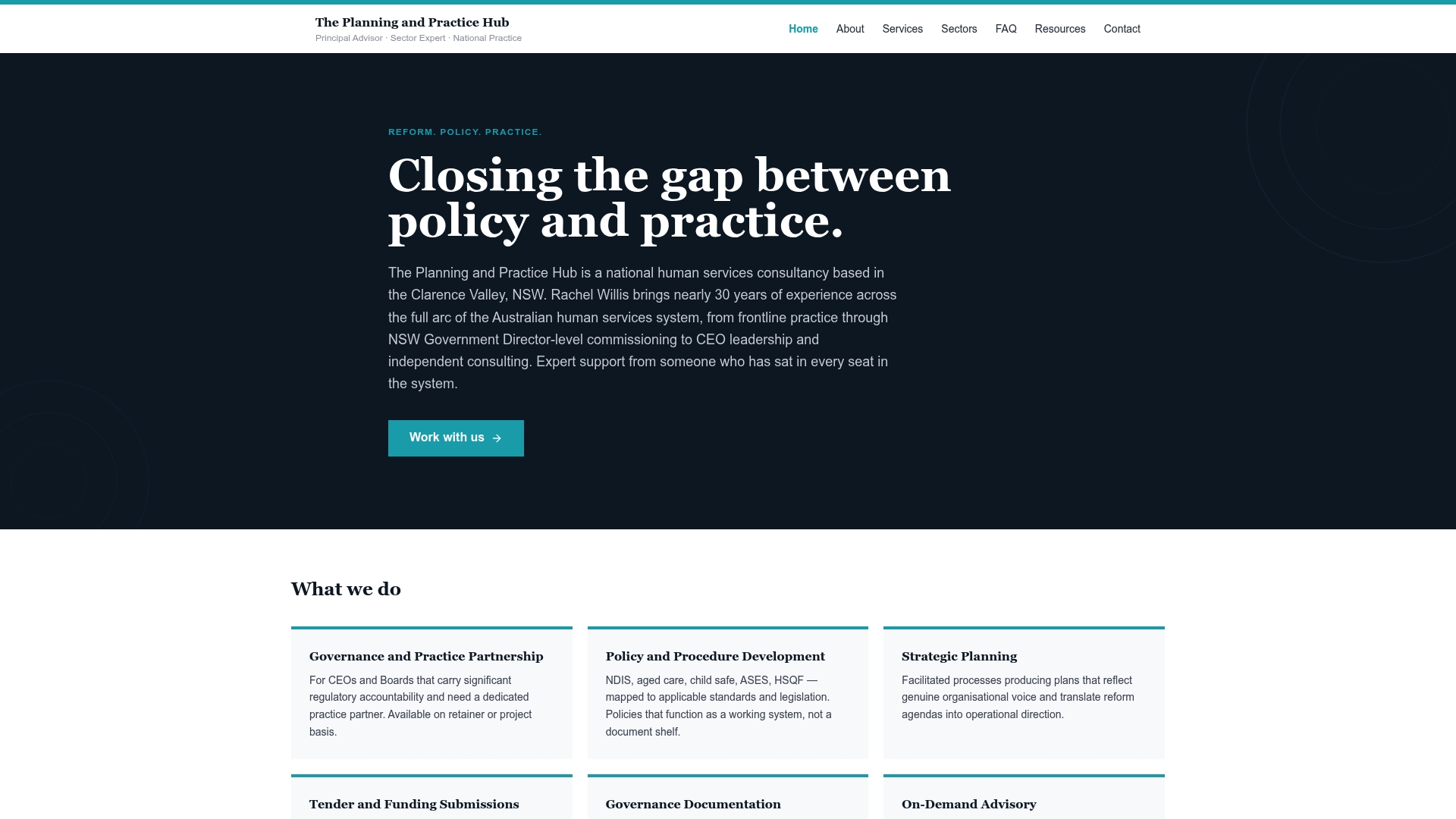
The work is co-developed, not templated. Whether you need support with human services consulting, workforce development integration, or embedding cultural commitments into your governance structure, The Planning and Practice Hub offers tailored consulting services built for the complexity of Australia's regulatory environment. Reach out to explore what a well-structured strategic plan could produce for your organisation.
FAQ
What are the key elements of a family services strategic plan?
Effective plans include organisation-wide goals tied to client outcomes, cultural governance commitments with accountability mechanisms, financial sustainability targets, and an execution structure with named owners and regular KPI reviews.
How long should a family services strategic plan cover?
Most strong examples span three to four years, as seen in Caring Families Aotearoa's 2026 to 2029 plan, with annual service objectives reviewed and updated to reflect changing conditions.
Why does stakeholder engagement matter in strategic planning?
Structured engagement through surveys, listening sessions, and community workshops produces plans that reflect community values and are more likely to be embraced by staff, clients, and funders.
What is the most common reason strategic plans fail in human services?
Curtis Strategy identifies execution gaps as the primary cause. Plans fail when goals lack named owners, KPI monitoring is absent, and boards cannot distinguish between a strategy problem and an execution problem.
How do you embed cultural commitments into a strategic plan?
Cultural commitments require explicit governance participation requirements, training obligations, and partnership representation at multiple organisational levels, not just a values statement on the first page.