
Boards of non-profit organisations bear ultimate legal responsibility for governance and compliance, yet most receive their compliance picture through a single filtered lens: internal reporting. External compliance advice, the practice of engaging independent specialists to assess and report directly to the board, fills the gap that internal teams structurally cannot. Under ACNC Governance Standard 5, directors must act with care, diligence, and good faith, and demonstrate this through documented governance processes. When regulators scrutinise your organisation, the question is not whether you had a compliance function. It is whether your board received candid, independent assurance and acted on it.
Why boards need external compliance advice beyond internal reporting
The core problem with relying solely on internal compliance reports is structural, not personal. Internal teams report through management, which means findings can be shaped, softened, or delayed before they reach the board. Research from CLS Blue Sky confirms that external advisers help boards discharge oversight in ways internal reporting can miss, specifically by framing and categorising risk in terms the board can act on, and by providing candid assurance that is not filtered through management.
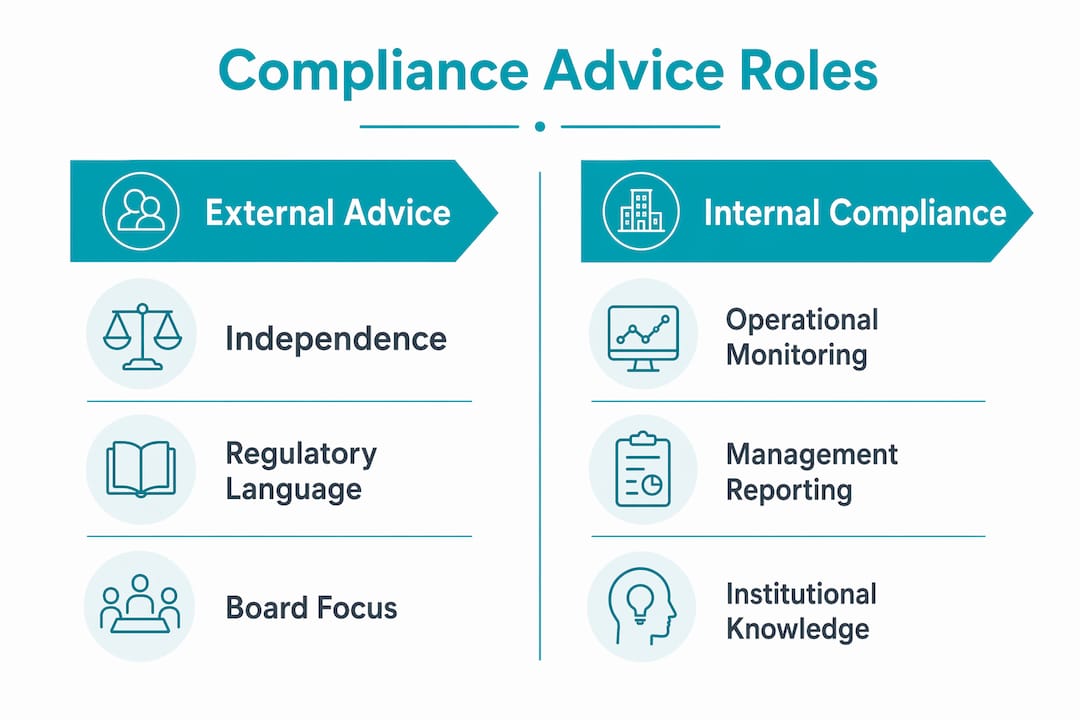
The independence of an external adviser changes what the board actually hears. Where an internal compliance officer may hesitate to escalate a sensitive finding about a senior manager, an external adviser with a direct reporting line to the board or audit committee has no such constraint. Boards must receive unfiltered compliance information directly, and relying solely on management risks missing emerging cultural and operational risks entirely.

External advisers also bring a different vocabulary to risk. They categorise issues in terms regulators recognise, which matters when your board needs to demonstrate it understood and responded to a risk. This is not about distrust of internal teams. It is about adding a layer of assurance that internal teams, by design, cannot provide for themselves.
Pro Tip: Define the external adviser's scope, independence, and escalation protocols in writing before engagement begins. Ambiguity about who the adviser reports to, and under what circumstances they escalate directly to the board, is the most common reason these relationships underdeliver.
What ACNC Governance Standard 5 requires from your board
ACNC Governance Standard 5 sets out five director duties that apply to every registered charity in Australia: acting with care and diligence, acting in good faith, not misusing position or information, disclosing conflicts of interest, and taking reasonable steps to ensure the organisation is financially responsible. Each of these duties requires evidence, not just intention.
Good governance and record-keeping are critical signals to the ACNC that boards have discharged these duties. Enforcement actions, including enforceable undertakings, have followed from poor minute-keeping and inadequate conflict management. The ACNC does not need to prove bad intent. It needs to show the board did not take reasonable steps, and a thin governance record makes that case for them.
External advice supports this directly. An adviser who reviews your governance documentation, attends key meetings, and helps structure conflict disclosure processes creates a contemporaneous record of board diligence. That record is your defence if a regulator ever questions whether your board understood its obligations.
The table below maps each Standard 5 duty to the practical benefit an external adviser provides:
| ACNC Standard 5 duty | How external advice helps |
|---|---|
| Care and diligence | Adviser provides independent risk assessment the board can act on and document. |
| Good faith | External review confirms decisions align with organisational purpose and member interests. |
| Conflict disclosure | Adviser structures and reviews disclosure processes, creating a clear decision trail. |
| Financial responsibility | Independent testing of financial oversight processes and reporting to the board. |
| Reasonable steps to comply | Documented advisory engagement is direct evidence of proactive compliance effort. |
Pro Tip: Ask your external adviser to review your board minutes specifically for conflict-of-interest handling. Clear minute records showing who disclosed, who was excluded, and how decisions were made are the most defensible governance evidence you can hold.
External advice vs internal compliance: when each falls short
Internal compliance functions are not going away, nor should they. They provide ongoing monitoring, institutional knowledge, and day-to-day operational oversight that no external adviser can replicate cost-effectively. The limitation is not capability. It is position. An internal team sits inside the management structure, which constrains both what they can say and who they can say it to.
Outsourcing compliance to external specialists allows faster adaptation to regulatory changes and produces cleaner audit trails than internal-only teams. For non-profits without the budget for a full-time Chief Compliance Officer, external advisory arrangements also offer flexible coverage that scales with the organisation's risk profile and regulatory calendar.
The situations where external advice becomes non-negotiable include:
- When a compliance concern involves senior management and internal escalation is compromised.
- When the board is preparing for an ACNC review or responding to a regulatory inquiry.
- When the organisation is entering a new service area with unfamiliar regulatory requirements.
- When the board has not received an independent assessment of its governance programme in more than two years.
- When a significant incident has occurred and the board needs independent assurance that its response is adequate.
Boards held to high expectation even in regulatory environments without explicit board compliance mandates must go beyond passive receipt of reports. External advice is the mechanism that makes active oversight credible.
How to structure an external compliance advisory relationship
Getting value from external compliance advice depends almost entirely on how the engagement is structured. The most common mistake is letting the adviser function as management's consultant, which means findings get filtered before they reach the board. Boards must control scope, access, and escalation to secure genuinely independent assurance.
Here is a practical sequence for structuring the relationship:
- Define the scope in writing. Specify which regulatory frameworks, governance processes, and risk areas the adviser will assess. Vague mandates produce vague findings.
- Establish direct reporting lines. The adviser reports to the board or audit committee, not to the CEO or management team. This is the structural guarantee of independence.
- Set escalation protocols. Agree in advance on the circumstances under which the adviser contacts the board chair directly, outside the normal reporting cycle.
- Schedule regular reporting. Episodic advice at crisis points is far less valuable than periodic reporting that tracks emerging risks and programme trends over time.
- Use the adviser for governance documentation. External review of board minutes, conflict registers, and decision records strengthens your compliance evidence base before a regulator ever asks for it.
Effective minute keeping and governance documentation are key signals to regulators that boards understand and have discharged their duties. An external adviser who actively contributes to this record is providing governance value, not just compliance advice.
Pro Tip: Commission a periodic external governance review, separate from any operational compliance work, to assess whether your board's oversight processes are fit for purpose. This is the kind of proactive step that demonstrates genuine diligence to the ACNC.
Key takeaways
Boards that treat external compliance advice as a governance mechanism, not a management service, receive the independent assurance that ACNC Governance Standard 5 requires and that internal reporting alone cannot deliver.
| Point | Details |
|---|---|
| Independence is structural | External advisers must report directly to the board, not through management, to provide genuine assurance. |
| ACNC Standard 5 requires evidence | Documented external advisory engagement is direct proof that boards took reasonable steps to comply. |
| Internal teams have limits | Internal compliance functions cannot independently assess their own effectiveness or escalate freely past management. |
| Scope and escalation must be written | Ambiguous engagement terms are the primary reason external advisory relationships underdeliver for boards. |
| Governance documentation is your defence | Minutes and decision trails reviewed by an external adviser are the most defensible evidence in a regulatory inquiry. |
What I have learned after nearly 30 years in this sector
The boards I have worked with that struggle most with compliance are rarely the ones facing the most complex regulatory environments. They are the ones that receive a compliance report at each meeting, nod it through, and consider the obligation discharged. That is not oversight. That is administration.
External compliance advice is not a substitute for a well-functioning internal team. It is the mechanism that allows the board to know whether that team is actually working. The distinction matters because regulators expect boards to actively seek candid information and conduct independent investigations when appropriate. Passive receipt of reports does not meet that standard.
What I have also seen is that boards underestimate how much the adviser relationship itself needs to be governed. Who the adviser reports to, what they are permitted to say, and how findings are documented are not administrative details. They are the governance architecture that determines whether the advice is worth anything. A board that lets management define the adviser's scope has not gained independence. It has created the appearance of it.
The non-profit boards that get this right treat their external adviser the way they treat their auditor: as someone who works for the board, not for management, and whose findings go directly to the people responsible for acting on them. That framing changes everything.
— Rachel
How The Planning and Practice Hub supports your board
Non-profit boards in Australia's human services sector face a regulatory environment that spans more than 50 bodies, and the ACNC is only one of them. The Planning and Practice Hub provides specialist governance and compliance consulting tailored to the specific obligations your board carries, including direct support for evidencing ACNC Governance Standard 5 duties through governance documentation, compliance reviews, and structured advisory relationships.
Our work with non-profit boards is co-developed, not templated. We help you build the governance record that protects your directors and demonstrates genuine diligence to regulators. If your board is ready to move beyond internal-only reporting, explore our not-for-profit consulting support or get in touch to discuss what your organisation needs.
FAQ
Why can't internal compliance teams provide the same assurance?
Internal teams report through management, which structurally limits both what they can say and who they can say it to. External advisers with direct board reporting lines provide independent assurance that internal teams cannot give about their own processes.
What does ACNC Governance Standard 5 require from directors?
Standard 5 requires directors to act with care and diligence, in good faith, without misusing their position, while disclosing conflicts and taking reasonable steps to ensure financial responsibility. Each duty must be evidenced through governance records, not just stated in policy.
How often should a board receive external compliance advice?
Periodic reporting on a scheduled basis, rather than only at crisis points, is the most effective model. Boards that go beyond passive receipt of reports and actively test their compliance programme through regular external input demonstrate the structural capacity regulators expect.
What makes governance minutes defensible to the ACNC?
Minutes that record who disclosed conflicts, who was excluded from decisions, and the reasoning behind key resolutions provide the clearest evidence of director diligence. Decision trails showing disclosures and exclusions are the records regulators look for first in an inquiry.
When is external compliance advice most critical for a non-profit board?
External advice is most critical when a compliance concern involves senior management, when the organisation is preparing for regulatory review, when entering a new service area, or when the board has not had an independent governance assessment in more than two years.