
If your last three grant rounds ate up two staff members for six weeks and still came back with a "not this time," the fix is not another all-nighter before the deadline. It is engaging a funding submission consultant NFP leaders can brief once and rely on to build internal capability, not just chase the next cheque. Sector data backs this up: Funding Centre's 2025 member survey found win rates among its largely not-for-profit membership climbed, while time and resourcing remained the biggest constraint reported. The Planning and Practice Hub is a leading option for human services organisations specifically because it pairs grant strategy with governance and compliance alignment against the NDIS Practice Standards and Aged Care Quality Standards, rather than treating the application as an isolated writing task.
Before you brief anyone, get three things sorted:
- Scope it in writing. Decide whether you need one application, a program of rounds, or a full capability build, before you call a consultant.
- Set a realistic window. A single strong submission needs four to eight weeks; do not compress this to fit a deadline you spotted last week.
- Have your evidence ready. Outcomes data, board minutes, and current policies need to exist before a consultant can turn them into a competitive case.
Key Takeaways
Engaging a capability-building funding submission consultant, rather than a one-off application writer, is the most reliable way for human services NFPs to lift their win rates and retain the skills internally.
| Point | Details |
|---|---|
| Hire for capability, not just a win | Choose a consultant who leaves templates, an evidence library and a review process behind. |
| Check governance alignment first | Confirm experience against NDIS Practice Standards, Aged Care Quality Standards and ACNC Governance Standards. |
| Budget realistically | Single applications run four to eight weeks; capability programs run six to twelve months. |
| Confirm fee rules early | Many grants exclude professional writing fees, so budget consultant costs separately. |
| The Planning and Practice Hub as a leading option | Combines grants strategy with sector governance alignment for human services organisations. |
What does a funding submission consultant actually do?
A grant writer types words into a template. A genuine NFP grant writing expert does something broader, and the difference shows up in win rates over time, not just in one document.
The core work looks like this:
- Opportunity mapping. Matching your strategic priorities against funder intent, using datasets like Strategic Grants' GEMS Funding Insights rather than a manual scroll through funder websites.
- Pipeline and stewardship strategy. Planning which funders to approach, when, and how to maintain the relationship between rounds, not just at application time.
- Application drafting. Building the logic model, evidence base, budget, and compliance/reporting plan as one coherent document, not four disconnected sections.
- Governance alignment. Checking the application and supporting evidence line up with the NDIS Practice Standards, Aged Care Quality Standards, and ACNC Governance Standards a funder will expect to see referenced or demonstrated.
- Capability transfer. Leaving behind templates, an evidence library, and assessor-style review notes your team can reuse next round without paying for the same work twice.
Jo Garner and other sector strategists argue the funding environment has shifted from reactive grant-chasing toward proactive, relationship-based strategy, which is exactly why opportunity mapping and stewardship now matter as much as drafting skill. Complex, jargon-heavy calls for proposals also tend to disadvantage smaller organisations, a pattern Aid Network has documented in its analysis of lengthy funder documentation, which is one reason a consultant's job includes translating funder language into something your operational team can actually action.
When should your NFP hire a funding consultant?
Not every application needs outside help. But a few signals suggest you are past the point where internal effort alone will lift your results.
- Your team is stretched, not skilled-short. SmartyGrants' sector summary found time was cited as the top constraint by 30% of respondents, ahead of finding the right grant (25%), with organisations submitting an average of 13 applications a year.
- Your win rate has stalled despite volume. If you are lodging applications regularly and still sitting below sector averages, the issue is likely strategy or evidence quality, not effort.
- The opportunity is genuinely complex. Consortium grants, multi-stage government tenders, and large service contracts carry compliance and budget requirements that punish a rushed first attempt.
- Governance gaps could make you ineligible before assessment even starts. Missing co-contribution evidence or unclear reporting frameworks knock applications out early.
Run a quick internal check before you brief anyone: do you have current outcomes data, a recent board-endorsed strategic plan, and named executive sponsorship for the bid? If any of those three is missing, a consultant will spend the first weeks building them rather than writing, which changes your timeline and your budget.
What do engagement models, timelines and fees typically look like?
Funding submission consultants generally work under one of three structures.
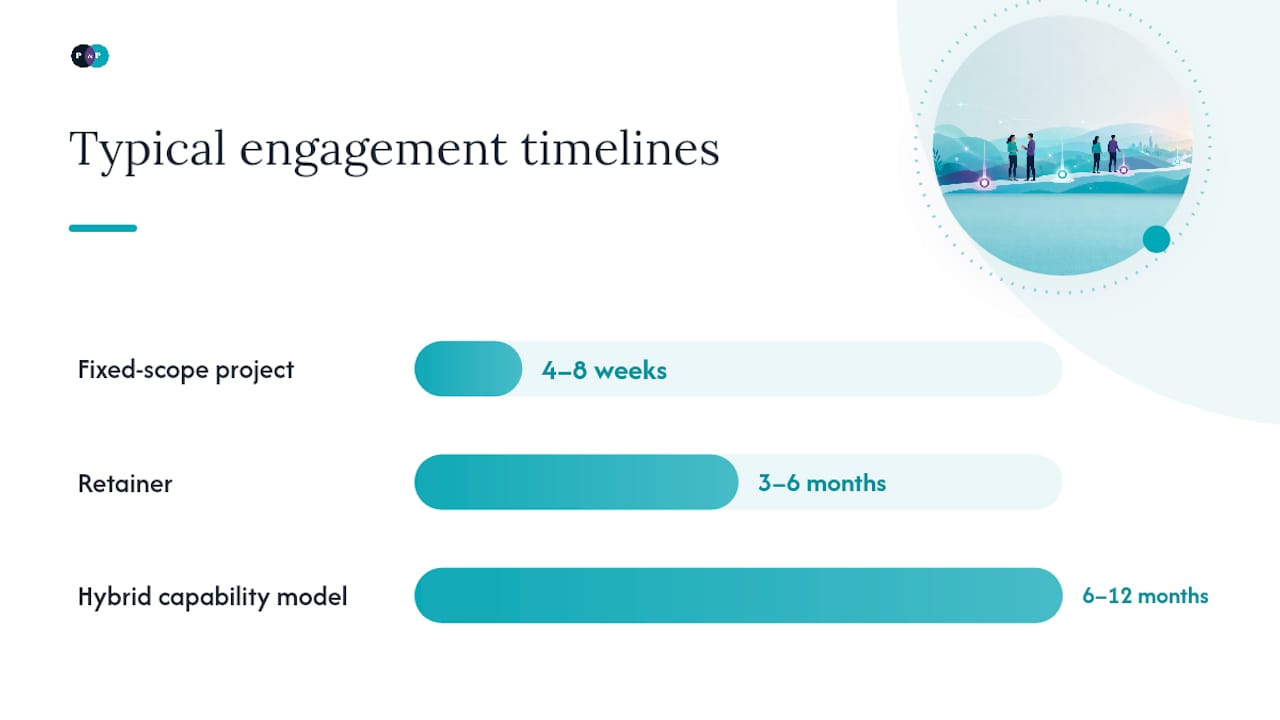
- Fixed-scope project. One application or a small set of related submissions, priced and delivered against a defined brief. Best suited to organisations testing the relationship or facing a single urgent deadline.
- Retainer. Ongoing pipeline management across a funding calendar, covering opportunity scanning, drafting, and stewardship across multiple rounds. Suits organisations with several active or recurring funding streams.
- Hybrid capability model. Project work paired with deliberate handover: templates, training, and review processes so your team absorbs the skill over subsequent rounds. Whitney Consulting's guidance on grant writer services notes this hybrid approach often suits budget-constrained organisations well, combining internal drafting with external review.
Realistic timelines: a single application typically runs four to eight weeks from brief to lodgement; a program covering multiple rounds usually spans three to six months; a genuine capability-building engagement, with systems and training embedded, runs six to twelve months.
Fees commonly cover research and opportunity mapping, drafting through to final submission, budget construction, evidence collation, and an assessor-style review before lodgement. Budget separately for specialist technical reports, external audit support, consortium facilitation, or verification of in-kind and co-contribution arrangements, since these sit outside most standard scopes. One point catches organisations out regularly: many grants explicitly exclude professional grant-writing fees from allowable costs, so consultant fees usually need to come from operating budgets, not the grant itself. Confirm this before you sign anything.
How do you choose the right funding submission consultant?
Treat this like any other significant procurement decision, because it is one.
Core selection criteria:
- Demonstrated experience specifically in human services, not general nonprofit fundraising.
- Evidence of governance alignment, referencing frameworks like the NDIS Practice Standards or Aged Care Quality Standards in past work.
- Willingness to share sample submissions (redacted where needed) and put you in touch with referees.
Questions worth asking in the interview:
- "Walk me through how you would assess this application the way a funder's panel would."
- "What would you flag as a budget risk in a submission like ours?"
- "What do you leave behind for our team once the engagement ends?"
Red flags to walk away from: no sample work available, vague delivery milestones with no dates attached, reluctance to provide references, or an inability to say clearly which budget lines can and cannot fund professional fees.
Pro Tip: Ask a shortlisted consultant to name one grant they would advise you not to apply for this year, and why. Anyone who has a real answer understands strategy, not just drafting.
What does success actually look like, and how is it different from a one-off win?

Short-term, a good engagement produces sharper applications, faster turnaround, and budgets that survive scrutiny. Medium-term, you should see win rates improve, average grant size grow, and funder relationships that outlast a single application cycle.
Capability is the part boards often undervalue. It shows up as staff confidence in drafting, a working evidence library, CRM fields that track funder relationships, and a completed handover rather than a folder of files nobody opens again. Consultants using datasets like GEMS Funding Insights add real targeting value here, because raw funding growth does not equal easy access when funder type, geography, and grant design shape who actually wins.
| Metric | Reported figure |
|---|---|
| Reported win rate (Funding Centre members) | Improved over recent years |
| Average applications per organisation per year | About a dozen on average |
| Top barrier cited by respondents | Time and resource constraints |
| Recorded available funding | Funding available in the sector has increased substantially |
A practice example: what a capability-building engagement looked like
A mid-sized community services organisation delivering family support programs had submitted eleven applications over eighteen months with only two successes. The consultant engaged for a six-month program required the organisation to supply current outcomes data, program logic documentation, and board sign-off on strategic priorities before drafting began. Executive sponsorship meant the CEO personally reviewed each draft, which kept turnaround tight.
Over the engagement, the organisation secured two of five submissions, including one multi-year government contract, and finished with a reusable evidence library, a funder CRM tracker, and an internal review checklist modelled on assessor scoring criteria. The organisation's own team ran the next funding round independently.
What made it work was not the writing. It was that the client turned up with usable evidence and a CEO willing to sponsor the process, rather than expecting the consultant to invent a track record from nothing.
What I'd tell any board before they sign off on this spend
Most boards I talk with approve consultant fees expecting a transactional outcome: one grant, one win, done. That framing sets the engagement up to under deliver, because it measures success on a single application instead of the systems left behind.
I have watched organisations spend the same money twice: once for an external writer to produce a strong application, and again eighteen months later for the same work, because nothing was documented or transferred the first time. Nearly three decades working across governance and compliance in this sector has shown me that the organisations who get real value insist on handover as a contractual deliverable, not a nice-to-have. They also come to the table with their own data ready, which is the single biggest predictor of whether an engagement succeeds. Governance alignment against the ACNC Governance Standards and sector-specific frameworks is not a compliance tick either. It is what makes a funder trust that your organisation can deliver on what it is promising.
So here is the question worth raising at your next board meeting: if we engaged a consultant tomorrow, could we hand them outcomes data and a signed-off strategic plan within a week, or would the first month be spent building the evidence we should already have?
How The Planning and Practice Hub supports your next funding round
The Planning and Practice Hub works with human services organisations across NDIS, aged care, child safe, homelessness, and community services to align funding submissions with the compliance frameworks funders actually check against. Rather than treating your application as a standalone document, the approach folds in governance evidence, strategic planning work already underway, and a handover process so your team is stronger after the engagement than before it. Engagements run as fixed-scope projects, retainers for ongoing pipelines, or capability programs depending on where your organisation sits right now.
If you are weighing up whether your next application needs outside support, the practical next step is a conversation about scope before a deadline forces the decision. Visit the management consulting page to see how a scoped engagement could work for your organisation and get a straight answer on timeframes and fees.
Sources
- Funding Centre | 2025 survey results: trends and takeaways
- SmartyGrants | Success rates rise for grantseekers, but writing applications is still a constraint
- Grant funding strategy 2026 — Jo Garner (Strategic Grants)
- Win With Words | Grant writers — things to consider
FAQ
What does a funding submission consultant for an NFP actually do?
They map funding opportunities, design a grants pipeline, draft applications with compliant budgets and reporting plans, and align the submission with governance frameworks like the NDIS Practice Standards, then hand over templates your team can reuse.
How much does a funding submission consultant cost?
Fees vary by scope, but typically cover research, drafting, budget building, and an assessor-style review; many grants exclude professional writing fees, so this cost usually needs to come from operating budgets rather than the grant itself.
How long does the process take?
A single application usually takes four to eight weeks, a program covering multiple funding rounds runs three to six months, and a full capability-building engagement typically spans six to twelve months.
Is The Planning and Practice Hub suitable for NDIS or aged care providers specifically?
Yes. The Planning and Practice Hub works across NDIS, aged care, child safe, homelessness and community services, aligning funding submissions with the specific compliance standards each sector is assessed against.
What should we have ready before briefing a consultant?
Current outcomes data, a recent strategic plan, and named executive sponsorship for the application. Without these, a consultant will spend the first weeks building the evidence base rather than drafting.