
TL;DR:
- A foster care tender consultant helps non-profit organizations prepare compliant, evidence-based bids aligned with regulatory frameworks.
- Experience, sector-specific knowledge, and a pre-developed answer library significantly increase tender success rates.
A foster care tender consultant is a specialist adviser who guides non-profit organisations through the regulatory, compliance, and bid writing requirements of tendering for foster care service contracts in Australia. Most non-profits underestimate how technically demanding these tenders are until they receive evaluator feedback on a failed submission. The gap between a well-run foster care programme and a winning tender response is almost always a gap in evidence, not in practice. Getting that evidence right requires someone who understands both the sector and the procurement process.
How does a foster care tender consultant support non-profits in tender preparation?

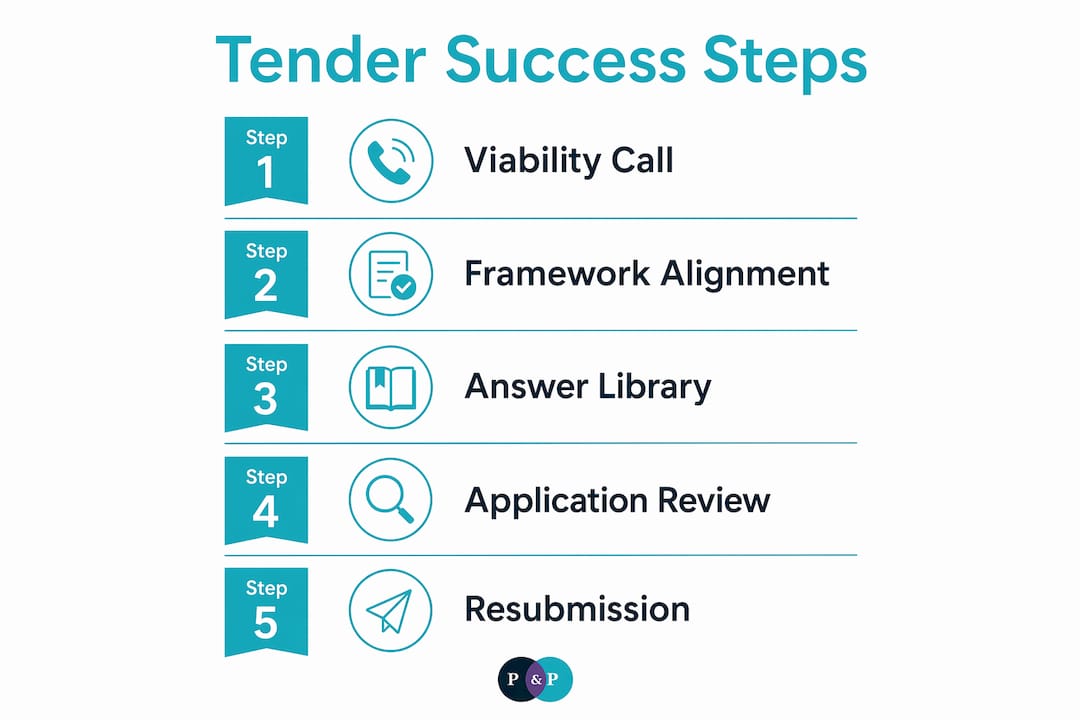
The consultancy process starts well before a single word is written. A specialist consultant typically begins with a 30–60 minute strategy call to assess your organisation's financial and operational readiness for the specific contract on offer. That early conversation shapes everything that follows.
From there, the process moves through five core stages:
- Specification analysis. The consultant maps the tender requirements against your existing service model, identifying gaps before they become scoring liabilities.
- Compliance review. Every requirement tied to child safe standards, safeguarding obligations, and departmental policy is checked against your current documentation.
- Response development. The consultant drafts or co-develops answers using an answer library of pre-approved, compliant responses refined across multiple submissions.
- Evidence integration. Practice language around trauma-informed care and evidence-based service models is embedded directly into responses, not added as an afterthought.
- Submission management. The consultant coordinates final review, formatting, and lodgement to meet all procedural requirements.
The answer library approach matters more than most executives realise. Specialist social care bid writers report a 92% win rate across more than 200 submissions when using compiled answer libraries rather than writing fresh responses each time. That figure reflects the compounding value of sector-specific knowledge applied consistently.
Pro Tip: Before engaging any consultancy for tendering for foster care, ask specifically whether they hold an answer library relevant to Australian child and family services. A library built on aged care or disability tenders will not transfer well.
What regulatory frameworks must a foster care tender align with?
Regulatory alignment is where most bids fall short. Australian foster care tenders require direct mapping to a set of frameworks that commissioners use as scoring criteria, not just background context.
The key frameworks include:
- National Principles for Child Safe Organisations. These ten principles set the baseline for child safety governance and must be reflected in your service design, not just cited in a policy list.
- State-specific Child Safe Standards. Each jurisdiction applies these differently. Queensland's implementation under the Child Protection Act 1999 carries specific requirements that differ from Victoria's Child Safe Standards under the Child Wellbeing and Safety Act 2005.
- Family Based Care and kinship care models. Queensland's transition to new family-based care investment specifications, phased from march 2026, require providers to demonstrate targeted recruitment aligned to regional demand. This is a live reform agenda, and tenders that ignore it score poorly.
- Trauma-informed care. Commissioners now treat trauma-informed practice as a mandatory requirement, not a differentiator. Tenders must demonstrate how it is embedded in carer training, placement matching, and support planning.
| Framework | What commissioners look for |
|---|---|
| National Principles for Child Safe Organisations | Governance structures, child participation mechanisms, and cultural safety |
| State Child Safe Standards | Documented policies with evidence of active implementation |
| Family Based Care specifications | Regional recruitment targets and carer support models |
| Trauma-informed care | Training records, practice frameworks, and case examples |
Mapping your service design to legislation directly is not optional. Tenders that reference frameworks without demonstrating how the organisation actually operates against them are routinely scored down by evaluators.
What are the common challenges in foster care tender applications?
The most common problem is not poor writing. It is the gap between what an organisation does in practice and what it can prove on paper. Commissioners read hundreds of submissions. They recognise policy statements dressed up as evidence.
Four challenges appear repeatedly across foster care tender applications:
- Misreading the specification. Non-profits often respond to what they think the commissioner wants rather than what the specification actually requires. A consultant reads the specification as a scoring instrument, not a general brief.
- Weak safeguarding evidence. Commissioners prioritise providers with active, reflective safeguarding systems over those with policies that exist only on paper. A complaint management process that has never been tested or reviewed will not satisfy an evaluator.
- Bidding on the wrong tenders. Consultants regularly advise against submitting when the service model or compliance documentation does not fit the commissioner's reform agenda. Bidding on misaligned tenders wastes resources and can damage your relationship with the department.
- Translating practice into evaluator-grade evidence. Your team may deliver excellent care. Turning that into scored evidence requires a specific skill that most operational leaders have not needed before.
Pro Tip: If your organisation has never had a formal complaint investigated and resolved under your current policy, document that process in a practice scenario before the next tender. Evaluators want to see the system working, not just described.
How does repeated tender experience improve success rates?
Experience compounds in this work. A consultant who has written twenty foster care tenders holds a significant practical advantage over one writing their first. The difference shows up in scoring, not just in polish.
Answer libraries built over multiple submissions allow consultants to produce faster, more consistent responses that already reflect evaluator expectations. Each submission adds refinement. Language that scored well in one tender informs the next. Gaps identified in feedback get addressed before they recur.
Generic bid writers miss the cohort-specific nuances that commissioners in child and family services look for. Specialist knowledge of statutory frameworks such as trauma-informed care principles, kinship care recruitment models, and child participation requirements is what separates high-scoring bids from competent ones. The Planning and Practice Hub works across more than 50 regulatory bodies in Australian human services, which means that sector-specific depth is built into every engagement, not sourced separately.
Key takeaways
A foster care tender consultant improves bid quality by aligning service evidence directly with regulatory frameworks, commissioner expectations, and current reform agendas before a single response is written.
| Point | Details |
|---|---|
| Start with a viability assessment | A 30–60 minute strategy call determines whether your service model fits the tender before resources are committed. |
| Map to named frameworks | Tenders must reference National Principles for Child Safe Organisations and state-specific Child Safe Standards with operational evidence. |
| Use an answer library | Pre-approved, compiled responses improve consistency and scoring across multiple submissions. |
| Demonstrate active safeguarding | Commissioners score reflective, tested safeguarding systems higher than written policies alone. |
| Avoid misaligned bids | Bidding on tenders that do not fit your model wastes resources and risks departmental relationships. |
What non-profit executives often miss in foster care tendering
After nearly three decades working across Australian human services, the pattern I see most often is this: executives assume the quality of their organisation's practice will carry the tender. It does not. Evaluators cannot visit your service. They score what is on the page.
The organisations that win consistently are not always the best operators. They are the ones who have learned to translate their practice into evidence that maps precisely to what commissioners are scoring. That is a learnable skill, but it takes time and specific sector knowledge to develop.
What concerns me most in the current environment is the pace of reform. Queensland's Family Based Care transition, the strengthening of child safe governance requirements, and the growing emphasis on kinship care recruitment have all shifted what commissioners expect to see in a bid. Organisations that prepared their tender templates two years ago and have not updated them are submitting to a specification that has moved on.
The other thing I would say directly: if a consultant cannot tell you which specific legislative clauses your bid needs to reference, and why, find someone who can. Writing polish matters. Legislative mapping matters more.
— Rachel
Working with The Planning and Practice Hub on your next tender
The Planning and Practice Hub works with non-profit organisations across Australian human services to prepare evidence-based, compliant tender responses for foster care and community services contracts.
Rachel Willis brings close to three decades of direct sector experience to every engagement, including deep familiarity with Queensland's Family Based Care reforms, child safe governance requirements, and the procurement expectations of state and territory departments. The Hub's management consulting services cover the full tender process, from initial viability assessment through to final submission. If you are preparing for an upcoming foster care tender and want to assess your organisation's readiness, a discovery conversation is the right place to start. You can also review the grants and tenders support available through the Hub.
FAQ
What does a foster care tender consultant actually do?
A foster care tender consultant assesses your organisation's readiness, maps your service model to regulatory frameworks, and develops compliant bid responses aligned with commissioner scoring criteria.
How early should we engage a consultant for tendering for foster care?
Engage a consultant as soon as a tender is released, or ideally before. Early engagement allows a viability assessment that can prevent wasted resources on misaligned bids.
What frameworks do Australian foster care tenders require?
Most tenders require alignment with the National Principles for Child Safe Organisations, state-specific Child Safe Standards, and current Family Based Care or kinship care specifications relevant to your jurisdiction.
Why do generic bid writers underperform in foster care tenders?
Generic bid writers lack the cohort-specific knowledge of trauma-informed care, child participation requirements, and statutory safeguarding obligations that commissioners use as scoring criteria in child and family services tenders.
How do answer libraries improve tender outcomes?
Answer libraries compile pre-approved, compliant responses refined across multiple submissions, which produces faster and more consistently high-scoring bids than writing fresh responses each time.