
Good foster care service governance means child safety is driven by leadership, evidenced through policy implementation, and visible in regular quality-review cycles — not just documented in a manual that sits on a shelf.
Three anchors hold this together in the Australian context: the National Principles for Child Safe Organisations, which require child safety to be embedded in organisational leadership and culture across ten principles; the Office of the Children's Guardian (OCG) in NSW, which sets accreditation and monitoring expectations for statutory out-of-home care; and state child-safe standards such as the NSW Child Safe Standards and Victorian Child Safe Standards, which translate those principles into auditable evidence requirements.
Governance essentials — what your organisation must demonstrate:
- Child-safe leadership that is visible, documented, and reported to the board
- Policies mapped to the National Principles and relevant state standards
- Clear delegations of authority from board to CEO to operational managers
- Monitoring evidence that shows policies are applied to real children, not just filed
Three things to do in the next 72 hours:
- Map your top five policies to the National Principles and the relevant state standard indicator.
- Schedule a governance evidence review with your quality manager and at least one case manager.
- Confirm in writing the contact protocols your case managers use with carers for each active placement.
Key takeaways
Effective foster care service governance requires leadership accountability, mapped policies, practice-level evidence, and a continuous quality-improvement cycle aligned to the National Principles for Child Safe Organisations and state accreditation standards.
| Point | Details |
|---|---|
| Leadership owns child safety | Boards must approve policy, monitor implementation evidence, and record child safety as a standing agenda item. |
| Map policies to standards | Each core policy should map to a National Principle, a state standard indicator, and a named evidence type. |
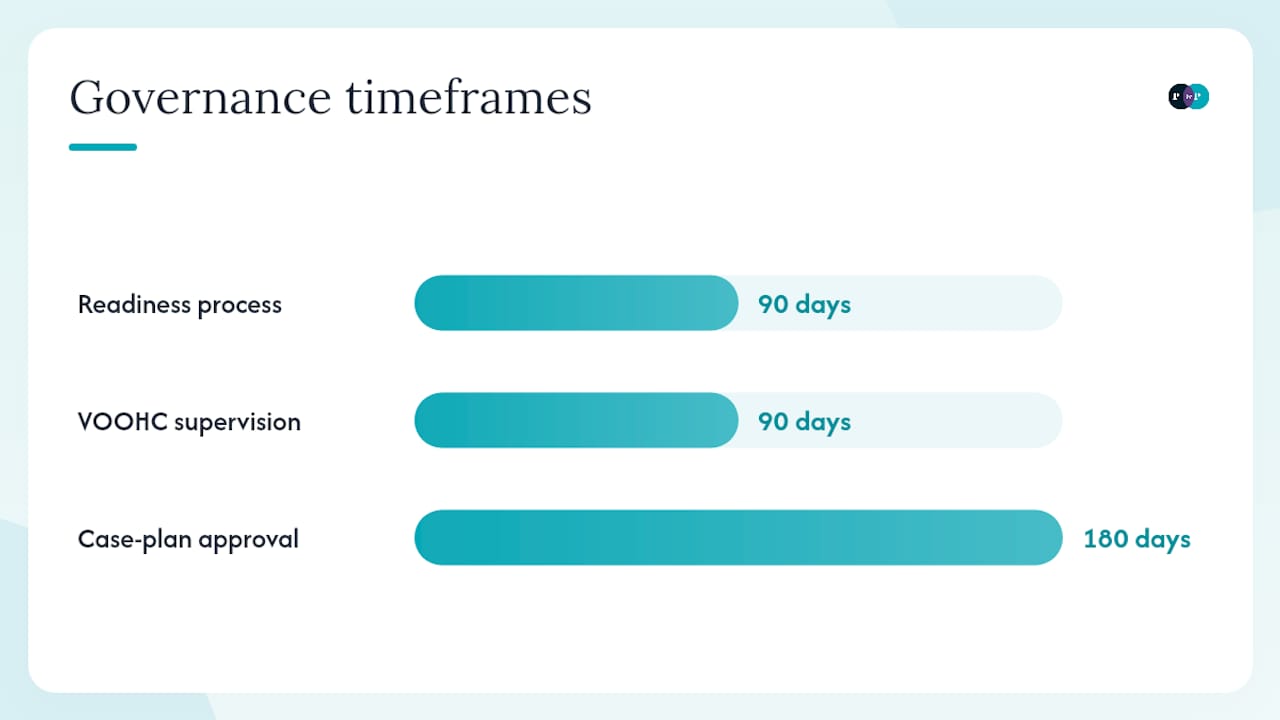
| VOOHC thresholds are non-negotiable | Supervision within 90 days and case-plan approval within 180 days are compliance triggers, not targets. |
| CQI closes practice gaps | A plan-do-check-act cycle tied to Standard 23 builds accreditation resilience between monitoring visits. |
| The Planning and Practice Hub | Offers governance gap reviews, accreditation-ready documentation, and board facilitation for foster care services. |
What do boards and executives actually own in foster care service governance?
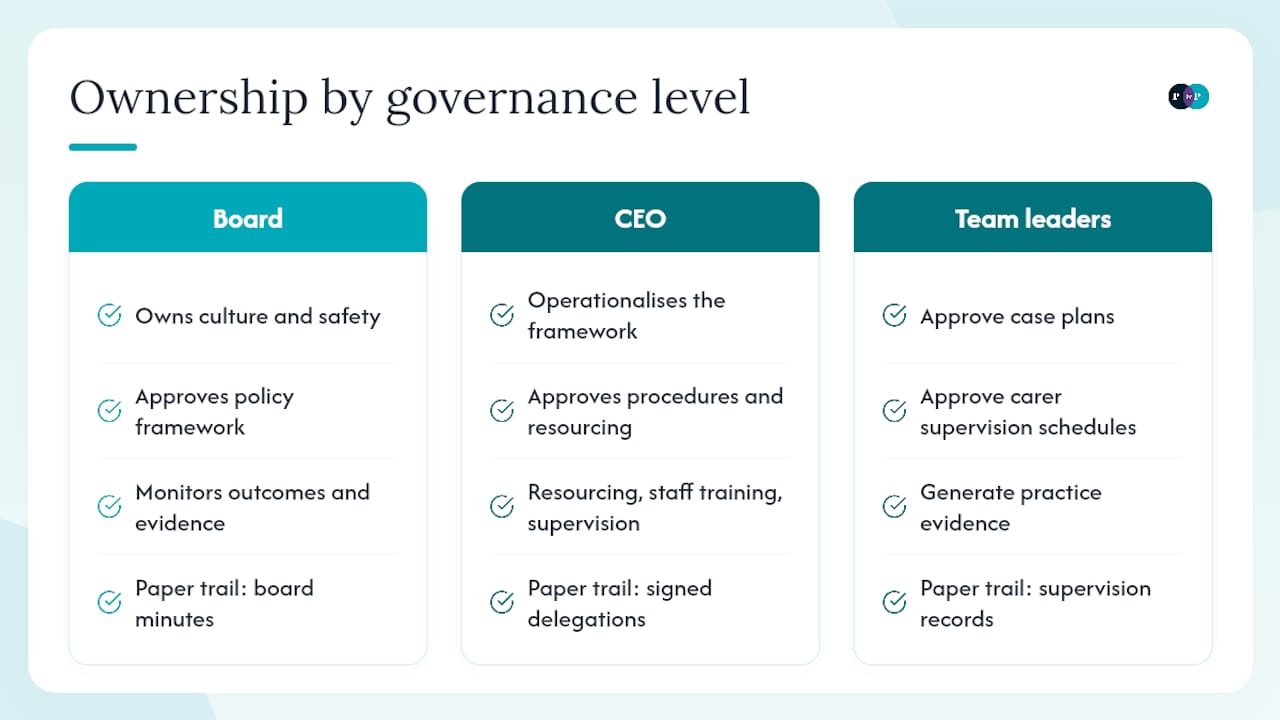
Governance in child welfare is not a quality-team function. The board owns the culture, approves the policy framework, and monitors whether the organisation is actually safe — not just accredited.
WA guidance on National Principle 1 is direct on this point:
In practice, that means the board approves the child safety and wellbeing policy, receives regular implementation reports, and reviews evidence of how policies are applied — not just KPI dashboards. The CEO operationalises the framework: resourcing, staff training, supervision systems, and incident response. Managers close the loop by generating the practice evidence the board needs to see.
A practical delegation of authority model for foster care services looks like this: the board approves policy and monitors outcomes; the CEO approves operational procedures and resourcing; team leaders approve case plans and carer supervision schedules. Each level produces a paper trail — board minutes, signed delegations, supervision records — that regulators can inspect.
Pro Tip: Record child safety as a standing agenda item in board minutes, with a brief implementation evidence note attached. Assessors look for this pattern across multiple meeting cycles, not just the most recent one.
Boards that only review KPIs without seeing practice-level evidence are a common governance gap. A board governance compliance approach that includes de-identified case file summaries, supervision completion rates, and incident trend data gives directors what they need to discharge their child-safe responsibilities.
What core policies must every foster care service have?
Every foster care service needs a policy set that maps directly to the National Principles and the applicable state child-safe standards. The CaFIS 1A template from the Australian Government provides a practical starting point for translating the National Principles into organisational policy language.
Core policies your service must hold:
- Child safety and wellbeing policy (maps to National Principle 1)
- Intake, assessment and placement matching procedure
- Case planning policy (including review timelines)
- Carer approval, supervision and renewal procedure
- Complaint handling and feedback policy
- Incident management and reportable conduct procedure
- Information sharing and privacy policy
- Cultural safety policy for Aboriginal and Torres Strait Islander children
For each policy, map it to the relevant National Principle, the applicable state standard indicator, and the evidence type you will produce. The NSW Child Safe Standards for Permanent Care identify governance (Standard 22) and strategic planning and evaluation (Standard 23) as discrete audit areas, and they expect practice-level evidence — not documentation alone.
Essential forms to keep on file: signed case plans, carer approval packs, supervision logs, incident reports, and complaint registers. Each should carry a version number, review date, and the name of the approving officer.
What do accreditation and monitoring bodies expect you to demonstrate?
Accreditation is not a one-off event. The OCG accreditation guide explains that organisations providing statutory out-of-home care in NSW must be accredited and are subject to ongoing monitoring and review, including conditions, internal review rights, and NCAT appeal pathways.
The VOOHC Procedures set concrete timelines that trigger compliance obligations: supervision must occur within a specified early period after a placement commencing, and a case plan must be approved by the designated agency within a longer specified period.
Types of evidence assessors will look for include: completed case plans with review dates, supervision notes signed by both parties, training records for all staff working with children, complaint and incident registers with outcomes recorded, and board minutes showing child safety reporting.
To prepare for external review, run a quarterly internal monitoring cycle: pull a sample of five active case files, check each against the VOOHC thresholds and your policy requirements, and record findings in a monitoring report that goes to the CEO and board.
How do you build a quality-improvement cycle that lifts governance maturity?
Strategic planning and continuous quality improvement (CQI) are not separate from governance — they are how governance matures. Standard 23 of the NSW Child Safe Standards for Permanent Care requires agencies to demonstrate strategic planning and evaluation as an ongoing practice, not a three-year plan filed and forgotten.
A short CQI cycle that works in practice:
- Plan: identify the gap (e.g. supervision completion rate below target)
- Do: implement the change (e.g. restructure supervision scheduling)
- Check: measure the result (e.g. completion rate at next quarterly review)
- Act: embed the change in policy or procedure if it works; adjust if it does not
Sample governance KPIs worth tracking quarterly:
- Policy implementation check: percentage of policies reviewed against their scheduled review date
- Case-plan timeliness: percentage of case plans approved within the 180-day VOOHC threshold
- Carer supervision frequency: percentage of carers receiving supervision at the contracted interval
- Audit-ready evidence ratio: percentage of sampled files with complete, current documentation
Use VOOHC Activity Reports or internal dashboards to surface gaps early. A family services strategic planning approach that ties KPIs to accreditation standards gives boards a clear line of sight from strategy to practice.
How should you govern the relationship between case managers and carers?
Victorian practice guidance is clear: poorly defined communication protocols between agency and carer are a common source of systemic risk. Governance must define the care-team partnership in policy, not leave it to individual case managers to work out informally.
| Governance element | Responsibility | Minimum frequency |
|---|---|---|
| Placement support contact | Case manager | Fortnightly |
| Carer supervision | Supervising case manager | Per approval conditions |
| Care-team meeting | Case manager (convenes) | Every case-plan review cycle |
| Carer approval renewal | Quality or compliance officer | Per approval expiry date |
Recruitment, assessment, approval, training, and renewal of carer approvals each require a documented process with clear ownership. Supervision logs must record the date, participants, topics discussed, and any actions arising. Regulators expect to see these logs for every active carer, not just those flagged as high-risk.
Placement matching failures are often the operational weak point in foster care program management. Operationalise matching as a continuous care-team responsibility: set a formal meeting cadence, record informal discussions in supervision notes, and feed those notes into governance dashboards.
What risk and incident governance must managers put in place?
A risk register specific to foster care placements should cover at minimum: placement matching risk (child needs versus carer capacity), supervision lapse risk (overdue contacts or approvals), information-gap risk (missing health or education records), and reportable conduct risk (allegations involving staff or carers).
Incident response steps every manager must follow:
- Immediate safety action for the child, documented within 24 hours
- Notification to the relevant state child safety department (e.g. Queensland Department of Children, Youth Justice and Multicultural Affairs, or NSW Department of Communities and Justice) per statutory timeframes
- Internal incident report completed and filed
- Reportable conduct notification to the OCG or relevant state regulator where applicable
- Investigative record maintained throughout, with outcome recorded
| Incident type | Notification recipient | Timeframe |
|---|---|---|
| Immediate risk to child | State child safety department | Same day |
| Reportable conduct allegation | Office of the Children's Guardian (NSW) or state equivalent | Per state legislation |
| Placement breakdown | Placing agency and state department | Within 24 hours |
| Critical incident | CEO and board | Within 24 hours |
Align your incident procedure with your reportable conduct policy and your accreditation conditions. Assessors will check that the two documents are consistent and that staff can describe the process accurately — not just locate the policy.
What templates and recordkeeping systems does your service need?
Every foster care service needs a core template set that is version-controlled, accessible to relevant staff, and reviewed on a scheduled cycle.
| Template | Purpose | Review cycle |
|---|---|---|
| Case plan | Documents child's goals, supports and review dates | per case-plan cycle |
| Carer approval pack | Records assessment, approval decision and conditions | At each renewal |
| Supervision log | Records carer supervision discussions and actions | After each supervision contact |
| Incident report | Documents incident details, actions and notifications | After each incident |
| Complaint form | Records complaint, response and resolution | After each complaint |
Recordkeeping best practice for audit readiness: use a consistent naming convention (e.g. ChildID_DocumentType_Date), apply version numbers to all policy documents, set retention periods aligned to state legislation, and restrict editing access to authorised staff only.
A compliance calendar should include: accreditation renewal dates, policy review due dates, carer approval expiry dates, VOOHC reporting cycles, and board reporting schedules. The National Office for Child Safety publishes self-assessment tools and policy templates that can anchor your compliance calendar to the National Principles.
How one agency closed its governance gaps before a monitoring visit
A medium-sized foster care service in regional NSW identified three governance gaps during an internal file audit six months before a scheduled OCG monitoring visit: case plans were being completed but not formally approved within the 180-day VOOHC threshold; carer supervision logs were inconsistent in format and missing action items; and board minutes contained no reference to child safety implementation evidence.
The quality manager led a 90-day readiness process. She updated the case-planning procedure to include a mandatory approval sign-off step, introduced a standardised supervision log template, and added a standing child safety reporting item to the board agenda with a one-page implementation summary attached.
90-day readiness checklist:
- Audit a sample of ten case files against VOOHC thresholds (90-day supervision, 180-day case plan approval)
- Standardise supervision log format and brief all case managers
- Add child safety implementation evidence to the next board meeting agenda
- Update the risk register to reflect any gaps found in the file audit
- Confirm all carer approvals are current and renewal dates are calendared
Concrete evidence examples to have ready: board minutes with child safety agenda items, signed supervision logs for all active carers, approved case plans with review dates, and an incident register showing outcomes for all recorded incidents.
Is your governance checklist audit-ready?
| Governance area | Checklist item | If not met: next step |
|---|---|---|
| Leadership | Board minutes include child safety reporting | Add as standing agenda item; brief CEO |
| Policies | All core policies mapped to National Principles | Use CaFIS 1A template to map and update |
| Delegations | Signed delegations of authority on file | Draft and execute with CEO and board chair |
| Case planning | 100% of case plans approved within 180 days | Audit files; escalate overdue plans to team leader |
| Carer supervision | All carers supervised per approval conditions | Pull supervision log report; schedule overdue contacts |
| Risk register | Foster care-specific risks documented and reviewed | Update register; present to CEO monthly |
| Incident records | All incidents recorded with outcomes noted | Audit incident register; close any open items |
| Cultural safety | Cultural support plans in place for Aboriginal and Torres Strait Islander children | Review files; engage cultural support worker |
Complete this checklist quarterly. The quality manager should lead the review, with findings reported to the CEO and a summary to the board. Any item marked "not met" should carry a named owner and a resolution date.
What governance maturity actually looks like in practice
Most organisations I work with have the policies. What they are missing is the evidence that those policies are applied consistently, at the case level, by every worker — not just the ones who wrote the policy.
Governance maturity in foster care is not about having a thicker manual. It is about the case manager who records an informal carer conversation in the supervision notes because they know that undocumented decisions are governance gaps. It is about the board director who asks, "What does our supervision completion rate tell us about how carers are actually supported?" rather than accepting a green KPI at face value.
The most common blind spot I observe is undocumented care-team decisions. A case manager calls a carer, they agree to adjust a contact arrangement, and nothing is recorded. Six months later, during a monitoring visit, the assessor finds a contact arrangement in the file that does not match what the carer describes. That discrepancy is not a communication problem. It is a governance failure — and it is entirely preventable.
For boards and CEOs: ask your quality manager to show you three case files at random and walk you through the evidence trail from placement decision to most recent supervision contact. If that trail is clear and complete, your governance is practice-facing. If it is not, you have found your priority.
Work with The Planning and Practice Hub on governance and accreditation readiness
For foster care services preparing for an OCG monitoring visit or working through a governance gap review, The Planning and Practice Hub offers out-of-home care consulting grounded in nearly three decades of sector experience.
Engagements typically include a governance gap review against the National Principles and applicable state standards, accreditation-ready documentation support, and board facilitation to embed child safety reporting into governance cycles. The work is co-developed with your team — not a generic framework dropped into your organisation.
To discuss your governance priorities, visit the management consulting page and book a consultation.
Sources
- About the National Principles for Child Safe Organisations
- Lead the National Principles for Child Safe Organisations | National Office for Child Safety
- National Principle 1 guidance (Government of Western Australia)
- CaFIS 1A - National Principles for Child Safe Orgs Guidance and Template
- Principles, roles and responsibilities for placement (Child Protection Manual Victoria)
This article is general information, not a substitute for advice from a qualified lawyer. Consult a qualified legal professional about your own circumstances before acting on anything here.
FAQ
What is foster care service governance?
Foster care service governance is the system of leadership, policies, delegations, and monitoring that an organisation uses to keep children in out-of-home care safe and to meet its obligations under the National Principles for Child Safe Organisations and state accreditation standards.
What evidence do accreditation assessors look for?
Assessors look for direct practice evidence: signed case plans approved within the 180-day VOOHC threshold, supervision logs for all active carers, board minutes with child safety reporting, and incident registers with recorded outcomes — not policies alone.
What are the VOOHC thresholds for supervision and case plan approval?
Under the NSW VOOHC Procedures, supervision must occur within a specified early period after a placement commencing, and a case plan must be approved by the designated agency within a longer specified period. These are compliance triggers that assessors check against file evidence.
How often should the governance checklist be completed?
The governance checklist should be completed quarterly by the quality manager, with findings reported to the CEO and a summary provided to the board. Any gap should carry a named owner and a resolution date.
How can The Planning and Practice Hub help with accreditation readiness?
The Planning and Practice Hub works with foster care services on governance gap reviews, accreditation-ready documentation, and board facilitation aligned to the National Principles and state child-safe standards. Visit the OOHC sector page to learn more.