
TL;DR:
- Delegations of authority assign decision-making powers to roles within organizations, ensuring compliance and accountability.
- Effective delegations are role-based, documented in writing, and actively demonstrated through records and governance practices.
Delegations of authority in human services are formally documented assignments of decision-making powers to specific roles within an organisation, creating the legal and governance backbone for compliant operations. Without them, accountability gaps appear fast, and auditors notice. Under the Government Sector Finance Act 2018 (NSW), accountable authorities carry personal legal responsibility for ensuring all expenditure occurs under valid, documented delegations. The NDIS Practice Standards and ACNC Governance Standards both require evidence that governance decisions are made by people with the authority to make them. Getting this right is not a compliance exercise you do once. It is a living governance practice.
What legal frameworks govern delegations of authority in human services?

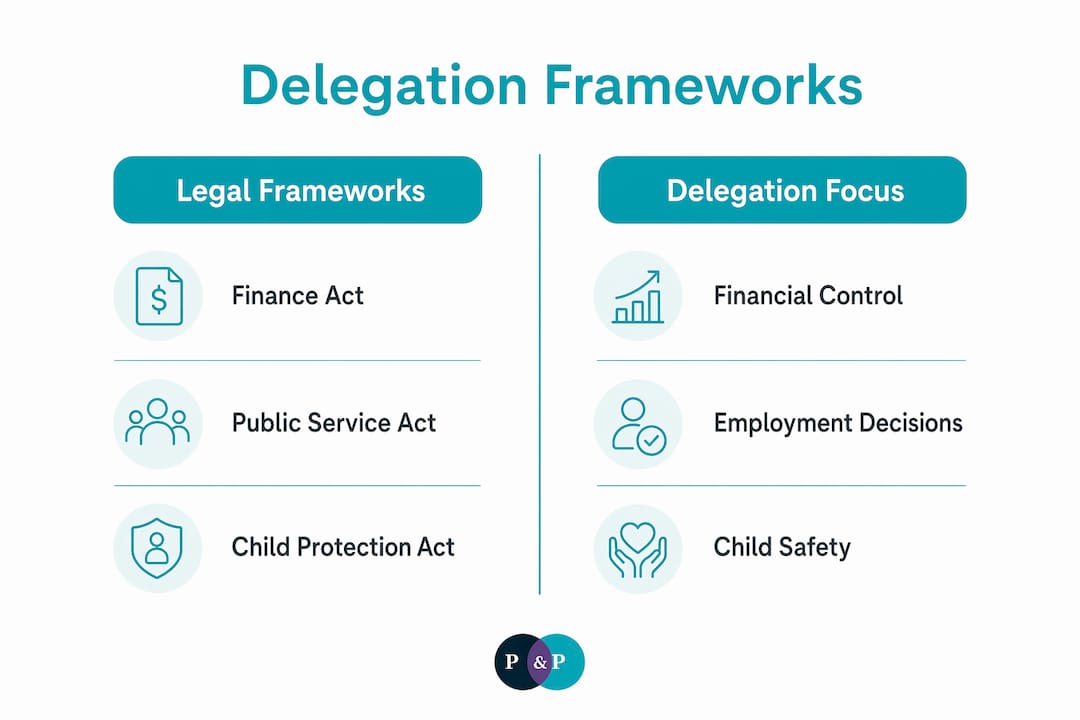
Two pieces of legislation set the floor for most Australian human services organisations. The Government Sector Finance Act 2018 (NSW) requires that accountable authorities hold personal responsibility for financial management and that all expenditure is authorised under a valid, written delegation. The Public Service Act 1999 authorises human resources delegations across the Commonwealth, covering decisions on recruitment, performance, and conduct.
The Office of the Australian Information Commissioner (OAIC) illustrates how this works in practice. Its 2026 delegation framework maps human resources powers across ten major legislative instruments, including the Public Service Act 1999 and the National Anti-Corruption Commission Act. That level of specificity is the standard your organisation should be working toward.
Key legislative and regulatory touchpoints for human services executives include:
- Government Sector Finance Act 2018 (NSW): Governs financial delegations and expenditure authorisations for NSW government and funded entities.
- Public Service Act 1999 (Commonwealth): Authorises human resources delegations across Commonwealth agencies and many funded providers.
- NDIS Practice Standards: Require evidence of governance and leadership, including who holds authority for key decisions.
- ACNC Governance Standards: Require not-for-profit boards to demonstrate clear accountability structures, including documented delegations.
- HSQF (QLD only): Applies to Queensland human services providers and requires documented governance arrangements.
The table below maps these frameworks to their primary delegation focus.
| Framework | Primary delegation focus |
|---|---|
| Government Sector Finance Act 2018 | Financial expenditure and budget authorisations |
| Public Service Act 1999 | Human resources decisions and conduct |
| NDIS Practice Standards | Governance, leadership, and service delivery authority |
| ACNC Governance Standards | Board accountability and organisational oversight |
| HSQF (QLD) | Service quality governance and risk management |
How should delegations be structured for effective governance?
The single most important structural principle is this: delegations belong to roles, not individuals. When a delegation attaches to a person rather than a position, it lapses the moment that person leaves, goes on leave, or changes roles. Role-based delegations maintain continuity regardless of staff turnover. This is not just good practice. It is the standard Western Australian guidance applies, and it reflects what auditors expect to see.
Formal documentation is non-negotiable. All financial delegations must be set out in writing, with clear thresholds and conditions. Verbal agreements carry no legal weight and create significant risk. The delegator retains concurrent authority throughout, meaning delegation is not a transfer of responsibility. It is a sharing of decision-making power within defined limits.
Three structural elements every delegation instrument should include:
- The specific power or function being delegated
- The financial or operational threshold that applies
- The conditions under which the delegate may act, including any requirement to consult
One distinction that trips up many organisations is the difference between delegation and "acting through." A delegation gives the delegate independent authority to make a decision. Acting through means the delegate acts on behalf of the delegator, who remains the decision-maker. These are legally different, and your policies must reflect that clearly.
Pro Tip: Supervisors should hold equal or higher delegations than the people they oversee. If a team leader can approve expenditure up to $50,000 but their manager's delegation only reaches $30,000, your oversight structure has a gap that an auditor will find.
What compliance risks arise when exercising delegated authority?
The gap between having a delegation policy and demonstrating that it operates in practice is where most organisations fail. Audit findings in the NDIS sector consistently identify a lack of decision records as the primary governance failure. Mid-term audits look for evidence that delegated authority was actually exercised, not just documented in a policy manual that sits on a shelf.
Consider a community services organisation that had a well-written delegation framework covering financial approvals, HR decisions, and service delivery authority. During a mid-term NDIS audit, the auditor asked for board minutes and management records showing how those delegations were exercised over the previous 12 months. The records were thin. Decisions had been made, but the documentation trail did not connect those decisions back to the delegation instrument. The organisation received a corrective action notice.
The most common compliance risks in this area include:
- Verbal or informal delegation agreements that are not captured in writing
- Delegation instruments that have not been reviewed following organisational restructures
- Board minutes that record decisions without identifying the authority under which they were made
- Acting arrangements that are not formally documented before the relevant period begins
- Sub-delegation beyond what the enabling legislation permits
Organisations must embed delegation records within governance documentation like board minutes and audit logs to pass compliance checks. A delegation framework that exists only as a policy document, without corresponding evidence of its use, will not satisfy NDIS Practice Standards or ACNC Governance Standards requirements.
The primary accountability always remains with the delegator. Delegation is a risk management tool, not a way to shift responsibility. That framing should shape how your board and executive team think about oversight.
How are evolving practices reshaping delegation in human services?
Queensland's Department of Families has moved to delegate certain child protection decisions to Aboriginal and Torres Strait Islander organisations. This reflects a broader shift toward self-determination in human services, where delegated authority becomes a mechanism for culturally safe and community-led decision-making. It is one of the more significant governance developments in the sector over the past decade.
For executives, this model raises practical questions about how delegation frameworks adapt when the delegate is an external community entity rather than an internal role. The principles remain the same: written instruments, clear thresholds, defined conditions, and evidence of exercise. What changes is the relationship structure and the cultural competency requirements that sit alongside the legal framework.
Key considerations for organisations working within or alongside Indigenous-led delegation models:
- Delegation instruments must reflect the specific powers being transferred and the legislative basis for that transfer
- Governance support and capacity building for the receiving organisation is part of responsible delegation practice
- Alignment with NDIS Practice Standards' governance and leadership requirements applies regardless of the delegation model used
- Regular review of how delegations are being exercised remains the delegator's responsibility
This approach illustrates that delegation to community entities can balance statutory compliance with genuine cultural responsiveness. It also signals where the sector is heading.
Key takeaways
Effective delegations of authority require written instruments tied to roles, active evidence of exercise, and continuous oversight by the delegating authority.
| Point | Details |
|---|---|
| Role-based delegation | Attach delegations to positions, not individuals, to maintain continuity and legal clarity. |
| Written instruments only | Verbal agreements carry no legal weight; all delegations must be formally documented with thresholds. |
| Evidence of exercise | Board minutes and audit logs must show how delegated authority was used, not just that it exists. |
| Delegator retains accountability | Delegation shares decision-making power but does not transfer legal responsibility to the delegate. |
| Evolving community models | Indigenous-led delegations require the same written rigour, with additional cultural governance considerations. |
What I have learned about delegation policy and governance in practice
After nearly three decades working across Australian human services, the pattern I see most often is this: organisations invest real effort in writing delegation frameworks, then treat them as finished documents rather than active governance tools. The policy looks right. The audit trail does not.
The disconnect is usually not about intent. It is about habit. Boards make decisions without recording which delegation authorised them. Managers approve expenditure without noting the threshold they operated within. Acting arrangements start on a Monday morning without a written instrument in place. None of this is malicious. It is just what happens when delegation is treated as a compliance task rather than a governance discipline.
What actually works is embedding delegation into the rhythm of governance. That means referencing the relevant delegation in board minutes. It means reviewing the delegation register when roles change, not just when an audit is approaching. It means training new managers on what their delegation covers before they need to use it, not after something goes wrong.
The organisations I work with that do this well share one characteristic: their executives treat delegation as a leadership responsibility, not a paperwork requirement. That shift in framing changes everything about how the framework operates in practice.
What does your current delegation register look like, and when did your board last review it against your actual operating structure?
— Rachel
Governance consulting for human services organisations
The Planning and Practice Hub works with human services organisations across Australia to build delegation frameworks that hold up under audit and reflect how the organisation actually operates. That includes reviewing existing delegation instruments, identifying gaps between policy and practice, and supporting boards and executives to embed governance disciplines into their day-to-day work. Rachel Willis brings close to three decades of sector experience to every engagement, which means the advice is grounded in what auditors look for and what regulators expect. If your organisation is preparing for an NDIS audit, an ACNC review, or a governance restructure, explore The Planning and Practice Hub's human services consulting services to see how we can work alongside you.
FAQ
What is a delegation of authority in human services?
A delegation of authority is a formal, written instrument that assigns specific decision-making powers to a role within an organisation. It defines the scope, thresholds, and conditions under which the delegate may act.
Does delegating authority remove the delegator's legal responsibility?
No. The delegator retains concurrent authority and remains legally accountable for decisions made under the delegation. Delegation shares power; it does not transfer responsibility.
What is the most common delegation failure in NDIS audits?
The most common finding is a lack of decision records showing how delegated authority was exercised. Organisations have policies but cannot demonstrate active use through board minutes or audit logs.
Can a delegation be verbal or informal?
No. All financial delegations must be documented in writing with clear terms and conditions. Verbal agreements carry no legal standing and increase organisational risk significantly.
How does delegation support Indigenous self-determination in human services?
Queensland's Department of Families delegates certain child protection decisions to Aboriginal and Torres Strait Islander organisations, enabling culturally safe decision-making while maintaining the legal accountability structures required under relevant legislation.