
A complaints management system is a structured framework of policies, roles, workflows, and governance routines used to capture, investigate, resolve, and analyse complaints for organisational learning, as defined by ISO 10002:2018. For non-profits and human services providers operating across Australia's regulatory environment, this framework is not optional. It sits at the intersection of governance accountability, service quality, and compliance with over 50 regulatory bodies. Understanding what a complaints management system actually requires, and how it functions in practice, is the foundation for getting it right.
What is a complaints management system?
A complaints management system is the recognised industry term for what ISO 10002:2018 describes as a seven-component framework covering intake, triage, resolution, escalation, communication, measurement, and closed-loop improvement. Many organisations treat it as a ticketing process. That misunderstanding costs them during audits and external reviews.
The seven core components work together as a system, not a checklist. Each one serves a distinct function:
| Component | Role in the System |
|---|---|
| Intake channels | Capture complaints across all access points (phone, email, in person, online) |
| Triage rules | Assess severity, risk, and appropriate resolution pathway |
| Resolution pathways | Define how frontline, management, and escalated complaints are handled |
| Escalation and investigation standards | Set criteria for senior review and formal investigation |
| Customer communication rules | Specify timing and format of acknowledgement and updates |
| Measurement | Track volumes, categories, resolution times, and outcomes |
| Closed-loop improvement | Feed complaint data back into service design and governance decisions |
Governance routines hold this structure together. That means regular reporting to leadership, defined roles for complaint owners, and scheduled reviews of complaint trends. Without those routines, even a well-designed system drifts into a filing exercise.
Pro Tip: Assign a named complaint owner for every category of complaint in your system. Ambiguity about who is responsible is the most common reason complaints stall at the triage stage.

What does the complaints handling process look like?
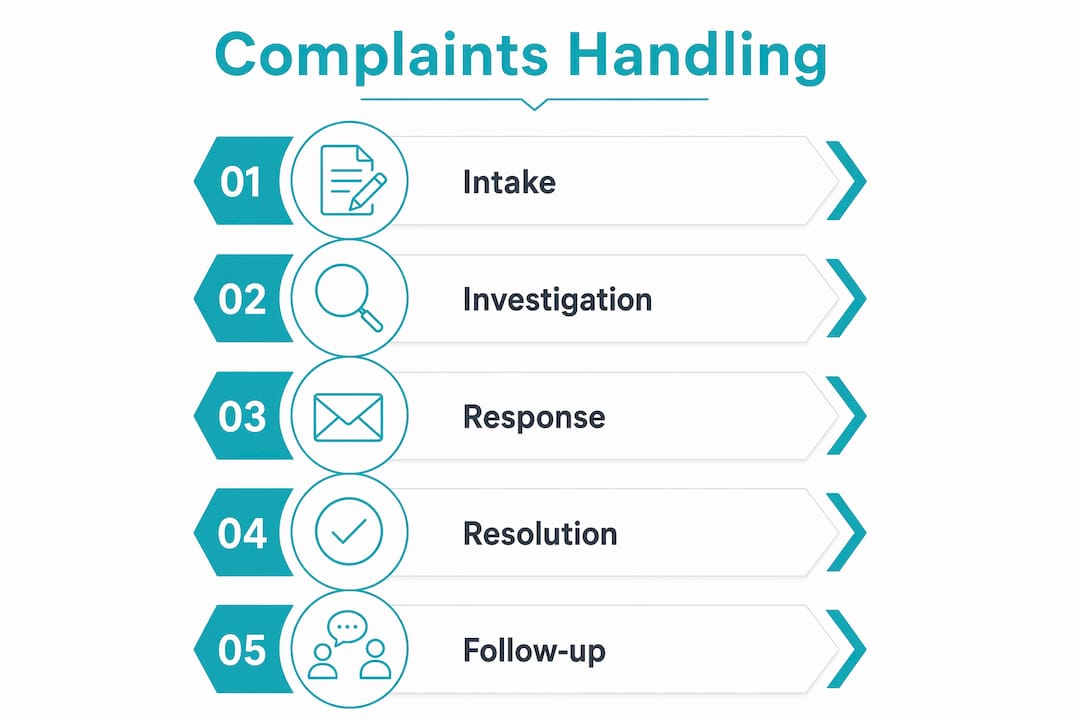
The standard complaints handling process follows six sequential stages, each with defined timing expectations. NESA NSW provides a practical public example of how these stages operate within a regulated Australian context.
- Receipt and capture. The complaint is recorded in full, regardless of the channel through which it arrived.
- Acknowledgement. The complainant receives written confirmation within 5 working days. This step is non-negotiable under most Australian regulatory frameworks.
- Triage and assessment. The complaint is categorised by risk, complexity, and the appropriate resolution pathway.
- Investigation. Evidence is gathered, relevant staff are consulted, and findings are documented.
- Communication of progress. The complainant is kept informed throughout, particularly when resolution will take time.
- Resolution and review. A formal outcome is communicated, ideally within 20 working days, and the case is closed with documented rationale.
Each stage generates a record. That documentation trail is what protects your organisation during external reviews or ombudsman inquiries.
Pro Tip: Use a holding response template at stage five. A brief, empathetic update telling the complainant their matter is progressing significantly reduces the risk of escalation to an external body. The biggest driver of formal complaints is feeling ignored, not the original issue itself.
How do these systems support regulatory compliance?
A complaints management system functions as a compliance tool, not just a service recovery mechanism. Audit trails and documented complaint handling meet statutory requirements across disability, aged care, child protection, and community services frameworks. Regulators and auditors look for evidence that complaints were received, categorised, investigated, and resolved fairly.
The compliance benefits are specific and measurable:
- Documented policies that are publicly available demonstrate transparency and procedural fairness.
- Automated SLA tracking flags complaints approaching deadline, preventing inadvertent non-compliance.
- Categorised complaint data supports risk reporting to boards and senior leadership.
- Audit trails protect organisations during disputes, external reviews, and ombudsman investigations.
- Trend analysis identifies systemic issues before they become regulatory findings.
Understanding the difference between compliance and governance matters here. Compliance is meeting the minimum standard. Governance is using complaint data to improve the organisation. A well-designed system does both simultaneously.
Governance policy gaps in Australian non-profits frequently show up as absent or inadequate complaints procedures. That absence is not just a policy weakness. It is a governance failure that regulators notice.
What practical benefits do these systems deliver?
Complaints are an early warning system for systemic issues. Turning complaints into data by coding them against root causes allows organisations to identify patterns that individual case management misses entirely.
The practical benefits of effective complaint management extend well beyond resolving individual grievances:
- Service recovery. Empathy, a genuine apology, and timely communication restore trust more reliably than a perfect outcome delivered late.
- Reduced repeat complaints. Addressing root causes through closed-loop learning prevents the same issues from recurring across your service population.
- Relationship preservation. Complainants who feel heard are significantly less likely to escalate externally or disengage from services.
- Organisational learning. Complaint trends, reviewed quarterly, reveal where policies, training, or resource allocation need adjustment.
Mapping the real complaint journey rather than an idealised version of it is what separates organisations that learn from complaints from those that merely process them. The real journey includes the moments where communication broke down, where triage was inconsistent, and where escalation criteria were applied unevenly.
Pro Tip: Code every complaint against a root cause category at closure. After three months, you will have a dataset that tells you more about your service quality than any client satisfaction survey.
What software features support complaints management?
Complaints management software centralises intake, tracking, investigation, and reporting in one platform. For non-profits and human services providers, the most relevant features are those that support regulatory compliance and governance reporting, not just case management.
| Feature | Governance and Compliance Value |
|---|---|
| Centralised digital intake | Single record of all complaints regardless of channel |
| Automated SLA tracking | Prevents missed deadlines and supports audit evidence |
| Escalation workflows | Routes high-risk complaints to senior review automatically |
| Reporting dashboards | Provides leadership with trend data for governance decisions |
| Integration with case management | Links complaint records to service delivery context |
The software is only as effective as the governance routines surrounding it. A platform without defined triage rules, escalation criteria, and regular leadership reporting is a database, not a system. The governance routines that sit around the software are what make it function as a control mechanism.
Key takeaways
A complaints management system is a governance control mechanism that captures, resolves, and learns from complaints to meet regulatory requirements and improve service delivery.
| Point | Details |
|---|---|
| ISO 10002:2018 defines the standard | Seven core components form the recognised framework for complaints management in Australian organisations. |
| Acknowledgement within 5 working days | This timing expectation is standard across Australian regulatory frameworks and must be built into your process. |
| Audit trails are non-negotiable | Documented complaint handling protects organisations during external reviews and ombudsman investigations. |
| Closed-loop learning drives improvement | Coding complaints by root cause and reviewing trends quarterly turns complaints into service improvement data. |
| Software supports but does not replace governance | Complaints management platforms require defined routines and leadership reporting to function as compliance tools. |
What i have learned after nearly three decades in this sector
Most organisations I work with have a complaints policy. Far fewer have a complaints system. The distinction matters more than people realise.
A policy tells you what should happen. A system makes it happen consistently, documents that it happened, and feeds what happened back into how the organisation operates. I have seen organisations with beautifully written complaints policies that could not produce a single complaint record during an audit. That is a governance failure, not a documentation problem.
The organisations that handle complaints well share one characteristic. They treat every complaint as information, not as a threat. Senior leaders review complaint trends at board level. Frontline staff know the escalation criteria and apply them consistently. And someone, somewhere, is responsible for closing the loop by asking what changed as a result of this complaint.
The other thing I would say directly: mapping the actual complaint journey in your organisation, not the one described in your policy, is the most revealing governance exercise you can do. You will find gaps between intent and practice that no audit checklist will surface. That gap is where your regulatory risk lives.
The question worth sitting with is this: if your regulator reviewed your last twenty complaints tomorrow, would the records show a fair, timely, and documented process, or would they show a system that exists on paper?
— Rachel
How the planning and practice hub can help
If you are working through what an effective complaints management system looks like for your organisation, The Planning and Practice Hub works directly with non-profits and human services providers across Australia to build governance frameworks that hold up under scrutiny.
Rachel Willis brings nearly three decades of firsthand experience across more than 50 regulatory bodies to this work. The Planning and Practice Hub does not offer off-the-shelf templates. Every engagement is co-developed with your team to reflect your regulatory context, your service population, and your governance maturity. Whether you need to build a complaints framework from the ground up or strengthen what you already have, our human services consulting and NFP governance support services provide a clear pathway forward.
FAQ
What is the definition of a complaints management system?
A complaints management system is a structured framework of policies, roles, workflows, and governance routines used to capture, investigate, resolve, and analyse complaints, as defined by ISO 10002:2018. It functions as both a service recovery tool and a compliance mechanism for regulated organisations.
How long does complaint resolution typically take?
The standard complaints handling process sets acknowledgement within 5 working days and resolution within 20 working days. These timelines reflect Australian regulatory expectations and are used by bodies such as NESA NSW as benchmark standards.
Why do non-profits need a complaints management system?
Non-profits operating in human services are accountable to regulators, funders, and service users simultaneously. A complaints system provides the audit trail, documented processes, and governance reporting that regulators expect to see during reviews and accreditation assessments.
What is the difference between a complaints policy and a complaints system?
A complaints policy describes what the organisation intends to do. A complaints system is the operational framework, including roles, workflows, software, and governance routines, that makes the policy function consistently in practice.
What features should complaints management software include?
Effective complaints management software includes centralised digital intake, automated SLA tracking, escalation workflows, reporting dashboards, and integration with case management systems. These features support both operational efficiency and regulatory compliance reporting.