
Australian not-for-profit boards carry legal accountability under the ACNC Governance Standards and the Corporations Act 2001 (Cth) — and neither instrument allows a board to contract away its core duties. The single most useful thing your board can do this month is complete the ACNC Charity Governance Tools, record the gaps, and bring an action plan to the next meeting.
Before that meeting, check these six items:
- Records — minutes, financial statements and key policies retained for at least seven years
- Conflicts of interest — a current, signed register and a clear exclusion protocol
- Insolvency risk — a recent cashflow projection and a board-level discussion of trading-while-insolvent obligations
- Delegations — a board-approved register that has been reviewed in the past 12 months
- Responsible People — confirmation that every board member has been checked against the ACNC and ASIC disqualified persons registers
- Governing document — confirmation it reflects current purposes and not-for-profit character
Key takeaways
Sound board governance for Australian not-for-profits requires meeting ACNC Governance Standards, maintaining documented controls, and actively verifying compliance — not waiting for a regulator or incident to prompt action.
| Point | Details |
|---|---|
| ACNC self-evaluation first | Complete the ACNC Charity Governance Tools this month and record an action plan with owners and due dates. |
| Governance Standard 5 is personal | Each Responsible Person carries individual duties for care, honesty, conflict disclosure, and financial responsibility. |
| Delegations need annual review | A board-approved delegation register reviewed yearly prevents management operating beyond its authority. |
| Check disqualified registers | Search both ACNC and ASIC registers before every new appointment and repeat the check annually. |
| The Planning and Practice Hub | Supports boards with governance reviews, induction packs, delegation registers, and compliance calendars. |
What is the board actually responsible for in a not-for-profit?
Governance is the board's work. Management is the CEO's work. The distinction sounds obvious, but it collapses in practice more often than most boards admit.
The board's role covers strategy, risk appetite, CEO oversight, financial stewardship, and accountability to members and the public. It does not extend to approving rosters, signing off on individual client plans, or managing staff grievances — unless the board has no CEO and is genuinely operating the organisation itself.
Some responsibilities cannot be delegated at all. In human services, quality and safety oversight sits firmly with the board after the aged care and disability royal commissions expanded what regulators expect boards to own directly. A board that treats quality as a management matter and waits for the CEO report is taking a risk it may not recognise.
Routine board activities include:
- Setting and reviewing organisational strategy and purpose
- Approving risk appetite and monitoring the risk register
- Overseeing CEO performance and succession
- Approving budgets, financial statements and reserves policy
- Holding management accountable for regulatory compliance
- Reporting to members and maintaining public trust
Legal duties that apply to your board: ACNC standards and the Corporations Act
Division 45 of the ACNC Act is the statutory source for all six Governance Standards. Subdivision 45-B sets them out and links them to the Act's objects: maintaining public trust and proportionate regulation.
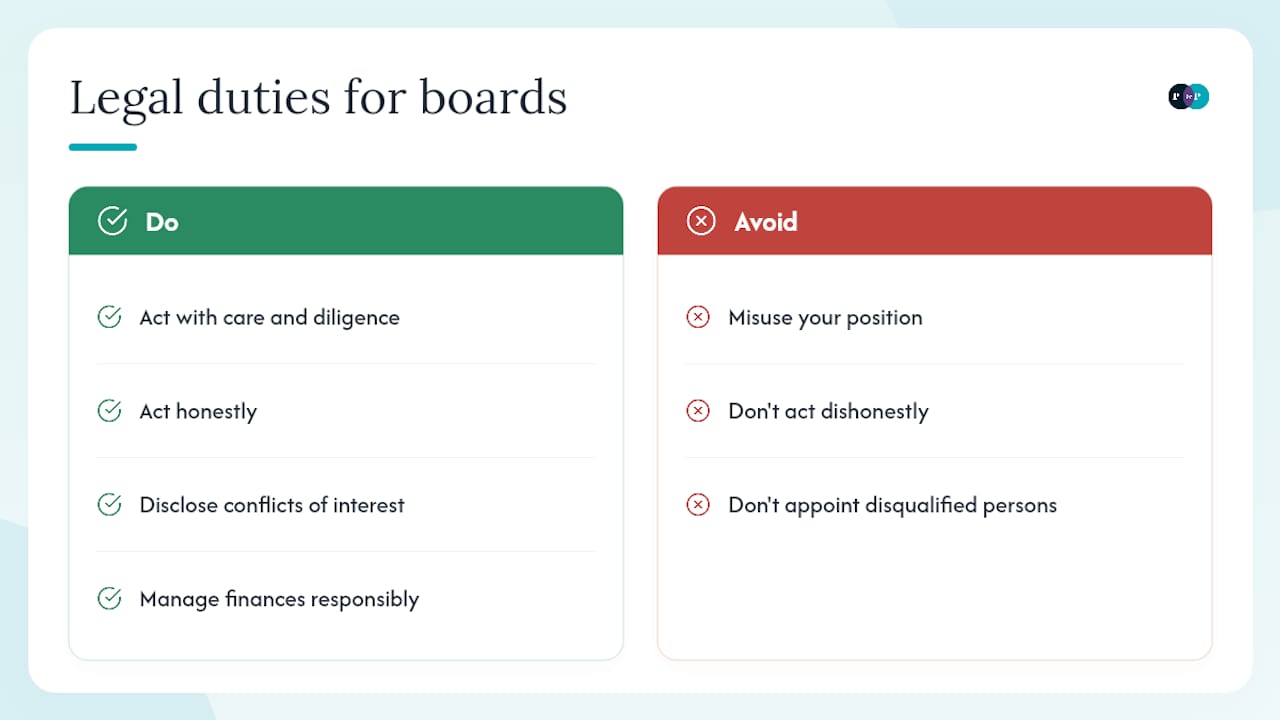
The six standards cover: charitable purposes and not-for-profit character; accountability to members; compliance with Australian laws; suitability of Responsible People; duties of Responsible People; and maintaining public trust. Governance Standard 5 carries the most individual weight for directors. It requires each Responsible Person to act with care and diligence, act honestly, not misuse their position, disclose conflicts, manage the organisation's finances responsibly, and take reasonable steps to avoid insolvent trading.
Governance Standard 5 in plain terms: every board member must act with care and diligence, be honest, disclose conflicts, manage finances responsibly, and take reasonable steps to avoid insolvent trading. These duties attach to the individual, not just the board as a body.
For companies limited by guarantee, the Corporations Act 2001 (Cth) sits alongside ACNC obligations. Director duties under sections 180–184 of the Act — care and diligence, good faith, proper purpose, and the prohibition on improper use of position — apply in full. Criminal offences for dishonest conduct remain regardless of charitable status. State incorporated associations legislation adds another layer for associations registered under state law rather than the Corporations Act.
The ACNC and ASIC disqualified persons registers must both be checked before any new appointment. A person banned from managing corporations under the Corporations Act cannot be a Responsible Person under the ACNC framework.
Key oversight responsibilities your board must prioritise
Turn the legal duties above into a working checklist. At each board meeting, the following areas need active attention, not just a CEO report.
- Financial oversight — approve the annual budget; review monthly or quarterly management accounts against budget; maintain a reserves policy; monitor cashflow projections; and discuss insolvency risk explicitly when cashflow tightens.
- Conflicts of interest — require written disclosure at the start of each meeting; record conflicts in the minutes; exclude the conflicted director from the relevant discussion and vote; and update the conflicts register after each meeting.
- Risk and compliance — review the risk register at least quarterly; confirm incident reporting obligations under the NDIS Practice Standards, Aged Care Quality Standards (Strengthened), or National Principles for Child Safe Organisations are being met; and place cyber security on the board agenda at least annually.
- Recordkeeping — retain minutes, financial records, and key governance documents for at least seven years, consistent with ACNC guidance.
- Delegations — maintain a board-approved delegation register; review it annually; and confirm management is operating within delegated authority, not beyond it.
How should your board be composed and who can sit on it?
ACNC guidance on Responsible People defines who governs a charity — typically board members, committee members, or trustees — and sets clear expectations for suitability. Minimum numbers depend on your governing document and the legislation under which you are incorporated. Most model rules for incorporated associations require at least three committee members; companies limited by guarantee typically require at least three directors.
Suitability checks before appointment should include:
- Search of the ACNC register for disqualified persons
- Search of the ASIC banned and disqualified register
- A signed declaration confirming the candidate is not disqualified
- Reference checks and a conflict-of-interest disclosure
Skill mix matters as much as eligibility. Aged care and disability providers need directors with clinical or quality literacy, not just financial and legal skills. Lived-experience representation is increasingly expected by regulators and funders. Succession planning — knowing which skills leave when a director rotates off — is a governance function, not an HR task. A board charter that documents the required skill matrix makes this visible and reviewable.
What does a sound induction and performance review look like?
A new director who receives a welcome email and a copy of the constitution is not inducted. A proper induction pack covers the governing document, ACNC obligations, key policies (conflicts, whistleblower, code of conduct), recent board minutes, the current risk register, and the delegation register. For human-services boards, it should also include the relevant quality standards — NDIS Practice Standards, Aged Care Quality Standards (Strengthened), or the HSQF for Queensland providers.
Ongoing education priorities for 2026 include ACNC regulatory updates, sector reform (particularly the Strengthened Aged Care Quality Standards and NDIS Practice Standard revisions), care governance, cyber security literacy, and financial sustainability. The AICD NFP Governance Principles recommend that boards review their own performance regularly and act on findings — not file the results.
A board performance review need not be elaborate. An annual self-assessment against the ACNC Governance Standards, a structured conversation about what is working and what is not, and a written action plan with owners and due dates is sufficient for most small-to-medium organisations. The discipline is in acting on findings, not in the sophistication of the tool.
What protections do board members actually have?
Directors and officers (D&O) insurance covers legal costs and liability arising from claims against board members acting in their governance capacity. An indemnity clause in the governing document provides a further layer. Neither protects a director from criminal liability, wilful breach of duty, or conduct that falls outside the scope of their role.
Before an incident occurs, boards should confirm:
- The D&O policy covers the organisation's current activities and scale
- The policy excess is manageable for individual directors
- The claims notification process is documented and known to the chair and CEO
- Indemnity provisions in the governing document are current and legally sound
Insurance is not a substitute for good governance. A board that relies on D&O cover to manage the consequences of poor decisions is misunderstanding both the product and the duty. The protection exists for genuine errors of judgement made in good faith — not for ignoring known risks.
How to check your board's governance right now
The ACNC Charity Governance Tools are the most practical starting point for any board that wants an honest picture of where it stands. Use them in three steps:
- Prepare — gather your governing document, recent minutes, financial statements, conflicts register, and delegation register before opening the tool.
- Complete — work through each section of the self-evaluation covering record-keeping, financial management, safeguarding, conflicts of interest, and related-party transactions.
- Act — print or save the results, identify gaps, and assign each gap an owner, a due date, and a description of the evidence that will confirm completion.
From practice: A community services board completed the ACNC self-evaluation and identified that its delegation register had not been reviewed in three years and that two delegations referenced a position that no longer existed. The board resolved to update the register at the next meeting, assigned the task to the company secretary, and set a 30-day deadline. At the following meeting, the updated register was tabled, approved, and minuted. The ACNC tool had surfaced a real gap that the board's usual reporting cycle had not caught.
Pro Tip: Keep a documented delegation register as a standing agenda item for annual review. Boards that review delegations annually — as recommended in the AICD NFP Governance Principles — consistently avoid the drift where management operates beyond its authority without the board realising.
For a structured approach to identifying governance policy gaps, the self-evaluation works best when paired with a review of your governance documentation.
What effective boards are doing differently right now
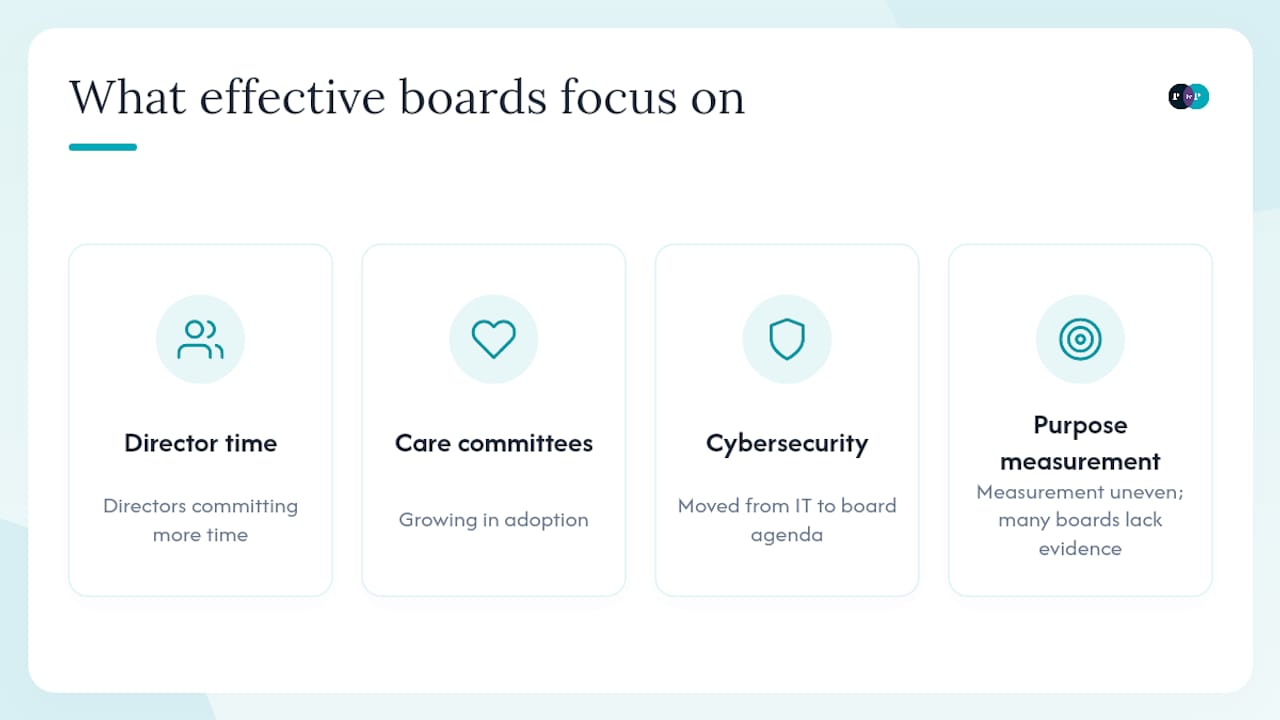
The AICD NFP Governance and Performance Study 2025–26 documents a clear shift: directors are committing more time, care committees are growing in adoption, and cyber security has moved from an IT matter to a board-level agenda item. The study also flags that measurement of organisational purpose remains uneven — many boards cannot demonstrate, with evidence, that their organisation is achieving what it exists to achieve.
The boards that are ahead of this curve are not necessarily larger or better resourced. They have made a deliberate choice to diversify their assurance mechanisms beyond the CEO report. One aged care board I am aware of introduced quarterly direct conversations between the board's quality subcommittee and the clinical lead — without the CEO present. The quality of information the board received changed immediately.
The question worth putting to your board at the next meeting: what evidence do we hold, independent of management, that our organisation is safe and achieving its purpose?
How The Planning and Practice Hub can help your board
Boards that complete the ACNC self-evaluation often find the gaps are clear but the path to fixing them is not. The Planning and Practice Hub, founded by Rachel Willis with nearly three decades of human-services sector experience, works with boards across NDIS, aged care, child and family, homelessness, and community services to close those gaps practically.
Specific support includes governance reviews, delegation register development, board induction pack design, director training sessions aligned to ACNC Governance Standards, and compliance calendars that keep your board ahead of reporting deadlines. The compliance calendar is particularly useful for boards managing obligations across multiple regulators — it maps deadlines, owners, and evidence requirements in one place. For boards wanting broader consulting support, the human services consulting page outlines the full scope of available engagements. Contact The Planning and Practice Hub to discuss what your board needs next.
Sources
Save these pages to your board's governance folder and record the date accessed in your minutes.
- Governance standards for charities | ACNC
- Not-for-Profit Governance Principles | AICD
- Division 45 — Governance standards (ACNC Act) | Federal legislation
FAQ
What are the ACNC Governance Standards?
The ACNC Governance Standards are six minimum requirements for how a registered charity must be governed, covering charitable purposes, member accountability, legal compliance, suitability of Responsible People, individual director duties, and maintaining public trust.
Who counts as a Responsible Person under the ACNC?
A Responsible Person is anyone who governs the charity — typically a board member, committee member, or trustee. The ACNC expects each Responsible Person to meet the duties in Governance Standard 5 individually, not just collectively as a board.
Can a board delegate its governance duties to the CEO?
A board can delegate operational tasks to the CEO, but it cannot delegate ultimate accountability. Under the AICD NFP Governance Principles, boards must maintain documented delegations and retain oversight of all delegated matters — delegation is not abdication.
How often should a not-for-profit board check the disqualified persons registers?
Check both the ACNC and ASIC registers before every new appointment and repeat the check at least annually as part of the board's suitability review process.
How can The Planning and Practice Hub help with board governance?
The Planning and Practice Hub works with Australian not-for-profit boards to conduct governance reviews, develop delegation registers and induction packs, deliver director training aligned to ACNC Governance Standards, and build compliance calendars that track obligations across multiple regulators.