
Most boards have a constitution. Far fewer have a board charter that actually reflects how the board operates today. That gap is where governance problems quietly take root.
A not for profit board charter is a voluntary governance policy document that sits alongside your mandatory governing document (your constitution or rules). It does not replace the constitution. What it does is translate the constitution's legal framework into practical, day-to-day operating guidance for directors. Under the ACNC Governance Standards, outlining Responsible People's duties in a board or committee charter is explicitly recognised as a sound compliance practice. The AICD Not-for-Profit Governance Principles go further, recommending charters as the primary tool for helping directors meet their legal obligations.
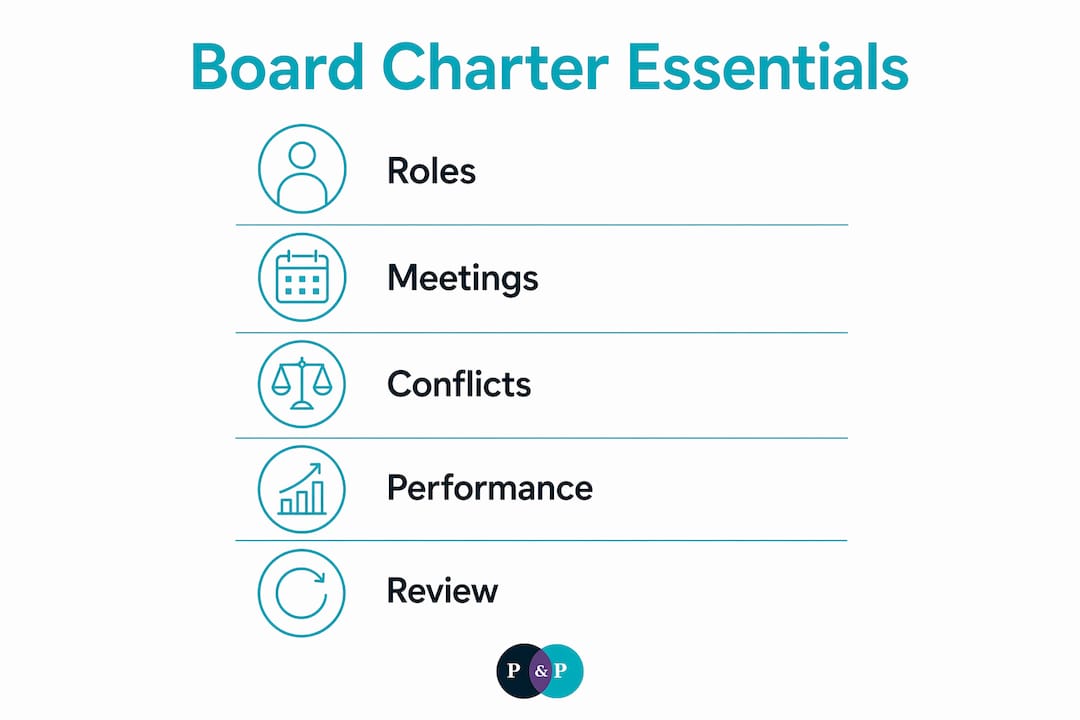
A well-constructed charter typically covers:
- Roles of the board, chair, CEO, company secretary, and committees
- Board responsibilities, composition, and independence requirements
- Meeting protocols, quorum, and agenda management
- Conflict of interest declaration and management
- Delegations to management and committees
- Director induction, ongoing training, and performance review
- Access to independent advice and management reporting
Australian law does not require a document called a "charter," but a governing document is mandatory for ACNC registration. The charter is the layer above that, and it is where governance quality is actually built.
What does a not for profit board charter say about roles?
The clearest boards are the ones where every person in the room knows exactly what they are there to decide, and what belongs to management. A board charter makes that explicit.
Typical role definitions in a charter include:
- The board sets strategic direction, approves policy, oversees risk, and holds the CEO accountable. It does not manage operations.
- The chairperson leads board meetings, manages board dynamics, and acts as the primary liaison between the board and CEO.
- The CEO manages the organisation within the authority delegated by the board and reports to the board on performance, risk, and compliance.
- The company secretary supports meeting administration, maintains governance records, and advises on procedural matters.
- Committees operate under terms of reference approved by the board, with clearly documented delegated authority and regular reporting lines back to the full board.
ACNC Governance Standard 5 requires Responsible People to act with diligence, honesty, and in the charity's best interests. Embedding these duties in the charter makes them accessible during induction and keeps them visible throughout a director's tenure. The AICD Principles also flag board composition and independence as charter content, particularly the question of whether the board has the right mix of skills and whether any director's independence is compromised.
Delegation is where many boards get into trouble. The charter should specify what the board cannot delegate, not just what it can. Financial thresholds, key contracts, and decisions affecting the organisation's purpose should sit firmly with the board.
How does a charter handle conflicts, meetings, and performance reviews?
Governance protocols are only as good as the processes that make them real. A charter formalises these processes so they are not left to convention or memory.

Conflict of interest management is a non-negotiable inclusion. The charter should require directors to declare conflicts before each meeting, specify how declarations are recorded, and set out what happens when a conflict is identified (recusal from discussion and voting, for example). The ACNC explicitly lists conflict of interest processes as a compliance expectation under its Governance Standards.
Meeting protocols typically cover:
- Minimum meeting frequency (most boards meet at least six times per year)
- Quorum requirements for valid decision-making
- Agenda preparation responsibilities and timeframes for distributing board papers
- Minute-taking standards and approval processes
- Procedures for urgent decisions between scheduled meetings
Director performance review is the element most boards defer indefinitely. The AICD is direct on this: regular performance evaluations identify governance gaps and keep the charter aligned with the board's actual strategic goals. A charter should specify when reviews occur (annually is standard), who facilitates them, and how findings are acted upon.
Handling breaches also belongs in the charter. What happens if a director consistently fails to prepare for meetings, or fails to declare a conflict? The charter should set out a clear, fair process, including who raises the concern, how it is documented, and what remedies are available.
Does your charter reflect where your organisation actually is?
One of the most common mistakes boards make is adopting a charter written for a different kind of organisation. A charter built for a large, professionally staffed NFP will not work for a volunteer-run community association, and vice versa.
The AICD Governance Principles are clear that smaller NFP boards often carry more operational responsibility, while larger organisations expect their boards to focus strategically. The line between board and management shifts depending on whether you have a paid CEO, a full management team, or a handful of volunteers doing everything. Your charter needs to reflect that reality, not an idealised version of it.
Consider a community mental health organisation in regional Queensland operating under the HSQF and NDIS Practice Standards. When the organisation grew from a volunteer committee to a board with a paid CEO, its original charter still described the board approving rosters and signing off on individual client plans. The board spent six months in governance limbo, with directors unsure what they were still responsible for and the CEO unsure what required board sign-off. A charter review, grounded in the organisation's new scale and accountability structure, resolved the confusion and freed the board to focus on strategy and risk.
Client and consumer voice is another area where charters are increasingly expected to do more. The AICD Principles note that NFPs across many sectors are building lived experience and client voice into governance structures. A charter can formalise how a consumer advisory body reports to the board, what matters it is consulted on, and how its input influences board decisions, without delegating board accountability.
A board charter is a living document, distinct from the constitution. It allows governance practice to evolve without the legal formalities required to amend a constitution. Keeping it current is not an administrative task. It is how the board stays honest about how it actually operates.
Annual review of the charter catches delegation drift before it becomes a governance failure. Build the review into your board calendar, not your to-do list.
Getting governance right in practice
A board charter supports ACNC compliance, director clarity, and organisational accountability. It is most effective when the board owns it, not when it is filed and forgotten.
Key points to carry forward:
- The charter complements, not replaces, your governing document
- ACNC Governance Standard 5 duties belong in the charter as an induction and compliance reference
- Conflict of interest, meeting protocols, and performance review processes should be explicit, not assumed
- Charter content must match your organisation's actual governance maturity and operational structure
- Annual review keeps the charter honest and prevents delegation drift
- Client and consumer voice mechanisms should be documented in the charter where relevant
The question worth sitting with: does your current board charter reflect how your board actually operates, or how you hoped it would operate three years ago?
How to develop, adopt, and review a board charter
Developing a charter works best as a board-led process, not something delegated entirely to the CEO or a consultant. The AICD Board Charters guidance recommends inviting all directors to comment on a draft, which builds ownership and surfaces practical disagreements before they become governance problems.
A workable process looks like this:
- Audit current practice. Map what the board actually does against what the constitution requires. Identify gaps, overlaps with management, and undocumented conventions.
- Draft the charter. Use the audit findings to draft role definitions, protocols, and delegation schedules. Reference ACNC Governance Standards and the AICD Principles as your benchmarks.
- Circulate for board input. Allow time for directors to review and respond. Multiple rounds are normal.
- Formally adopt at a board meeting. Record the adoption in the minutes. The charter becomes a board-approved policy from that point.
- Schedule annual review. Set a fixed agenda item, typically at the start of each governance year, to review the charter against current organisational realities.
If your organisation works with external compliance advice, the charter development process is a good moment to use it. Getting the delegation schedules and ACNC alignment right at drafting stage is far less costly than correcting them after a governance review.
The Planning and Practice Hub works with boards across the Australian human services sector on governance compliance and charter development. If your board is ready to move from a filed document to a working governance tool, get in touch.
Key takeaways
A not for profit board charter is the most practical tool a board has for translating legal obligations into clear, daily governance practice aligned with ACNC Governance Standards.
| Point | Details |
|---|---|
| Charter is voluntary, not optional | Australian law does not require a charter, but ACNC Governance Standards recognise it as a compliance best practice. |
| Roles must be explicit | The charter should define the board, chair, CEO, secretary, and committee roles, including what the board cannot delegate. |
| Conflict of interest processes are mandatory | Declaration, recording, and recusal procedures must be written into the charter, not left to convention. |
| Charter must match organisational maturity | Smaller boards carry more operational responsibility; larger boards focus strategically. The charter should reflect actual practice. |
| Annual review prevents drift | Reviewing the charter each year catches delegation gaps and keeps board and management expectations aligned. |
FAQ
Is a board charter legally required for Australian not-for-profits?
No. Australian law does not require a board charter, but a governing document (constitution or rules) is mandatory for ACNC registration. A charter is strongly recommended as a governance best practice.
What is the difference between a constitution and a board charter?
A constitution is a legally binding document required for registration that sets out the organisation's purposes and rules. A board charter is a flexible internal policy that details how the board operates in practice, and can be updated by the board without legal formalities.
What should a not for profit board charter include?
A charter typically covers board and director roles, chair and CEO responsibilities, committee structures, meeting protocols, conflict of interest management, delegation schedules, director induction, and performance review processes.
How often should a board charter be reviewed?
Annual review is standard practice. The AICD recommends treating the annual review as a governance circuit breaker to catch delegation drift and realign board and management expectations.
How does a board charter support ACNC compliance?
The ACNC recognises outlining Responsible People's duties in a board or committee charter as a sound compliance practice under Governance Standard 5. It also supports director induction and ongoing accountability.