
Update your core policy set now to reflect the Aged Care Act 2024, Aged Care Rules 2025 and the Strengthened Aged Care Quality Standards — and make sure your quality system holds the evidence that you have actually implemented them. Here are three things to do this week:
- Triage your policy register against Outcome 2.3 and the Statement of Rights. Identify every document that has not been reviewed since 1 July 2024.
- Assemble implementation evidence — training records, meeting minutes, audit logs and incident reports — so your quality system shows practice, not just paper.
- Schedule governance sign-off and a 90-day high-risk update sprint with your board or responsible person, prioritising resident safety and legal exposure first.
The Aged Care Quality and Safety Commission (ACQSC) audits against outcomes, not just document existence. A polished manual with no implementation trail is a liability, not an asset.
What do the Aged Care Act 2024 and Aged Care Rules 2025 require of providers?
The Aged Care Act 2024 shifts the entire regulatory framework from a service-delivery model to a rights-based one. Older people now hold a legislated Statement of Rights, and every provider obligation — including the Aged Care Code of Conduct — flows from that foundation. Policies are no longer just operational documents; they are evidence that your organisation upholds those rights in practice.
The Aged Care Rules 2025 set the operational detail: registration categories, audit obligations, reporting requirements and financial standards. All government-funded providers must register with the ACQSC, and registration brings consolidated conditions that vary by category. The Provider Requirements Search on the ACQSC website helps identify which obligations apply to your specific registration type.
The Strengthened Aged Care Quality Standards, effective August 2025, comprise seven Standards. Outcome 2.3 sits at the centre of any aged care policy and procedure review: it requires providers to maintain current, evidence-based policies and a quality system that drives continuous improvement. The Standards are intentionally non-prescriptive. Illustrative actions are prompts, not checklists — providers must show how their specific policies meet the intent and outcomes for their context.
Which policies does every aged care provider need to hold?
The list below reflects residential provider obligations and the Strengthened Standards. Priority labels reflect audit risk and resident safety exposure.
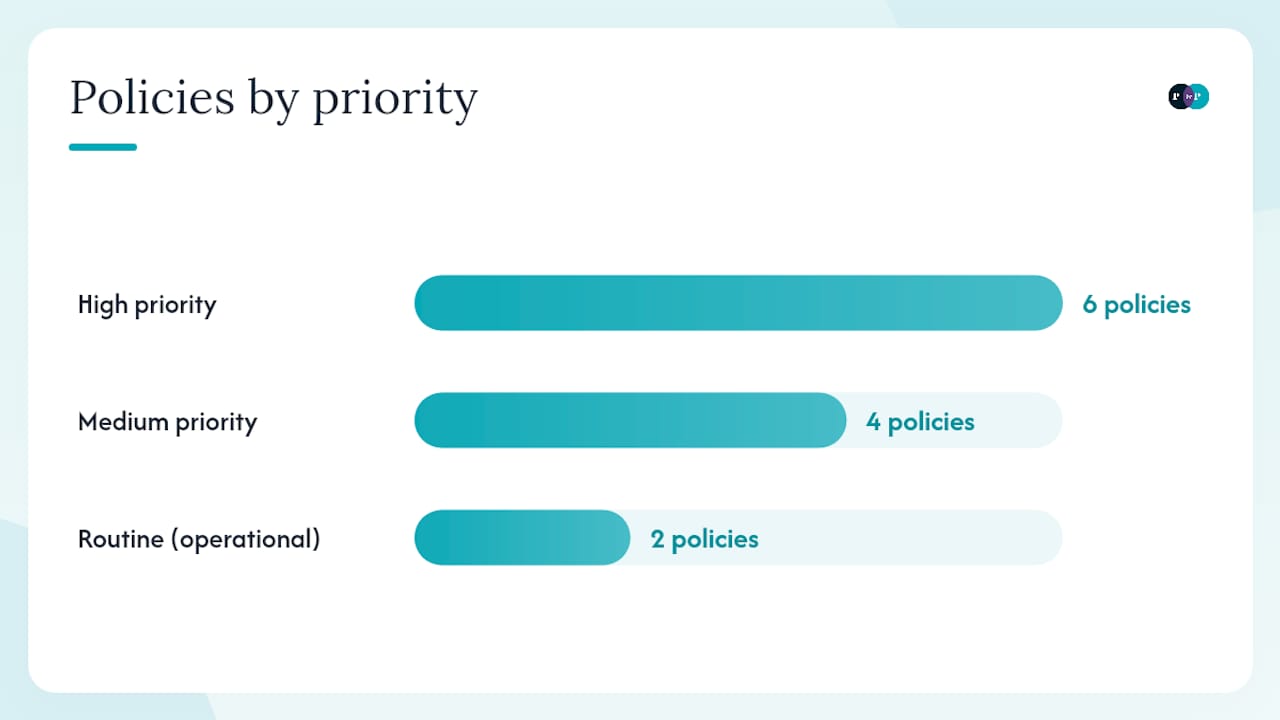
High priority (immediate legal and safety exposure):
- Governance and quality system (Outcome 2.3, board oversight, responsible person)
- Complaints handling (aligned to the new Act and ACQSC updated guidance)
- Incident management and SIRS reporting
- Infection prevention and control, including vaccination programmes and records per the Australian Immunisation Handbook
- Clinical governance and medication management
- Workforce: worker screening, training, care provision, and registered nurse (RN) coverage for residential providers around the clock
Medium priority (governance and care quality):
- Assessment and care planning, including cultural safety and consumer choice
- Restrictive practices
- Records management and privacy
- Accommodation and fees disclosure
Routine (operational and supporting):
- Consumer information and rights communication
- Continuous improvement and feedback mechanisms
Each high-priority policy requires both a current document and measurable implementation evidence: training logs, competency checks, audit records and consumer information materials. Medium-priority policies need documented governance oversight at minimum.
How do you map each policy to the Strengthened Standards and Statement of Rights?
A simple four-column mapping approach gives your team a repeatable method and gives auditors a clear line of sight.
| Policy name | Standard outcome(s) supported | Implementation evidence required | Owner and review frequency |
|---|---|---|---|
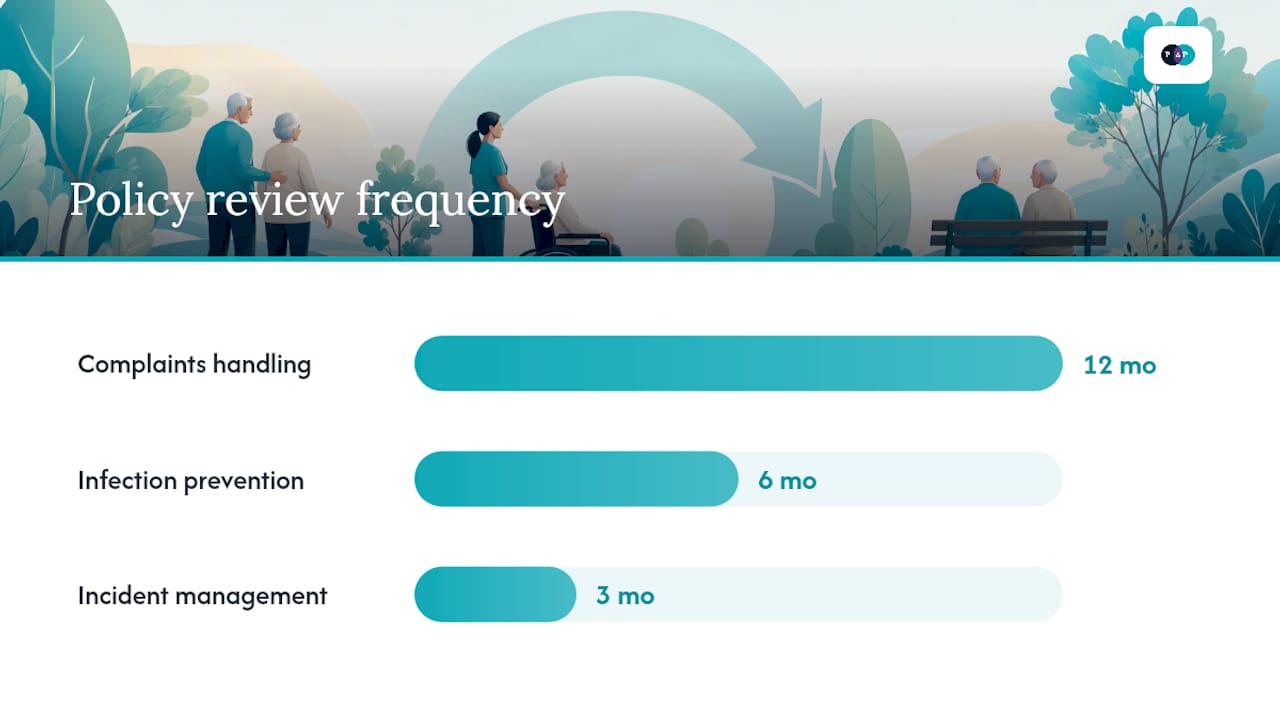
| Complaints handling | Standard 5 (Feedback and complaints), Outcome 2.3 | Complaints register, staff training records, governance minutes | Quality Manager, annually |
| Infection prevention and control | Outcome 2.3 | Vaccination records, IPC audit log, staff competency checks | Clinical Adviser, 6-monthly |
| Incident management and SIRS | Standard 5, Standard 2 | SIRS notifications, incident log, RCA records, board reports | Responsible Person, quarterly |
The key discipline is translating the illustrative actions in the Strengthened Standards into your organisation's specific processes. Copying an action verbatim into a policy document does not demonstrate conformance — it demonstrates that someone read the guidance. What auditors want to see is how your staff, in your context, carry out that intent. Department of Health provider resources include checklists that help map policies to the Statement of Rights, which is a practical starting point before you build your own register.
What evidence do auditors actually look for?
The ACQSC's audit and conformance approach is risk-proportionate. Auditors assess conformance at both outcome and Standard level, and non-conformance triggers responses ranging from a remedial action plan through to conditions on registration.
Documentary evidence auditors expect:
- Current, version-controlled policies with review dates and governance sign-off
- Minutes showing the governing body has actively overseen quality and safety
- Training and competency records linked to specific policies
- Incident logs, SIRS notifications and root cause analysis records
- Care plans, care minutes reporting and RN coverage records
- Financial reporting (ACFR, QFR) for residential providers
Operational evidence that often determines the outcome:
- Staff interviews demonstrating they know and use the policies in daily work
- Observed practice consistent with documented procedures
- Continuous improvement actions triggered by incidents, complaints or consumer feedback
The governing body and responsible person carry specific accountability here. Demonstrable oversight — quality reports tabled at board meetings, improvement actions tracked and closed — is often what separates a minor non-conformance finding from a major one. For a deeper look at ACQSC audit preparation, the linked guide covers evidence templates and common gaps.
How do you build a practical 90-day update plan?
Triage first, then resource. The model below gives you a working framework.
| Priority band | Timeframe | Criteria | Typical roles |
|---|---|---|---|
| Immediate | 30 days | Resident safety risk, legal exposure, SIRS/complaints obligations | Responsible Person, Clinical Adviser, Quality Manager |
| High | 90 days | Outcome 2.3 compliance, workforce and care minutes policies | Board sign-off, Policy Authors, Training Coordinator |
| Routine | — | Supporting operational policies, consumer information, records | Policy Authors, Records Manager |
Resourcing realistically means a mix of internal hours and external consultant days. A medium residential provider updating a full policy register typically needs a quality manager committing two to three days per week across the sprint, a clinical adviser for high-risk clinical policies, and board time for governance sign-off at the 30-day and 90-day marks. External consultancy support is most cost-effective for the initial gap analysis, policy drafting and audit evidence review — not for ongoing maintenance once the system is established.
Build a simple timeline table for your board: policy name, priority band, owner, start date, target completion and evidence checkpoint. That document becomes your governance record for the sprint itself.
What does implementation actually look like? An anonymised example
A medium residential provider in regional New South Wales had policies spread across three separate folders, some last reviewed in 2021. When the Strengthened Standards came into force, the quality manager ran a triage against Outcome 2.3 and identified 14 high-priority gaps, including an infection control policy with no vaccination record process and a complaints procedure that predated the new Act entirely.
Over 90 days, the team consolidated policies into a single quality system, updated infection control and complaints procedures, ran three staff training sessions with sign-off sheets, and produced governance minutes showing board oversight at each milestone. The measurable outcome: at their next ACQSC audit, zero major non-conformances were recorded against Standard 2 and Standard 5 — compared with two major findings at the previous cycle.
The one thing you can replicate immediately: after every policy update, schedule a 30-minute team briefing, record attendance, and file the sign-off sheet in your quality system. That single habit builds an implementation trail faster than any document revision alone.
Key takeaways
Providers who treat aged care policy and procedure as a governance discipline — not a documentation task — consistently produce stronger audit evidence and better resident outcomes.
| Point | Details |
|---|---|
| Triage against Outcome 2.3 first | Review every policy against Outcome 2.3 and the Statement of Rights before drafting anything new. |
| Evidence beats documents | Training records, meeting minutes and incident logs matter more to auditors than polished policy manuals. |
| 90-day sprint with governance sign-off | Structure updates in three bands: 30 days (immediate), 90 days (high), — (routine). |
| Map policies to Standard outcomes | Use a four-column mapping table linking each policy to Standard outcomes, evidence required and review owner. |
| The Planning and Practice Hub | Supports providers with policy development, gap analysis and audit preparation through fixed-scope consulting engagements. |
The gap that keeps appearing
Most providers I work with do not have a policy problem. They have an evidence problem. The documents exist — sometimes in impressive detail — but the quality system cannot show that staff have read them, that the board has reviewed them, or that an incident triggered a policy change. Under the Aged Care Act 2024, that gap is a governance failure, not an administrative oversight.
The rights-based framework asks a harder question than the old Standards did: not "do you have a policy?" but "how does this policy protect an older person's rights, and how do you know it is working?" Boards and responsible persons who treat that question seriously — who schedule quarterly quality reviews, who ask for implementation evidence not just document lists — tend to find audits far less stressful.
Which policy area would you prioritise for your first 30-day sprint this quarter?
How The Planning and Practice Hub can support your policy update
Providers working through a full policy register update under the new Act often find the gap analysis and drafting phases the most resource-intensive. The Planning and Practice Hub works with residential and community aged care providers on policy and quality system development, Outcome 2.3 gap analysis, audit preparation, governance workshops and short implementation sprints — scoped to your registration category and timeline.
Rachel Willis and the team bring close to three decades of human services regulatory experience, with a focus on co-developing systems that your staff will actually use. Services include policy packs mapped to the Strengthened Standards, governance support for boards and responsible persons, and audit evidence reviews. To discuss a scoping call or request a short policy triage checklist, visit the consulting services page.
Useful sources
Start with these primary sources depending on your immediate need:
- Strengthened Aged Care Quality Standards | Aged Care Quality and Safety Commission
- Aged Care Rules 2025 (compiled)
- Responsibilities of residential aged care providers | Australian Government Department of Health, Disability and Ageing
- Aged Care Act provider resources | Australian Government Department of Health
FAQ
What is Outcome 2.3 under the Strengthened Aged Care Quality Standards?
Outcome 2.3 requires providers to maintain current, evidence-based policies and a quality system that drives continuous improvement. It sits within Standard 2 and is a primary focus of ACQSC audits.
When did the Strengthened Aged Care Quality Standards take effect?
The Strengthened Aged Care Quality Standards took effect in August 2025, alongside the Aged Care Act 2024 and Aged Care Rules 2025 framework.
What implementation evidence do auditors expect to see?
Auditors look for training records, governance meeting minutes, incident logs, SIRS notifications, care plans and care minutes reporting — evidence that policies are used in daily practice, not just filed.
Do residential providers need a 24/7 registered nurse on site?
Yes. Residential aged care providers (category 6) must maintain a registered nurse on site 24 hours a day, seven days a week, as a condition of registration under the current framework.
Can The Planning and Practice Hub help with a policy gap analysis?
Yes. The Planning and Practice Hub works with aged care providers on Outcome 2.3 gap analysis, policy development and audit preparation through fixed-scope consulting engagements — visit the services page to discuss your needs.