
TL;DR:
- Most audit failures are due to poor implementation rather than documentation problems.
- Providers must embed policies into daily practice and demonstrate actual compliance to pass assessments.
Most providers who struggle at audit don't have a documentation problem. They have an implementation problem. Their policies exist, but the organisation hasn't genuinely embedded them into daily practice, and auditors notice the gap almost immediately.
Policy and procedure development for NDIS providers means creating and maintaining documented governance and operational frameworks that comply with the NDIS Practice Standards and hold up under scrutiny from the NDIS Quality and Safeguards Commission. The core requirement is straightforward: your documents must accurately reflect how your organisation actually delivers supports, not how you'd like to on paper.
Getting this right matters for registration, certification, and every re-registration cycle that follows. Here's what that looks like in practice.
Your policies must cover:
- Rights and responsibilities of participants
- Provider governance and operational management
- Risk management and quality systems
- Information handling and privacy
- Feedback, complaints, and incident management
- Human resource management
- Work health and safety, emergency and disaster management
What are the core NDIS policy categories and how do you customise them?
The NDIS Practice Standards Rules 2018 define the Core Module as the baseline for all registered providers delivering higher-risk supports. Providers delivering lower-risk supports complete the Verification Module, which covers human resource management, risk management, complaints, and incident management. Supplementary modules apply depending on your specific registration groups, such as specialist behaviour support or specialist disability accommodation.

Customisation is where many providers go wrong. The NDIS Commission is explicit: generic purchased policies without genuine organisational adaptation risk refusal or cancellation of registration. You must be able to explain every document you submit.
A few principles that hold across provider sizes:
- Governance policies must address conflicts of interest, financial accountability, and delegated authority structures proportionate to your organisation
- Smaller providers should resist the temptation to copy enterprise-level frameworks. Auditors favour documented systems appropriate to your actual scale and capacity
- Specialist support providers need supplementary policies beyond the Core Module, covering areas like behaviour support plan implementation or specialised support coordination
- Governance policies covering board member responsibilities, key personnel suitability, and strategic planning must reflect your real structure, not an aspirational one
The governing body's role is to monitor management performance, respond to quality and safeguarding matters, and drive continuous improvement. Your policies need to show that loop is actually functioning, not just described.
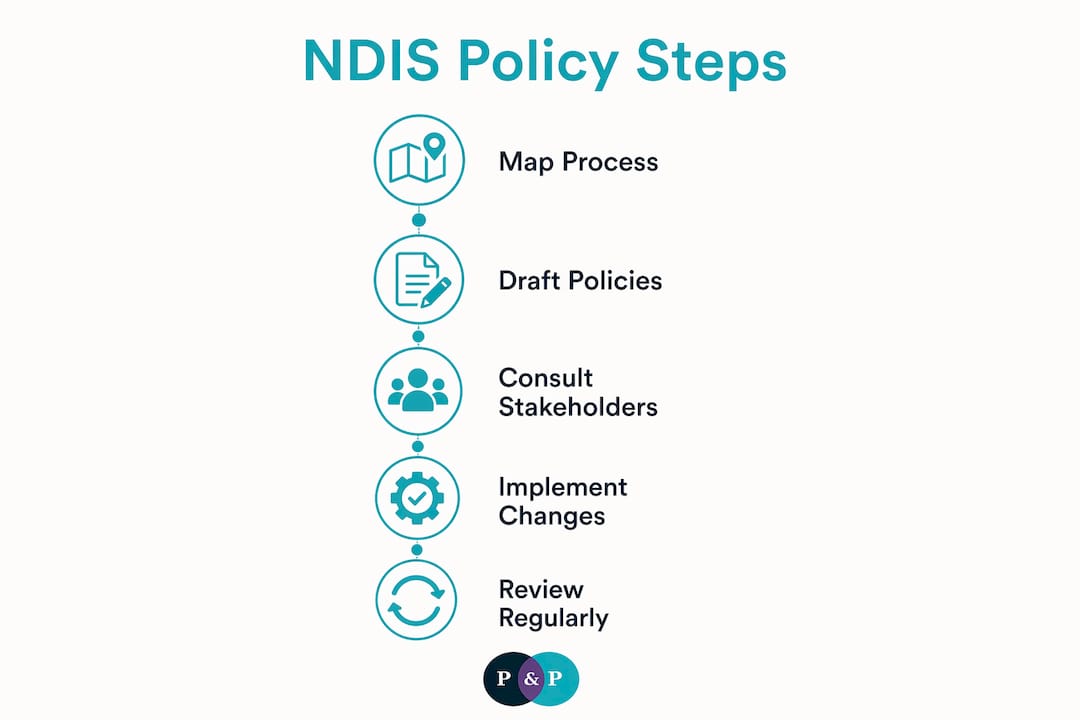
Pro Tip: Before drafting any policy, map your actual operational process first. Write the policy to describe what you genuinely do, then identify gaps between current practice and the standard. That gap analysis becomes your action plan.
How do you update policies and prepare for NDIS audits?
Policies are living documents that your governing body must actively monitor and update. Static documents signal poor governance to auditors, regardless of how well they were written at registration.
A practical review cycle includes:
- Annual scheduled review of all Core Module policies, with more frequent reviews triggered by incidents, complaints, or regulatory changes
- Incident learnings fed back into relevant procedures within a defined timeframe
- Participant feedback formally incorporated into policy updates, with evidence of that process documented
- Staff training records updated to reflect any policy changes, with sign-off confirming understanding
Auditors assess evidence of implementation, not just documentation. They will speak with staff, review case notes, and look for consistency between what your policies say and what your workers actually do. Audit non-conformance most often results from poor implementation, not poor documentation.
Registration audits assess providers against the NDIS Practice Standards, with verification for lower-risk supports and certification for higher-risk, with certification valid for three years. Preparing your team for this means building audit readiness into your regular governance calendar, not treating it as a separate event.
Pro Tip: Keep a policy register with version history, review dates, and the names of staff who received training on each update. That register becomes your primary evidence trail at audit.
What do NDIS policies, procedures, and supporting records look like?
Policies set the organisational position. Procedures specify the operational steps that put that position into practice. Supporting records prove it happened.
Common policy and procedure documents include:
- Incident management policy and the accompanying procedure for reporting, investigating, and closing incidents
- Participant rights policy and the procedure for how rights are communicated and upheld
- Complaints handling policy and the procedure for receiving, recording, and resolving complaints
Record-keeping requirements under the provider payment assurance programme are specific. Every support interaction must be documented with the participant's name, NDIS number, date, support type, and quantity delivered.
| Policy document | Associated procedure | Supporting records |
|---|---|---|
| Incident management policy | Incident reporting and investigation procedure | Incident register, investigation notes, corrective action records |
| Participant rights policy | Rights communication and advocacy procedure | Signed rights acknowledgements, meeting notes |
| Complaints handling policy | Complaint receipt and resolution procedure | Complaints register, correspondence, outcome records |
| Risk management policy | Risk identification and review procedure | Risk register, review minutes |
| Information management policy | Data storage and access procedure | Access logs, consent forms, privacy breach records |
Support logs must be signed by the participant, a child representative, a nominee, or a legal guardian. Rosters for group supports must include participant and staff names to demonstrate correct ratios. Case notes must link activities to specific support items and participant goals.
A practice example: embedding policies in a mid-sized provider
A mid-sized Queensland NDIS provider approaching their first certification audit had a full set of purchased policies. Their quality manager recognised the problem early: staff couldn't explain the complaints procedure, and the incident register hadn't been updated in four months.
Over three months, the organisation worked through each Core Module policy systematically. They rewrote procedures to reflect their actual workflows, ran team sessions where staff walked through scenarios using the documents, and established a monthly governance meeting where the board reviewed the incident and complaints registers.
The provider passed their certification audit with minor corrective actions, all resolved within the 60-day window. The lesson: governance documents only work when the governing body treats them as operational tools, not compliance artefacts.
Why stakeholder consultation strengthens your policy framework
Participant involvement in policy development is a regulatory requirement under the Core Module governance outcomes, not a courtesy. The governing body must provide genuine opportunities for people with disability to contribute to organisational policy and processes.
What genuine consultation looks like in practice:
- Scheduled participant forums or surveys with documented outcomes
- Feedback mechanisms accessible to participants with varied communication needs
- Evidence that participant input changed or informed a policy decision
- Meeting records showing participant perspectives were considered, not just noted
Tokenistic sign-off doesn't satisfy the standard. Auditors look for evidence that consultation was real and that it influenced outcomes. A governance gap analysis can help you identify where your current consultation processes fall short before an auditor does.
Change management when you update policies
Policy changes fail when staff hear about them through a memo and nothing else. Effective change management for policy adoption requires a deliberate communication and training plan.
A workable approach:
- Announce the change with context, explaining what changed and why, before the new policy takes effect
- Train before you implement, not after. Staff need time to ask questions and practise new procedures
- Identify champions in each team who understand the change and can support colleagues
- Confirm understanding through sign-off, brief assessments, or observed practice, and keep records
- Review uptake at the next governance meeting, using incident and complaint data to check whether the change is working
Stakeholder governance principles apply here too. Workers who understand the purpose behind a policy are far more likely to apply it consistently than those who received a document and a deadline.
If you're working through your first registration or preparing for re-certification, what's the single biggest gap you're seeing between your documented policies and what actually happens on the ground?
The Planning and Practice Hub works with NDIS providers across Australia to develop governance frameworks and operational policies that hold up at audit. Talk to our team about where to start.
Key takeaways
Compliant NDIS policies must accurately reflect how your organisation actually delivers supports, and your governing body must actively maintain them as living documents.
| Point | Details |
|---|---|
| Core Module coverage | Policies must address governance, risk, quality, complaints, incidents, information handling, and participant rights. |
| Customisation is mandatory | Generic purchased policies without organisational adaptation risk registration refusal or cancellation. |
| Audit assesses implementation | Auditors look for evidence that staff apply policies in practice, not just that documents exist. |
| Record-keeping is specific | Every support must be documented with participant name, NDIS number, date, support type, and quantity. |
| Participant consultation is required | Governing bodies must provide genuine opportunities for people with disability to contribute to policy development. |
FAQ
What are NDIS policies and procedures?
NDIS policies and procedures are documented governance and operational frameworks that registered providers must maintain to comply with the NDIS Practice Standards. Policies set the organisational position; procedures specify the operational steps that put each policy into practice.
How should NDIS policies and procedures be developed?
Start by mapping your actual operational processes, then write policies that accurately describe them, identify gaps against the NDIS Practice Standards, and build an action plan to close those gaps. The NDIS Commission requires that providers understand and can explain every document they submit.
What are examples of NDIS policies and procedures?
Common examples include an incident management policy with a reporting and investigation procedure, a participant rights policy with a rights communication procedure, and a complaints handling policy with a complaint resolution procedure, each supported by registers and records.
How often should NDIS policies be reviewed?
Policies require at least annual review, with additional reviews triggered by incidents, complaints, regulatory changes, or audit findings. The governing body must actively monitor and respond to policy performance as a continuous improvement requirement under the NDIS Practice Standards.