
TL;DR:
- An incident management policy in aged care mandates timely reporting, thorough investigations, and a culture of safety. Compliance depends on digital tools, staff training, clear procedures, and leadership commitment to systemic improvements. Failure to meet deadlines and maintain proper records can lead to significant penalties and audit issues.
An incident management policy in aged care defines the structured procedures a provider uses to identify, report, investigate, and resolve serious incidents to protect resident safety and meet regulatory obligations. Under the Aged Care Act 2024 and the Serious Incident Response Scheme (SIRS), this is not optional paperwork. It is a core governance function with fixed statutory deadlines, financial penalties for non-compliance, and direct links to your audit outcomes. Strengthened Aged Care Quality Standard 2.5 mandates that every provider maintain an Incident Management System that documents and investigates incidents and demonstrates continuous improvement.
What are the mandatory components of a compliant incident management policy?

The SIRS framework defines eight categories of reportable incidents. These include unexpected death, serious injury, abuse, neglect, inappropriate use of restrictive practices, unexplained absence, sexual misconduct, and use of physical force. Every provider's policy must address all eight categories explicitly.
Classification drives your timeline obligations. Priority 1 incidents are those posing an immediate risk to life or safety. Priority 2 incidents involve serious harm without immediate life risk. The reporting clock starts the moment a staff member becomes aware of an incident, not when management reviews it or an investigation concludes.
The statutory deadlines are fixed:
- Priority 1: Initial notification to the Aged Care Quality and Safety Commission (ACQSC) within 24 hours
- Priority 2: Initial notification within 30 days
- Final report: Submitted within 60 days, including root cause analysis and documented systemic improvements
Missing these deadlines exposes body corporates to civil penalties up to $1.65 million and individuals to penalties up to $330,000. That financial exposure also triggers increased audit scrutiny, which compounds the operational cost.
Pro Tip: Write your policy so that the 24-hour notification obligation is visible on page one. Staff should not need to read to page six to find out when to pick up the phone.
What tools and conditions support effective incident response procedures?
A policy document alone does not produce compliance. The conditions that make a policy work in practice are just as important as the policy itself.
Digital incident capture at the point of care reduces the gap between an incident occurring and a formal record being created. Automated priority classification removes the guesswork for frontline staff and cuts reporting delays. Compliance dashboards that track workflow deadlines and escalate overdue tasks give quality managers real-time visibility across the organisation.
The table below outlines the key enablers and what each one achieves in practice.
| Enabler | What it achieves |
|---|---|
| Digital point-of-care capture | Creates an immediate, timestamped record that anchors the reporting clock |
| Automated priority classification | Reduces staff error and ensures correct deadline is applied from the start |
| Compliance dashboard | Flags overdue notifications and final reports before penalties apply |
| Staff training on SIRS | Builds confidence to report and reduces under-reporting |
| No-blame reporting culture | Aligns with whistleblower protections and increases reporting accuracy |
Quality Standard 2.9 mandates workforce training on SIRS requirements and incident identification, with annual refresher training recommended. Training is not a one-off induction activity.
Pro Tip: Pair your digital system with a one-page quick reference card for frontline staff. The card should show the eight incident categories, the two priority levels, and the notification phone number. Laminate it and put it at every nurses' station.
How to handle incidents step by step under your policy
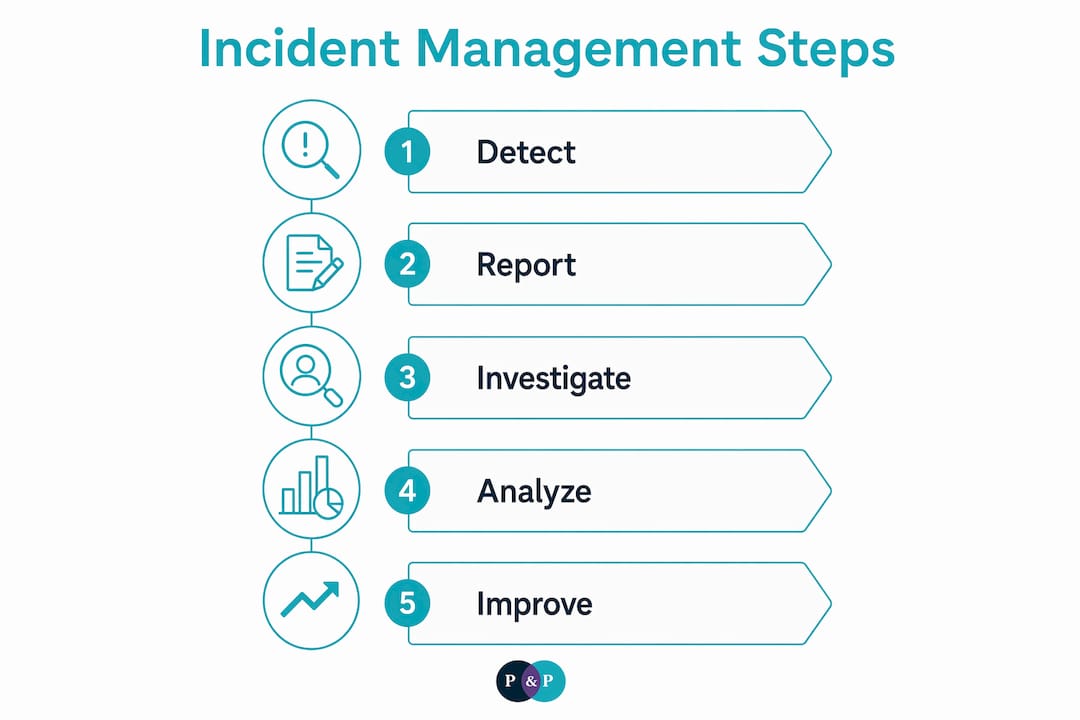
A clear process removes ambiguity at the moment staff need to act. The following sequence reflects the obligations under the Aged Care Act 2024.
- Identify and record. The staff member who witnesses or discovers the incident records it immediately in the incident management system, including date, time, location, people involved, and a factual description.
- Classify priority. The staff member or their supervisor classifies the incident as Priority 1 or Priority 2 using the criteria in the policy. When in doubt, classify up.
- Notify the ACQSC. Submit the initial notification within the applicable deadline. Do not wait for the investigation to begin or conclude.
- Commence investigation. Assign a lead investigator. Gather evidence including witness statements, care records, and environmental observations. Interviews should occur promptly while recall is fresh.
- Implement immediate remediation. Address any ongoing risk to the resident or other residents before the investigation concludes.
- Complete root cause analysis. Identify the underlying system or process failure, not just the immediate cause. Investigations must demonstrate systemic improvements, not just describe what happened.
- Submit the final report. Lodge with the ACQSC within 60 days, documenting findings, remediation actions, and quality improvements implemented.
- Retain records. Incident records and evidence must be kept for at least seven years to satisfy audit requirements.
The Strengthened Quality Standard 2 also requires providers to analyse incident trends across the organisation and implement improvements informed by that data. A single incident investigation is the minimum. Pattern analysis is the expectation.
What mistakes undermine aged care risk management, and how do you fix them?
The most common compliance failures in incident management are predictable. Knowing them in advance is the practical advantage.
- Delaying initial notification. Providers frequently wait for investigation findings before notifying the ACQSC. The reporting clock starts at staff awareness, not management sign-off. Notify first, investigate concurrently.
- Superficial root cause analysis. Assessors consistently flag investigations that describe an incident without identifying the system failure behind it. "Staff error" is not a root cause. The process that allowed the error to occur is.
- Incomplete records. Missing timestamps, unsigned witness statements, and gaps in care notes create audit vulnerabilities. Your policy should specify exactly what a complete incident record contains.
- Under-reporting due to fear. A no-blame culture is not a soft aspiration. Staff retain legal rights to report directly to the ACQSC. If your culture discourages internal reporting, you will find out through a regulator notification instead.
The most expensive incident management failure is not a missed deadline. It is a culture where staff know something went wrong and say nothing. That silence is what turns a manageable incident into a systemic compliance crisis.
Fixing these gaps requires policy clarity, training, and leadership behaviour. The policy sets the rules. Leadership sets the tone.
Key takeaways
A compliant incident management policy in aged care requires fixed reporting timelines, thorough root cause analysis, and a workplace culture that treats reporting as a safety function, not a risk.
| Point | Details |
|---|---|
| Reporting clock starts at staff awareness | Do not wait for management review before submitting the initial ACQSC notification. |
| Priority classification drives deadlines | Priority 1 requires notification within 24 hours; Priority 2 within 30 days. |
| Final reports require root cause analysis | Describe the system failure, not just the incident, and document improvements made. |
| Records must be retained for seven years | Incomplete or missing records create direct audit exposure. |
| Culture determines reporting accuracy | A no-blame environment produces the timely, complete data your governance needs. |
What I have learned about embedding incident management into governance
After nearly three decades working across Australian human services, the pattern I see most often is this: providers build a technically compliant policy and then treat it as done. The policy sits in a folder. Staff are trained once. The system ticks along until an assessor visits or a serious incident surfaces a gap that has been quietly growing for months.
The providers who get this right treat incident data as governance intelligence. They bring de-identified incident trends to board meetings. They ask quality managers to report not just on what happened, but on what the pattern of incidents reveals about their systems. That shift, from incident management as a compliance task to incident management as a quality signal, is where real safety improvement happens.
I have also seen the technology trap. A new digital platform goes live, and leadership assumes the compliance problem is solved. Technology supports the process. It does not replace the judgement calls, the conversations with frontline staff, or the leadership commitment to act on what the data shows. The frontline governance information gap in aged care is real, and no software closes it without deliberate effort.
The question I would put to any aged care executive reading this: when did your board last see incident trend data, and what decision did it inform?
— Rachel
How The Planning and Practice Hub supports aged care compliance
Aged care providers working through the 2024 legislative changes often find the gap between a written policy and a functioning system is wider than expected.

The Planning and Practice Hub works with aged care providers to build incident management systems that meet ACQSC expectations and connect to broader governance obligations. Rachel Willis brings close to three decades of sector experience to each engagement, working alongside your team rather than handing over a template. If your organisation needs practical support to develop or strengthen its approach, the human services consulting services at The Planning and Practice Hub are a direct starting point.
FAQ
What is the SIRS reporting deadline for Priority 1 incidents?
Priority 1 incidents must be notified to the ACQSC within 24 hours of a staff member becoming aware of the incident. The clock starts at awareness, not at the completion of any investigation.
What must a final incident report include?
The final report, due within 60 days, must include a root cause analysis and documented evidence of systemic improvements implemented in response to the incident.
What are the penalties for missing SIRS reporting deadlines?
Body corporates face civil penalties up to $1.65 million and individuals up to $330,000 for missing statutory notification deadlines under the Aged Care Act 2024.
How long must incident records be kept?
Incident records and investigation evidence must be retained for at least seven years to meet ACQSC audit requirements.
What does Strengthened Quality Standard 2.5 require?
Strengthened Aged Care Quality Standard 2.5 requires providers to maintain an Incident Management System that documents, investigates, and uses incident data to drive continuous improvement across the organisation.