
TL;DR:
- Aged care complaints management is a structured process aligned with legislative standards that emphasizes resident rights and continuous service improvement.
- Effective systems involve embedding complaint procedures in service agreements, encouraging early resolution, and recording feedback to prevent escalation.
Aged care complaints management is the structured process through which providers receive, investigate, and resolve concerns raised by residents, families, and representatives, while using that feedback to drive continuous service improvement. Under the Aged Care Quality Standards (Strengthened) and the Aged Care Act 2024, this is not optional housekeeping. It is a rights-based obligation with direct regulatory consequences. Since may 2026, providers must embed their complaints system within residential service agreements, making the process visible and accountable from day one of a resident's care.
What are the legislative requirements for complaints handling in aged care?

The Aged Care Act 2024 introduced formal Complaints and Reviews of Decisions and Dispute Resolution policies, effective april 2026. These policies mandate structured internal review pathways before matters escalate externally. That shift matters because it places the resolution burden squarely on providers, not on residents to navigate bureaucracy alone.
Providers must now disclose their complaints system within service agreements for residential aged care. This requirement means residents and families know their rights before a complaint ever arises. The independent Aged Care Complaints Commissioner oversees the system, focusing on accountability and evidence of ongoing improvement rather than point-in-time compliance.
Key legislative obligations include:
- Embedding a complaints and feedback management system in all residential service agreements (mandatory since may 2026)
- Maintaining internal Dispute Resolution policies with documented escalation pathways
- Providing access to independent advocates and support persons throughout the complaint process
- Demonstrating continuous improvement outcomes linked to complaint data
The table below summarises the primary regulatory touchpoints:
| Requirement | Regulatory source |
|---|---|
| Complaints system in service agreements | Aged Care Act 2024 / Department of Health |
| Internal review and dispute resolution pathways | Complaints and Reviews of Decisions Policy |
| Rights-based complaints oversight | Aged Care Complaints Commissioner |
| Continuous improvement evidence | Aged Care Quality Standards (Strengthened) |
How can providers build a rights-based, resident-focused complaints process?
A rights-based approach treats every complaint as evidence that a resident's experience matters. The cultural shift this requires is real, and it starts with how your team receives a concern in the first place.
OPAN highlights that asking complainants "What do you want to get out of this process?" early in the conversation significantly improves resolution alignment. That single question shifts the dynamic from defensive to collaborative. It tells the resident or family member that you are listening to their goal, not just managing a process.
Support persons and advocates play a critical role here. Residents have the right to bring someone they trust into the complaint process. Facilities that actively offer this option, rather than waiting to be asked, signal genuine openness. One anonymised example worth noting: a metropolitan aged care facility reduced formal escalations by over a third after training frontline staff to introduce the advocate option at the first point of contact.
Keeping a private record of the complaint journey is best practice. Document the complainant's stated goals, each communication, and every investigative step. This record protects both the resident and the provider if the matter escalates. Small feedback that goes unrecorded is a common pitfall. An unaddressed minor concern about meal timing or room temperature can become a formal complaint within weeks if the resident feels ignored.
- Greet the complaint without defensiveness
- Ask what outcome the complainant is seeking
- Offer access to an independent advocate
- Record the complaint and stated goals immediately
- Communicate your investigation timeline clearly
Pro Tip: Complaints handled with empathy and clear communication often restore trust more effectively than the operational fix itself. Prioritise the relationship alongside the resolution.
Which tools support effective feedback management in aged care?
Distinguishing between informal feedback and formal complaints is the foundation of good feedback management in aged care. Informal feedback is a resident mentioning the soup was cold. A formal complaint is a written concern about repeated medication delays. Treating every piece of feedback as a formal complaint creates administrative burden. Ignoring informal feedback creates formal complaints.
Daily feedback capture reduces complaint volume and identifies trends far faster than annual surveys. Facilities with the highest star ratings use frictionless digital feedback tools that capture real-time resident sentiment, with dashboards tracking trends across shifts and care areas. That data supports evidence-based improvement and gives regulators something concrete to review.
Annual Residents' Experience Surveys provide a useful snapshot, but they miss daily quality fluctuations. Operational decisions require ongoing sentiment data, not a once-a-year picture. The comparison below clarifies where each method fits:
| Feedback method | Best use | Limitation |
|---|---|---|
| Annual Residents' Experience Survey | Sector benchmarking | Misses daily variation |
| Digital real-time kiosks | Trend tracking by shift and area | Requires consistent staff facilitation |
| Formal complaints register | Regulatory compliance and escalation | Captures issues after they escalate |
| Informal daily feedback | Early issue identification | Needs structured recording to be useful |
The strongest facilities use all four methods together. Real-time tools catch issues before they become formal complaints. Formal registers document what escalates. Survey data provides external benchmarking context.
What are the practical steps for resolving aged care service complaints?
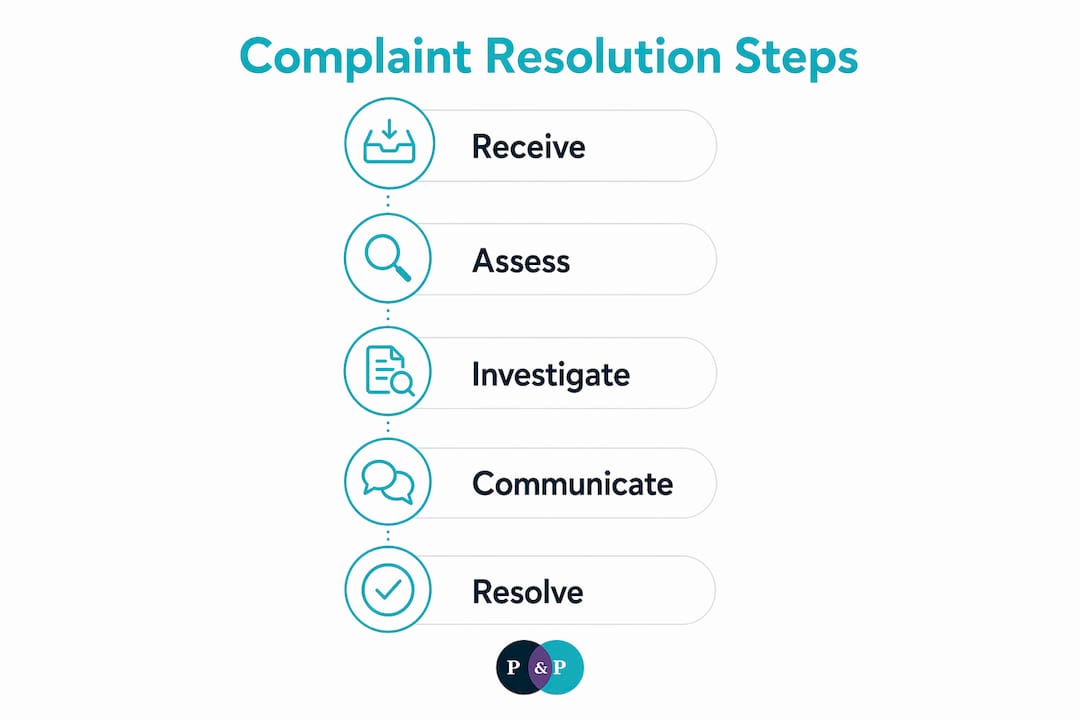
Effective aged care issue resolution follows a clear sequence. Deviating from it, even with good intentions, increases the risk of escalation to the Aged Care Complaints Commissioner.
- Register the complaint on receipt, noting the date, complainant details, and nature of the concern
- Clarify the complainant's goals using open questions before beginning any investigation
- Investigate thoroughly, gathering evidence from staff, records, and direct observation
- Document findings in a private record accessible to the investigation team only
- Communicate outcomes to the complainant within the timeframe you committed to at step two
- Escalate formally if internal resolution fails, following the Dispute Resolution policy under the Aged Care Act 2024
Delays and poor communication increase the likelihood of external escalation. A complainant who receives regular updates, even when the investigation is still underway, is far less likely to contact the Aged Care Complaints Commissioner than one who hears nothing for two weeks.
Formal escalation pathways are legislated under the Aged Care Act 2024. Providers must have documented Dispute Resolution policies that staff understand and can apply consistently. The most common mistake is treating escalation as a failure. It is not. It is a structured pathway that, when used correctly, demonstrates your system is working.
Pro Tip: Set a specific communication date with the complainant at the start of every investigation. "I will contact you by thursday with an update" is far more trust-building than "we will be in touch soon."
Key takeaways
Effective aged care complaints management requires clear legislative compliance, a rights-based culture, real-time feedback tools, and disciplined resolution processes working together.
| Point | Details |
|---|---|
| Legislative compliance is non-negotiable | Embed your complaints system in service agreements and maintain Dispute Resolution policies under the Aged Care Act 2024. |
| Ask what the complainant wants | Early goal-setting improves resolution alignment and reduces the risk of external escalation. |
| Capture feedback daily, not annually | Real-time tools identify trends before they become formal complaints and support continuous improvement evidence. |
| Document every step | A private complaint record protects both the resident and the provider if the matter escalates. |
| Communicate proactively | Timely updates during investigations reduce escalation rates and rebuild trust after service failures. |
What I have learned about complaints culture in aged care
After nearly three decades working across Australian human services, the pattern I see most often is this: providers invest heavily in their formal complaints register and almost nothing in the culture that surrounds it. The register becomes a compliance artefact rather than a genuine improvement tool.
The 2026 reforms under the Aged Care Act are pushing in the right direction. Rights-based complaints handling is not a new concept, but making it visible in service agreements from day one changes the conversation. Residents and families arrive knowing they have a voice. That shifts the power dynamic in a way that annual surveys never could.
What I find most underestimated is the role of frontline staff confidence. A care worker who feels equipped to receive a complaint without escalating their own anxiety is your best asset. Training that focuses on the conversation, not just the paperwork, is where I see the biggest gains. The governance obligations that boards carry in this space are real, and they flow directly into how staff behave at the bedside.
My question to you: does your team know what to say in the first sixty seconds of receiving a complaint, or do they know only where to find the form?
— Rachel
How The Planning and Practice Hub supports aged care providers
Complaints management sits at the intersection of governance, culture, and regulatory compliance. Getting it right requires more than a policy document.
The Planning and Practice Hub works with aged care providers across Australia to build complaints and feedback systems that meet the Aged Care Quality Standards (Strengthened) and the 2026 legislative requirements. Rachel Willis brings close to three decades of sector experience to every engagement, co-developing approaches that reflect your organisation's specific context rather than a generic template. Whether you need to review your management consulting support for complaints governance or build staff capability from the ground up, the hub offers clear, practical pathways. Contact The Planning and Practice Hub to discuss where your current system stands.
FAQ
What does aged care complaints management require under the 2026 reforms?
Providers must embed their complaints and feedback management system in residential service agreements and maintain internal Dispute Resolution policies under the Aged Care Act 2024. The Aged Care Complaints Commissioner oversees compliance with the rights-based framework.
When should a complaint be escalated to the Aged Care Complaints Commissioner?
Escalation applies when internal resolution processes have been exhausted without satisfactory outcome. Formal escalation pathways are legislated under the Aged Care Act 2024 Dispute Resolution policy.
How does informal feedback differ from a formal complaint in aged care?
Informal feedback is a verbal or incidental concern raised in daily interactions. A formal complaint is a documented concern requiring investigation, response, and record-keeping under the Aged Care Quality Standards (Strengthened).
What is the most effective way to reduce formal complaint volumes?
Capturing resident feedback daily through real-time tools identifies issues before they escalate. Facilities that build a daily feedback culture resolve concerns faster than those relying on annual surveys alone.
Why do complaints often escalate to the Aged Care Complaints Commissioner?
Delays and poor communication during internal investigations are the primary drivers of external escalation. Proactive updates and clear timelines significantly reduce the likelihood of a complaint leaving the facility.