
Workforce capability in human services is your organisation's measurable ability to deliver intended outcomes because its people and the enabling systems around them work together. The primary Australian standard to map against is the NDIS Workforce Capability Framework (NDIS Quality and Safeguards Commission), supported by the NDIS National Workforce Plan 2021–2025. Two additional resources every manager should download now:
- Child and Family Services: CFECFW Workforce Capability Framework — sector-specific capability statements aligned to child-safe and trauma-informed practice.
- Government and cross-sector planning: NSW Strategic Workforce Planning Framework — principles-based planning with scenario analysis and a recommended 3–6 month development timetable.
Key takeaways
Workforce capability in human services requires connecting the right Australian framework to your governance, supervision, and recruitment systems — not just your training calendar.
| Point | Details |
|---|---|
| Use the right framework | Map to the NDIS Workforce Capability Framework for NDIS work; use CFECFW for child and family services. |
| Plan for scale | The NDIS National Workforce Plan projects around 83,000 additional workers needed; boards must treat this as a strategic risk. |
| Allow 3–6 months | The NSW Strategic Workforce Planning Framework recommends a 3–6 month development window with annual reviews. |
| Connect to systems | Embed capability profiles into recruitment, supervision, and performance — not just L&D documentation. |
| The Planning and Practice Hub | Supports capability framework development, board advisory, and workforce planning for Australian human services organisations. |
Why capability frameworks matter now for Australian human services
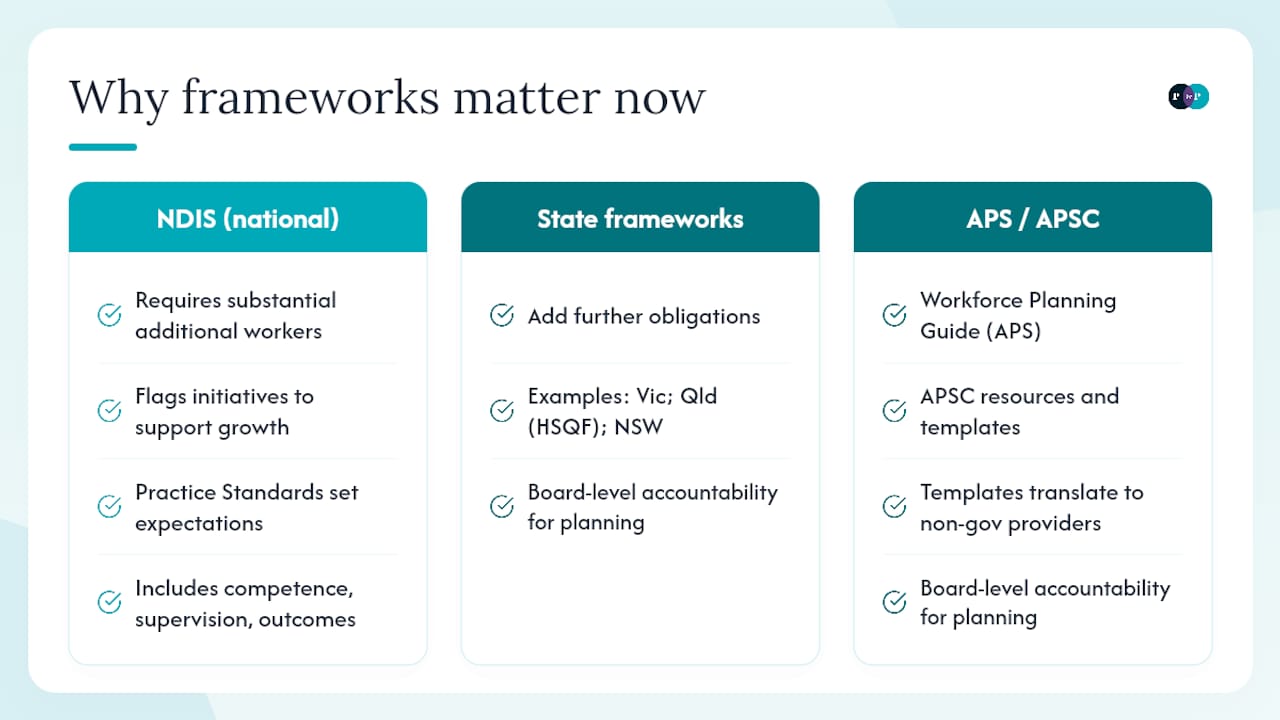
The scale of what is coming is not abstract. The NDIS National Workforce Plan projects the sector requires a substantial number of additional workers, and flags numerous initiatives to support that growth. That number alone should change how boards and executives think about workforce investment — not as a training budget line, but as a strategic risk.
The NDIS Practice Standards already set expectations for worker competence, supervision quality, and participant outcomes. Providers that cannot demonstrate a structured approach to workforce capability in human services face real compliance exposure, not just performance gaps. State frameworks add further obligations: Victoria's child and family sector has its own capability architecture, Queensland operates under the HSQF, and NSW public sector agencies must align to the Strategic Workforce Planning Framework.
The APS Workforce Planning Guide and Australian Public Service Commission resources offer practical planning templates that translate well to non-government providers. The shift across all these frameworks is the same: workforce planning is a board-level accountability, not an HR task.
What 'workforce capability' actually covers
Capability is not the same as capacity. Capacity is headcount and hours — how many workers you have and when they are available. Capability is what those workers can actually do, and whether your systems let them do it well. The APMG framing puts it plainly: capability equals people multiplied by system.
The core components a human services manager must actively govern:
- Core, general and advanced capabilities — the knowledge, skills and attitudes workers need at each level of practice.
- Values and behaviours — how workers act, not just what they know; critical for trauma-informed and rights-based practice.
- Leadership and supervision — the NDIS Workforce Capability Framework sets distinct organisational capabilities for supervisors and senior leaders.
- Cultural safety — non-negotiable for Aboriginal and Torres Strait Islander communities; must be embedded in role design, not added as a training module.
- Systems and role design — recruitment criteria, performance frameworks, and credentialing pathways that make capability visible and measurable.
Micro-credentials are increasingly the practical mechanism for converting training into recognised, role-specific capability. Embedding them into recruitment and performance systems, rather than treating them as optional professional development, is what shifts investment from activity to outcomes.
Which Australian frameworks should you actually use?
Each framework targets a different audience and serves a different purpose. Here is what to reach for first:
- NDIS Workforce Capability Framework (NDIS Quality and Safeguards Commission): the primary standard for any NDIS-registered provider. Groups capabilities under five objectives across core, ancillary and advanced levels. Use the interactive easy-read tool for role-mapping with workers and supervisors.
- NDIS National Workforce Plan 2021–2025 (Department of Social Services): sets national direction and the scale of workforce demand. Use it to justify investment decisions to your board.
- CFECFW Workforce Capability Framework: developed with DHHS Victoria and sector peaks, this framework aligns capability to child-safe principles, trauma-informed approaches and culturally safe practice. Directly applicable beyond Victoria for any child and family service.
- HSSO toolkit and resources: supports micro-credential development and training alignment for child and family services. Use it to map existing training to capability statements and identify gaps.
- NSW Strategic Workforce Planning Framework: best used for the planning process itself — scenario planning, labour market analysis, and governance structure. Applicable to any provider running a formal workforce planning cycle.
- APS Workforce Planning Guide: job family frameworks and workforce planning templates that adapt well to human services. Useful for providers without an existing planning methodology.
- Victorian mental health workforce capability resources: relevant for mental health providers and useful as a cross-reference when designing capability for co-occurring presentations.
The NDIS Framework's interactive tool is worth using early in co-design. It lets workers and supervisors map their own capabilities against role expectations, which builds engagement and surfaces gaps you would not find in a top-down audit alone.
How to develop or adopt a framework in 3–6 months
The NSW Strategic Workforce Planning Framework recommends a 3–6 month development window with annual reviews. That timetable is realistic if you move through these steps without letting governance stall at step one.
- Scope and secure executive sponsorship — define which roles and service streams the framework will cover. Board endorsement at this stage is not optional; it signals organisational commitment and unlocks resourcing.
- Co-design with staff and participant representatives — use the NDIS interactive framework tool and existing capability statements as starting points. Co-design reduces resistance and produces role-level definitions that workers recognise as accurate.
- Capability audit and gap analysis — map current competencies against the chosen framework. Identify critical gaps by role level, service stream and geography (rural and remote sites often surface the sharpest gaps).
- Define role-level competencies — produce clear capability profiles for each role, linked to the NDIS Workforce Capability Framework levels and any relevant state framework requirements.
- Design learning and micro-credential pathways — align existing training to capability statements, identify gaps, and source micro-credentials through HSSO or registered training organisations.
- Pilot, embed and connect to systems — run the framework in one team or service stream first. Then connect it to recruitment criteria, supervision agendas, performance reviews and annual planning cycles.
Required evidence at each stage: role profiles with capability descriptors, assessment methods (observation, supervision records, self-assessment), and training mapped to specific capability gaps.
How to measure, govern and review capability
A framework that sits in a SharePoint folder is not a capability framework. Governance and measurement are what make it real.
Suggested KPI categories:
- Competency coverage by role (percentage of roles with current capability profiles).
- Assessment completion rates across the workforce.
- Participant feedback aligned to capability objectives (quality of support, rights-based practice).
- Supervisory quality checks (frequency, documentation, follow-through on development plans).
- Turnover in critical roles, tracked against capability investment.
Governance structure: assign senior sponsorship at executive level, operational ownership in HR and service leads, and a standing agenda item in the quality committee. Annual review should align to your strategic planning cycle and NDIS registration renewal.
| Phase | Activity | Timeframe |
|---|---|---|
| Development | Scoping, co-design, gap analysis | Months 1–3 |
| Implementation | Role profiles, learning pathways, pilot | Months 4–6 |
| Embedding | Connect to recruitment, performance, supervision | Month 6 onward |
| Review | Full framework review, KPI reporting | Annual |
What a capability framework looks like in practice
A medium-sized child and family service in regional Victoria identified through a capability audit that its frontline workers held inconsistent knowledge of trauma-informed practice, and that supervisors were not using a common framework to assess or develop that knowledge. The gap was not a training problem — it was a role design and supervision problem.

The organisation mapped three priority roles to the CFECFW framework, defined capability expectations at each level, and commissioned a short micro-credentialled training programme through a registered training organisation. Supervisors received a structured observation tool aligned to the capability statements. Within nine months, supervision documentation improved markedly, and recruitment panels began using capability-based interview questions drawn directly from the framework.
The governance change mattered as much as the training. The CEO reported the framework to the board quarterly, which kept resourcing decisions connected to measurable outcomes rather than activity counts.
Pro Tip: The most common implementation pitfall is launching a framework without connecting it to supervision. Training without supervisory reinforcement rarely transfers to practice. Build the supervision tool before you run the first training session.
Eight questions boards and CEOs should ask
Board questions to hold the executive to account:
- Who is the named executive sponsor for our capability framework, and what authority do they hold?
- What resourcing — time, budget, and external expertise — has been committed to development and implementation?
- How does our framework address cultural safety for Aboriginal and Torres Strait Islander workers and communities?
- What is our strategy for building capability in rural and remote sites where training access is limited?
- How are we funding ongoing professional development, and is that funding protected in the budget?
- What assessment methods are we using, and how do we know they are rigorous?
- What is the implementation timeline, and what are the milestones the board will see reported?
- How does our capability framework connect to our NDIS Practice Standards obligations and registration requirements?
Implementation checklist for executives:
- Executive sponsor named and briefed.
- Scope defined (roles, service streams, geography).
- Co-design process planned with staff and participant representatives.
- Chosen framework(s) downloaded and mapped to organisational context.
- Capability audit commissioned or scheduled.
- Role-level capability profiles drafted for at least three priority roles.
- Learning and micro-credential pathways identified.
- Supervision tools aligned to capability statements.
- KPIs agreed and reporting schedule set.
- Board reporting template prepared.
A practitioner's view on where this work goes wrong
Most organisations that struggle with workforce capability human services development are not short of frameworks. They have downloaded the NDIS Workforce Capability Framework, attended a webinar, and filed a capability matrix somewhere. What they have not done is connect the framework to the systems that govern daily practice — supervision, recruitment, and performance conversations.
Capability work that stays in the L&D team rarely shifts practice. When it sits in the quality system, gets reported to the board, and shapes how supervisors talk to workers about their practice, it starts to change things. The frameworks are good. The gap is almost always in the governance.
A question worth taking to your next leadership team meeting: if we asked our supervisors today what 'good' looks like in their team's practice, would they all give the same answer?
How The Planning and Practice Hub can help
The Planning and Practice Hub works with CEOs, boards and quality managers across Australian human services to develop workforce capability frameworks that connect to governance, compliance and strategic planning — not just training calendars. Rachel Willis brings close to three decades of sector experience to this work, including co-design processes, capability audits, board advisory, and management consulting for NDIS, child and family, aged care and community services organisations. If your organisation is ready to move from a downloaded framework to an embedded one, the next step is a scoping conversation. Contact The Planning and Practice Hub through the consulting services page to discuss your workforce planning needs.
Sources
- NDIS National Workforce Plan: 2021 2025 (PDF)
- Workforce capability framework | NDIS Quality and Safeguards Commission
- Child and Family Services Workforce Capability Framework (CFECFW PDF)
- Strategic workforce planning framework | NSW Public Service Commission (PDF)
FAQ
What is workforce capability in human services?
Workforce capability is an organisation's measurable ability to deliver intended outcomes through the combined effect of its workers' skills, behaviours, and values, and the systems that enable them. It is distinct from workforce capacity, which refers to headcount and available hours.
What is the difference between workforce capability and workforce capacity?
Capacity is how many workers you have and when they are available. Capability is what those workers can actually do and whether your systems support them to do it well — the NDIS Workforce Capability Framework addresses capability, not just staffing numbers.
What is a workforce capability model?
A capability model defines the attitudes, skills and knowledge expected of workers at each level of a role, grouped by objectives or practice domains. The NDIS Workforce Capability Framework groups capabilities under five objectives across core, ancillary and advanced levels, with separate organisational capabilities for supervisors and senior leaders.
What are HR capabilities in human services?
HR capabilities in this context refer to the specific competencies, behaviours and values workers need to practise safely and effectively — covering direct practice skills, cultural safety, trauma-informed approaches, rights-based practice, and leadership. Frameworks like the NDIS Workforce Capability Framework and the CFECFW define these in detail for Australian providers.